Revision notes for Edexcel IGCSE Maths Similar Shapes (Lengths). Open the guide for explanations and worked examples. Written against the Edexcel IGCSE Maths (4MA1) specification, so the content matches what's examinable rather than general Maths background.
Similar Shapes (Lengths)
What you'll learn
- How to recognise mathematically similar shapes.
- How to find and use a scale factor.
- How parallel lines create similar triangles.
- How to show two rectangles are not similar.
1. The basic idea: same shape, different size
Similar shapes have the same shape, but they may be different sizes. For length questions, the key is that every matching length changes by the same multiplier.
Definition
Similar shapes, corresponding sides, and scale factor
- Two shapes are mathematically similar if their matching angles are equal and their matching sides are in the same ratio.
- Corresponding sides are sides in matching positions.
- The scale factor is the multiplier used to get from one shape to the similar shape.
Key Idea
One multiplier for every length
If two shapes are similar, one scale factor works for all corresponding lengths. If one pair of matching sides has been multiplied by 1.5, every pair of matching sides has been multiplied by 1.5.
Worked example: named similar triangles
Example
Using a scale factor between two triangles
Triangles ABCABCABC and PQRPQRPQR are similar. Angle AAA matches angle PPP, and angle BBB matches angle QQQ.
AB=10AB=10AB=10 cm, AC=18AC=18AC=18 cm, PQ=15PQ=15PQ=15 cm, and QR=24QR=24QR=24 cm. Find PRPRPR and BCBCBC.
-
Use the matching angles to pair the sides: AB↔PQAB \leftrightarrow PQAB↔PQ, AC↔PRAC \leftrightarrow PRAC↔PR, and BC↔QRBC \leftrightarrow QRBC↔QR.
-
Use the known matching sides ABABAB and PQPQPQ to find the scale factor from triangle ABCABCABC to triangle PQRPQRPQR.
PQAB=1510=1.5\frac{PQ}{AB}=\frac{15}{10}=1.5ABPQ=1015=1.5 -
Since ACACAC corresponds to PRPRPR, multiply 18 by 1.5 to get 27 cm.
PR=18×1.5=27PR=18 \times 1.5=27PR=18×1.5=27 -
Since BCBCBC corresponds to QRQRQR, divide 24 by 1.5 to get 16 cm.
BC=24÷1.5=16BC=24 \div 1.5=16BC=24÷1.5=16
Common Mistake
Matching sides by eyesight
Do not match sides just because they look similar in the drawing. Use the angle information or the order of the letters to decide which sides correspond.
2. Parallel lines inside a triangle
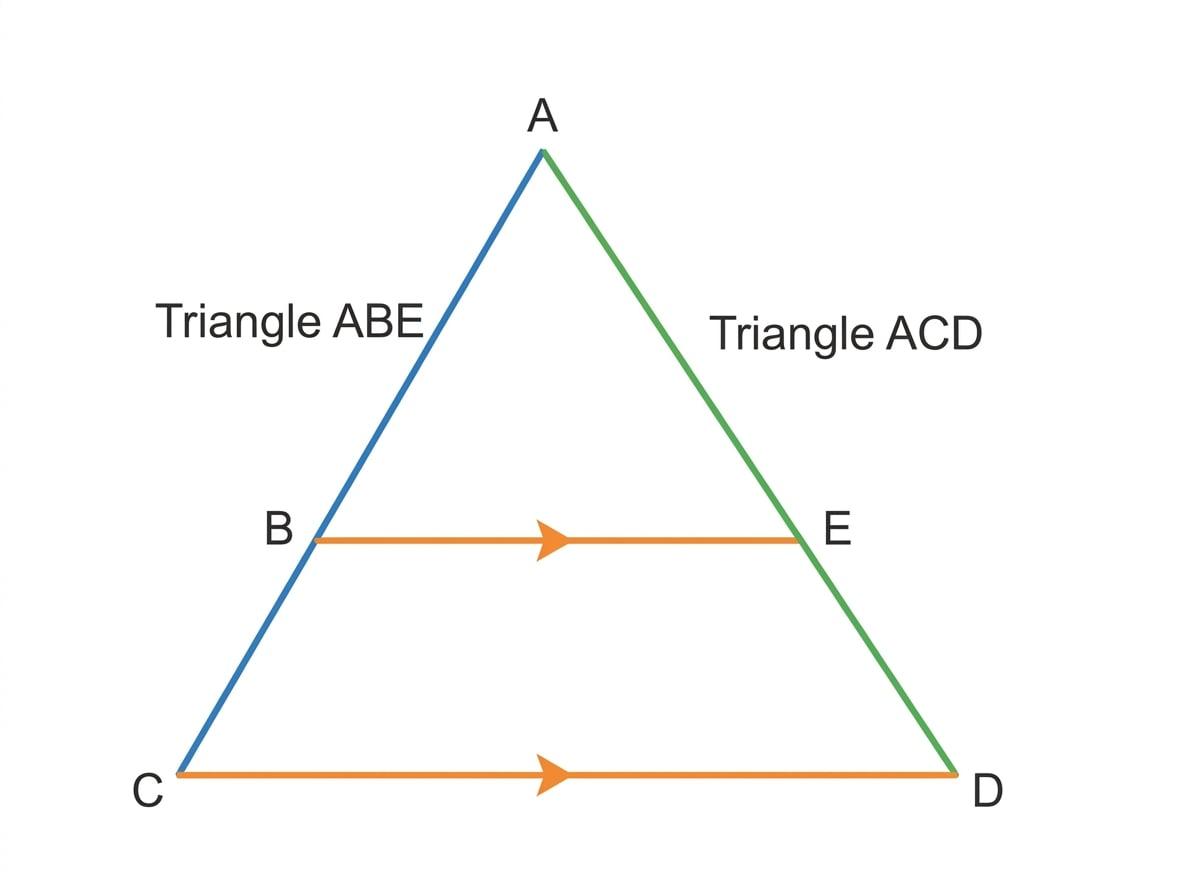
A very common IGCSE setup is a small triangle inside a larger triangle. If one side of the small triangle is parallel to one side of the large triangle, the two triangles are similar.
Parallel lines are lines that stay the same distance apart and never meet. Arrow marks on a diagram usually show parallel lines.
This diagram shows triangle ABEABEABE inside triangle ACDACDACD, with BE∥CDBE \parallel CDBE∥CD.
Key Idea
Small triangle to large triangle
For triangle ABEABEABE inside triangle ACDACDACD, using small side over matching large side gives:
ABAC=AEAD=BECD\frac{AB}{AC}=\frac{AE}{AD}=\frac{BE}{CD}ACAB=ADAE=CDBEWorked example: finding a missing piece
Example
Parallel line inside a triangle
In triangle ACDACDACD, point BBB lies on ACACAC and point EEE lies on ADADAD. The line BEBEBE is parallel to CDCDCD.
AB=10AB=10AB=10 cm, BC=5BC=5BC=5 cm, AE=8AE=8AE=8 cm, and CD=12CD=12CD=12 cm. Find EDEDED and BEBEBE.
-
First find the full length ACACAC by adding the two parts.
AC=10+5=15AC=10+5=15AC=10+5=15 -
Find the scale factor from the small triangle ABEABEABE to the large triangle ACDACDACD.
ACAB=1510=1.5\frac{AC}{AB}=\frac{15}{10}=1.5ABAC=1015=1.5 -
Use the same scale factor on AEAEAE to find the full length ADADAD, giving 12 cm.
AD=8×1.5=12AD=8 \times 1.5=12AD=8×1.5=12 -
Subtract to find the extra piece EDEDED, giving 4 cm.
ED=12−8=4ED=12-8=4ED=12−8=4 -
Since CDCDCD is the large base, divide by 1.5 to find the small base BEBEBE, giving 8 cm.
BE=12÷1.5=8BE=12 \div 1.5=8BE=12÷1.5=8
Tip
Add the whole side first
If a side is split into two parts, the larger triangle usually uses the whole side. Add the pieces before finding the scale factor.
3. Bow-tie diagrams
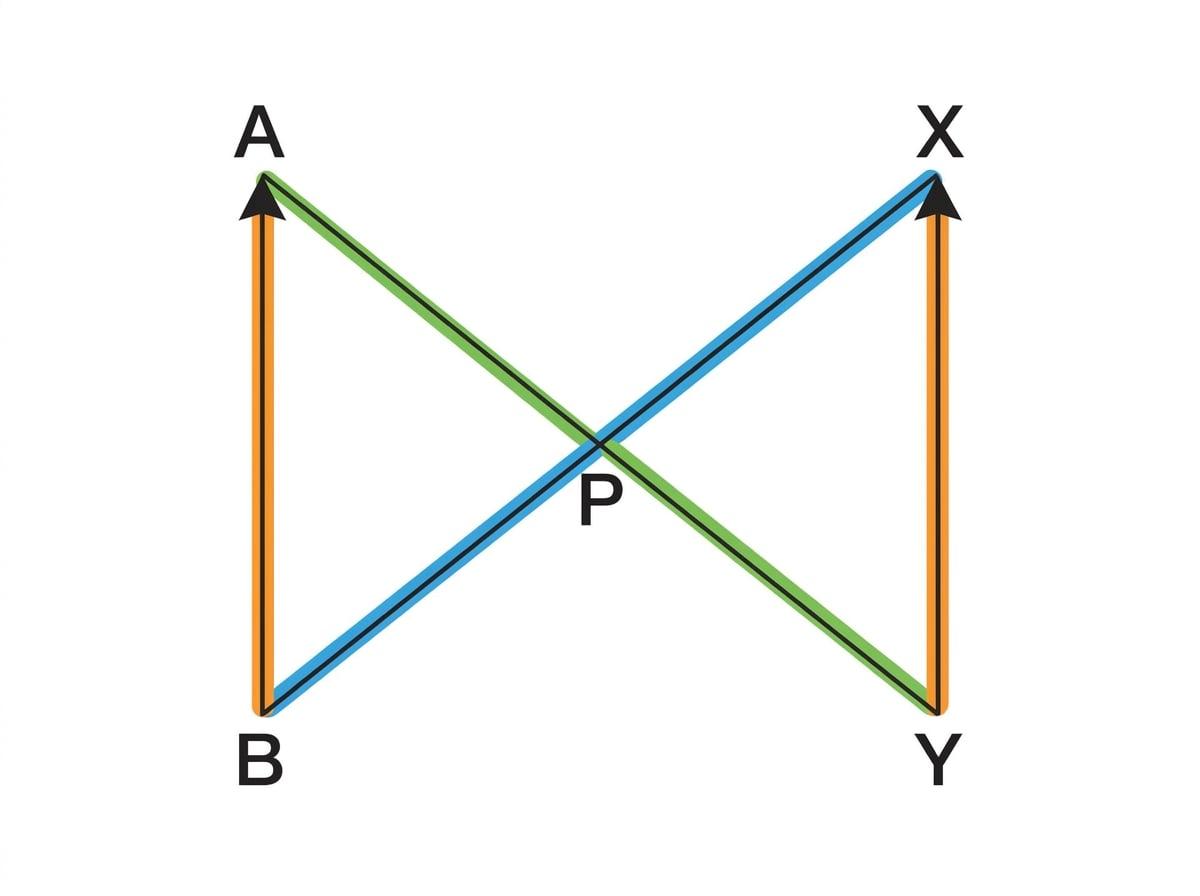
Sometimes the similar triangles are on opposite sides of a crossing point. These are often called bow-tie diagrams because of their shape.
The reason this works is angle geometry: vertically opposite angles are equal, and parallel lines create equal corresponding angles.
Worked example: crossing lines
Example
Finding a length in a bow-tie diagram
ABABAB is parallel to XYXYXY. The straight lines AYAYAY and BXBXBX meet at PPP.
AB=7AB=7AB=7 cm, XY=21XY=21XY=21 cm, and XP=18XP=18XP=18 cm. Find BPBPBP.
-
The similar triangles are triangle ABPABPABP and triangle XYPXYPXYP.
-
Match the corresponding sides: AB↔XYAB \leftrightarrow XYAB↔XY and BP↔XPBP \leftrightarrow XPBP↔XP.
-
Find the scale factor from triangle ABPABPABP to triangle XYPXYPXYP.
XYAB=217=3\frac{XY}{AB}=\frac{21}{7}=3ABXY=721=3 -
Since XPXPXP is the larger matching side, divide by 3 to find BPBPBP, giving 6 cm.
BP=18÷3=6BP=18 \div 3=6BP=18÷3=6
Common Mistake
Using the wrong line through P
In a bow-tie diagram, sides on the same straight line usually correspond. For example, if BBB, PPP, and XXX are on one straight line, then BPBPBP and XPXPXP are a matching pair.
4. Back-to-back triangles
Another common setup has two triangles meeting at a point, with one side of each triangle parallel. The triangles may face opposite directions, but they can still be similar.
Worked example: triangles meeting at a point
Example
Back-to-back similar triangles
Two triangles meet at CCC. Points AAA, CCC, and EEE are on a straight line, and points BBB, CCC, and DDD are on a straight line. Also, AB∥DEAB \parallel DEAB∥DE.
AB=8AB=8AB=8 cm, DE=12DE=12DE=12 cm, AC=10AC=10AC=10 cm, and CD=18CD=18CD=18 cm. Find CECECE and BCBCBC.
-
The similar triangles are triangle ABCABCABC and triangle EDCEDCEDC.
-
Use the parallel sides to find the scale factor from triangle ABCABCABC to triangle EDCEDCEDC.
DEAB=128=1.5\frac{DE}{AB}=\frac{12}{8}=1.5ABDE=812=1.5 -
Since ACACAC corresponds to CECECE, multiply 10 by 1.5 to get 15 cm.
CE=10×1.5=15CE=10 \times 1.5=15CE=10×1.5=15 -
Since BCBCBC corresponds to CDCDCD, divide 18 by 1.5 to get 12 cm.
BC=18÷1.5=12BC=18 \div 1.5=12BC=18÷1.5=12
5. Using a given ratio
Sometimes the question gives a ratio such as AB:AC=2:5AB:AC=2:5AB:AC=2:5. This tells you how two corresponding lengths compare.
If AB:AC=2:5AB:AC=2:5AB:AC=2:5, then the scale factor from ABABAB to ACACAC is:
52=2.5\frac{5}{2}=2.525=2.5Worked example: similar right-angled triangles
Example
Using a ratio to find lengths
A small right-angled triangle is similar to a larger right-angled triangle. The side ABABAB corresponds to ACACAC, and BEBEBE corresponds to CDCDCD.
AB=6AB=6AB=6 cm, BE=4BE=4BE=4 cm, and AB:AC=2:5AB:AC=2:5AB:AC=2:5. Find CDCDCD and BCBCBC.
-
Convert the ratio into a scale factor from the smaller triangle to the larger triangle.
ACAB=52=2.5\frac{AC}{AB}=\frac{5}{2}=2.5ABAC=25=2.5 -
Since BEBEBE corresponds to CDCDCD, multiply 4 by 2.5 to get 10 cm.
CD=4×2.5=10CD=4 \times 2.5=10CD=4×2.5=10 -
Find the full length ACACAC by multiplying 6 by 2.5 to get 15 cm.
AC=6×2.5=15AC=6 \times 2.5=15AC=6×2.5=15 -
If BBB lies between AAA and CCC, subtract to find BCBCBC, giving 9 cm.
BC=15−6=9BC=15-6=9BC=15−6=9
Tip
Ratios are not lengths
A ratio tells you the comparison between lengths. You still need to use the actual given length to calculate the missing side.
6. Showing rectangles are not similar
All rectangles have four right angles, so their angles match. But that is not enough for similarity: the side lengths must also be in the same ratio.
For rectangles, compare the scale factor for the lengths with the scale factor for the widths. If they are different, the rectangles are not similar.
Worked example: rectangles
Example
Showing two rectangles are not similar
A small rectangle measures 140 mm by 75 mm. A larger rectangle measures 180 mm by 90 mm. Show that the rectangles are not mathematically similar.
-
Compare the longer sides.
180140=97≈1.29\frac{180}{140}=\frac{9}{7}\approx 1.29140180=79≈1.29 -
Compare the shorter sides.
9075=1.2\frac{90}{75}=1.27590=1.2 -
The two scale factors are different, so the rectangles are not mathematically similar.
Common Mistake
Thinking all rectangles are similar
Rectangles all have equal angles, but they are only similar if their length-to-width ratios match.
Exam technique
In the exam
- Mark corresponding sides on the diagram before calculating.
- Find one reliable scale factor using a pair of matching sides.
- Use the same scale factor consistently: multiply to go to the larger shape, divide to go to the smaller shape.
- If a side is split into parts, add or subtract carefully to get the exact length asked for.
Self review
Check yourself
- How do you decide which sides correspond in similar triangles?
- If the scale factor from a small shape to a large shape is 2.4, what operation gets you from the large shape back to the small shape?
- For two rectangles, what must be true about the length scale factor and the width scale factor?

Recap questions
Test yourself with 5 quick questions on this guide. Answer them all correctly to complete it.
You've reached the end
Test yourself on this topic, or move on to the next guide.
How was this guide?