Revision notes for Edexcel IGCSE Maths Expanding and Factorising. Open the guide for explanations and worked examples. Written against the Edexcel IGCSE Maths (4MA1) specification, so the content matches what's examinable rather than general Maths background.
Expanding and Factorising
What you'll learn
- How to expand a single bracket by multiplying every term inside it.
- How to collect like terms after expanding more than one bracket.
- How to factorise by taking out the highest common factor.
- How to solve simple equations that contain brackets.
Algebra building blocks
Before expanding and factorising, you need to feel confident with the basic parts of an algebra expression.
Definition
Key algebra words
- A variable is a letter that represents a number, such as xxx, yyy or aaa.
- A term is one part of an expression, separated by plus or minus signs. For example, in 5x+35x + 35x+3, the terms are 5x5x5x and 3.
- A coefficient is the number multiplying a variable. In 7x7x7x, the coefficient is 7.
- Like terms have the same variable part, such as 4x4x4x and 9x9x9x, or 3a23a^23a2 and 8a28a^28a2.
You can only collect like terms. For example, 6x6x6x and 2x2x2x can combine, but 6x6x6x and 2y2y2y cannot.
Example
Collecting like terms
Simplify 7x+5+4x−2−3x7x + 5 + 4x - 2 - 3x7x+5+4x−2−3x.
-
Identify the like terms with xxx: 7x7x7x, 4x4x4x and −3x-3x−3x.
-
Combine the xxx terms:
7x+4x−3x=8x7x + 4x - 3x = 8x7x+4x−3x=8x -
Combine the number terms: 5 - 2 = 3.
-
Write the simplified expression as 8x+38x + 38x+3.
Tip
Check like terms carefully
The variable part must match exactly. xxx and x2x^2x2 are not like terms, because x2x^2x2 means x×xx \times xx×x.
Expanding one bracket
Definition
Expanding
To expand means to remove brackets by multiplying the term outside the bracket by every term inside the bracket.
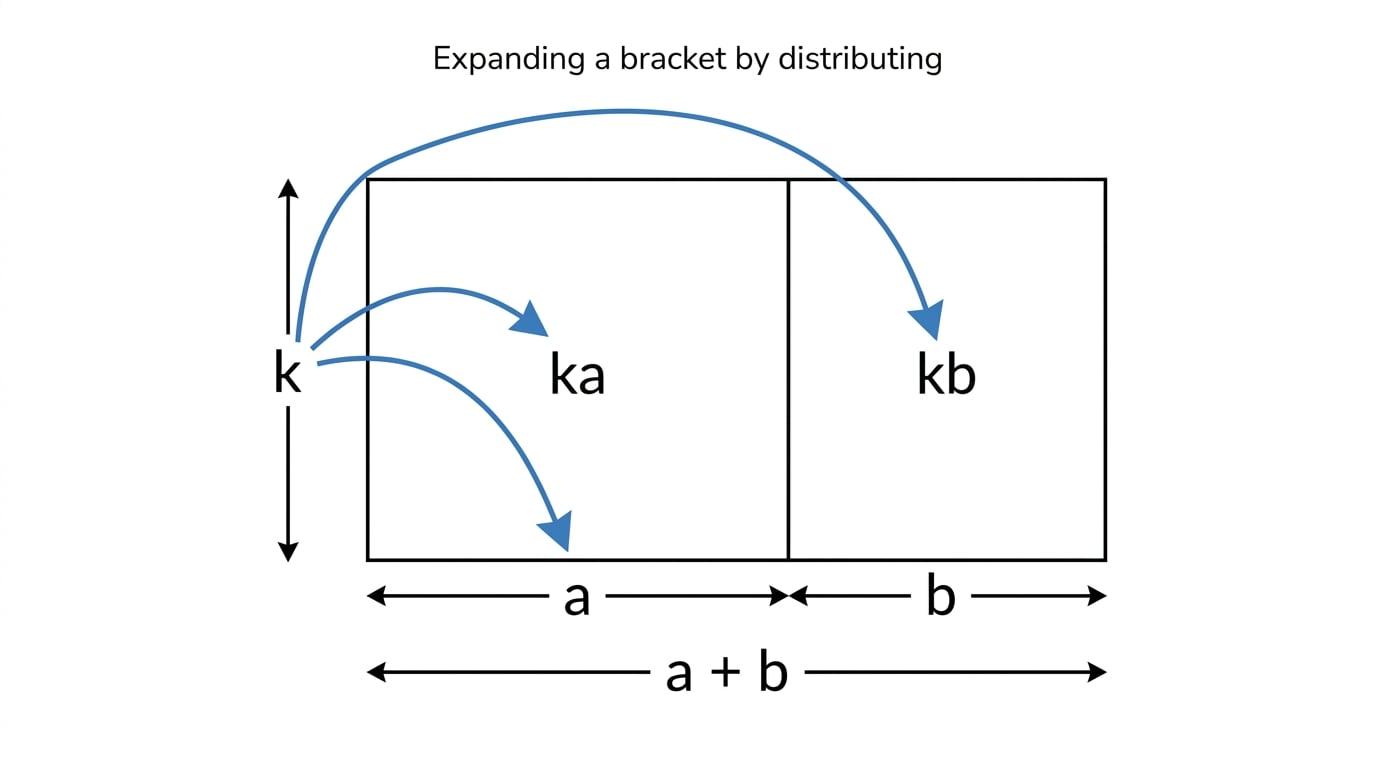
The main rule is called the distributive law. It means the outside factor is shared across everything inside the bracket:
k(a+b)=ka+kbk(a + b) = ka + kbk(a+b)=ka+kb k(a−b)=ka−kbk(a - b) = ka - kbk(a−b)=ka−kbExpanding can be thought of as an area split into two parts: the outside factor is the common height, and each term inside the bracket is a width. The total area is the sum of the two smaller areas.
Key Idea
Multiply every term
When expanding a bracket, the outside multiplier must multiply every term inside the bracket, including negative terms.
Example
Expanding a number outside a bracket
Expand 8(4s−3)8(4s - 3)8(4s−3).
-
The outside number is 8, so 8 multiplies both 4s4s4s and -3.
-
Multiply the first term:
8×4s=32s8 \times 4s = 32s8×4s=32s -
Multiply the second term:
8×(−3)=−248 \times (-3) = -248×(−3)=−24 -
Put the two results together: 8(4s−3)=32s−248(4s - 3) = 32s - 248(4s−3)=32s−24.
Sometimes the term outside the bracket contains a variable as well.
Example
Expanding with a variable outside
Expand 5x(3x−2)5x(3x - 2)5x(3x−2).
-
Multiply 5x5x5x by 3x3x3x:
5x×3x=15x25x \times 3x = 15x^25x×3x=15x2 -
Multiply 5x5x5x by -2:
5x×(−2)=−10x5x \times (-2) = -10x5x×(−2)=−10x -
Write the expanded expression: 5x(3x−2)=15x2−10x5x(3x - 2) = 15x^2 - 10x5x(3x−2)=15x2−10x.
Common Mistake
Only multiplying the first term
Do not write 8(4s−3)=32s−38(4s - 3) = 32s - 38(4s−3)=32s−3. The 8 must also multiply the -3.
Expanding and simplifying
Definition
Simplifying
To simplify means to write an expression in a shorter or cleaner form, usually by collecting like terms.
When you see two brackets, expand each bracket first. Then collect like terms.
Example
Expanding and simplifying with addition
Expand and simplify 6(g+4)+2(g−7)6(g + 4) + 2(g - 7)6(g+4)+2(g−7).
-
Expand the first bracket:
6(g+4)=6g+246(g + 4) = 6g + 246(g+4)=6g+24 -
Expand the second bracket:
2(g−7)=2g−142(g - 7) = 2g - 142(g−7)=2g−14 -
Put the expanded parts together:
6g+24+2g−146g + 24 + 2g - 146g+24+2g−14 -
Collect like terms: 6g+2g=8g6g + 2g = 8g6g+2g=8g, and 24 - 14 = 10.
-
The simplified answer is 8g+108g + 108g+10.
A minus sign before a bracket is especially important. It changes the signs of the terms in that bracket when expanded.
Example
Expanding and simplifying with subtraction
Expand and simplify 4(3y−5)−2(5y+1)4(3y - 5) - 2(5y + 1)4(3y−5)−2(5y+1).
-
Expand the first bracket:
4(3y−5)=12y−204(3y - 5) = 12y - 204(3y−5)=12y−20 -
Treat the subtraction as multiplying the second bracket by -2:
−2(5y+1)=−10y−2-2(5y + 1) = -10y - 2−2(5y+1)=−10y−2 -
Put everything together:
12y−20−10y−212y - 20 - 10y - 212y−20−10y−2 -
Collect like terms: 12y−10y=2y12y - 10y = 2y12y−10y=2y, and -20 - 2 = -22.
-
The simplified answer is 2y−222y - 222y−22.
Common Mistake
Forgetting the second sign change
In −2(5y+1)-2(5y + 1)−2(5y+1), both terms change: 5y5y5y becomes −10y-10y−10y and 1 becomes -2.
Factorising with a common factor
Factorising is the opposite of expanding.
For example:
6(3x+4)=18x+246(3x + 4) = 18x + 246(3x+4)=18x+24So the reverse is:
18x+24=6(3x+4)18x + 24 = 6(3x + 4)18x+24=6(3x+4)Definition
Factorising fully
To factorise means to rewrite an expression as multiplication using brackets. To factorise fully, you take out the highest common factor from every term.
The highest common factor, or HCF, is the biggest factor shared by the terms. It can include numbers and variables.
Example
Factorising a simple expression
Factorise 20y+3520y + 3520y+35.
-
Find the HCF of the number parts 20 and 35, which is 5.
-
Divide each term by 5: 20y÷5=4y20y \div 5 = 4y20y÷5=4y and 35÷5=735 \div 5 = 735÷5=7.
-
Put the HCF outside the bracket:
20y+35=5(4y+7)20y + 35 = 5(4y + 7)20y+35=5(4y+7)
When variables are involved, take out the variable part that appears in every term.
Example
Factorising fully with variables
Factorise fully 12m2n+18mn212m^2n + 18mn^212m2n+18mn2.
-
Find the HCF of the number parts 12 and 18, which is 6.
-
Look at the variables. Both terms contain at least one mmm and one nnn, so the variable part of the HCF is mnmnmn.
-
The full HCF is 6mn6mn6mn.
-
Divide each term by 6mn6mn6mn: 12m2n÷6mn=2m12m^2n \div 6mn = 2m12m2n÷6mn=2m and 18mn2÷6mn=3n18mn^2 \div 6mn = 3n18mn2÷6mn=3n.
-
Write the factorised expression:
12m2n+18mn2=6mn(2m+3n)12m^2n + 18mn^2 = 6mn(2m + 3n)12m2n+18mn2=6mn(2m+3n)
Tip
Check by expanding back
After factorising, quickly expand your answer. If it returns to the original expression, your factorisation is correct.
Common Mistake
Not factorising fully
For 18x+2418x + 2418x+24, writing 3(6x+8)3(6x + 8)3(6x+8) is factorising, but not fully. The HCF is 6, so the fully factorised answer is 6(3x+4)6(3x + 4)6(3x+4).
Solving equations with brackets
Definition
Solving an equation
To solve an equation means to find the value of the variable that makes the equation true.
An inverse operation is an operation that undoes another one. Addition and subtraction undo each other; multiplication and division undo each other.
For equations like 5(b+4)=455(b + 4) = 455(b+4)=45, it is often quickest to divide first, then deal with the bracket.
Example
Solving an equation with a bracket
Solve 5(b+4)=455(b + 4) = 455(b+4)=45.
-
The bracket is being multiplied by 5, so divide both sides by 5:
b+4=9b + 4 = 9b+4=9 -
Subtract 4 from both sides:
b=5b = 5b=5 -
Check by substituting: 5(5+4)=455(5 + 4) = 455(5+4)=45, so the solution works.
Sometimes the answer is not a whole number. That is fine.
Example
Solving when the answer is a decimal
Solve 4(c−3)=184(c - 3) = 184(c−3)=18.
-
Divide both sides by 4:
c−3=184c - 3 = \frac{18}{4}c−3=418 -
Simplify 184\frac{18}{4}418 to 4.54.54.5.
-
Add 3 to both sides: c=7.5c = 7.5c=7.5.
Exam technique
In the exam
-
Read the command word carefully: expand means remove brackets, factorise means create brackets, and solve means find the unknown.
-
When expanding, multiply the outside factor by every term inside the bracket, including negative terms.
-
When factorising fully, take out the HCF of the numbers and the variables, then expand your answer to check it.
Self review
Check yourself
- If you expand 3(2x−5)3(2x - 5)3(2x−5), what must the 3 multiply?
- What is the HCF of the terms in 12a2b+18ab212a^2b + 18ab^212a2b+18ab2?
- When solving 4(y+2)=284(y + 2) = 284(y+2)=28, what operation should you undo first?

Recap questions
Test yourself with 5 quick questions on this guide. Answer them all correctly to complete it.
You've reached the end
Test yourself on this topic, or move on to the next guide.
How was this guide?