Revision notes for Edexcel IGCSE Maths Angles in Polygons. Open the guide for explanations and worked examples. Written against the Edexcel IGCSE Maths (4MA1) specification, so the content matches what's examinable rather than general Maths background.
Angles in Polygons
What you'll learn
- How to find the sum of interior angles in any polygon.
- How to find interior and exterior angles in regular polygons.
- How to work backwards to find the number of sides of a regular polygon.
- How to handle polygons meeting at a point and questions with algebra.
Quick angle facts you need first
Before polygons, make sure these three facts are secure:
- Angles on a straight line add to 180°.
- Angles around a point add to 360°.
- Angles in a triangle add to 180°.
These facts are used constantly in polygon questions, especially when several shapes meet at one point.
What is a polygon?
Definition
Polygon
A polygon is a flat 2D shape made from straight sides. A vertex is a corner of the polygon. A polygon with nnn sides also has nnn vertices.
Common polygon names:
- Triangle: 3 sides
- Quadrilateral: 4 sides
- Pentagon: 5 sides
- Hexagon: 6 sides
- Octagon: 8 sides
- Decagon: 10 sides
Interior angles of a polygon
An interior angle is an angle inside the polygon at a vertex.
The key idea is that you can split a polygon into triangles from one vertex. For example:
- A quadrilateral splits into 2 triangles.
- A pentagon splits into 3 triangles.
- A hexagon splits into 4 triangles.
So an nnn-sided polygon splits into n−2n - 2n−2 triangles.
Key Idea
Interior angle sum
For a polygon with nnn sides:
sum of interior angles=(n−2)×180∘\text{sum of interior angles} = (n - 2)\times 180^\circsum of interior angles=(n−2)×180∘Worked example: finding a missing angle in a pentagon
Example
Missing angle in a pentagon
A pentagon has interior angles 102°, 118°, 93°, 127° and xxx. Find xxx.
-
A pentagon has 5 sides, so its interior angle sum is:
(5−2)×180∘=540∘(5 - 2)\times 180^\circ = 540^\circ(5−2)×180∘=540∘ -
Add the four known angles:
102∘+118∘+93∘+127∘=440∘102^\circ + 118^\circ + 93^\circ + 127^\circ = 440^\circ102∘+118∘+93∘+127∘=440∘ -
Subtract from the total:
x=540∘−440∘=100∘x = 540^\circ - 440^\circ = 100^\circx=540∘−440∘=100∘
Common Mistake
Using 360° for every shape
Only angles around a point add to 360°. The interior angles of a whole polygon usually do not add to 360°. For example, a pentagon’s interior angles add to 540°.
Regular polygons
Definition
Regular polygon
A regular polygon has all sides equal and all interior angles equal.
This means once you know the total interior angle sum, you can divide by the number of sides to find each interior angle.
For a regular polygon with nnn sides:
each interior angle=(n−2)×180∘n\text{each interior angle} = \frac{(n - 2)\times 180^\circ}{n}each interior angle=n(n−2)×180∘Worked example: each interior angle of a regular decagon
Example
Interior angle of a regular decagon
Find each interior angle of a regular decagon.
-
A decagon has 10 sides, so use n=10n = 10n=10:
(10−2)×180∘=1440∘(10 - 2)\times 180^\circ = 1440^\circ(10−2)×180∘=1440∘ -
Because the decagon is regular, divide by 10:
1440∘10=144∘\frac{1440^\circ}{10} = 144^\circ101440∘=144∘ -
Each interior angle is 144°.
Exterior angles
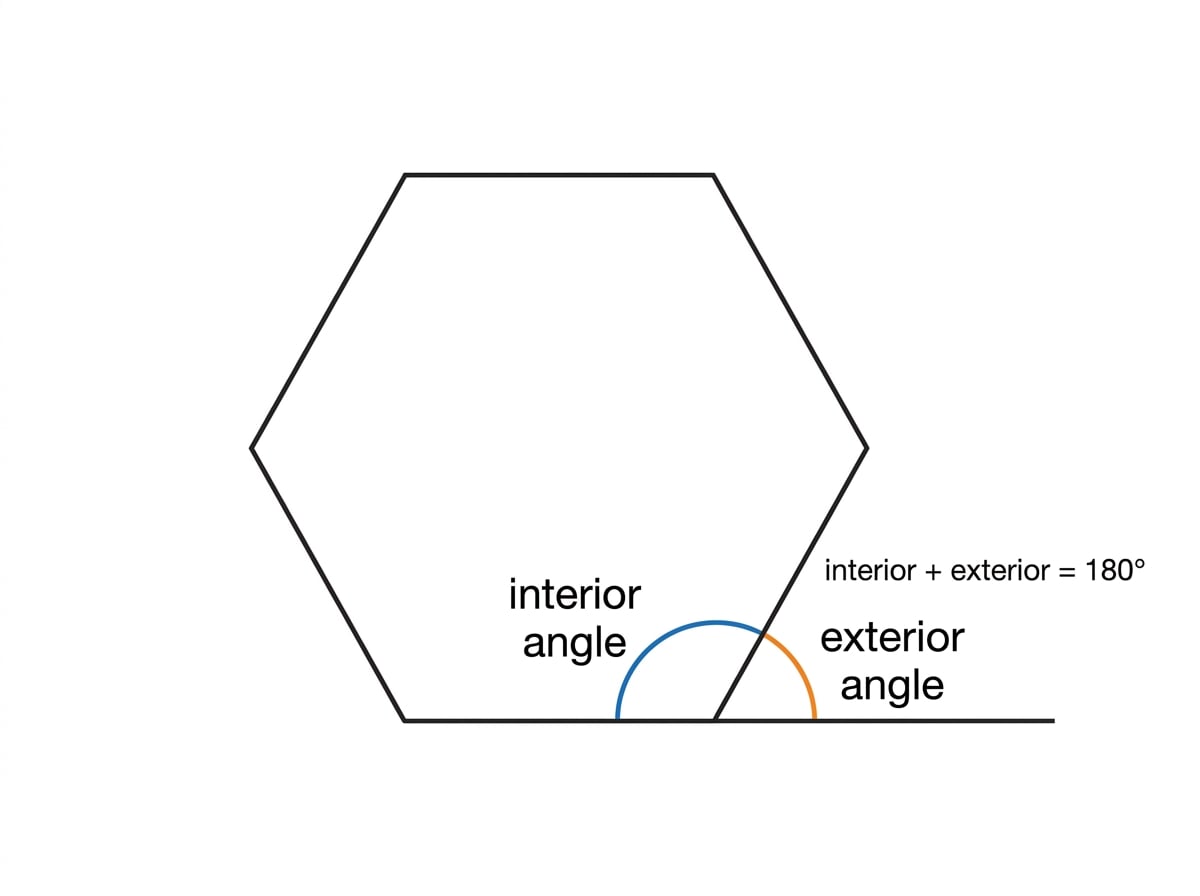
An exterior angle is formed when you extend one side of a polygon. It sits outside the polygon next to the interior angle.
Definition
Exterior angle
An exterior angle of a polygon is the angle between one side and the extension of the next side.
The interior angle and exterior angle at the same vertex lie on a straight line, so they add to 180°.
For any convex polygon, the exterior angles add to 360°.
Key Idea
Regular polygon exterior angle
For a regular polygon with nnn sides:
each exterior angle=360∘n\text{each exterior angle} = \frac{360^\circ}{n}each exterior angle=n360∘Worked example: exterior angle of a regular 12-sided polygon
Example
Exterior angle of a regular polygon
Find the size of each exterior angle of a regular 12-sided polygon.
-
A regular 12-sided polygon has 12 equal exterior angles.
-
The exterior angles add to 360°, so divide by 12:
360∘12=30∘\frac{360^\circ}{12} = 30^\circ12360∘=30∘ -
Each exterior angle is 30°.
Worked example: using exterior angle to find interior angle
Example
Interior angle from exterior angle
A regular polygon has each exterior angle equal to 24°. Find each interior angle.
-
The interior angle and exterior angle form a straight line.
-
Subtract the exterior angle from 180°:
180∘−24∘=156∘180^\circ - 24^\circ = 156^\circ180∘−24∘=156∘ -
Each interior angle is 156°.
Tip
Fast link
In a regular polygon, each interior angle and each exterior angle add to 180°. If one is hard to find directly, find the other first.
Finding the number of sides
If you know the exterior angle of a regular polygon, you can work backwards:
number of sides=360∘each exterior angle\text{number of sides} = \frac{360^\circ}{\text{each exterior angle}}number of sides=each exterior angle360∘If you are given the interior angle instead, first find the exterior angle by subtracting from 180°.
Worked example: number of sides from exterior angle
Example
Exterior angle given
Each exterior angle of a regular polygon is 15°. Work out how many sides it has.
-
Use the fact that exterior angles add to 360°.
-
Divide 360° by the size of one exterior angle:
360∘15∘=24\frac{360^\circ}{15^\circ} = 2415∘360∘=24 -
The polygon has 24 sides.
Worked example: number of sides from interior angle
Example
Interior angle given
Each interior angle of a regular polygon is 160°. Work out how many sides it has.
-
First find the exterior angle:
180∘−160∘=20∘180^\circ - 160^\circ = 20^\circ180∘−160∘=20∘ -
Now divide 360° by the exterior angle:
360∘20∘=18\frac{360^\circ}{20^\circ} = 1820∘360∘=18 -
The polygon has 18 sides.
Common Mistake
Dividing by the interior angle
To find the number of sides, divide 360° by the exterior angle, not the interior angle. If you are given the interior angle, subtract it from 180° first.
Irregular polygons with algebra
Not all polygon questions are regular. If the angles are different, you cannot just divide by the number of sides.
Instead:
- Find the total interior angle sum.
- Add the known angles.
- Use algebra for the unknown angles.
Worked example: a hexagon with two related angles
Example
Hexagon with one angle twice another
A hexagon has four known interior angles: 118°, 132°, 126° and 140°. The two remaining angles are xxx and 2x2x2x. Find the larger unknown angle.
-
A hexagon has 6 sides, so its interior angle sum is:
(6−2)×180∘=720∘(6 - 2)\times 180^\circ = 720^\circ(6−2)×180∘=720∘ -
Add the four known angles:
118∘+132∘+126∘+140∘=516∘118^\circ + 132^\circ + 126^\circ + 140^\circ = 516^\circ118∘+132∘+126∘+140∘=516∘ -
Subtract to find the total of the two unknown angles:
720∘−516∘=204∘720^\circ - 516^\circ = 204^\circ720∘−516∘=204∘ -
The two unknown angles are xxx and 2x2x2x, so together they make 3x3x3x:
3x=204∘3x = 204^\circ3x=204∘ -
Divide by 3:
x=68∘x = 68^\circx=68∘ -
The larger angle is 2x2x2x:
2x=136∘2x = 136^\circ2x=136∘
Worked example: several equal angles in a hexagon
Example
Equal unknown angles
In a hexagon, two angles are 128° and 136°. The other four angles are all equal. Find one of the equal angles.
-
The interior angle sum of a hexagon is:
(6−2)×180∘=720∘(6 - 2)\times 180^\circ = 720^\circ(6−2)×180∘=720∘ -
Add the two known angles:
128∘+136∘=264∘128^\circ + 136^\circ = 264^\circ128∘+136∘=264∘ -
Subtract from 720° to find the total of the four equal angles:
720∘−264∘=456∘720^\circ - 264^\circ = 456^\circ720∘−264∘=456∘ -
Divide by 4:
456∘4=114∘\frac{456^\circ}{4} = 114^\circ4456∘=114∘ -
Each of the equal angles is 114°.
Polygons meeting at a point
Sometimes regular polygons are fitted together at a single vertex. The important fact is:
angles around a point=360∘\text{angles around a point} = 360^\circangles around a point=360∘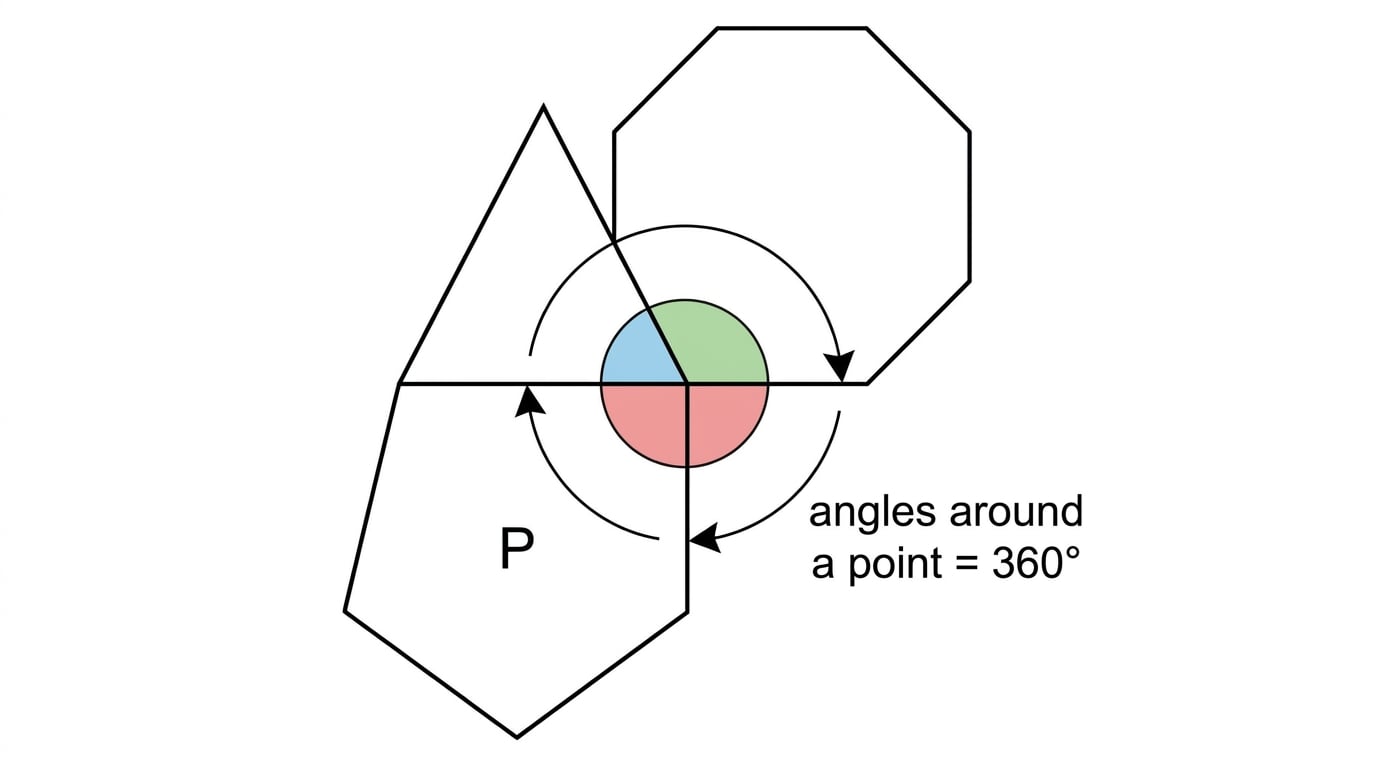
You usually need to:
- Find the interior angle of each known regular polygon.
- Subtract these from 360°.
- Use the remaining angle as the interior angle of the unknown regular polygon.
- Convert that interior angle into an exterior angle.
- Use 360∘÷exterior angle360^\circ \div \text{exterior angle}360∘÷exterior angle to find the number of sides.
Worked example: finding an unknown polygon at a point
Example
Regular polygons around a point
A regular triangle, a regular decagon and a regular polygon P meet at a point. Find how many sides polygon P has.
-
A regular triangle has interior angle 60°.
-
Find the interior angle of a regular decagon:
(10−2)×180∘10=144∘\frac{(10 - 2)\times 180^\circ}{10} = 144^\circ10(10−2)×180∘=144∘ -
Subtract these from 360° to find the angle for polygon P:
360∘−60∘−144∘=156∘360^\circ - 60^\circ - 144^\circ = 156^\circ360∘−60∘−144∘=156∘ -
Polygon P has interior angle 156°, so its exterior angle is:
180∘−156∘=24∘180^\circ - 156^\circ = 24^\circ180∘−156∘=24∘ -
Find the number of sides:
360∘24∘=15\frac{360^\circ}{24^\circ} = 1524∘360∘=15 -
Polygon P has 15 sides.
Worked example: gap between three regular pentagons
Example
Three regular pentagons
Three regular pentagons meet at one point. Find the angle left between them.
-
First find the interior angle of one regular pentagon:
(5−2)×180∘5=108∘\frac{(5 - 2)\times 180^\circ}{5} = 108^\circ5(5−2)×180∘=108∘ -
Three pentagon angles meet at the point:
3×10⁸∘=324∘3\times 108^\circ = 324^\circ3×108∘=324∘ -
Subtract from 360°:
360∘−324∘=36∘360^\circ - 324^\circ = 36^\circ360∘−324∘=36∘ -
The angle left between them is 36°.
Tip
Sanity check
Regular polygon interior angles get larger as the number of sides increases. A triangle has 60°, a square has 90°, a pentagon has 108°, and the angles keep getting closer to 180°.
Exam technique
In the exam
- Write down the key total first: interior sum for a polygon, or 360° for angles around a point.
- If the polygon is regular, use equal angles. If it is not regular, add the given angles and subtract.
- When finding the number of sides, always use the exterior angle: n=360∘exterior anglen = \frac{360^\circ}{\text{exterior angle}}n=exterior angle360∘.
Self review
Check yourself
- Can you find the interior angle sum of a 9-sided polygon?
- If each exterior angle of a regular polygon is 30°, how many sides does it have?
- If two regular polygons meet at a point, what total should their angles be compared with?

Recap questions
Test yourself with 5 quick questions on this guide. Answer them all correctly to complete it.
You've reached the end
Test yourself on this topic, or move on to the next guide.
How was this guide?