Revision notes for Edexcel IGCSE Maths Compound Interest and Depreciation. Open the guide for explanations and worked examples. Written against the Edexcel IGCSE Maths (4MA1) specification, so the content matches what's examinable rather than general Maths background.
Compound Interest and Depreciation
What you'll learn
- How to turn percentage increases and decreases into multipliers.
- How to calculate compound interest over several years.
- How to calculate depreciation and mixed percentage changes.
- How to compare different savings or depreciation situations in exam questions.
1. Percentage multipliers
Before compound interest, you need to be confident with one-step percentage changes.
Definition
Multiplier
A multiplier is the number you multiply by to increase or decrease an amount by a percentage in one step.
For an increase:
- Increase by 5% means keep 100% and add 5%, so multiply by 105%, which is 1.05.
- Increase by 2.7% means multiply by 1.027.
For a decrease:
- Decrease by 12% means keep 88%, so multiply by 0.88.
- Decrease by 30% means keep 70%, so multiply by 0.70.
Key Idea
The key percentage skill
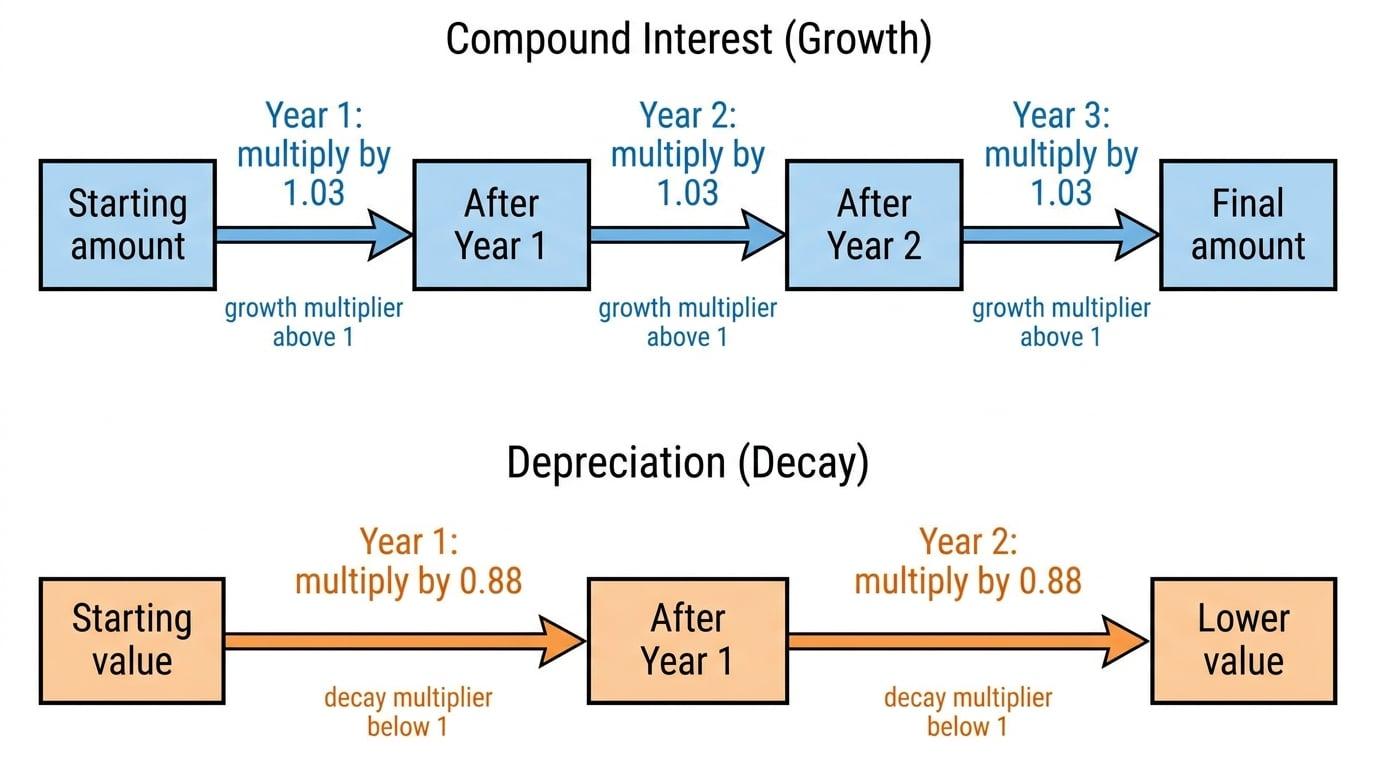
For compound interest and depreciation, you do not repeatedly add or subtract the same amount. You repeatedly multiply by the correct multiplier.
Compound interest and depreciation are repeated multipliers, not repeated adding or subtracting.
Example
Using multipliers for an increase and a decrease
A painting is worth £4000. Its value increases by 6% in the first year, then decreases by 10% in the second year. Find its value after 2 years.
-
Convert each percentage change into a multiplier.
- Increase by 6% means multiply by 1.06.
- Decrease by 10% means multiply by 0.90.
-
Apply the first year change.
4000×1.06=42404000 \times 1.06 = 42404000×1.06=4240 -
Apply the second year change to the new value, not the original value.
4240×0.90=38164240 \times 0.90 = 38164240×0.90=3816 -
The value after 2 years is £3816.
Common Mistake
Adding the percentages
An increase of 6% followed by a decrease of 10% is not simply an overall decrease of 4%. The second percentage is taken from the new amount, so you must multiply step by step.
2. Compound interest
Definition
Compound interest
Compound interest is interest added to an amount, then future interest is calculated on the new, larger amount.
The principal is the starting amount of money. The phrase per annum means “per year”.
If £100 earns 3% compound interest per annum:
- after 1 year, you multiply by 1.03;
- after 2 years, you multiply by 1.03 again;
- after 3 years, you multiply by 1.03 again.
The formula is:
A=P(1+r100)nA = P\left(1+\frac{r}{100}\right)^nA=P(1+100r)nwhere:
- AAA is the final amount,
- PPP is the principal,
- rrr is the annual percentage rate,
- nnn is the number of years.
Example
Reading the rate from a compound interest formula
An investment of £9000 has value VVV after nnn years, where
V=9000×1.018nV = 9000 \times 1.018^nV=9000×1.018nFind the annual interest rate, then find the total interest after 3 years.
-
Read the multiplier from the formula. The multiplier is 1.018.
-
Compare it with the compound interest multiplier.
1+r100=1.0181+\frac{r}{100}=1.0181+100r=1.018 -
The annual interest rate is 1.8%.
-
Substitute n=3n=3n=3 to find the value after 3 years.
V=9000×1.0183=9494.800488…V = 9000 \times 1.018^3 = 9494.800488\ldotsV=9000×1.0183=9494.800488… -
The final amount is £9494.80, rounded to the nearest penny.
-
Subtract the original investment to find the total interest.
9494.80−9000=494.809494.80 - 9000 = 494.809494.80−9000=494.80 -
The total interest after 3 years is £494.80.
Tip
Final amount vs interest
If the question asks “How much money is in the account?”, give the final amount. If it asks for “total interest”, subtract the original amount at the end.
Example
Finding the final amount in a savings account
£2700 is invested for 4 years at 3% compound interest per annum. Find the amount in the account at the end of 4 years.
-
Convert 3% compound interest into a multiplier: 1.03.
-
Use the compound interest formula.
A=2700×1.034A = 2700 \times 1.03^4A=2700×1.034 -
Calculate using a calculator.
A=3038.873787…A = 3038.873787\ldotsA=3038.873787… -
Round to the nearest penny. The amount in the account is £3038.87.
3. Depreciation
Definition
Depreciation
Depreciation means an item goes down in value over time, usually by a percentage each year.
Depreciation is common with cars, phones, machinery, and equipment.
If something depreciates by 14% each year, it keeps 86% of its value each year, so the multiplier is 0.86.
If the same depreciation rate is used every year:
A=P(1−r100)nA = P\left(1-\frac{r}{100}\right)^nA=P(1−100r)nExample
Car depreciation over three years
A car is bought for £16 000. It loses 25% of its value in the first year, then loses 15% of its value in each of the next 2 years. Find its value after 3 years.
-
Convert each depreciation rate into a multiplier.
- Losing 25% means multiplying by 0.75.
- Losing 15% means multiplying by 0.85.
-
Apply the first year depreciation.
16000×0.75=1200016000 \times 0.75 = 1200016000×0.75=12000 -
Apply the second year depreciation.
12000×0.85=1020012000 \times 0.85 = 1020012000×0.85=10200 -
Apply the third year depreciation.
10200×0.85=867010200 \times 0.85 = 867010200×0.85=8670 -
The car is worth £8670 after 3 years.
Common Mistake
Using the percentage lost as the multiplier
If a car depreciates by 30%, you multiply by 0.70, not 0.30. The multiplier is the percentage left, not the percentage lost.
4. Mixed percentage changes
Some questions have increases in some years and decreases in others. Treat each year separately and multiply in the order given.
Example
A value that rises, then falls
A flat is bought for £280 000. Its value increases by 4% in the first year, increases by 1.5% in the second year, then decreases by 3% in the third year. Find its value after 3 years.
-
Write down the three multipliers.
- Increase by 4% gives 1.04.
- Increase by 1.5% gives 1.015.
- Decrease by 3% gives 0.97.
-
Multiply the starting value by all three multipliers.
280000×1.04×1.015×0.97280000 \times 1.04 \times 1.015 \times 0.97280000×1.04×1.015×0.97 -
Calculate the result.
280000×1.04×1.015×0.97=286966.4280000 \times 1.04 \times 1.015 \times 0.97 = 286966.4280000×1.04×1.015×0.97=286966.4 -
The value after 3 years is £286 966.40.
5. Finding the number of years
Sometimes you know the starting amount, the rate, and the final amount, but not the number of years.
At Grade 4, you can usually solve these by trying powers of the multiplier until you match the amount or pass the target.
Example
Finding from a final amount
£4800 is invested at 2% compound interest per annum. After nnn years, the account contains £5299.59. Find nnn.
-
Write the compound interest equation.
4800×1.02n=5299.594800 \times 1.02^n = 5299.594800×1.02n=5299.59 -
Divide the final amount by the starting amount to see the multiplier effect.
1.02n≈5299.5948001.02^n \approx \frac{5299.59}{4800}1.02n≈48005299.59 -
Calculate the right-hand side.
5299.594800≈1.10408\frac{5299.59}{4800} \approx 1.1040848005299.59≈1.10408 -
Try powers of 1.02.
1.025≈1.104081.02^5 \approx 1.104081.025≈1.10408 -
Therefore, n=5n=5n=5. The money has been invested for 5 years.
Example
How long until a value halves?
A machine depreciates by 15% each year. Find the number of years it takes for the machine to be worth less than half of its original value.
-
A depreciation of 15% means the multiplier is 0.85.
-
Half of the original value means 50% of the starting value, so compare powers of 0.85 with 0.5.
-
Test nearby powers.
0.854≈0.5220.855≈0.444\begin{aligned} 0.85^4 &\approx 0.522\\ 0.85^5 &\approx 0.444 \end{aligned}0.8540.855≈0.522≈0.444 -
After 4 years, the value is still more than half. After 5 years, it is less than half.
-
It takes 5 years for the machine to fall below half its original value.
Tip
Keep full calculator values
Do not round too early. Use the full calculator display for powers, then round your final money answer to the nearest penny.
6. Comparing investment options
Definition
Simple interest
Simple interest means the interest is calculated only on the original amount each year, not on the growing balance.
For simple interest, the total percentage interest is:
rate per year×number of years\text{rate per year} \times \text{number of years}rate per year×number of yearsSo 2.8% simple interest for 5 years gives 14% total interest.
Example
Compound interest compared with simple interest
An investor can choose between two options for 5 years:
- Option A: 2.5% compound interest per annum.
- Option B: 2.6% simple interest per annum.
Which option is better?
-
Since no starting amount is given, compare what happens to £100. The better option for £100 will also be better for any starting amount.
-
For Option A, use the compound interest multiplier 1.025.
100×1.0255=113.1408212…100 \times 1.025^5 = 113.1408212\ldots100×1.0255=113.1408212… -
Option A gives £113.14 from each £100.
-
For Option B, simple interest is 2.6% each year for 5 years, so the total interest rate is 13%.
100×1.13=113100 \times 1.13 = 113100×1.13=113 -
Option B gives £113.00 from each £100.
-
Option A is better, because £113.14 is more than £113.00.
Example
Comparing banks with different yearly rates
£8000 is invested for 3 years. Bank A pays 1.3% compound interest each year. Bank B pays 2% in the first year, then 0.9% in each of the next 2 years. Which bank gives more interest?
-
For Bank A, the multiplier is 1.013 for each of the 3 years.
8000×1.0133=8316.073576…8000 \times 1.013^3 = 8316.073576\ldots8000×1.0133=8316.073576… -
Bank A gives a final amount of £8316.07.
-
For Bank B, use the multipliers in order: 1.02, then 1.009, then 1.009 again.
8000×1.02×1.0092=8307.540968000 \times 1.02 \times 1.009^2 = 8307.540968000×1.02×1.0092=8307.54096 -
Bank B gives a final amount of £8307.54.
-
Bank A gives more interest, because £8316.07 is greater than £8307.54.
Exam technique
In the exam
-
Decide whether each percentage is an increase or a decrease, then write the correct multiplier before calculating.
-
For compound interest or depreciation over several years, use powers when the rate is repeated, such as 1.0341.03^41.034 or 0.8860.88^60.886.
-
Check what the question is asking for: final amount, total interest, difference between two amounts, or number of years.
Self review
Check yourself
-
If an amount increases by 2.7%, what multiplier should you use?
-
What is the difference between compound interest and simple interest?
-
If something depreciates by 18% each year, why is the multiplier 0.82 rather than 0.18?

Recap questions
Test yourself with 5 quick questions on this guide. Answer them all correctly to complete it.
You've reached the end
Test yourself on this topic, or move on to the next guide.
How was this guide?