Revision notes for Edexcel IGCSE Maths Exchange Rates. Open the guide for explanations and worked examples. Written against the Edexcel IGCSE Maths (4MA1) specification, so the content matches what's examinable rather than general Maths background.
Exchange Rates
What you'll learn
- What an exchange rate tells you.
- When to multiply and when to divide.
- How to round money to the nearest penny.
- How to compare prices in different currencies fairly.
The basic idea
A currency is the type of money used in a country, such as pounds, euros or yen.
Definition
Exchange rate
An exchange rate tells you how much one currency is worth in another currency. For example, “£1 equals €1.15” means every £1 can be changed into €1.15.
Exchange rates are usually written using one unit of a currency, often £1. The key is to notice which currency has the 1.
This diagram is the main idea for questions where the rate is written as “£1 equals some amount of foreign currency”.
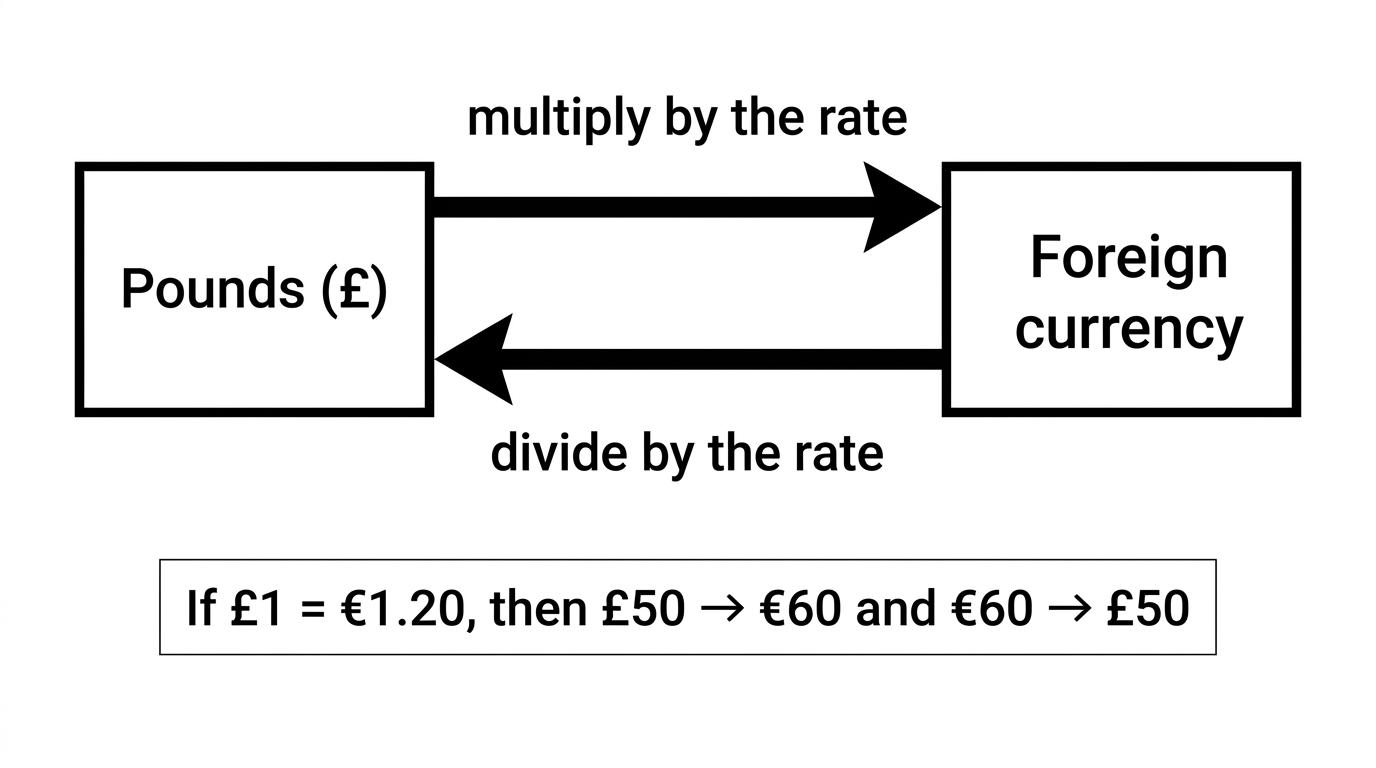
Converting pounds into another currency
If the rate is written like this:
£1 equals €1.18
then each pound becomes 1.18 euros. So to change pounds into euros, you multiply by 1.18.
Key Idea
Pounds to foreign currency
When the exchange rate is written as “£1 equals foreign amount”, multiply the number of pounds by the exchange rate.
Example
Changing pounds into euros
A student changes £280 into euros. The exchange rate is £1 equals €1.18. Work out how many euros they receive.
-
Identify the rate. For every £1, the student receives €1.18.
-
Multiply the number of pounds by 1.18:
280×1.18=330.40280 \times 1.18 = 330.40280×1.18=330.40 -
The student receives €330.40.
Tip
Quick sense check
When changing pounds into euros using a rate bigger than 1, the euro amount should be bigger than the pound amount.
Converting foreign currency back into pounds
Now suppose the rate is:
£1 equals €1.16
This means 1 pound is worth 1.16 euros. So if you already have euros and want pounds, you need to find out how many groups of 1.16 euros you have. That means you divide.
Definition
Nearest penny
To give an answer to the nearest penny, write the amount of money to two decimal places, because £1 is made of 100 pennies.
Example
Changing euros back into pounds
A traveller has €95 left after a trip. The exchange rate is £1 equals €1.17. Work out how many pounds they receive, to the nearest penny.
-
The amount is in euros, but the answer must be in pounds.
-
Since £1 equals €1.17, divide the euros by 1.17:
95÷1.17=81.19658…95 \div 1.17 = 81.19658\ldots95÷1.17=81.19658… -
Round to two decimal places.
-
The traveller receives £81.20.
Common Mistake
Multiplying when you should divide
If the rate is “£1 equals €1.17” and you are changing euros into pounds, do not multiply by 1.17. You should divide, because you are going back to pounds.
When the exchange rate is written the other way round
Sometimes the rate is not written with £1 first. For example:
€1 equals £0.89
This means each euro is worth £0.89. So to change euros into pounds, you multiply by 0.89.
Common Mistake
Read the side with 1
Do not just memorise “foreign currency to pounds means divide”. That is only true when the rate is written as “£1 equals foreign amount”. Always check which currency has the 1.
Example
Restaurant bill in pounds
Someone spends €42 in a restaurant. The exchange rate is €1 equals £0.86. Work out the cost in pounds.
-
The rate says 1 euro is worth £0.86.
-
Multiply the number of euros by 0.86:
42×0.86=36.1242 \times 0.86 = 36.1242×0.86=36.12 -
The restaurant bill costs £36.12.
Comparing prices in different countries
You cannot fairly compare prices in different currencies until they are written in the same currency.
For example, €54 and £49.99 are not directly comparable because euros and pounds have different values.
Key Idea
Compare in one currency
To compare two prices, convert one price so that both prices are in the same currency. Then compare the numbers.
Example
Which country is cheaper?
A jacket costs €54 abroad. The same jacket costs £49.99 in the UK. The exchange rate is £1 equals €1.20. Decide where the jacket is cheaper.
-
Convert the euro price into pounds.
-
Since £1 equals €1.20, divide the euro price by 1.20:
54÷1.20=4554 \div 1.20 = 4554÷1.20=45 -
The jacket abroad costs £45.
-
Compare £45 with £49.99.
-
The jacket is cheaper abroad.
Common Mistake
Comparing the original numbers
Do not say €54 is more expensive than £49.99 just because 54 is bigger than 49.99. They are different currencies, so you must convert first.
Finding the difference in price
Some questions ask for the difference between two prices. Once both prices are in the same currency, subtract the smaller price from the larger price.
Example
Difference between two trainer prices
A pair of trainers costs 5175 rupees in one country. The same trainers cost £62 in the UK. The exchange rate is £1 equals 75 rupees. Work out the difference in price in pounds.
-
Convert the rupee price into pounds.
-
Since £1 equals 75 rupees, divide by 75:
5175÷75=695175 \div 75 = 695175÷75=69 -
The trainers cost £69 in the other country.
-
Find the difference between £69 and £62:
69−62=769 - 62 = 769−62=7 -
The difference in price is £7.
Choosing the better exchange rate
Sometimes two places offer exchange rates written in different ways. If you want to change pounds into another currency, compare how much foreign currency you get for £1.
Example
Best place to change pounds into euros
In City A, the exchange rate is £1 equals €1.14. In City B, the exchange rate is €1 equals £0.86. A traveller wants to change pounds into euros. Which city gives more euros?
-
City A is already written as euros per £1, so £1 gives €1.14.
-
City B says €1 equals £0.86, so find how many euros £1 gives by doing 1 divided by 0.86:
1÷0.86=1.16279…1 \div 0.86 = 1.16279\ldots1÷0.86=1.16279… -
City B gives about €1.16 for £1.
-
Compare €1.14 and about €1.16.
-
City B gives more euros for each £1.
Tip
Best rate strategy
If you are changing pounds into euros, the better rate is the one that gives the larger number of euros for £1.
Whole-number note questions
Some questions ask for the greatest number of notes, such as 200 000 dong notes. You must give a whole number of notes, so if your answer is a decimal, round down.
Example
Greatest number of notes
A traveller changes £730 into dong. The exchange rate is £1 equals 28 000 dong. They want as many 200 000 dong notes as possible. Work out the greatest number of notes they can get.
-
Convert £730 into dong:
730×28000=20440000730 \times 28000 = 20440000730×28000=20440000 -
Divide by the value of one note:
20440000÷200000=102.220440000 \div 200000 = 102.220440000÷200000=102.2 -
They cannot receive 0.2 of a note, so round down.
-
The greatest number of 200 000 dong notes is 102.
Multi-step exchange rate questions
Longer questions may involve more than one cost, more than one currency, or a budget.
A budget is the maximum amount someone is allowed to spend.
Example
Checking whether a trip is within budget
A traveller can spend no more than £1000. Flights cost 710 US dollars. A hotel costs €45 per night for 12 nights. The exchange rates are £1 equals €1.14, and 1 US dollar equals €0.85. Work out whether the traveller can afford the flights and hotel.
-
Convert the flights from US dollars into euros:
710×0.85=603.50710 \times 0.85 = 603.50710×0.85=603.50 -
Work out the hotel cost in euros:
45×12=54045 \times 12 = 54045×12=540 -
Add the two euro costs:
603.50+540=1143.50603.50 + 540 = 1143.50603.50+540=1143.50 -
Convert the total euros into pounds. Since £1 equals €1.14, divide by 1.14:
1143.50÷1.14=1003.070…1143.50 \div 1.14 = 1003.070\ldots1143.50÷1.14=1003.070… -
The total cost is £1003.07, which is more than £1000.
-
The traveller cannot afford the flights and hotel.
Value for money with units
Sometimes the prices are in different currencies and different units. For example, one price might be per lb and another price per kilogram.
In these questions, make both the currency and the unit the same before comparing.
Example
Comparing prices per kilogram
In one city, potatoes cost £0.60 per lb. In another city, potatoes cost €1.54 per kilogram. Use 1 kilogram equals 2.2 lb and £1 equals €1.10. Decide which city is better value.
-
Convert the first city’s price into pounds per kilogram:
0.60×2.2=1.320.60 \times 2.2 = 1.320.60×2.2=1.32 -
So the first city costs £1.32 per kilogram.
-
Convert the second city’s euro price into pounds:
1.54÷1.10=1.401.54 \div 1.10 = 1.401.54÷1.10=1.40 -
So the second city costs £1.40 per kilogram.
-
Compare £1.32 and £1.40.
-
The first city is better value.
Exam technique
In the exam
-
Write down the exchange rate and underline which currency has the 1.
-
Decide whether to multiply or divide before using your calculator.
-
For comparisons, convert everything into the same currency first, then subtract or compare.
-
Round money answers to two decimal places unless the question asks for whole notes or a greatest number.
Self review
Check yourself
-
If £1 equals €1.25, how would you convert £80 into euros?
-
If £1 equals €1.25, how would you convert €80 into pounds?
-
Why is it unfair to compare €40 and £40 without converting first?

Recap questions
Test yourself with 5 quick questions on this guide. Answer them all correctly to complete it.
You've reached the end
Test yourself on this topic, or move on to the next guide.
How was this guide?