Revision notes for Edexcel IGCSE Maths Best Buy Questions. Open the guide for explanations and worked examples. Written against the Edexcel IGCSE Maths (4MA1) specification, so the content matches what's examinable rather than general Maths background.
Best Buy Questions
What you'll learn
- What best value and unit price mean.
- How to compare packs with different amounts and prices.
- How to handle offers like extra free and percentage off.
- How to show clear working for full marks.
The big idea: compare like with like
In a best buy question, you are deciding which option gives you the most for your money. The cheapest total price is not always the best value, because it might also give you much less of the product.
To compare fairly, you usually find the cost of the same amount for each option, such as the cost per roll, per kg, per 100 g, or per 100 ml.
Definition
Best value and unit price
-
Best value means the option that gives you the lowest cost for the same amount of product.
-
Unit price means the cost of one unit, such as one roll, 1 kg, 100 g, or 100 ml.
-
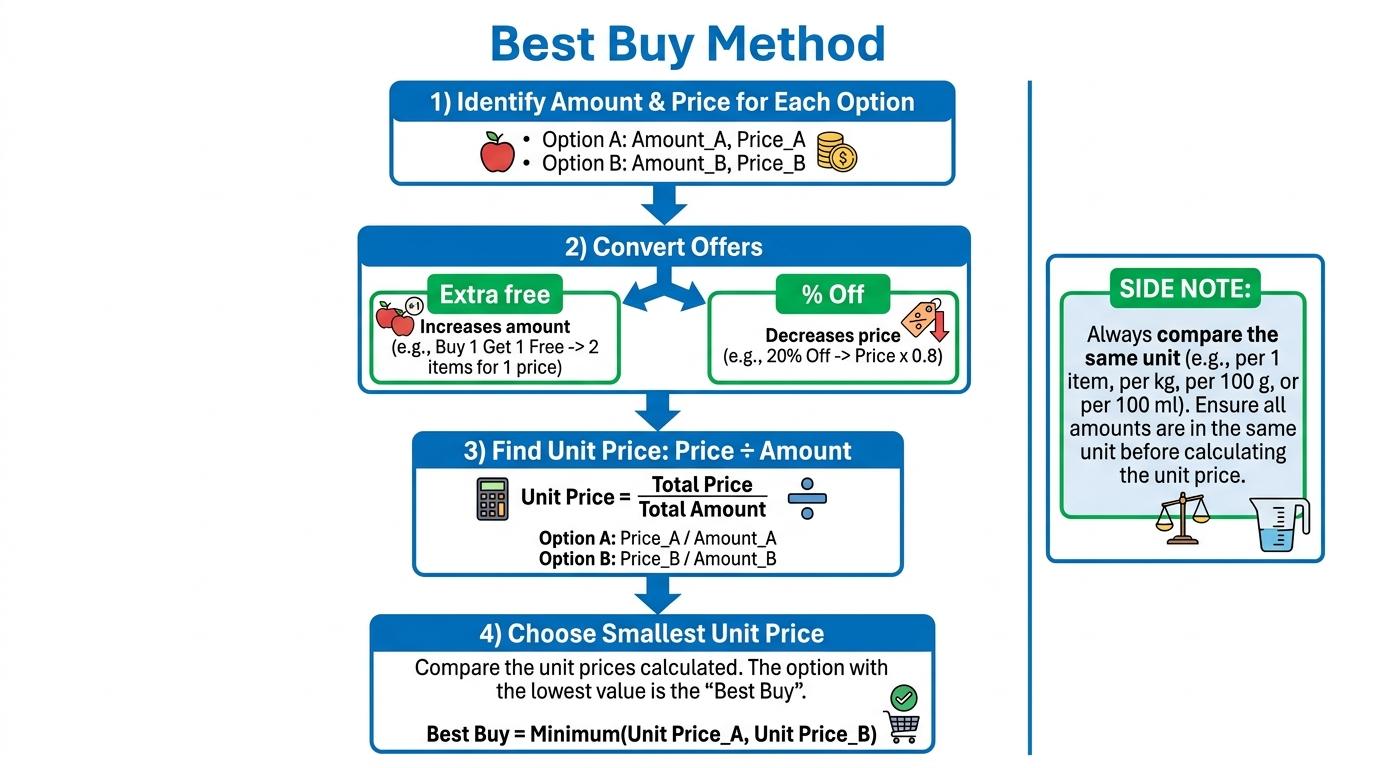
The main formula is:
unit price=priceamount\text{unit price} = \frac{\text{price}}{\text{amount}}unit price=amountprice
The flowchart below shows the usual method: fix the amount and price first, then compare a fair unit price.
Prerequisite: pounds and pence
Sometimes it is easier to work in pence instead of pounds, especially when the answer is a small cost per item.
Remember:
- £1 = 100p
- £2.50 = 250p
- £4.08 = 408p
Tip
Use pence for small items
For things like tea bags, toilet rolls, or biscuits, converting the price into pence often makes the division easier and avoids awkward £0.02-style answers.
Example
Finding a cost in pence per item
A pack of 12 cereal bars costs £2.64. Find the cost per cereal bar.
-
Convert £2.64 into pence.
£2.64 = 264p
-
Divide the total cost by the number of bars.
264p divided by 12 = 22p
-
So each cereal bar costs 22p.
Method 1: Find the cost per item
For countable items, such as rolls, bags, bottles, or tea bags, find the cost of one item in each option.
Then choose the option with the smaller cost per item.
Example
Comparing two packs by cost per item
Two packs of kitchen rolls are on sale.
- Pack A: 8 rolls for £3.60
- Pack B: 6 rolls for £2.82
Which pack is the better value?
-
Find the cost per roll for Pack A.
£3.60 divided by 8 = £0.45, so Pack A costs 45p per roll.
-
Find the cost per roll for Pack B.
£2.82 divided by 6 = £0.47, so Pack B costs 47p per roll.
-
Compare the unit prices.
Pack A costs 45p per roll and Pack B costs 47p per roll.
-
Choose the lower cost per roll.
Pack A is the better value.
Common Mistake
Choosing the cheaper total price
Do not just choose the pack with the lower price tag. A smaller pack often costs less overall, but it may cost more per item.
Method 2: Choose a sensible unit
For weights and volumes, you need to decide what unit to compare.
Common choices are:
- per kg for potatoes, rice, flour, and similar foods
- per 100 g for coffee, cheese, or sweets
- per 100 ml for shampoo, drinks, or washing liquid
You can choose any fair unit, as long as you use the same unit for every option.
Example
Comparing two jars using cost per 100 g
Two jars of the same coffee are available.
- Jar A: 250 g for £5.95
- Jar B: 400 g for £8.80
Which jar is the better value?
-
Find the cost per 100 g for Jar A.
250 g is 2.5 lots of 100 g, so £5.95 divided by 2.5 = £2.38 per 100 g.
-
Find the cost per 100 g for Jar B.
400 g is 4 lots of 100 g, so £8.80 divided by 4 = £2.20 per 100 g.
-
Compare the costs per 100 g.
Jar A costs £2.38 per 100 g and Jar B costs £2.20 per 100 g.
-
Choose the smaller cost per 100 g.
Jar B is the better value.
Tip
Keep the units the same
Comparing “per kg” with “per 100 g” is not fair until you convert one of them. Always check that both answers are for the same amount.
Method 3: Scale to the same amount
Sometimes you do not need to find the cost of one unit. If one amount is a simple multiple of the other, you can scale up to compare the same quantity.
Definition
Scaling
Scaling means multiplying or dividing the amount and the price by the same number, so the deal stays equivalent.
Example
Comparing shampoo by scaling
Two bottles of the same shampoo are available.
- Bottle A: 750 ml for £4.20
- Bottle B: 250 ml for £1.50
Which bottle is the better value?
-
Notice that 750 ml is 3 lots of 250 ml.
-
Work out the cost of three smaller bottles.
3 bottles of Bottle B would cost 3 lots of £1.50, which is £4.50.
-
Compare the same volume.
Bottle A gives 750 ml for £4.20, while three Bottle B bottles give 750 ml for £4.50.
-
Choose the cheaper price for the same volume.
Bottle A is the better value.
Comparing three or more options
If there are three packs, do the same calculation for each one. It helps to be organised and write one line of working for every pack.
Example
Comparing three packs of tea bags
Three packs of tea bags are available.
- Pack A: 240 tea bags for £5.04
- Pack B: 200 tea bags for £4.10
- Pack C: 160 tea bags for £3.36
Which pack is the best value?
-
Convert each price into pence.
Pack A costs 504p, Pack B costs 410p, and Pack C costs 336p.
-
Find the cost per tea bag for Pack A.
504p divided by 240 = 2.1p per tea bag.
-
Find the cost per tea bag for Pack B.
410p divided by 200 = 2.05p per tea bag.
-
Find the cost per tea bag for Pack C.
336p divided by 160 = 2.1p per tea bag.
-
Compare the three unit prices.
Pack B has the lowest cost per tea bag, so Pack B is the best value.
Tip
Write a comparison sentence
After your calculations, always write a final sentence such as: “Pack B is the best value because it has the lowest cost per tea bag.”
Special offers: extra free and percentage off
Some best buy questions include offers. You must first work out the new amount or the new price before comparing unit prices.
Definition
Percentage offers
-
20% extra free means the amount increases by 20%, but the price stays the same.
-
15% off means the price decreases by 15%, but the amount stays the same.
Common Mistake
% off and extra free change different things
“Extra free” changes the amount you receive. “% off” changes the price you pay. Do not apply both changes to the same pack unless the question says so.
Example
Comparing extra free with money off
Two packs of tea bags are available.
- Pack A: 200 tea bags plus 25% extra free for £3.60
- Pack B: 200 tea bags with 10% off the normal price of £3.60
Which pack is the better value?
-
Work out the new number of tea bags in Pack A.
25% of 200 tea bags is 50 tea bags, so Pack A has 250 tea bags.
-
The price of Pack A stays the same.
Pack A costs £3.60, which is 360p.
-
Find the cost per tea bag for Pack A.
360p divided by 250 = 1.44p per tea bag.
-
Work out the new price of Pack B.
10% of £3.60 is 36p, so the discounted price is 360p minus 36p = 324p.
-
Find the cost per tea bag for Pack B.
324p divided by 200 = 1.62p per tea bag.
-
Compare the unit prices.
Pack A costs 1.44p per tea bag and Pack B costs 1.62p per tea bag, so Pack A is the better value.
Common Mistake
Forgetting to adjust the offer first
Before dividing, make sure you have used the correct updated amount or price. Offers must be dealt with before you compare unit prices.
Exam technique
In the exam
-
Decide whether to compare per item, per kg, per 100 g, or per 100 ml.
-
Convert prices into pence if the unit cost is likely to be small.
-
For each option, show your division clearly and keep enough decimal places to compare accurately.
-
Finish with a sentence naming the best value option and explaining why.
Self review
Check yourself
-
Can you explain why the cheapest total price is not always the best value?
-
If a bottle says “20% extra free”, does the price change or does the amount change?
-
When comparing two packs, have you used the same unit for both answers?

Recap questions
Test yourself with 5 quick questions on this guide. Answer them all correctly to complete it.
You've reached the end
Test yourself on this topic, or move on to the next guide.
How was this guide?