Revision notes for Edexcel IGCSE Maths Systematic Listing. Open the guide for explanations and worked examples. Written against the Edexcel IGCSE Maths (4MA1) specification, so the content matches what's examinable rather than general Maths background.
Systematic Listing
What you'll learn
- How to list all possible outcomes without missing any.
- How to organise choices using a pattern, a grid, or a tree-style list.
- How to deal with repeated digits and avoid duplicate answers.
- How to use a complete list to find simple probabilities.
What is systematic listing?
When a question asks you to “write down all the possible outcomes”, the main challenge is not usually the maths — it is being organised.
Definition
Systematic listing
Systematic listing means writing all possible outcomes in a clear order, so you can check that none are missing and none are repeated.
Definition
Outcome
An outcome is one possible result. For example, if you flip a coin once, “heads” is one outcome and “tails” is another outcome.
A good systematic list usually follows a repeated pattern. For example, keep the first choice fixed while you work through every second choice, then move to the next first choice.
Key Idea
The main idea
Choose an order, stick to it, and check each item has been paired with every possible option it needs.
Listing choices from two groups
Many questions give you two groups of choices, such as starters and mains, humanities and languages, or cards from two boxes.
Suppose there are 3 starters and 2 mains. For each starter, you can choose each main. So you should list all mains with the first starter, then all mains with the second starter, and so on.
Definition
Combination
In these notes, a combination means one complete choice made from the options given, such as one starter with one main.
Example
Choosing one snack and one drink
A café offers 3 snacks: crisps, fruit, yoghurt. It offers 2 drinks: water, juice. List all possible choices of one snack and one drink.
-
Start with the first snack, crisps, and pair it with each drink:
- crisps and water
- crisps and juice
-
Move to the second snack, fruit, and pair it with each drink:
- fruit and water
- fruit and juice
-
Move to the third snack, yoghurt, and pair it with each drink:
- yoghurt and water
- yoghurt and juice
-
The complete list is:
- crisps and water
- crisps and juice
- fruit and water
- fruit and juice
- yoghurt and water
- yoghurt and juice
Tip
Quick count check
If there are 3 choices in one group and 2 choices in another group, you should have 6 outcomes in your list.
You can use this check after listing. If your list has only 5 outcomes, you know you have missed one.
Using initials to keep lists short
In exams, it is often fine to use clear initials if you define them or if they are obvious. For example, for a coin you can write H for heads and T for tails.
This is especially useful when outcomes get longer, such as flipping a coin three times.
Example
Rolling a dice and flipping a coin
A fair dice can land on 1, 2, 3, 4, 5, or 6. A coin can land on heads or tails. List all possible outcomes.
-
Keep the dice result fixed at 1 and list both coin results:
- 1H
- 1T
-
Repeat this pattern for dice result 2:
- 2H
- 2T
-
Continue in the same way for 3, 4, 5, and 6.
-
The complete list is:
- 1H, 1T
- 2H, 2T
- 3H, 3T
- 4H, 4T
- 5H, 5T
- 6H, 6T
-
There are 12 outcomes in total, because there are 6 dice results and 2 coin results.
Common Mistake
Changing the pattern halfway through
Do not list 1H, 2H, 3H and then suddenly switch to 1T, 2T unless you are still being consistent. Both orders can work, but mixing methods makes it easier to miss something.
Repeated events: coin flips
If the same thing happens more than once, the order usually matters.
For example, if you flip a coin three times, HHT is different from HTH because the tails happens on a different flip.
Definition
Sample space
The sample space is the complete list of all possible outcomes for an experiment.
Example
Flipping a coin three times
List all possible outcomes when a coin is flipped three times.
-
Begin with outcomes starting with H.
-
For the second flip, split into H then T:
- HH
- HT
-
Add the third flip to each of those:
- HHH
- HHT
- HTH
- HTT
-
Now do the same for outcomes starting with T:
- THH
- THT
- TTH
- TTT
-
The complete sample space is:
- HHH, HHT, HTH, HTT
- THH, THT, TTH, TTT
Tip
Double the list each time
For coin flips, each extra flip doubles the number of outcomes. One flip has 2 outcomes, two flips have 4 outcomes, and three flips have 8 outcomes.
Number cards and making numbers
Some questions ask you to make two-digit, three-digit, or four-digit numbers using cards.
Definition
Digit
A digit is one symbol used to write a number, such as 0, 1, 2, 3, 4, 5, 6, 7, 8, or 9.
If the cards are separate physical cards, you normally use each card at most once unless the question says you can reuse them.
For a two-digit number:
- the first digit is the tens digit;
- the second digit is the units digit.
For a three-digit number:
- the first digit is the hundreds digit;
- the second digit is the tens digit;
- the third digit is the units digit.
Example
Making two-digit numbers from three cards
Cards show the digits 3, 6, and 8. List all possible two-digit numbers using two different cards.
-
Put 3 in the tens position. The units digit can be 6 or 8:
- 36
- 38
-
Put 6 in the tens position. The units digit can be 3 or 8:
- 63
- 68
-
Put 8 in the tens position. The units digit can be 3 or 6:
- 83
- 86
-
The complete list is:
- 36, 38, 63, 68, 83, 86
Common Mistake
Reusing a card by accident
If you only have one 3 card, you cannot make 33 unless the question says cards can be used more than once.
Three-digit numbers from cards
With three cards, a systematic method is to fix the hundreds digit first. Then list the remaining two digits in both possible orders.
Example
Making three-digit numbers from three cards
Cards show the digits 2, 5, and 9. List all possible three-digit numbers using all three cards.
-
Put 2 in the hundreds position. The remaining digits 5 and 9 can be written in two orders:
- 259
- 295
-
Put 5 in the hundreds position. The remaining digits 2 and 9 can be written in two orders:
- 529
- 592
-
Put 9 in the hundreds position. The remaining digits 2 and 5 can be written in two orders:
- 925
- 952
-
The complete list is:
- 259, 295, 529, 592, 925, 952
Tip
Expected number of answers
With 3 different digit cards used to make a three-digit number, there are 6 possible numbers.
Repeated digits: avoiding duplicates
Sometimes two cards show the same digit, such as 5, 5, 2, and 9. These are two separate cards, but if swapping the two 5 cards gives the same written number, you should not list it twice.
Definition
Duplicate
A duplicate is a repeated answer that looks exactly the same as one you have already listed.
Example
Making four-digit numbers with a repeated digit
Cards show 1, 4, 4, and 7. List the different four-digit numbers that can be made using all the cards.
-
Start with 1 as the first digit. Arrange 4, 4, and 7:
- 1447
- 1474
- 1744
-
Start with 4 as the first digit. The remaining cards are 1, 4, and 7:
- 4147
- 4174
- 4417
- 4471
- 4714
- 4741
-
Start with 7 as the first digit. Arrange 1, 4, and 4:
- 7144
- 7414
- 7441
-
The complete list has 12 different numbers:
- 1447, 1474, 1744
- 4147, 4174, 4417, 4471, 4714, 4741
- 7144, 7414, 7441
Common Mistake
Identical digits
If two cards have the same digit, swapping those two cards does not create a new written number. Count different numbers, not different physical swaps, unless the question says otherwise.
Using lists for probability
Once you have a complete list of equally likely outcomes, probability becomes much easier.
Definition
Probability
Probability is a measure of how likely something is to happen. For equally likely outcomes, use:
probability=number of successful outcomestotal number of outcomes\text{probability}=\frac{\text{number of successful outcomes}}{\text{total number of outcomes}}probability=total number of outcomesnumber of successful outcomesA successful outcome is one that matches what the question asks for, such as “a total greater than 7” or “an odd product”.
For two dice, a grid is often the neatest way to organise all 36 outcomes.
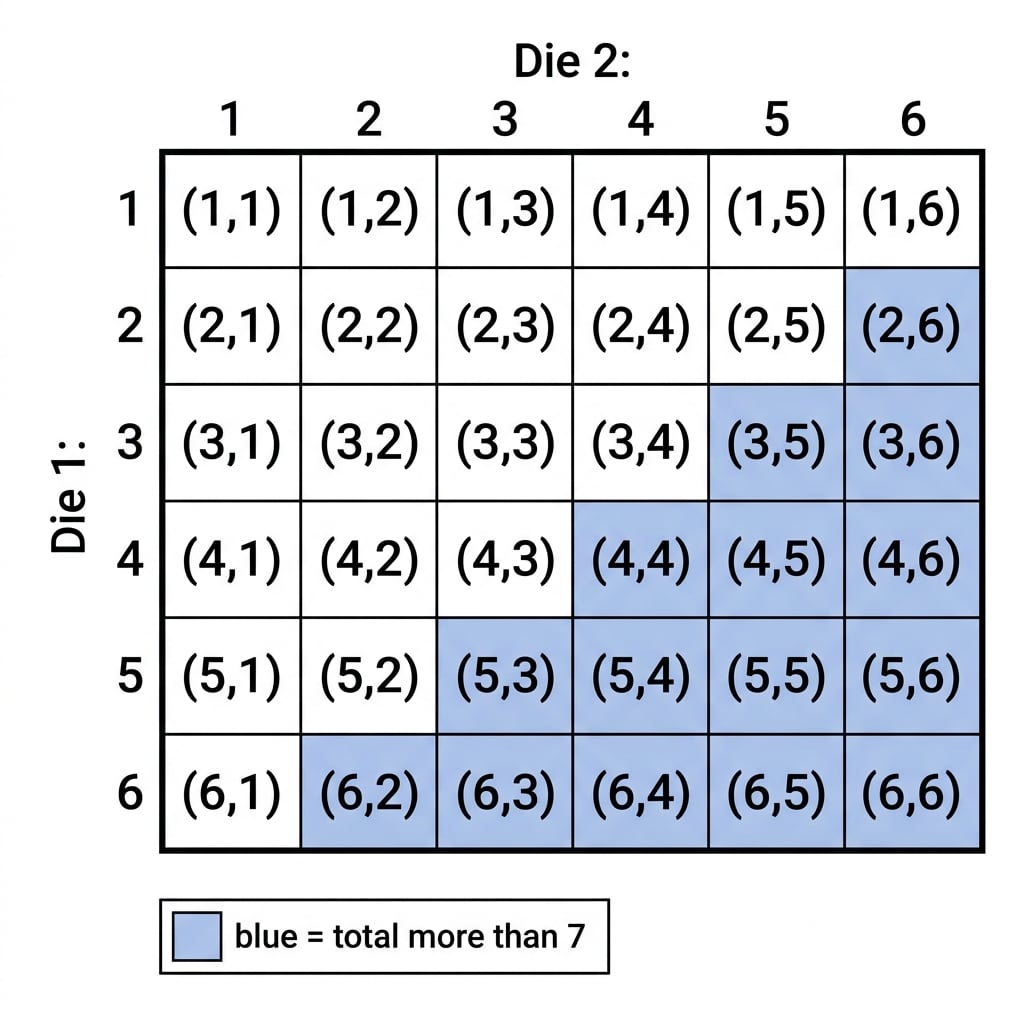
Example
Two dice: probability of a total greater than 7
Two fair dice are rolled. Work out the probability that the total score is greater than 7.
-
There are 6 possible results on the first dice and 6 possible results on the second dice.
-
So there are 36 equally likely outcomes in total.
-
List or count the outcomes with total greater than 7:
- total 8: 2 and 6, 3 and 5, 4 and 4, 5 and 3, 6 and 2
- total 9: 3 and 6, 4 and 5, 5 and 4, 6 and 3
- total 10: 4 and 6, 5 and 5, 6 and 4
- total 11: 5 and 6, 6 and 5
- total 12: 6 and 6
-
Count the successful outcomes: 5 + 4 + 3 + 2 + 1 = 15.
-
Write the probability as a fraction:
1536=512\frac{15}{36}=\frac{5}{12}3615=125
Common Mistake
Forgetting order with dice
With two dice, 2 then 6 and 6 then 2 are different outcomes, because the first dice and second dice can be distinguished.
Odd and even products
For card questions involving multiplication, remember this key fact:
- odd multiplied by odd gives odd;
- odd multiplied by even gives even;
- even multiplied by anything gives even.
Example
Cards from two boxes: odd product
Box A contains 1, 4, and 7. Box B contains 3, 6, and 9. One card is chosen from each box. Find the probability that the product is odd.
-
For the product to be odd, both chosen numbers must be odd.
-
In Box A, the odd numbers are 1 and 7, so there are 2 successful choices from Box A.
-
In Box B, the odd numbers are 3 and 9, so there are 2 successful choices from Box B.
-
The successful outcomes are:
- 1 with 3
- 1 with 9
- 7 with 3
- 7 with 9
-
There are 3 choices from Box A and 3 choices from Box B, so there are 9 outcomes in total.
-
The probability is:
49\frac{4}{9}94
Matches and finishing positions
Some listing questions are about teams playing each other or finishing in order.
If teams play matches against each other, Ajax vs Barcelona is the same match as Barcelona vs Ajax. You should not list it twice.
If teams finish first, second, third, and fourth, order matters. Ajax first and Barcelona second is different from Barcelona first and Ajax second.
Example
Three teams playing each other once
Teams A, B, and C each play every other team once. List the matches.
-
Start with team A:
- A vs B
- A vs C
-
Move to team B. B has already been listed against A, so only list:
- B vs C
-
Team C has already been listed against both A and B.
-
The complete list is:
- A vs B
- A vs C
- B vs C
Tip
Matches versus rankings
For matches, do not reverse the same pair. For rankings, every different order is a different outcome.
Exam technique
In the exam
-
Decide what counts as one outcome before you start listing.
-
Use a clear pattern: fix the first choice, then work through all the second choices.
-
Check your total number of outcomes before using your list for probability.
Self review
Check yourself
- If there are 4 starter choices and 3 main choices, how many meal combinations should your list contain?
- When making numbers from cards 2, 6, and 8, why is 266 not allowed?
- For two dice, why are 1 then 5 and 5 then 1 counted as different outcomes?

Recap questions
Test yourself with 5 quick questions on this guide. Answer them all correctly to complete it.
You've reached the end
Test yourself on this topic, or move on to the next guide.
How was this guide?