Revision notes for Edexcel IGCSE Maths Probability. Open the guide for explanations and worked examples. Written against the Edexcel IGCSE Maths (4MA1) specification, so the content matches what's examinable rather than general Maths background.
Probability
What you'll learn
- How to describe chance using the probability scale from 0 to 1.
- How to find probabilities by counting outcomes.
- How to handle questions involving spinners, dice, bags, cards and tables.
- How to find the probability of something not happening.
1. What is probability?
Probability is a way of measuring how likely something is to happen.
Definition
Probability
A probability is a number from 0 to 1 that shows how likely an event is to happen.
- Probability 0 means the event is impossible.
- Probability 1 means the event is certain.
- Probability 12\frac{1}{2}21 means the event has an even chance.
Definition
Event and outcome
An outcome is one possible result, such as rolling a 4 on a dice.
An event is what you are interested in, such as rolling an even number.
Here is the probability scale:
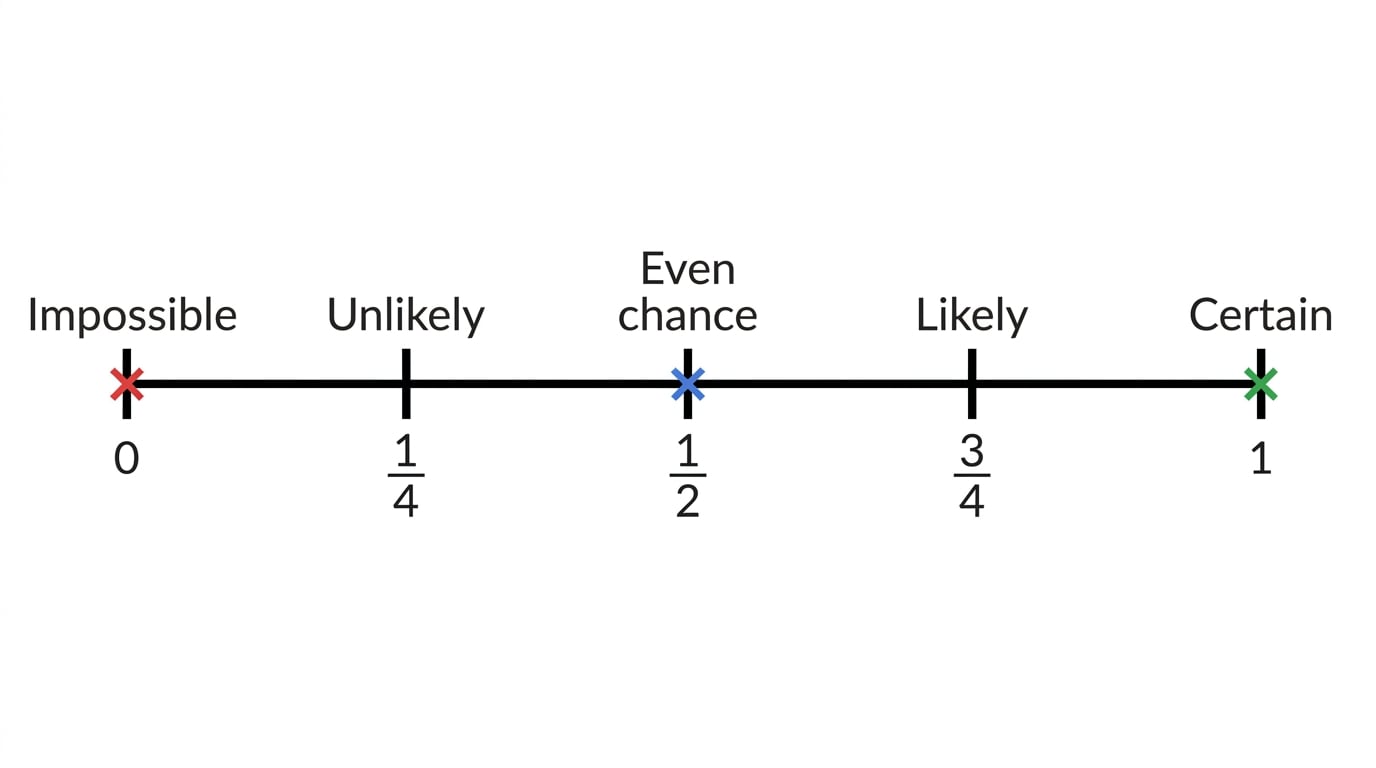
Key Idea
The probability scale
Every probability must be between 0 and 1. If your answer is less than 0 or more than 1, something has gone wrong.
Worked example: placing a probability on a scale
A fair spinner has 4 equal sections. One section is labelled P, one is labelled Q, and two are labelled R. Mark the probability of landing on P on a probability scale.
Example
Spinner probability on a scale
-
Count the total number of equal sections.
There are 4 equal sections.
-
Count the number of sections labelled P.
There is 1 section labelled P.
-
Write the probability as “wanted outcomes over total outcomes”.
P(P)=14P(\text{P})=\frac{1}{4}P(P)=41 -
On the probability scale, place the cross halfway between 0 and 12\frac{1}{2}21.
Common Mistake
Ignoring repeated labels
If a label appears more than once, count every section it appears in. Two sections labelled R means R has probability 24\frac{2}{4}42, not 14\frac{1}{4}41.
2. Finding probability by counting
When outcomes are equally likely, you can use the basic probability formula.
Definition
Equally likely
Outcomes are equally likely if each one has the same chance of happening. For example, on a fair dice, each number from 1 to 6 is equally likely.
The main formula is:
Probability=number of favourable outcomestotal number of outcomes\text{Probability}=\frac{\text{number of favourable outcomes}}{\text{total number of outcomes}}Probability=total number of outcomesnumber of favourable outcomesA favourable outcome means an outcome that matches what the question asks for.
Worked example: choosing a number
A number is chosen at random from this list:
2, 4, 5, 7, 9, 10, 12, 15
Find the probability that the number chosen is 9.
Example
Choosing from a list
-
Count how many numbers are in the list.
There are 8 numbers.
-
Count how many of them are 9.
There is 1 number that is 9.
-
Write the probability as a fraction.
18\frac{1}{8}81
Tip
At random
“At random” means you should treat each item as equally likely to be chosen, unless the question says otherwise.
3. Dice probabilities
An ordinary fair dice has 6 faces: 1, 2, 3, 4, 5 and 6.
Because it is fair, each face has probability 16\frac{1}{6}61.
Worked example: even numbers on a dice
A fair dice is thrown once. Find the probability of getting an even number.
Example
Dice event: even number
-
List the possible dice outcomes.
The outcomes are 1, 2, 3, 4, 5 and 6.
-
Identify the even numbers.
The even numbers are 2, 4 and 6.
-
Count the favourable outcomes.
There are 3 favourable outcomes out of 6.
-
Write the probability and simplify if possible.
36=12\frac{3}{6}=\frac{1}{2}63=21
Worked example: impossible dice outcome
A fair dice is thrown once. Find the probability of getting 8.
Example
Dice event: impossible outcome
-
Check whether 8 is on an ordinary dice.
An ordinary dice only has 1, 2, 3, 4, 5 and 6.
-
Since 8 cannot happen, there are no favourable outcomes.
06=0\frac{0}{6}=060=0 -
The probability is 0, so the event is impossible.
Common Mistake
Forgetting the dice only has 1 to 6
For an ordinary dice, outcomes like 0, 7, 8 or 10 are impossible. Their probability is 0.
4. Certain events and impossible events
Some probability questions are quicker if you recognise whether the event must happen or cannot happen.
- Impossible means probability 0.
- Certain means probability 1.
Worked example: certain dice event
A fair dice is thrown once. Find the probability that the number is less than 7.
Example
Certain dice event
-
List the possible dice outcomes.
The possible outcomes are 1, 2, 3, 4, 5 and 6.
-
Check the event “less than 7”.
Every possible dice outcome is less than 7.
-
So all 6 outcomes are favourable.
66=1\frac{6}{6}=166=1
Tip
Quick check
If the event includes every possible outcome, the probability is 1. If it includes no possible outcomes, the probability is 0.
5. Spinners, cards and repeated values
For fair spinners with equal sections, count the sections. For cards, count the actual cards — not just the different numbers.
Worked example: repeated numbers on cards
There are 7 cards with these numbers:
1, 6, 8, 6, 3, 8, 10
One card is chosen at random.
Find the probability that the card has the number 6 on it.
Example
Cards with repeated values
-
Count the total number of cards.
There are 7 cards.
-
Count how many cards show 6.
There are 2 cards showing 6.
-
Write the probability.
27\frac{2}{7}72
Worked example: odd numbers on cards
Using the same cards, find the probability that the card has an odd number on it.
Example
Cards with an odd number
-
Identify the odd numbers in the list.
The odd numbers are 1 and 3.
-
Count how many odd-numbered cards there are.
There are 2 odd-numbered cards.
-
Put this over the total number of cards.
27\frac{2}{7}72
Common Mistake
Counting types instead of items
If the cards are 1, 6, 8, 6, 3, 8, 10, there are 7 cards in total. Do not count only the different numbers.
6. Bags, boxes and tables
Many probability questions give counts of objects, such as pens, counters, sweets or chocolates.
The denominator is the total number of objects.
Worked example: finding a missing total category
A box contains 28 pens. There are 9 black pens and 6 green pens. The rest are red. One pen is chosen at random.
Find the probability that the pen is red.
Example
Pens in a box
-
Add the pens that are not red.
9+6=159+6=159+6=15 -
Subtract from the total to find the number of red pens.
28−15=1328-15=1328−15=13 -
Write the probability of choosing a red pen.
1328\frac{13}{28}2813
Worked example: using a table
A bag contains counters in these amounts:
- Red: 6
- Blue: 4
- Yellow: 5
- Green: 3
One counter is chosen at random. Find the probability that it is not blue.
Example
Not blue from a table
-
Find the total number of counters.
6+4+5+3=186+4+5+3=186+4+5+3=18 -
Count the counters that are not blue.
Red, yellow and green are not blue.
6+5+3=146+5+3=146+5+3=14 -
Write the probability.
1418=79\frac{14}{18}=\frac{7}{9}1814=97
Tip
Use the word not carefully
“Not blue” means every colour except blue. You can either add all the non-blue counters, or do total minus blue.
7. The probability of “not”
The probability of an event happening and the probability of it not happening always add to 1.
Key Idea
Complement rule
The probability of something not happening is:
1−probability it happens1-\text{probability it happens}1−probability it happensFor example, if the probability of winning is 38\frac{3}{8}83, then the probability of not winning is 1−381-\frac{3}{8}1−83.
Worked example: not winning with fractions
A player has probability 512\frac{5}{12}125 of winning a game. Find the probability that the player does not win.
Example
Probability of not winning
-
Start with the complement rule.
1−5121-\frac{5}{12}1−125 -
Write 1 as 1212\frac{12}{12}1212.
1212−512\frac{12}{12}-\frac{5}{12}1212−125 -
Subtract the numerators.
712\frac{7}{12}127
Worked example: not winning with decimals
The probability that a player wins a match is 0.65. Find the probability that the player does not win.
Example
Decimal complement
-
Use the rule that probabilities add to 1.
1−0.651-0.651−0.65 -
Subtract.
0.350.350.35
Common Mistake
Thinking not means impossible
“Not winning” does not mean probability 0. It means every outcome except winning, such as losing or drawing if a draw is possible.
8. Completing probability tables
Sometimes you are given probabilities for several outcomes and asked to find the missing one.
All probabilities in a complete set add to 1.
Worked example: missing probability
A counter is picked from a bag. The probabilities are:
- Red: 0.25
- Blue: 0.35
- Yellow: 0.15
- Green: unknown
Find the probability of green.
Example
Completing probabilities
-
Add the probabilities you know.
0.25+0.35+0.15=0.750.25+0.35+0.15=0.750.25+0.35+0.15=0.75 -
Subtract from 1 to find the missing probability.
1−0.75=0.251-0.75=0.251−0.75=0.25 -
So the probability of green is 0.25.
Common Mistake
Only add probabilities for all possible outcomes
You can only subtract from 1 when the listed outcomes cover every possible result. For colours in a bag, this works if every counter is one of those colours.
Exam technique
In the exam
-
Count the total number of equally likely outcomes first — this is usually the denominator.
-
Count the outcomes the question asks for — this is usually the numerator.
-
For “not” questions, either count everything except that outcome or subtract from 1.
-
Check your answer is between 0 and 1, and simplify fractions when it is easy.
Self review
Check yourself
- Can you explain why the probability of rolling a number greater than 6 on a fair dice is 0?
- If a bag has 5 red counters and 15 counters altogether, what fraction of the counters are red?
- If the probability of rain is 0.4, what calculation gives the probability of no rain?

Recap questions
Test yourself with 5 quick questions on this guide. Answer them all correctly to complete it.
You've reached the end
Test yourself on this topic, or move on to the next guide.
How was this guide?