Revision notes for Edexcel IGCSE Maths BIDMAS. Open the guide for explanations and worked examples. Written against the Edexcel IGCSE Maths (4MA1) specification, so the content matches what's examinable rather than general Maths background.
BIDMAS
What you'll learn
- What BIDMAS means and why the order matters.
- How to handle brackets, powers, multiplication, division, addition and subtraction.
- How to work through mixed calculations one step at a time.
- How to place brackets to make a calculation true.
Why do we need BIDMAS?
In maths, an operation is an action such as add, subtract, multiply, divide or square.
An expression is a calculation, such as:
6+4×26 + 4 \times 26+4×2This expression does not have an equals sign yet. To work it out correctly, everyone must use the same order. That order is called BIDMAS.
Definition
BIDMAS
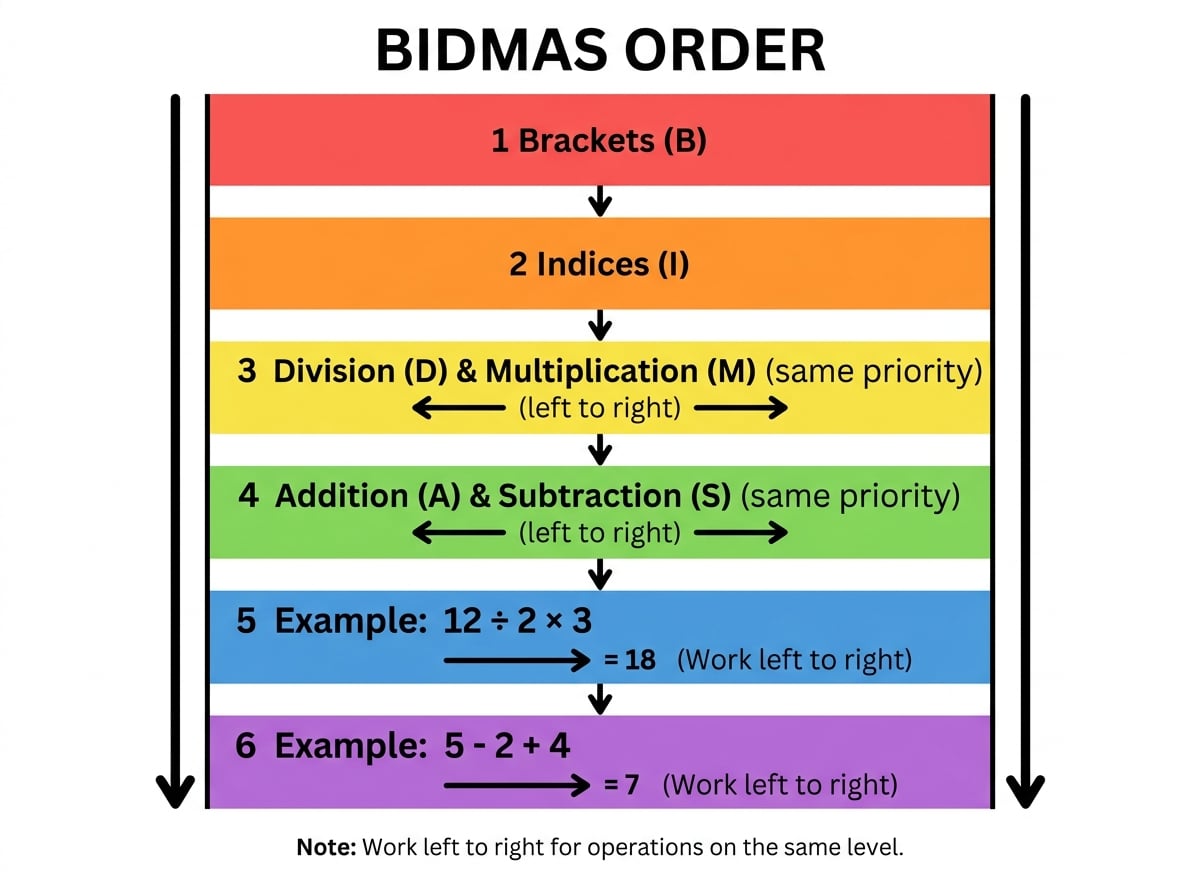
BIDMAS tells you the order to do operations in:
- Brackets
- Indices
- Division and Multiplication
- Addition and Subtraction
The order is shown in this ladder. Notice that division and multiplication share a level, and addition and subtraction share a level.
Key Idea
The big idea
Do the highest-priority part first. Do not simply work from left to right unless the operations are on the same BIDMAS level.
Example
Multiplication before subtraction
Work out:
4×6−54 \times 6 - 54×6−5-
Multiplication comes before subtraction, so do 4 multiplied by 6 first:
4×6=244 \times 6 = 244×6=24 -
Now subtract 5:
24−5=1924 - 5 = 1924−5=19
Common Mistake
Going straight from left to right
For a calculation like 2 + 5 × 4, do not do 2 + 5 first. Multiplication comes before addition, so you must do 5 × 4 first.
B is for Brackets
Brackets group part of a calculation together. Anything inside brackets must be worked out first.
For example, in this expression:
(9−3)×4(9 - 3) \times 4(9−3)×4the bracket tells you to do 9 − 3 before multiplying.
Definition
Brackets
Brackets are symbols like ( ) that show which part of a calculation should be done first.
Example
Working out brackets first
Work out:
(10−4)×5(10 - 4) \times 5(10−4)×5-
Start with the part inside the brackets:
10−4=610 - 4 = 610−4=6 -
Replace the bracket with 6:
6×56 \times 56×5 -
Multiply to get the answer:
6×5=306 \times 5 = 306×5=30
Example
Two sets of brackets
Work out:
(8−5)×(7−2)(8 - 5) \times (7 - 2)(8−5)×(7−2)-
Work out the first bracket:
8−5=38 - 5 = 38−5=3 -
Work out the second bracket:
7−2=57 - 2 = 57−2=5 -
Multiply the two results:
3×5=153 \times 5 = 153×5=15
Tip
Brackets are a shortcut instruction
Think of brackets as saying: “Deal with me first.” Once the bracket is worked out, the calculation usually becomes much simpler.
I is for Indices
An index is a small raised number that tells you to multiply a number by itself. Indices are also called powers.
For example, 323^232 means 3 squared, so:
32=3×3=93^2 = 3 \times 3 = 932=3×3=9Definition
Index
An index is a small raised number, such as the 2 in 525^252. It tells you how many times the base number is used as a factor.
At this level, you will most often see squares, such as 424^242 or (6+1)2(6 + 1)^2(6+1)2.
Example
Addition with a square
Work out:
6+426 + 4^26+42-
The index comes before addition, so work out the square first:
42=164^2 = 1642=16 -
Now add 6:
6+16=226 + 16 = 226+16=22
Example
Brackets before indices
Work out:
(3+4)2(3 + 4)^2(3+4)2-
Brackets come before indices, so work out the bracket first:
3+4=73 + 4 = 73+4=7 -
Now square the result:
72=497^2 = 4972=49
Common Mistake
Squaring the wrong number
In (3+4)2(3 + 4)^2(3+4)2, the whole bracket is squared. In 3 + 424^242, only the 4 is squared. Brackets can completely change the answer.
D and M: Division and Multiplication
Division and multiplication are on the same BIDMAS level. This means one does not always come before the other.
If a calculation has only multiplication and division, work from left to right.
Key Idea
Same level means left to right
Division and multiplication have equal priority. Work them in the order they appear from left to right.
Example
Multiplication and division together
Work out:
18÷3×218 \div 3 \times 218÷3×2-
Division and multiplication are the same level, so start from the left:
18÷3=618 \div 3 = 618÷3=6 -
Now multiply by 2:
6×2=126 \times 2 = 126×2=12
Example
Division after multiplication
Work out:
5×12÷35 \times 12 \div 35×12÷3-
Multiplication and division are the same level, so start from the left:
5×12=605 \times 12 = 605×12=60 -
Now divide by 3:
60÷3=2060 \div 3 = 2060÷3=20
Common Mistake
Do not always do division first
The D appears before the M in BIDMAS, but division does not always happen before multiplication. Division and multiplication are equal priority, so use left to right.
A and S: Addition and Subtraction
Addition and subtraction are also on the same BIDMAS level.
If a calculation has only addition and subtraction, work from left to right.
Example
Addition and subtraction from left to right
Work out:
12−7+312 - 7 + 312−7+3-
Addition and subtraction are the same level, so start from the left:
12−7=512 - 7 = 512−7=5 -
Now add 3:
5+3=85 + 3 = 85+3=8
Common Mistake
Adding before subtracting
In 12 − 7 + 3, it is wrong to do 7 + 3 first just because addition is in the question. Addition and subtraction are equal priority, so work left to right.
Mixing several operations
Most BIDMAS questions combine several operations. The safest method is to rewrite the calculation after each stage.
A good order to check is:
- Brackets
- Indices
- Multiplication and division, left to right
- Addition and subtraction, left to right
Example
Addition, multiplication and an index
Work out:
4+6×234 + 6 \times 2^34+6×23-
Indices come before multiplication, so work out 232^323 first:
23=82^3 = 823=8 -
Replace 232^323 with 8:
4+6×84 + 6 \times 84+6×8 -
Multiplication comes before addition:
6×8=486 \times 8 = 486×8=48 -
Now add 4:
4+48=524 + 48 = 524+48=52
Example
Two multiplications before subtraction
Work out:
8×3−2×58 \times 3 - 2 \times 58×3−2×5-
Do both multiplications before the subtraction:
8×3=248 \times 3 = 248×3=24 -
Work out the other multiplication:
2×5=102 \times 5 = 102×5=10 -
Now subtract:
24−10=1424 - 10 = 1424−10=14
Example
Division and multiplication before addition
Work out:
3+8×6÷43 + 8 \times 6 \div 43+8×6÷4-
Multiplication and division come before addition. Start with 8 × 6 because it appears first from the left:
8×6=488 \times 6 = 488×6=48 -
Now divide by 4:
48÷4=1248 \div 4 = 1248÷4=12 -
Finally add 3:
3+12=153 + 12 = 153+12=15
Tip
Rewrite after each move
After each BIDMAS step, write the new shorter calculation. This helps you avoid trying to do too much in your head.
Adding brackets to make a statement true
Sometimes you are given a statement and asked to insert brackets so that it becomes correct.
Brackets change the order, so your job is to make the numbers combine in the right way.
Example
Choosing brackets to make the answer correct
Add brackets to make this statement correct:
5×4+2=305 \times 4 + 2 = 305×4+2=30-
Without brackets, multiplication happens first:
5×4+2=20+2=225 \times 4 + 2 = 20 + 2 = 225×4+2=20+2=22 -
We need 30, so try making the addition happen first:
5×(4+2)5 \times (4 + 2)5×(4+2) -
Check the bracket first:
4+2=64 + 2 = 64+2=6 -
Now multiply:
5×6=305 \times 6 = 305×6=30
Example
More than one pair of brackets
Add brackets to make this statement correct:
2+6×4+1=572 + 6 \times 4 + 1 = 572+6×4+1=57-
The target is 57. Since 57 is close to 3 × 19, look for a way to make 3 and 19:
2+1=32 + 1 = 32+1=3 -
Use brackets to make 2 + 1 and 6 × 4? That gives 3 and 24, which is too large:
(2+1)×(6×4)=72(2 + 1) \times (6 \times 4) = 72(2+1)×(6×4)=72 -
Instead, group the middle addition first to make 10, then multiply by 6 and subtract? There is no subtraction, so try grouping the first addition:
(2+6)×(4+1)(2 + 6) \times (4 + 1)(2+6)×(4+1) -
Check the brackets:
8×5=408 \times 5 = 408×5=40
The example above shows an important point: not every first try works. In bracket questions, test your idea by substituting it back into the calculation.
Here is a cleaner successful example.
Example
A successful bracket placement
Add brackets to make this statement correct:
3+5×4+2=403 + 5 \times 4 + 2 = 403+5×4+2=40-
Without brackets, the calculation gives 25, so we need brackets to make a bigger product:
3+5×4+2=3+20+2=253 + 5 \times 4 + 2 = 3 + 20 + 2 = 253+5×4+2=3+20+2=25 -
Make 3 + 5 happen first and 4 + 2 happen first:
(3+5)×(4+2)(3 + 5) \times (4 + 2)(3+5)×(4+2) -
Work out the brackets:
8×6=488 \times 6 = 488×6=48
Actually, that gives 48, not 40. So we must keep checking. Try grouping only the first addition.
Example
Checking and correcting brackets
Add brackets to make this statement correct:
3+5×4+2=343 + 5 \times 4 + 2 = 343+5×4+2=34-
We want the 3 + 5 to happen before multiplying:
(3+5)×4+2(3 + 5) \times 4 + 2(3+5)×4+2 -
Work out the bracket:
3+5=83 + 5 = 83+5=8 -
Multiply and then add:
8×4+2=32+2=348 \times 4 + 2 = 32 + 2 = 348×4+2=32+2=34
Tip
How to try bracket questions
If the target answer is bigger than the normal answer, try putting brackets around an addition before a multiplication. This often makes the answer larger.
Exam technique
In the exam
-
Underline or circle any brackets first, then deal with indices.
-
Work multiplication and division from left to right before doing addition and subtraction.
-
For bracket-inserting questions, always check your final version by working it out fully.
Self review
Check yourself
-
Can you explain why 2 + 3 × 5 is not worked out from left to right?
-
What is the difference between 626^262 and (6+2)2(6 + 2)^2(6+2)2?
-
In a calculation with multiplication and division only, which direction do you work in?

Recap questions
Test yourself with 5 quick questions on this guide. Answer them all correctly to complete it.
You've reached the end
Test yourself on this topic, or move on to the next guide.
How was this guide?