Revision notes for CIE IGCSE Maths Completing the Square. Open the guide for explanations and worked examples. Written against the CIE IGCSE Maths (0580) specification, so the content matches what's examinable rather than general Maths background.
Completing the Square
What you'll learn
- How to rewrite a quadratic expression in completed square form.
- How to find the turning point of a quadratic graph quickly.
- How to handle quadratics where the coefficient of x2x^2x2 is not 1.
- How to solve quadratic equations exactly, giving answers in surd form.
1. The key idea: build a perfect square
A quadratic is an expression or equation where the highest power of the variable is squared, for example x2−6x+1x^2 - 6x + 1x2−6x+1.
To complete the square, you rewrite the first two terms so they come from expanding a squared bracket.
Definition
Perfect square
A perfect square expression is something like (x+3)2(x + 3)^2(x+3)2 or (x−5)2(x - 5)^2(x−5)2. It is called a square because it is a bracket multiplied by itself.
Before completing the square, you need to be confident expanding these:
(x+p)2=x2+2px+p2(x + p)^2 = x^2 + 2px + p^2(x+p)2=x2+2px+p2So the middle term is controlled by twice the number inside the bracket.
Key Idea
Half the coefficient of x
For x2+bxx^2 + bxx2+bx, the completed square starts with:
(x+b2)2\left(x + \frac{b}{2}\right)^2(x+2b)2You halve the coefficient of xxx.
Example
Expanding to see the pattern
-
Expand (x+4)2(x + 4)^2(x+4)2 as a bracket multiplied by itself:
(x+4)2=(x+4)(x+4)(x + 4)^2 = (x + 4)(x + 4)(x+4)2=(x+4)(x+4) -
Multiply out the brackets:
(x+4)(x+4)=x2+4x+4x+16(x + 4)(x + 4) = x^2 + 4x + 4x + 16(x+4)(x+4)=x2+4x+4x+16 -
Collect like terms:
(x+4)2=x2+8x+16(x + 4)^2 = x^2 + 8x + 16(x+4)2=x2+8x+16 -
Notice that the coefficient of xxx is 8, which is double 4.
2. Completing the square when the coefficient of x2x^2x2 is 1
Definition
Completed square form
The completed square form of a quadratic is a form such as (x+a)2+b(x + a)^2 + b(x+a)2+b. It shows a squared bracket plus or minus a constant.
The method is:
- Halve the coefficient of xxx.
- Put that number inside the bracket.
- Expand the bracket mentally to see what extra constant has been created.
- Correct it by adding or subtracting outside the bracket.
Example
Writing in completed square form
-
Look at the coefficient of xxx. It is -8, and half of -8 is -4.
-
Start with the square bracket (x−4)2(x - 4)^2(x−4)2.
-
Expand it to check what it gives:
(x−4)2=x2−8x+16(x - 4)^2 = x^2 - 8x + 16(x−4)2=x2−8x+16 -
The original expression is x2−8x+6x^2 - 8x + 6x2−8x+6, but the bracket gives x2−8x+16x^2 - 8x + 16x2−8x+16.
-
Subtract 16, then add 6:
x2−8x+6=(x−4)2−16+6x^2 - 8x + 6 = (x - 4)^2 - 16 + 6x2−8x+6=(x−4)2−16+6 -
Simplify the constants:
x2−8x+6=(x−4)2−10x^2 - 8x + 6 = (x - 4)^2 - 10x2−8x+6=(x−4)2−10
Common Mistake
Forgetting the correction
Do not write x2−8x+6=(x−4)2+6x^2 - 8x + 6 = (x - 4)^2 + 6x2−8x+6=(x−4)2+6. The bracket already contains a hidden +16, so you must correct it.
When the coefficient of xxx is positive
The same idea works when the middle term is positive.
Example
Writing in the form
-
The coefficient of xxx is 12, so half of 12 is 6.
-
Start with (x+6)2(x + 6)^2(x+6)2.
-
Expand the square:
(x+6)2=x2+12x+36(x + 6)^2 = x^2 + 12x + 36(x+6)2=x2+12x+36 -
Correct the constant:
x2+12x+7=(x+6)2−36+7x^2 + 12x + 7 = (x + 6)^2 - 36 + 7x2+12x+7=(x+6)2−36+7 -
Simplify:
x2+12x+7=(x+6)2−29x^2 + 12x + 7 = (x + 6)^2 - 29x2+12x+7=(x+6)2−29
3. Finding the turning point
Definition
Turning point
The turning point of a quadratic graph is the point where the curve changes direction. For a positive x2x^2x2 coefficient, it is the minimum point.
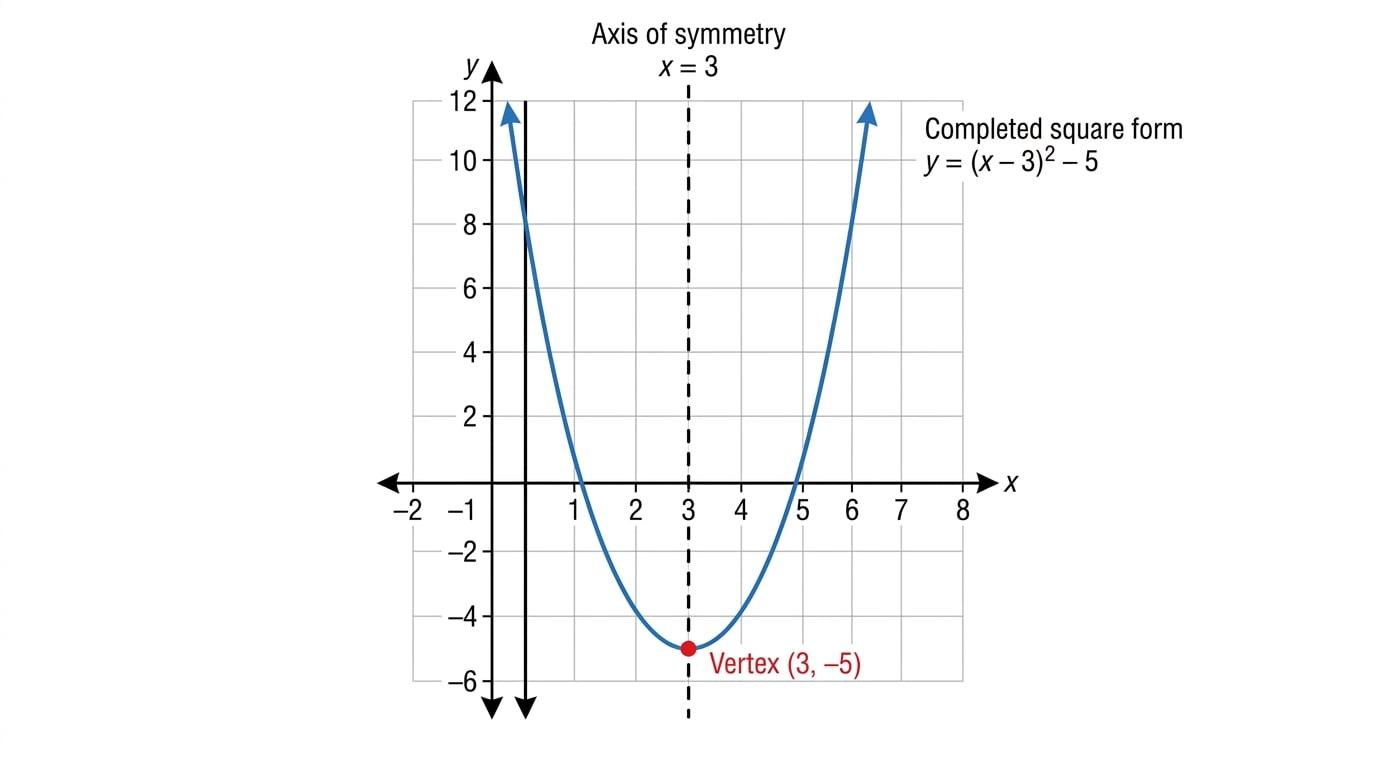
A quadratic graph is a U-shaped curve called a parabola. Completed square form makes the turning point easy to spot.
If
y=(x+a)2+by = (x + a)^2 + by=(x+a)2+bthen the smallest value of the square part is zero. This happens when x+a=0x + a = 0x+a=0, so x=−ax = -ax=−a. The turning point is:
(−a, b)(-a,\ b)(−a, b)The diagram shows the same idea in the form y=(x−h)2+ky = (x - h)^2 + ky=(x−h)2+k: the squared part is smallest at x=hx = hx=h, so the turning point is (h, k)(h,\ k)(h, k).
Example
Finding a turning point after completing the square
-
Start with the quadratic:
y=x2+10x+4y = x^2 + 10x + 4y=x2+10x+4 -
Complete the square. Half of 10 is 5:
y=(x+5)2−25+4y = (x + 5)^2 - 25 + 4y=(x+5)2−25+4 -
Simplify:
y=(x+5)2−21y = (x + 5)^2 - 21y=(x+5)2−21 -
The square part is zero when x+5=0x + 5 = 0x+5=0, so x=−5x = -5x=−5.
-
The turning point is (−5, −21)(-5,\ -21)(−5, −21).
Tip
Sign check for the x-coordinate
In (x+5)2−21(x + 5)^2 - 21(x+5)2−21, the turning point has x=−5x = -5x=−5, not positive 5. The sign changes because you solve x+5=0x + 5 = 0x+5=0.
4. Odd coefficients give fractions
Sometimes halving the coefficient of xxx gives a fraction. That is completely normal.
For example, half of 3 is 32\frac{3}{2}23, so a square bracket might be (x+32)2\left(x + \frac{3}{2}\right)^2(x+23)2.
Example
Completing the square with an odd coefficient
-
Start with:
y=x2+5x−2y = x^2 + 5x - 2y=x2+5x−2 -
Half of 5 is 52\frac{5}{2}25, so use (x+52)2\left(x + \frac{5}{2}\right)^2(x+25)2.
-
Expand the square to see the extra constant:
(x+52)2=x2+5x+254\left(x + \frac{5}{2}\right)^2 = x^2 + 5x + \frac{25}{4}(x+25)2=x2+5x+425 -
Correct the constant:
y=(x+52)2−254−2y = \left(x + \frac{5}{2}\right)^2 - \frac{25}{4} - 2y=(x+25)2−425−2 -
Write -2 as −84-\frac{8}{4}−48 and simplify:
y=(x+52)2−334y = \left(x + \frac{5}{2}\right)^2 - \frac{33}{4}y=(x+25)2−433 -
The turning point is (−52, −334)\left(-\frac{5}{2},\ -\frac{33}{4}\right)(−25, −433).
5. When the coefficient of x2x^2x2 is not 1
If the quadratic starts with something like 2x22x^22x2 or 3x23x^23x2, first factor out the coefficient from the x2x^2x2 and xxx terms.
Example
Writing in the form
-
Factor out 2 from the first two terms:
2x2−20x+41=2(x2−10x)+412x^2 - 20x + 41 = 2(x^2 - 10x) + 412x2−20x+41=2(x2−10x)+41 -
Complete the square inside the bracket. Half of -10 is -5:
x2−10x=(x−5)2−25x^2 - 10x = (x - 5)^2 - 25x2−10x=(x−5)2−25 -
Substitute this into the expression:
2(x2−10x)+41=2((x−5)2−25)+412(x^2 - 10x) + 41 = 2\left((x - 5)^2 - 25\right) + 412(x2−10x)+41=2((x−5)2−25)+41 -
Expand the 2 carefully:
2((x−5)2−25)+41=2(x−5)2−50+412\left((x - 5)^2 - 25\right) + 41 = 2(x - 5)^2 - 50 + 412((x−5)2−25)+41=2(x−5)2−50+41 -
Simplify:
2x2−20x+41=2(x−5)2−92x^2 - 20x + 41 = 2(x - 5)^2 - 92x2−20x+41=2(x−5)2−9 -
The turning point is (5, −9)(5,\ -9)(5, −9).
Common Mistake
Not multiplying the correction
When there is a number outside the bracket, it multiplies everything inside. In 2((x−5)2−25)2((x - 5)^2 - 25)2((x−5)2−25), the correction becomes -50, not -25.
6. Solving quadratics by completing the square
Definition
Surd form
A surd is an exact square root that cannot be simplified to a whole number, such as 7\sqrt{7}7 or 13\sqrt{13}13. Leaving answers in surd form means giving exact answers, not decimals.
To solve by completing the square:
- Rewrite the quadratic in completed square form.
- Move the constant to the other side.
- Square root both sides.
- Remember the ±\pm± sign.
- Solve for xxx.
Example
Solving by completing the square
-
Complete the square for x2+6x−5x^2 + 6x - 5x2+6x−5:
x2+6x−5=(x+3)2−9−5x^2 + 6x - 5 = (x + 3)^2 - 9 - 5x2+6x−5=(x+3)2−9−5 -
Simplify:
x2+6x−5=(x+3)2−14x^2 + 6x - 5 = (x + 3)^2 - 14x2+6x−5=(x+3)2−14 -
Set it equal to zero:
(x+3)2−14=0(x + 3)^2 - 14 = 0(x+3)2−14=0 -
Move 14 to the other side:
(x+3)2=14(x + 3)^2 = 14(x+3)2=14 -
Square root both sides, remembering both signs:
x+3=±14x + 3 = \pm\sqrt{14}x+3=±14 -
Subtract 3:
x=−3±14x = -3 \pm \sqrt{14}x=−3±14
Common Mistake
Square roots give two answers
If A2=14A^2 = 14A2=14, then A=14A = \sqrt{14}A=14 or A=−14A = -\sqrt{14}A=−14. Missing the negative root loses a solution.
Solving when decimals appear
Decimals are often easier if you convert them to fractions first.
Example
Solving in surd form
-
Convert 2.25 to a fraction:
2.25=942.25 = \frac{9}{4}2.25=49 -
Complete the square. Half of 7 is 72\frac{7}{2}27:
x2+7x+94=(x+72)2−494+94x^2 + 7x + \frac{9}{4} = \left(x + \frac{7}{2}\right)^2 - \frac{49}{4} + \frac{9}{4}x2+7x+49=(x+27)2−449+49 -
Simplify the constants:
x2+7x+94=(x+72)2−10x^2 + 7x + \frac{9}{4} = \left(x + \frac{7}{2}\right)^2 - 10x2+7x+49=(x+27)2−10 -
Set the expression equal to zero:
(x+72)2−10=0\left(x + \frac{7}{2}\right)^2 - 10 = 0(x+27)2−10=0 -
Move 10 to the other side:
(x+72)2=10\left(x + \frac{7}{2}\right)^2 = 10(x+27)2=10 -
Square root both sides:
x+72=±10x + \frac{7}{2} = \pm\sqrt{10}x+27=±10 -
Subtract 72\frac{7}{2}27:
x=−72±10x = -\frac{7}{2} \pm \sqrt{10}x=−27±10
Exam technique
In the exam
- Show the completed square line clearly before writing the turning point or solving.
- Check signs carefully: (x−4)2+3(x - 4)^2 + 3(x−4)2+3 has turning point (4, 3)(4,\ 3)(4, 3), while (x+4)2+3(x + 4)^2 + 3(x+4)2+3 has turning point (−4, 3)(-4,\ 3)(−4, 3).
- If the coefficient of x2x^2x2 is not 1, factor it out from the x2x^2x2 and xxx terms first, then multiply the correction by that coefficient.
- When solving, remember the ±\pm± after square rooting.
Self review
Check yourself
- Can you explain why half the coefficient of xxx goes inside the bracket?
- If y=(x−6)2−11y = (x - 6)^2 - 11y=(x−6)2−11, what is the turning point?
- When solving by completing the square, where does the ±\pm± sign appear?

Recap questions
Test yourself with 5 quick questions on this guide. Answer them all correctly to complete it.
You've reached the end
Test yourself on this topic, or move on to the next guide.
How was this guide?