Revision notes for CIE IGCSE Maths Quadratic Simultaneous Equations. Open the guide for explanations and worked examples. Written against the CIE IGCSE Maths (0580) specification, so the content matches what's examinable rather than general Maths background.
Quadratic Simultaneous Equations
What you'll learn
- How to solve two equations when one contains squared terms.
- Why quadratic simultaneous equations often have two solutions.
- How to substitute a linear equation into a quadratic equation.
- How to handle non-factorising answers and round to 3 significant figures.
The big picture: line meets curve
Definition
Simultaneous equations
Simultaneous equations are two or more equations that must be true at the same time. A solution is usually an ordered pair, written like (x,y)(x, y)(x,y), that works in every equation.
In this topic, one equation is usually linear, meaning its graph is a straight line, and the other is quadratic, meaning it contains a squared term such as x2x^2x2 or y2y^2y2.
A common example is:
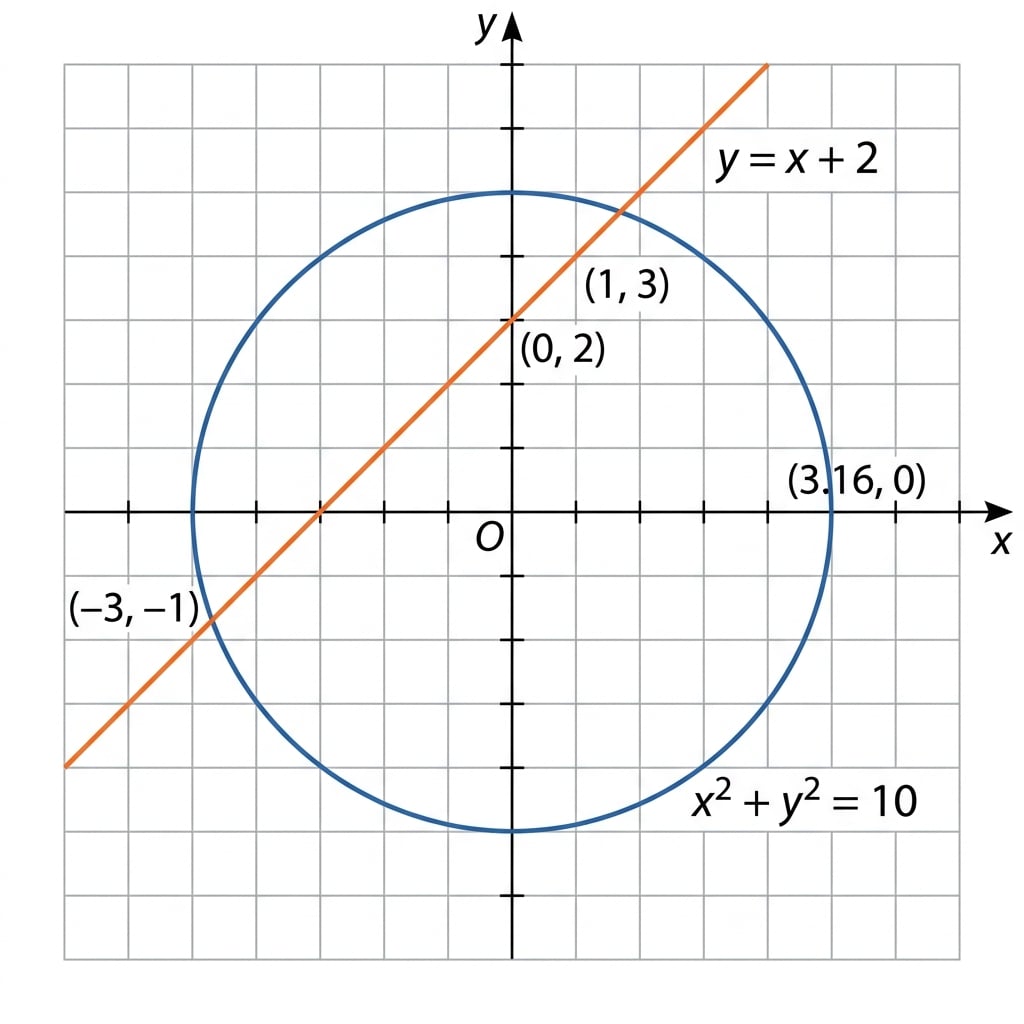
x2+y2=10x^2 + y^2 = 10x2+y2=10This is a circle centred at the origin. If you solve it together with a straight line, you are finding the points where the line and circle intersect.
Key Idea
What the answers mean
Each solution is a coordinate pair. If there are two intersections, you should expect two coordinate pairs.
Example
Solving a line and circle by substitution
Solve:
x2+y2=10x^2 + y^2 = 10x2+y2=10 y=x+2y = x + 2y=x+2-
The second equation already tells you what yyy is, so substitute y=x+2y = x + 2y=x+2 into the quadratic equation:
x2+(x+2)2=10x^2 + (x + 2)^2 = 10x2+(x+2)2=10 -
Expand the bracket carefully:
x2+x2+4x+4=10x^2 + x^2 + 4x + 4 = 10x2+x2+4x+4=10 -
Collect like terms and rearrange to make the equation equal to zero:
2x2+4x−6=02x^2 + 4x - 6 = 02x2+4x−6=0 -
Divide every term by 2 to simplify:
x2+2x−3=0x^2 + 2x - 3 = 0x2+2x−3=0 -
Factorise the quadratic:
(x+3)(x−1)=0(x + 3)(x - 1) = 0(x+3)(x−1)=0 -
Solve for xxx:
x=−3orx=1x = -3 \quad \text{or} \quad x = 1x=−3orx=1 -
Use y=x+2y = x + 2y=x+2 to find the matching yyy-values:
If x=−3,y=−1If x=1,y=3\begin{aligned} \text{If } x &= -3, & y &= -1 \\ \text{If } x &= 1, & y &= 3 \end{aligned}If xIf x=−3,=1,yy=−1=3 -
Write the two coordinate pairs:
(−3,−1)and(1,3)(-3, -1) \quad \text{and} \quad (1, 3)(−3,−1)and(1,3)
Common Mistake
Do not split the squares
From x2+y2=10x^2 + y^2 = 10x2+y2=10, you cannot say x+y=10x + y = \sqrt{10}x+y=10. Square roots do not work separately across addition.
The main method: substitute, solve, pair up
Definition
Substitution
Substitution means replacing one variable with an equal expression involving the other variable. This turns two equations into one equation with one unknown.
Most Grade 8/9 quadratic simultaneous questions follow this pattern:
- Rearrange the linear equation if needed.
- Substitute into the quadratic equation.
- Solve the quadratic equation.
- Substitute back to find the matching values.
- Give answers as coordinate pairs.
Example
When the line is written as a difference
Solve:
x2+y2=29x^2 + y^2 = 29x2+y2=29 x−y=3x - y = 3x−y=3-
Rearrange the linear equation to make yyy the subject:
x−y=3⇒y=x−3x - y = 3 \Rightarrow y = x - 3x−y=3⇒y=x−3 -
Substitute y=x−3y = x - 3y=x−3 into x2+y2=29x^2 + y^2 = 29x2+y2=29:
x2+(x−3)2=29x^2 + (x - 3)^2 = 29x2+(x−3)2=29 -
Expand the bracket:
x2+x2−6x+9=29x^2 + x^2 - 6x + 9 = 29x2+x2−6x+9=29 -
Collect terms and rearrange:
2x2−6x−20=02x^2 - 6x - 20 = 02x2−6x−20=0 -
Divide by 2:
x2−3x−10=0x^2 - 3x - 10 = 0x2−3x−10=0 -
Factorise:
(x−5)(x+2)=0(x - 5)(x + 2) = 0(x−5)(x+2)=0 -
Solve for xxx:
x=5orx=−2x = 5 \quad \text{or} \quad x = -2x=5orx=−2 -
Substitute into y=x−3y = x - 3y=x−3:
If x=5,y=2If x=−2,y=−5\begin{aligned} \text{If } x &= 5, & y &= 2 \\ \text{If } x &= -2, & y &= -5 \end{aligned}If xIf x=5,=−2,yy=2=−5 -
Write the final answers:
(5,2)and(−2,−5)(5, 2) \quad \text{and} \quad (-2, -5)(5,2)and(−2,−5)
Tip
Pair the values correctly
Do not list all the xxx-values and all the yyy-values separately. Each yyy-value comes from substituting a particular xxx-value, so keep them as matched coordinate pairs.
Rearranging a line with coefficients
Sometimes the linear equation looks like 2x+y=52x + y = 52x+y=5 or 3x=4−y3x = 4 - y3x=4−y. That is still just a straight line. Rearrange it before substituting.
Example
Line not already in the form
Solve:
x2+y2=25x^2 + y^2 = 25x2+y2=25 4x+y=54x + y = 54x+y=5-
Rearrange the linear equation to make yyy the subject:
y=5−4xy = 5 - 4xy=5−4x -
Substitute into the quadratic equation:
x2+(5−4x)2=25x^2 + (5 - 4x)^2 = 25x2+(5−4x)2=25 -
Expand the bracket:
x2+25−40x+16x2=25x^2 + 25 - 40x + 16x^2 = 25x2+25−40x+16x2=25 -
Simplify:
17x2−40x=017x^2 - 40x = 017x2−40x=0 -
Factorise by taking out the common factor xxx:
x(17x−40)=0x(17x - 40) = 0x(17x−40)=0 -
Solve for xxx:
x=0orx=4017x = 0 \quad \text{or} \quad x = \frac{40}{17}x=0orx=1740 -
Substitute each value into y=5−4xy = 5 - 4xy=5−4x:
If x=0,y=5If x=4017,y=−7517\begin{aligned} \text{If } x &= 0, & y &= 5 \\ \text{If } x &= \frac{40}{17}, & y &= -\frac{75}{17} \end{aligned}If xIf x=0,=1740,yy=5=−1775 -
Write the final answers:
(0,5)and(4017,−7517)(0, 5) \quad \text{and} \quad \left(\frac{40}{17}, -\frac{75}{17}\right)(0,5)and(1740,−1775)
When the quadratic does not factorise nicely
Definition
Quadratic formula
The quadratic formula solves equations of the form ax2+bx+c=0ax^2 + bx + c = 0ax2+bx+c=0:
x=−b±b2−4ac2ax = \frac{-b \pm \sqrt{b^2 - 4ac}}{2a}x=2a−b±b2−4acIf the question asks for answers to 3 significant figures, it is a strong hint that the quadratic may not factorise neatly.
Example
Answers to 3 significant figures
Solve, giving your answers to 3 significant figures:
x2+y2=18x^2 + y^2 = 18x2+y2=18 2x+y=42x + y = 42x+y=4-
Rearrange the linear equation:
y=4−2xy = 4 - 2xy=4−2x -
Substitute into the quadratic equation:
x2+(4−2x)2=18x^2 + (4 - 2x)^2 = 18x2+(4−2x)2=18 -
Expand and simplify:
x2+16−16x+4x2=185x2−16x−2=0\begin{aligned} x^2 + 16 - 16x + 4x^2 &= 18 \\ 5x^2 - 16x - 2 &= 0 \end{aligned}x2+16−16x+4x25x2−16x−2=18=0 -
Use the quadratic formula with a=5a = 5a=5, b=−16b = -16b=−16, and c=−2c = -2c=−2:
x=16±(−16)2−4(5)(−2)10x = \frac{16 \pm \sqrt{(-16)^2 - 4(5)(-2)}}{10}x=1016±(−16)2−4(5)(−2) -
Simplify inside the square root:
x=16±29610x = \frac{16 \pm \sqrt{296}}{10}x=1016±296 -
Find the two xxx-values:
x≈3.320orx≈−0.120x \approx 3.320 \quad \text{or} \quad x \approx -0.120x≈3.320orx≈−0.120 -
Substitute into y=4−2xy = 4 - 2xy=4−2x:
If x≈3.320,y≈−2.641If x≈−0.120,y≈4.241\begin{aligned} \text{If } x &\approx 3.320, & y &\approx -2.641 \\ \text{If } x &\approx -0.120, & y &\approx 4.241 \end{aligned}If xIf x≈3.320,≈−0.120,yy≈−2.641≈4.241 -
Round both coordinate pairs to 3 significant figures:
(3.32,−2.64)and(−0.120,4.24)(3.32, -2.64) \quad \text{and} \quad (-0.120, 4.24)(3.32,−2.64)and(−0.120,4.24)
Tip
Rounding decimals less than 1
For a number like -0.120, the zero after the 2 is significant. Writing -0.12 gives only 2 significant figures, so keep -0.120 when 3 significant figures are required.
Quadratics that are not circles
Not every quadratic simultaneous equation looks like x2+y2=kx^2 + y^2 = kx2+y2=k. You may see equations such as x2−3y2=13x^2 - 3y^2 = 13x2−3y2=13 or 2x2−y2=142x^2 - y^2 = 142x2−y2=14.
The method is the same: use the linear equation to replace one variable, then solve the resulting quadratic.
Definition
Solve algebraically
To solve algebraically means to use algebraic methods such as rearranging, substituting, expanding and factorising. You should not rely on a graph for your final answer.
Example
Solving a quadratic with different squared terms
Solve algebraically:
2x2−y2=12x^2 - y^2 = 12x2−y2=1 3x+2y=13x + 2y = 13x+2y=1-
Rearrange the linear equation to make yyy the subject:
2y=1−3x2y = 1 - 3x2y=1−3x -
Divide by 2:
y=1−3x2y = \frac{1 - 3x}{2}y=21−3x -
Substitute into 2x2−y2=12x^2 - y^2 = 12x2−y2=1:
2x2−(1−3x2)2=12x^2 - \left(\frac{1 - 3x}{2}\right)^2 = 12x2−(21−3x)2=1 -
Multiply every term by 4 to remove the fraction:
8x2−(1−3x)2=48x^2 - (1 - 3x)^2 = 48x2−(1−3x)2=4 -
Expand the bracket carefully:
8x2−(1−6x+9x2)=48x^2 - (1 - 6x + 9x^2) = 48x2−(1−6x+9x2)=4 -
Remove the bracket and simplify:
−x2+6x−1=4-x^2 + 6x - 1 = 4−x2+6x−1=4 -
Rearrange into standard quadratic form:
x2−6x+5=0x^2 - 6x + 5 = 0x2−6x+5=0 -
Factorise:
(x−1)(x−5)=0(x - 1)(x - 5) = 0(x−1)(x−5)=0 -
Solve for xxx:
x=1orx=5x = 1 \quad \text{or} \quad x = 5x=1orx=5 -
Substitute into y=1−3x2y = \frac{1 - 3x}{2}y=21−3x:
If x=1,y=−1If x=5,y=−7\begin{aligned} \text{If } x &= 1, & y &= -1 \\ \text{If } x &= 5, & y &= -7 \end{aligned}If xIf x=1,=5,yy=−1=−7 -
Write the two solutions:
(1,−1)and(5,−7)(1, -1) \quad \text{and} \quad (5, -7)(1,−1)and(5,−7)
Common Mistake
Forgetting the minus before a bracket
In expressions like 2x2−(1−3x)22x^2 - (1 - 3x)^22x2−(1−3x)2, the minus sign applies to the whole expanded bracket. Write the brackets out fully before simplifying.
Common Mistake
Sometimes there are not two real solutions
A line might touch the curve once or miss it completely. Algebraically, this shows up as a repeated root or a negative value under the square root in the quadratic formula.
Exam technique
In the exam
-
Rearrange the linear equation first, then substitute into the quadratic equation.
-
Keep your working neat when expanding brackets, especially when there is a minus sign before a squared bracket.
-
Always give answers as coordinate pairs and check each pair in both original equations if you have time.
Self review
Check yourself
-
Can you explain why a quadratic simultaneous equation can have two coordinate-pair solutions?
-
When substituting y=3−2xy = 3 - 2xy=3−2x into x2+y2=20x^2 + y^2 = 20x2+y2=20, where do the brackets need to go?
-
If your quadratic gives two xxx-values, how do you find the matching yyy-values?

Recap questions
Test yourself with 5 quick questions on this guide. Answer them all correctly to complete it.
You've reached the end
Test yourself on this topic, or move on to the next guide.
How was this guide?