Revision notes for CIE IGCSE Maths Quadratic Formula. Open the guide for explanations and worked examples. Written against the CIE IGCSE Maths (0580) specification, so the content matches what's examinable rather than general Maths background.
Quadratic Formula
What you'll learn
- How to recognise a quadratic equation and write it in standard form.
- How to substitute correctly into the quadratic formula.
- How to give answers as decimals or exact surds.
- How to use the formula in area and Pythagoras problems.
Before the formula: standard form
To use the quadratic formula, the equation must be written with everything on one side and zero on the other side.
Definition
Quadratic equation
A quadratic equation is an equation where the highest power of the variable is squared, such as x2x^2x2. The standard form is ax2+bx+c=0ax^2+bx+c=0ax2+bx+c=0, where aaa, bbb and ccc are coefficients: the numbers multiplying the terms. You must have a≠0a \neq 0a=0. A solution or root is a value of xxx that makes the equation true.
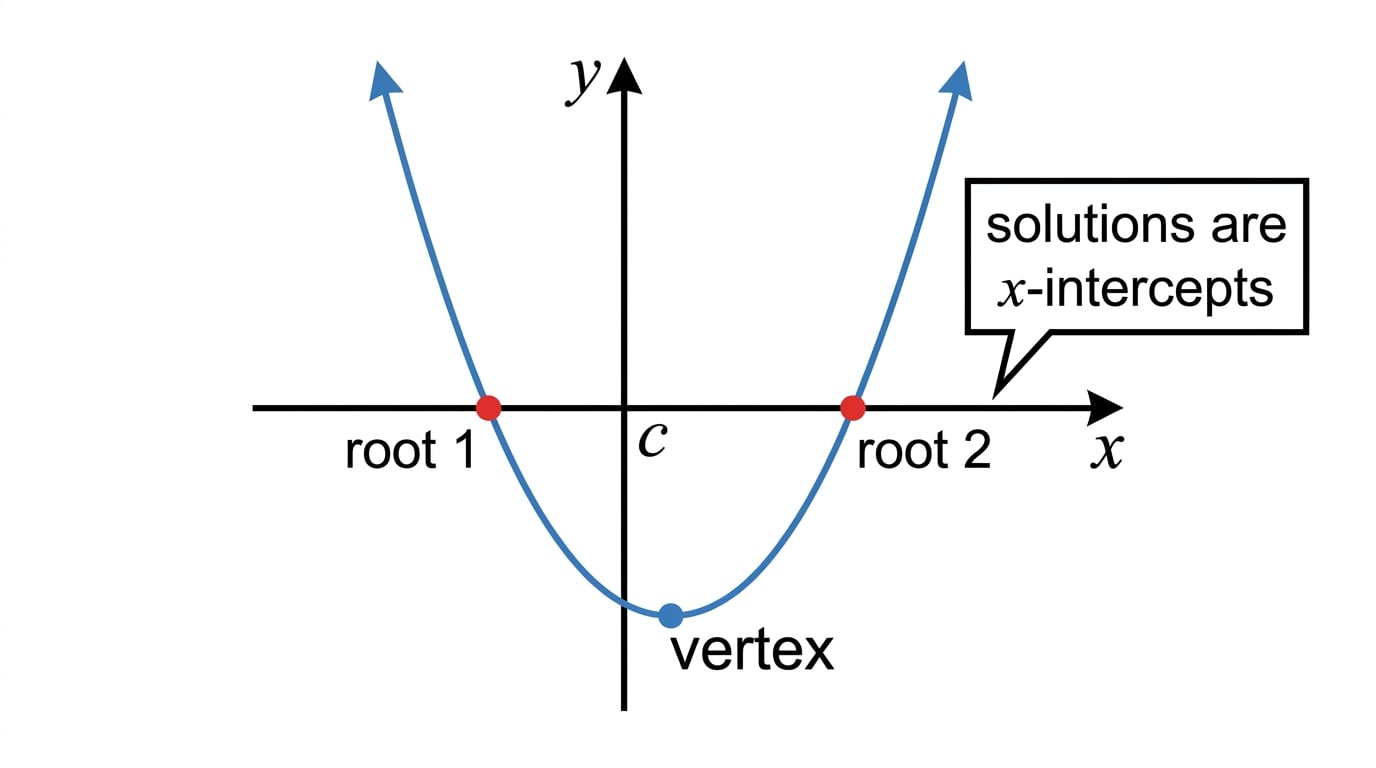
A quadratic graph is called a parabola, which is a U-shaped curve. The roots are where the graph crosses the x-axis.
Key Idea
Why standard form matters
The formula only works when the equation is in the form ax2+bx+c=0ax^2+bx+c=0ax2+bx+c=0. Rearrange first, then identify aaa, bbb and ccc with their signs.
Example
Writing a quadratic in standard form
Solve later if needed, but first rewrite 4x2=7x+24x^2=7x+24x2=7x+2 in standard form and identify aaa, bbb and ccc.
-
Move every term to the left-hand side.
4x2−7x−2=04x^2-7x-2=04x2−7x−2=0 -
Compare with ax2+bx+c=0ax^2+bx+c=0ax2+bx+c=0.
-
The coefficients are a=4a=4a=4, b=−7b=-7b=−7 and c=−2c=-2c=−2.
Common Mistake
Losing the signs
If the equation is 4x2−7x−2=04x^2-7x-2=04x2−7x−2=0, then b=−7b=-7b=−7 and c=−2c=-2c=−2. The minus signs belong to the coefficients.
The quadratic formula
The quadratic formula solves any quadratic equation in standard form, even when factorising is awkward or impossible.
Definition
Quadratic formula
For ax2+bx+c=0ax^2+bx+c=0ax2+bx+c=0, the solutions are
x=−b±b2−4ac2ax=\frac{-b\pm\sqrt{b^2-4ac}}{2a}x=2a−b±b2−4acThe symbol ±\pm± means “plus or minus”, so it usually gives two answers.
The expression under the square root, b2−4acb^2-4acb2−4ac, is called the discriminant. It helps decide what kind of answers you get.
- If it is positive, there are two real roots.
- If it is zero, there is one repeated root.
- If it is negative, there are no real roots.
Common Mistake
When the formula does not apply
The quadratic formula is not for linear equations. If a=0a=0a=0, there is no x2x^2x2 term, so the equation is not quadratic.
Example
Solving a quadratic to 2 decimal places
Solve 3x2+4x−5=03x^2+4x-5=03x2+4x−5=0, giving your answers correct to 2 decimal places.
-
Identify the coefficients: a=3a=3a=3, b=4b=4b=4 and c=−5c=-5c=−5.
-
Substitute into the formula.
x=−4±42−4(3)(−5)2(3)x=\frac{-4\pm\sqrt{4^2-4(3)(-5)}}{2(3)}x=2(3)−4±42−4(3)(−5) -
Simplify the discriminant.
42−4(3)(−5)=16+60=764^2-4(3)(-5)=16+60=7642−4(3)(−5)=16+60=76 -
Write the exact formula result.
x=−4±766x=\frac{-4\pm\sqrt{76}}{6}x=6−4±76 -
Work out both values.
x=−4+766≈0.786x=−4−766≈−2.120\begin{aligned} x&=\frac{-4+\sqrt{76}}{6}\approx 0.786\\ x&=\frac{-4-\sqrt{76}}{6}\approx -2.120 \end{aligned}xx=6−4+76≈0.786=6−4−76≈−2.120 -
Round to 2 decimal places: x=0.79x=0.79x=0.79 or x=−2.12x=-2.12x=−2.12.
Tip
Calculator brackets
Type the numerator in brackets, especially for the negative answer: (-4 - sqrt(76)) ÷ 6. This avoids accidentally dividing only part of the expression.
Rounding your answers
A question may ask for answers correct to a certain number of decimal places or significant figures.
- Decimal places count digits after the decimal point.
- Significant figures count from the first non-zero digit.
For example, 1.6489 to 3 significant figures is 1.65, while -0.8489 to 3 significant figures is -0.849.
Example
Rearranging first, then rounding to 3 significant figures
Solve 5x2=4x+75x^2=4x+75x2=4x+7, giving your answers correct to 3 significant figures.
-
Rearrange into standard form.
5x2−4x−7=05x^2-4x-7=05x2−4x−7=0 -
Identify the coefficients: a=5a=5a=5, b=−4b=-4b=−4 and c=−7c=-7c=−7.
-
Substitute into the quadratic formula.
x=−(−4)±(−4)2−4(5)(−7)2(5)x=\frac{-(-4)\pm\sqrt{(-4)^2-4(5)(-7)}}{2(5)}x=2(5)−(−4)±(−4)2−4(5)(−7) -
Simplify carefully.
x=4±16+14010x=\frac{4\pm\sqrt{16+140}}{10}x=104±16+140 -
Work out both values.
x=4+15610≈1.649x=4−15610≈−0.849\begin{aligned} x&=\frac{4+\sqrt{156}}{10}\approx 1.649\\ x&=\frac{4-\sqrt{156}}{10}\approx -0.849 \end{aligned}xx=104+156≈1.649=104−156≈−0.849 -
To 3 significant figures, x=1.65x=1.65x=1.65 or x=−0.849x=-0.849x=−0.849.
Common Mistake
Rounding too early
Do not round the square root first unless the question asks you to. Keep the full calculator value until the final answer.
Exact answers using surds
Sometimes the question does not want a decimal. It may ask for an exact answer in a form like a±bca\pm b\sqrt{c}a±bc.
Definition
Surd
A surd is an irrational root left in exact form, such as 2\sqrt{2}2 or 7\sqrt{7}7. You should simplify it if it has a square factor, for example 72=62\sqrt{72}=6\sqrt{2}72=62.
Example
Giving answers in exact surd form
Solve x2+10x+7=0x^2+10x+7=0x2+10x+7=0, giving your answers in the form a±bca\pm b\sqrt{c}a±bc.
-
Identify a=1a=1a=1, b=10b=10b=10 and c=7c=7c=7.
-
Substitute into the formula.
x=−10±102−4(1)(7)2(1)x=\frac{-10\pm\sqrt{10^2-4(1)(7)}}{2(1)}x=2(1)−10±102−4(1)(7) -
Simplify the discriminant.
102−4(1)(7)=100−28=7210^2-4(1)(7)=100-28=72102−4(1)(7)=100−28=72 -
Simplify the surd.
72=36⋅2=62\sqrt{72}=\sqrt{36\cdot 2}=6\sqrt{2}72=36⋅2=62 -
Substitute this back into the answer.
x=−10±622x=\frac{-10\pm 6\sqrt{2}}{2}x=2−10±62 -
Divide both terms in the numerator by 2.
x=−5±32x=-5\pm 3\sqrt{2}x=−5±32
Using the formula in geometry problems
In problem-solving questions, the hard part is often forming the quadratic equation. Once you have it, the formula is the same as before.
Key Idea
Set up first, solve second
For area or triangle problems, write an equation using the geometry first. Then expand, simplify to standard form, and solve.
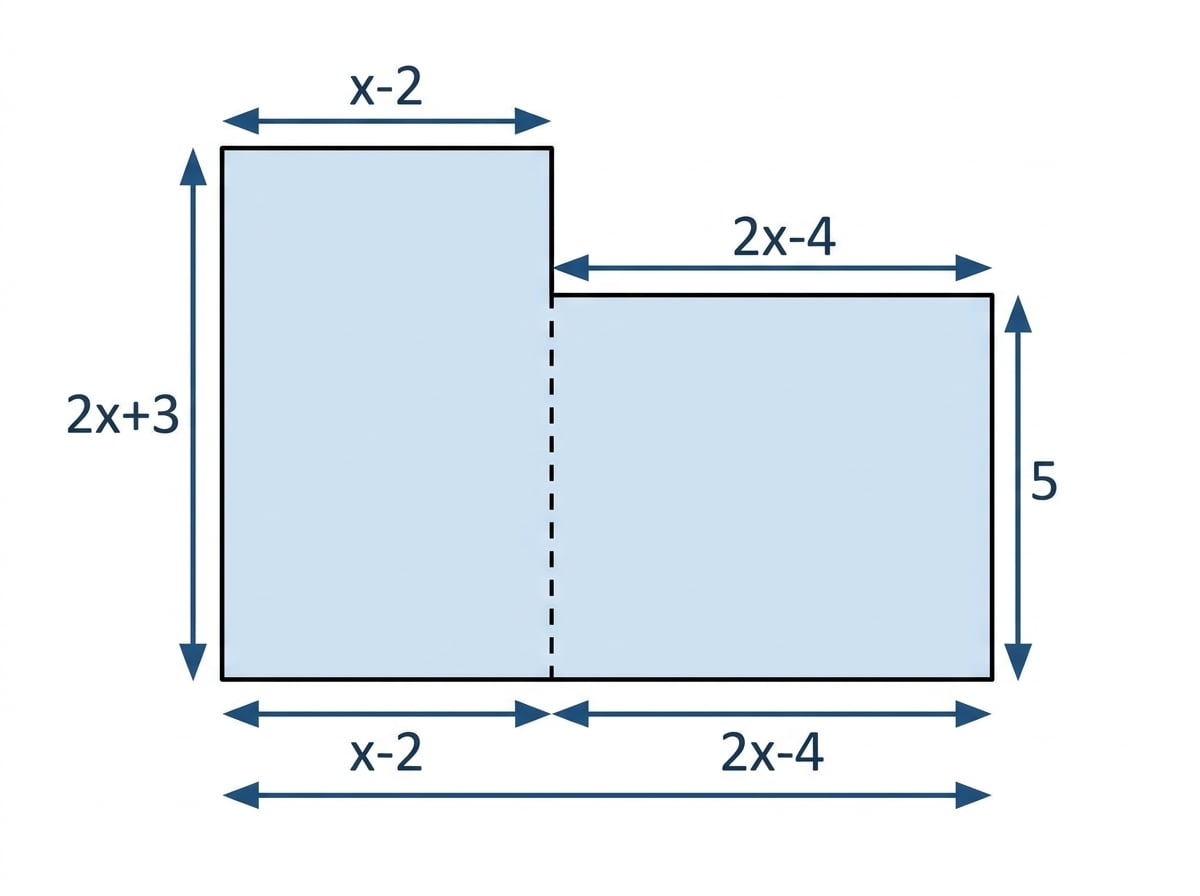
The diagram below shows a typical compound shape made from two rectangles. To find the total area, add the area of each rectangle.
Example
Area of a compound shape
A compound shape is made from two rectangles. The left rectangle has width x−2x-2x−2 and height 2x+32x+32x+3. The right rectangle has width 2x−42x-42x−4 and height 5. The total area is 46 cm². Find xxx to 3 significant figures.
-
Write the area of each rectangle.
(x−2)(2x+3)+5(2x−4)=46(x-2)(2x+3)+5(2x-4)=46(x−2)(2x+3)+5(2x−4)=46 -
Expand each part.
2x2−x−6+10x−20=462x^2-x-6+10x-20=462x2−x−6+10x−20=46 -
Simplify and rearrange to standard form.
2x2+9x−72=02x^2+9x-72=02x2+9x−72=0 -
Use the quadratic formula with a=2a=2a=2, b=9b=9b=9 and c=−72c=-72c=−72.
x=−9±92−4(2)(−72)2(2)x=\frac{-9\pm\sqrt{9^2-4(2)(-72)}}{2(2)}x=2(2)−9±92−4(2)(−72) -
Simplify.
x=−9±6574x=\frac{-9\pm\sqrt{657}}{4}x=4−9±657 -
Work out both possible values: x≈4.158x\approx 4.158x≈4.158 or x≈−8.658x\approx -8.658x≈−8.658.
-
Reject the negative value because lengths such as x−2x-2x−2 and 2x−42x-42x−4 must be positive. So x=4.16x=4.16x=4.16 to 3 significant figures.
Tip
Check physical meaning
In geometry, a negative algebraic solution may be mathematically correct but impossible for a length. Always check whether your answer makes the side lengths positive.
Right-angled triangle problems
For a right-angled triangle, the hypotenuse is the longest side, opposite the right angle. Pythagoras’ theorem says that
a2+b2=c2a^2+b^2=c^2a2+b2=c2where ccc is the hypotenuse.
Example
Using Pythagoras to form a quadratic
A right-angled triangle has shorter sides x+3x+3x+3 and x+4x+4x+4, and hypotenuse x+6x+6x+6. Find the exact value of xxx.
-
Use Pythagoras’ theorem.
(x+3)2+(x+4)2=(x+6)2(x+3)^2+(x+4)^2=(x+6)^2(x+3)2+(x+4)2=(x+6)2 -
Expand both sides.
x2+6x+9+x2+8x+16=x2+12x+36x^2+6x+9+x^2+8x+16=x^2+12x+36x2+6x+9+x2+8x+16=x2+12x+36 -
Simplify and rearrange.
x2+2x−11=0x^2+2x-11=0x2+2x−11=0 -
Apply the quadratic formula.
x=−2±22−4(1)(−11)2x=\frac{-2\pm\sqrt{2^2-4(1)(-11)}}{2}x=2−2±22−4(1)(−11) -
Simplify the surd.
x=−2±482=−1±23x=\frac{-2\pm\sqrt{48}}{2}=-1\pm 2\sqrt{3}x=2−2±48=−1±23 -
Only x=−1+23x=-1+2\sqrt{3}x=−1+23 is valid, because the other value would make some side lengths negative.
Exam technique
In the exam
-
Put the equation into ax2+bx+c=0ax^2+bx+c=0ax2+bx+c=0 before using the formula.
-
Write down aaa, bbb and ccc, including negative signs.
-
Use brackets in your calculator, keep full accuracy until the end, and answer in the requested form: decimal, significant figures, or surd.
-
In geometry questions, reject any value that makes a length negative.
Self review
Check yourself
-
Can you rearrange an equation like 6x2=5x+86x^2=5x+86x2=5x+8 into standard form and identify aaa, bbb and ccc?
-
When bbb is negative, can you correctly work out −b-b−b in the formula?
-
If an exact answer is requested, can you simplify a surd such as 80\sqrt{80}80?

Recap questions
Test yourself with 5 quick questions on this guide. Answer them all correctly to complete it.
You've reached the end
Test yourself on this topic, or move on to the next guide.
How was this guide?