Revision notes for CIE IGCSE Maths 3d Pythagoras and Trigonometry. Open the guide for explanations and worked examples. Written against the CIE IGCSE Maths (0580) specification, so the content matches what's examinable rather than general Maths background.
3d Pythagoras and Trigonometry
What you'll learn
- How to find space diagonals in cuboids using Pythagoras twice.
- How to use SOH CAH TOA inside 3D shapes by choosing the correct 2D triangle.
- How to find the angle a line makes with a plane.
- How to use trig to find the height and volume of a square-based pyramid.
1. Recap: right-angled triangles
Before 3D geometry, you need to be confident with ordinary 2D right-angled triangles. In 3D questions, the hard part is usually not the formula — it is spotting the right triangle hidden inside the shape.
Definition
Right-angled triangle language
- The hypotenuse is the longest side, opposite the right angle.
- For a chosen angle, the opposite side is across from the angle.
- The adjacent side is next to the angle, but is not the hypotenuse.
For lengths, use Pythagoras:
a2+b2=c2a^2+b^2=c^2a2+b2=c2where ccc is the hypotenuse.
For angles or missing sides, use SOH CAH TOA:
sinθ=oppositehypotenuse,cosθ=adjacenthypotenuse,tanθ=oppositeadjacent\sin\theta=\frac{\text{opposite}}{\text{hypotenuse}},\qquad \cos\theta=\frac{\text{adjacent}}{\text{hypotenuse}},\qquad \tan\theta=\frac{\text{opposite}}{\text{adjacent}}sinθ=hypotenuseopposite,cosθ=hypotenuseadjacent,tanθ=adjacentoppositeExample
Finding a diagonal in a rectangle
A rectangle is 6 cm by 9 cm. Find its diagonal to 3 significant figures.
-
The diagonal is the hypotenuse of a right-angled triangle.
-
Use Pythagoras.
d2=62+92=117d^2=6^2+9^2=117d2=62+92=117 -
Take the square root and round.
d=117=10.816…≈10.8 cmd=\sqrt{117}=10.816\ldots\approx 10.8\text{ cm}d=117=10.816…≈10.8 cm
2. The key idea in 3D: make a 2D triangle
A 3D shape can look complicated, but Pythagoras and trigonometry only work in right-angled triangles. Your job is to draw or imagine the flat triangle you need.
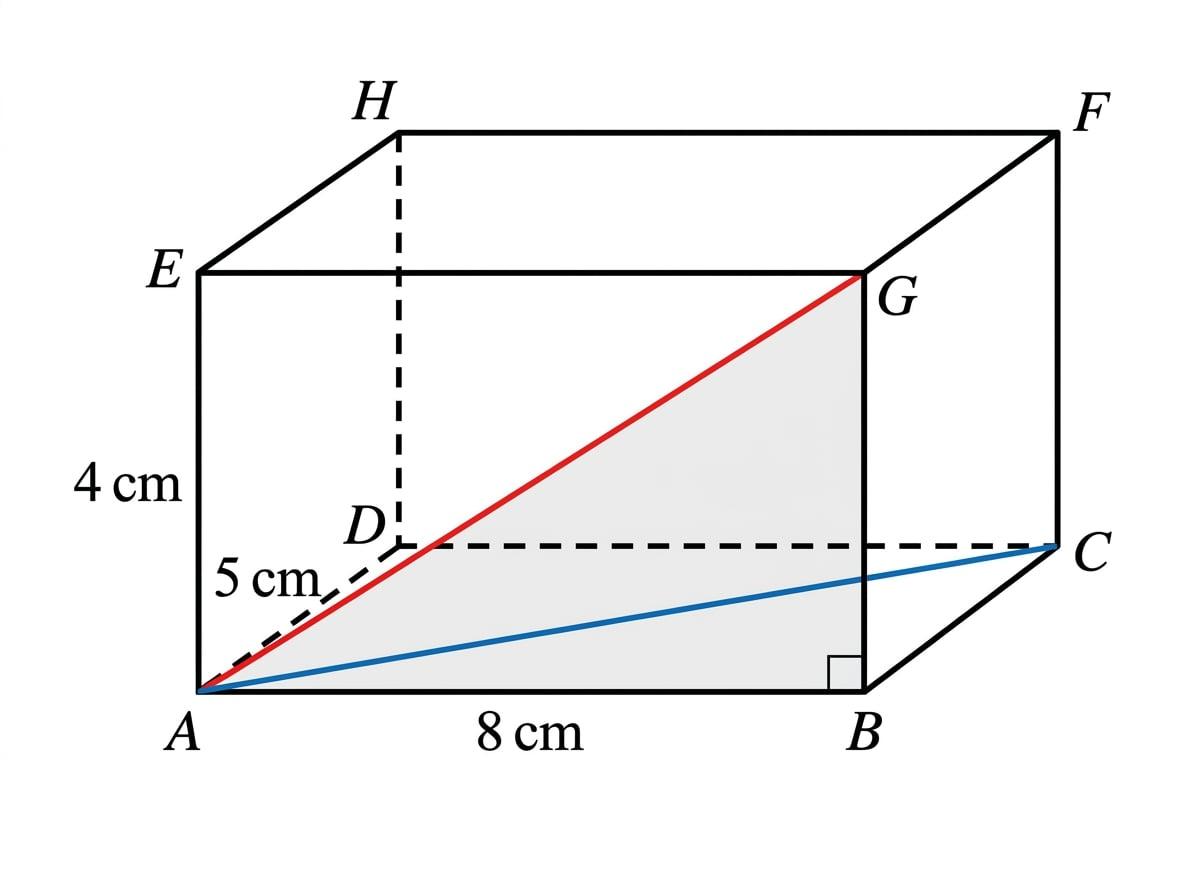
In a cuboid, a common trick is to find the diagonal across the base first, then use that diagonal with the height.
Definition
Space diagonal
A space diagonal joins two opposite corners of a 3D shape, passing through the inside of the solid rather than along a face.
Key Idea
Cuboid diagonal strategy
For a cuboid, find a face or base diagonal first. Then use that diagonal as one side of a second right-angled triangle.
Example
Finding the space diagonal of a cuboid
A cuboid has length 9 cm, depth 5 cm and height 6 cm. Find the space diagonal AGAGAG to 3 significant figures.
-
First find the base diagonal ACACAC.
AC2=92+52=106AC^2=9^2+5^2=106AC2=92+52=106 -
Now use ACACAC with the height 6 cm to find AGAGAG.
AG2=AC2+62=106+36=142AG^2=AC^2+6^2=106+36=142AG2=AC2+62=106+36=142 -
Take the square root.
AG=142=11.916…≈11.9 cmAG=\sqrt{142}=11.916\ldots\approx 11.9\text{ cm}AG=142=11.916…≈11.9 cm
Tip
Shortcut for cuboids
Once you understand why it works, you can use the shortcut d2=l2+w2+h2d^2=l^2+w^2+h^2d2=l2+w2+h2 for the space diagonal of a cuboid.
3. Finding a missing edge in a cuboid
Sometimes the space diagonal is given, and you need to work backwards to find a missing length. This is still Pythagoras, but you subtract the known squares.
Example
Finding a missing cuboid length
A cuboid has width 5 cm, height 6 cm and space diagonal 12 cm. Find the missing depth xxx to 3 significant figures.
-
Use the cuboid diagonal relationship.
122=52+x2+6212^2=5^2+x^2+6^2122=52+x2+62 -
Rearrange by subtracting the known squares.
x2=122−52−62=144−25−36=83x^2=12^2-5^2-6^2=144-25-36=83x2=122−52−62=144−25−36=83 -
Square root the result.
x=83=9.110…≈9.11 cmx=\sqrt{83}=9.110\ldots\approx 9.11\text{ cm}x=83=9.110…≈9.11 cm
Common Mistake
Adding before squaring
Do not do 12=5+x+612=5+x+612=5+x+6. Pythagoras works with squares of lengths, not the lengths added directly.
4. Angles inside a cuboid
To find an angle in a cuboid, you often need to find a diagonal first, then use trigonometry in a triangle that cuts through the cuboid.
Example
Finding an angle between a diagonal and the base
A cuboid has base dimensions 8 cm by 6 cm and height 4 cm. Find the angle between the sloping diagonal ECECEC and the base diagonal ACACAC.
-
Find the base diagonal ACACAC.
AC=82+62=10 cmAC=\sqrt{8^2+6^2}=10\text{ cm}AC=82+62=10 cm -
In triangle AECAECAEC, the height AE=4AE=4AE=4 is opposite the angle at C, and AC=10AC=10AC=10 is adjacent.
-
Use tangent because you know opposite and adjacent.
tanθ=410,θ=tan−1(410)=21.801…∘\tan\theta=\frac{4}{10},\qquad \theta=\tan^{-1}\left(\frac{4}{10}\right)=21.801\ldots^\circtanθ=104,θ=tan−1(104)=21.801…∘ -
The angle is 21.8° to 3 significant figures.
Common Mistake
Using the wrong adjacent side
If the angle is with a diagonal of the base, the adjacent side is the base diagonal, not just one edge of the base.
5. Triangular prisms: link two right triangles
A triangular prism has two matching triangular ends joined by rectangular faces. Many prism questions need two stages: find a hidden length in one triangle, then use it in another triangle.
Example
Finding an angle in a triangular prism
In a triangular prism, triangle ADCADCADC is right-angled at C. The lengths are AD=15AD=15AD=15 cm and CD=8CD=8CD=8 cm. In another right-angled triangle, ∠FDC=35∘\angle FDC=35^\circ∠FDC=35∘. Find ∠AFC\angle AFC∠AFC to 1 decimal place.
-
Find ACACAC from triangle ADCADCADC.
AC=152−82=161AC=\sqrt{15^2-8^2}=\sqrt{161}AC=152−82=161 -
Find FCFCFC from triangle FDCFDCFDC.
FC=8tan35∘=5.601…FC=8\tan35^\circ=5.601\ldotsFC=8tan35∘=5.601… -
In triangle AFCAFCAFC, the angle at F has opposite side ACACAC and adjacent side FCFCFC.
θ=tan−1(1615.601…)=66.19…∘\theta=\tan^{-1}\left(\frac{\sqrt{161}}{5.601\ldots}\right)=66.19\ldots^\circθ=tan−1(5.601…161)=66.19…∘ -
So ∠AFC=66.2∘\angle AFC=66.2^\circ∠AFC=66.2∘ to 1 decimal place.
6. The angle between a line and a plane
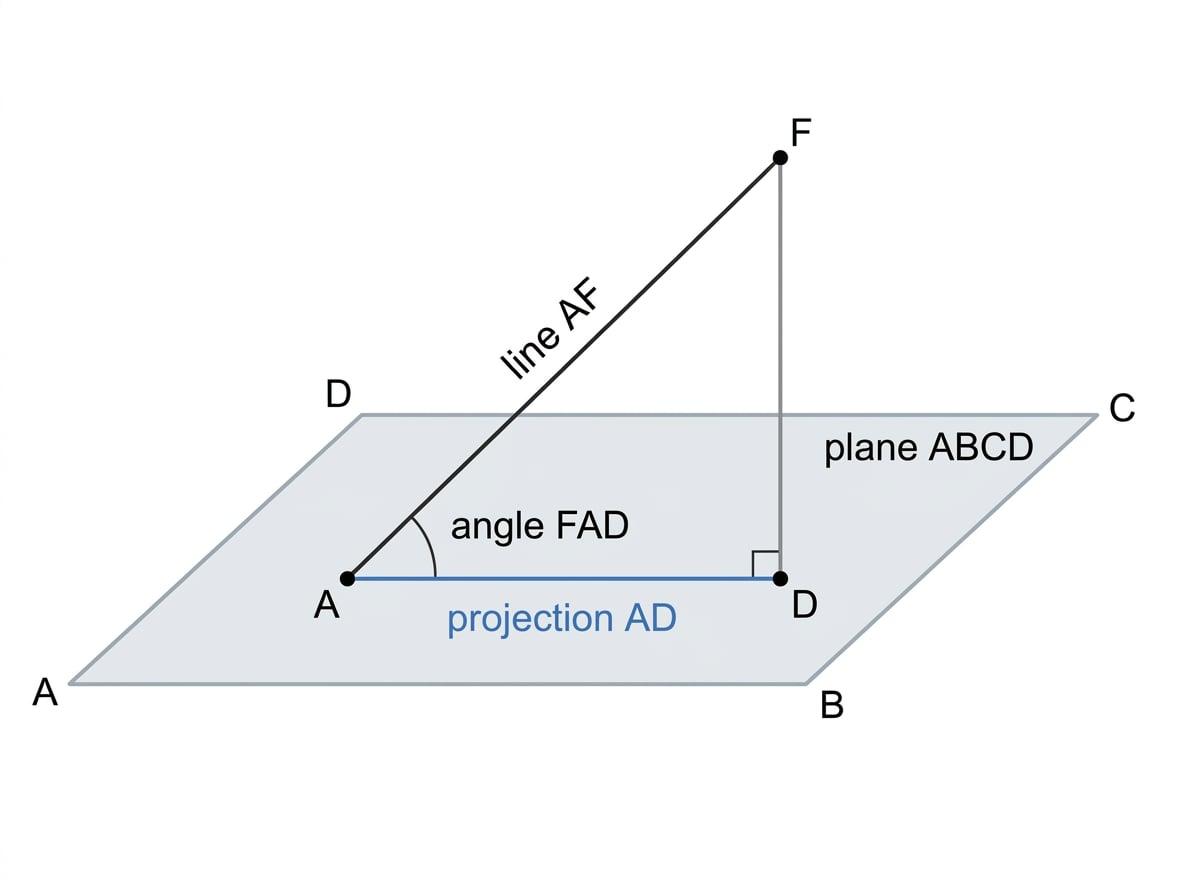
A plane is a flat surface, such as the base of a prism or pyramid. The angle between a line and a plane is not measured using a random edge on the plane. It is measured using the line’s projection.
Definition
Projection
The projection of a line onto a plane is like its shadow on the plane. To find it, drop a perpendicular from the raised point down to the plane.
Key Idea
Line-plane angle
The angle a line makes with a plane is the angle between the line and its projection on the plane.
Example
Finding the angle a line makes with a plane
In a prism, point F is vertically above C. The projection of AFAFAF onto the base plane is ACACAC. In the base, triangle ADCADCADC is right-angled at C, with AD=34AD=34AD=34 cm and CD=16CD=16CD=16 cm. Also, in triangle FCDFCDFCD, ∠FDC=35∘\angle FDC=35^\circ∠FDC=35∘. Find the angle between AFAFAF and the base plane.
-
The required angle is ∠FAC\angle FAC∠FAC, because ACACAC is the projection of AFAFAF on the plane.
-
Find the projection length ACACAC.
AC=342−162=30 cmAC=\sqrt{34^2-16^2}=30\text{ cm}AC=342−162=30 cm -
Find the vertical height FCFCFC.
FC=16tan35∘=11.203…FC=16\tan35^\circ=11.203\ldotsFC=16tan35∘=11.203… -
Use triangle AFCAFCAFC to find the angle.
θ=tan−1(11.203…30)=20.49…∘\theta=\tan^{-1}\left(\frac{11.203\ldots}{30}\right)=20.49\ldots^\circθ=tan−1(3011.203…)=20.49…∘ -
The angle is 20.5° to 3 significant figures.
7. Square-based pyramids
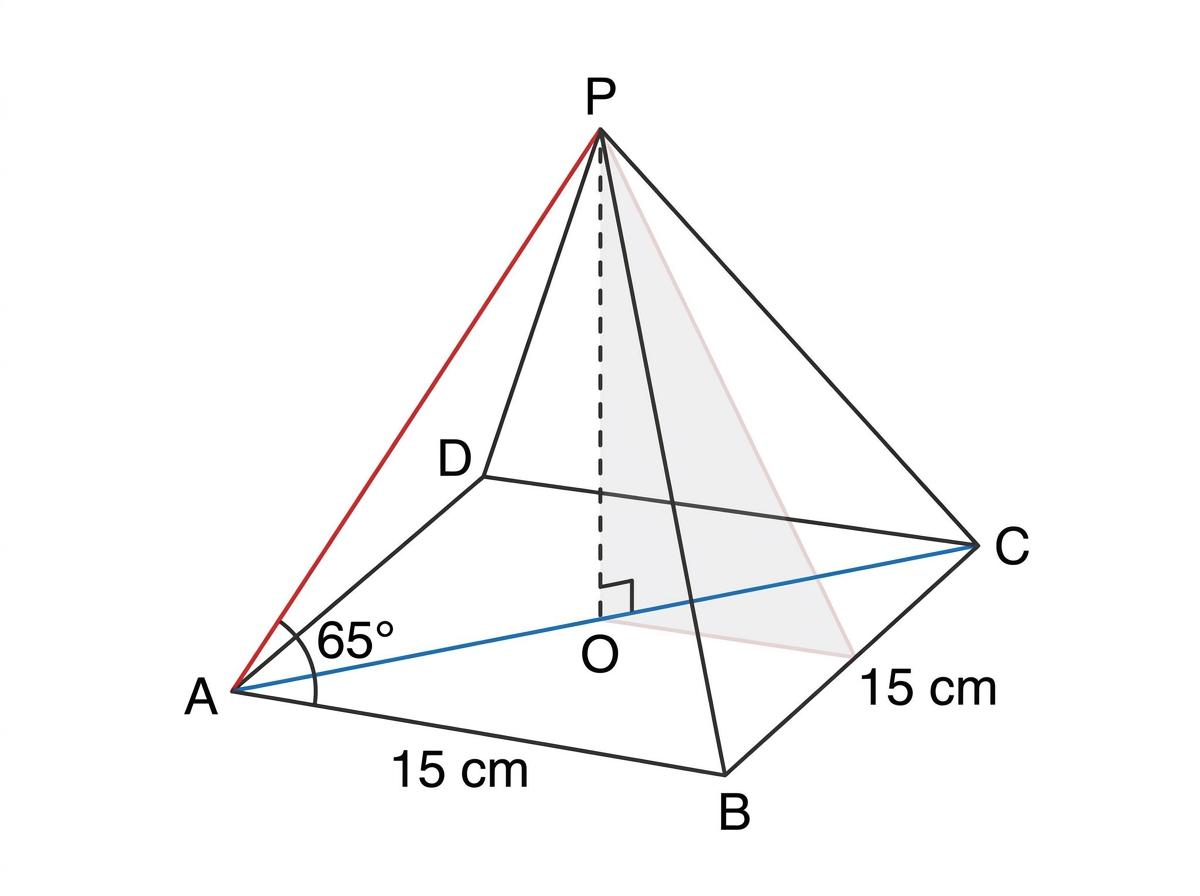
A square-based pyramid has a square base and one top point called the apex. If the pyramid is symmetrical, the vertical height meets the base at the centre of the square.
Common Mistake
Sloping height versus vertical height
The vertical height goes straight down from the apex to the base at 90°. A sloping edge, such as PAPAPA, is not the vertical height.
Example
Finding an angle in a square-based pyramid
A square-based pyramid has side length 8 cm. The apex E is 12 cm vertically above the centre O of the base. Find ∠EAC\angle EAC∠EAC.
-
Find the diagonal of the square base.
AC=82AC=8\sqrt{2}AC=82 -
Since O is the centre of the square, AOAOAO is half the diagonal.
AO=42AO=4\sqrt{2}AO=42 -
In right-angled triangle AOEAOEAOE, ∠EAC\angle EAC∠EAC is the same as ∠EAO\angle EAO∠EAO.
tanθ=1242\tan\theta=\frac{12}{4\sqrt{2}}tanθ=4212 -
Use inverse tangent.
θ=tan−1(1242)=64.760…∘\theta=\tan^{-1}\left(\frac{12}{4\sqrt{2}}\right)=64.760\ldots^\circθ=tan−1(4212)=64.760…∘ -
So ∠EAC=64.8∘\angle EAC=64.8^\circ∠EAC=64.8∘ to 3 significant figures.
Example
Finding the volume of a pyramid using trig
A square-based pyramid has base side length 15 cm. The apex P is vertically above the centre O, and ∠PAC=65∘\angle PAC=65^\circ∠PAC=65∘. Find the volume of the pyramid.
-
Find AOAOAO, half the diagonal of the square.
AO=1522=10.606…AO=\frac{15\sqrt{2}}{2}=10.606\ldotsAO=2152=10.606… -
Use tangent to find the vertical height POPOPO.
PO=10.606…tan65∘=22.744…PO=10.606\ldots\tan65^\circ=22.744\ldotsPO=10.606…tan65∘=22.744… -
Find the base area.
base area=152=225\text{base area}=15^2=225base area=152=225 -
Use the pyramid volume formula.
V=13×225×22.744…=1705.8…V=\frac{1}{3}\times225\times22.744\ldots=1705.8\ldotsV=31×225×22.744…=1705.8… -
The volume is about 1710 cm³ to 3 significant figures.
Exam technique
In the exam
-
Mark the right angle first, then identify the exact triangle you are using.
-
If a question asks for an angle with a plane, find the projection on the plane before using trig.
-
Keep extra decimal places in working, and round only your final answer to the required accuracy.
Self review
Check yourself
- In a cuboid, why is it often useful to find the base diagonal before the space diagonal?
- What does the projection of a line onto a plane mean?
- In a square-based pyramid, where does the vertical height meet the base?

Recap questions
Test yourself with 5 quick questions on this guide. Answer them all correctly to complete it.
You've reached the end
Test yourself on this topic, or move on to the next guide.
How was this guide?