Revision notes for CIE IGCSE Maths Expanding Triple Brackets. Open the guide for explanations and worked examples. Written against the CIE IGCSE Maths (0580) specification, so the content matches what's examinable rather than general Maths background.
Expanding Triple Brackets
What you'll learn
- How to expand brackets using the distributive law.
- How to turn three linear brackets into a cubic expression.
- How to deal with negatives, repeated brackets, and coefficients like 2x2x2x or 3x3x3x.
- How to prove a “show that” expansion is true for all values of xxx.
Key algebra words
Before triple brackets, make sure the basic language is secure.
Definition
Useful vocabulary
- A term is a separate part of an expression, such as 3x23x^23x2, −5x-5x−5x, or 7.
- A coefficient is the number multiplying a variable. In 4x4x4x, the coefficient is 4.
- Like terms have the same variable part, such as 3x23x^23x2 and −8x2-8x^2−8x2.
- To simplify means to collect like terms and write the expression as neatly as possible.
Prerequisite 1: expanding one bracket
To expand a bracket means to multiply everything inside the bracket by what is outside it.
Definition
Expanding
Expanding removes brackets by multiplying each term inside the bracket by the factor outside or beside it.
For example, in 3(x+5)3(x+5)3(x+5), the 3 multiplies both xxx and 5.
Example
Expanding a single bracket
Expand and simplify 4(x−3)+2x4(x-3)+2x4(x−3)+2x.
-
Multiply 4 by each term inside the bracket:
4(x−3)=4x−124(x-3)=4x-124(x−3)=4x−12 -
Put the rest of the expression back in:
4(x−3)+2x=4x−12+2x4(x-3)+2x=4x-12+2x4(x−3)+2x=4x−12+2x -
Collect the like xxx terms:
4x+2x−12=6x−124x+2x-12=6x-124x+2x−12=6x−12
Prerequisite 2: expanding two brackets
A pair of brackets such as (x+3)(x−2)(x+3)(x-2)(x+3)(x−2) means every term in the first bracket must multiply every term in the second bracket.
Key Idea
Every term multiplies every term
When expanding brackets, do not just multiply the first terms. Each term in one bracket must be paired with each term in the other bracket.
Example
Expanding two brackets
Expand and simplify (x+4)(x−3)(x+4)(x-3)(x+4)(x−3).
-
Multiply the first xxx by both terms in the second bracket:
x(x−3)=x2−3xx(x-3)=x^2-3xx(x−3)=x2−3x -
Multiply the 4 by both terms in the second bracket:
4(x−3)=4x−124(x-3)=4x-124(x−3)=4x−12 -
Combine the results:
(x+4)(x−3)=x2−3x+4x−12(x+4)(x-3)=x^2-3x+4x-12(x+4)(x−3)=x2−3x+4x−12 -
Collect like terms:
x2−3x+4x−12=x2+x−12x^2-3x+4x-12=x^2+x-12x2−3x+4x−12=x2+x−12
Common Mistake
Only multiplying the outside terms
For (x+4)(x−3)(x+4)(x-3)(x+4)(x−3), writing x2−12x^2-12x2−12 is not enough. The middle terms −3x-3x−3x and 4x4x4x also appear, then combine to make xxx.
What happens with triple brackets?
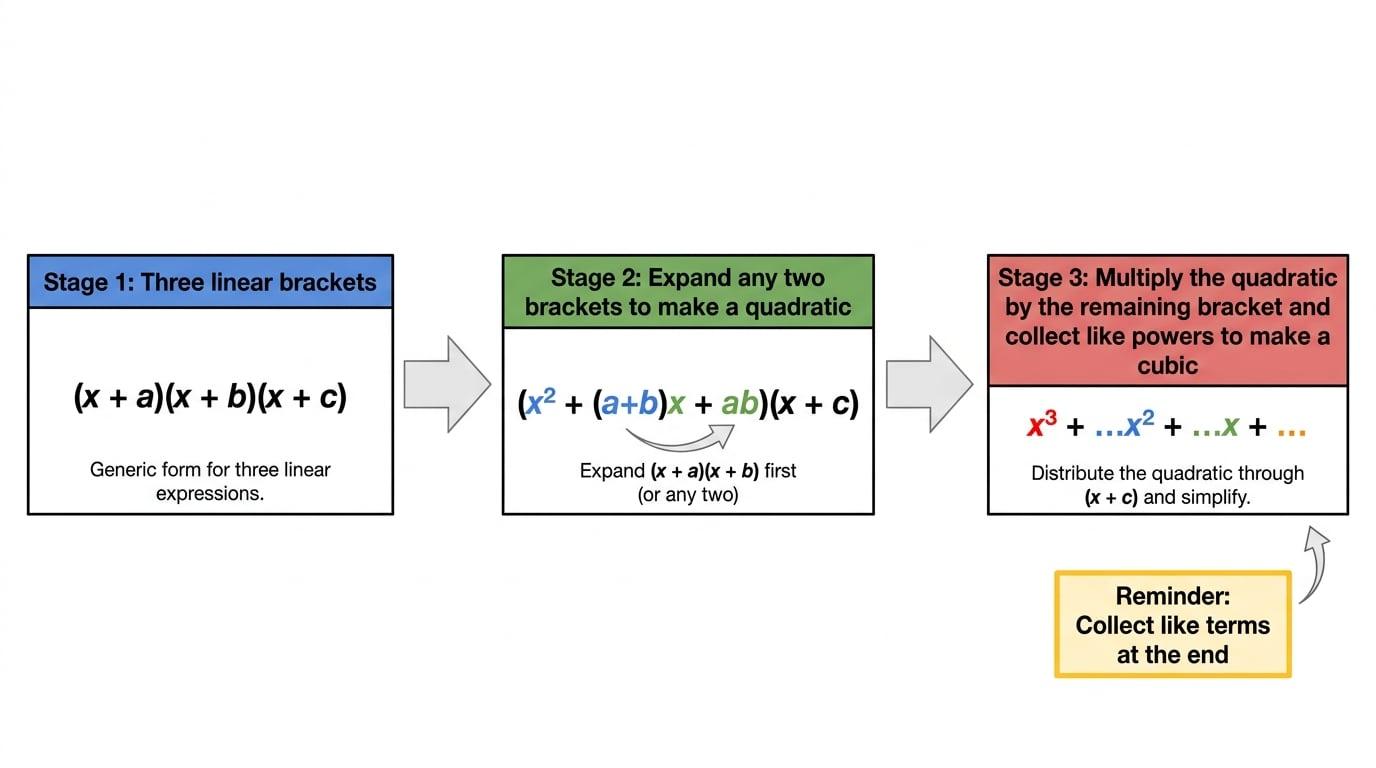
A triple bracket has three brackets multiplied together, for example (x+2)(x+5)(x−1)(x+2)(x+5)(x-1)(x+2)(x+5)(x−1).
Each bracket is usually linear, meaning the highest power of xxx inside it is x1x^1x1. When you multiply three linear brackets, the answer is usually a cubic expression, meaning the highest power is x3x^3x3.
Key Idea
The main method
Expand two brackets first to make a quadratic, then multiply that quadratic by the remaining bracket, then collect like terms.
You can choose any pair of brackets to expand first. The final answer will be the same, but some choices make the arithmetic easier.
Triple brackets where each bracket starts with xxx
Start with the most straightforward type: each bracket looks like xxx plus or minus a number.
Example
Expanding three simple brackets
Expand and simplify (x+3)(x+4)(x+2)(x+3)(x+4)(x+2)(x+3)(x+4)(x+2).
-
Choose two brackets to expand first. Here, expand the first two:
(x+3)(x+4)=x2+4x+3x+12(x+3)(x+4)=x^2+4x+3x+12(x+3)(x+4)=x2+4x+3x+12 -
Collect like terms in the quadratic:
x2+4x+3x+12=x2+7x+12x^2+4x+3x+12=x^2+7x+12x2+4x+3x+12=x2+7x+12 -
Now multiply this quadratic by the remaining bracket:
(x2+7x+12)(x+2)(x^2+7x+12)(x+2)(x2+7x+12)(x+2) -
Multiply each term in the quadratic by xxx:
x(x2+7x+12)=x3+7x2+12xx(x^2+7x+12)=x^3+7x^2+12xx(x2+7x+12)=x3+7x2+12x -
Multiply each term in the quadratic by 2:
2(x2+7x+12)=2x2+14x+242(x^2+7x+12)=2x^2+14x+242(x2+7x+12)=2x2+14x+24 -
Add the two rows and collect like terms:
x3+7x2+12x+2x2+14x+24=x3+9x2+26x+24x^3+7x^2+12x+2x^2+14x+24=x^3+9x^2+26x+24x3+7x2+12x+2x2+14x+24=x3+9x2+26x+24
So:
(x+3)(x+4)(x+2)=x3+9x2+26x+24(x+3)(x+4)(x+2)=x^3+9x^2+26x+24(x+3)(x+4)(x+2)=x3+9x2+26x+24Tip
Check the shape of your answer
For three brackets each containing an xxx term, expect an answer with powers going down: x3x^3x3, then x2x^2x2, then xxx, then a constant.
Handling negative signs carefully
Negative signs are the main source of errors in this topic. Treat subtraction as adding a negative number.
For example, x−5x-5x−5 means x+(−5)x+(-5)x+(−5).
Example
Expanding with mixed signs
Expand and simplify (x−4)(x+6)(x−1)(x-4)(x+6)(x-1)(x−4)(x+6)(x−1).
-
Expand the first two brackets:
(x−4)(x+6)=x2+6x−4x−24(x-4)(x+6)=x^2+6x-4x-24(x−4)(x+6)=x2+6x−4x−24 -
Collect the middle terms:
x2+6x−4x−24=x2+2x−24x^2+6x-4x-24=x^2+2x-24x2+6x−4x−24=x2+2x−24 -
Multiply the quadratic by the remaining bracket:
(x2+2x−24)(x−1)(x^2+2x-24)(x-1)(x2+2x−24)(x−1) -
Multiply the quadratic by xxx:
x(x2+2x−24)=x3+2x2−24xx(x^2+2x-24)=x^3+2x^2-24xx(x2+2x−24)=x3+2x2−24x -
Multiply the quadratic by −1-1−1:
−1(x2+2x−24)=−x2−2x+24-1(x^2+2x-24)=-x^2-2x+24−1(x2+2x−24)=−x2−2x+24 -
Add and collect like terms:
x3+2x2−24x−x2−2x+24=x3+x2−26x+24x^3+2x^2-24x-x^2-2x+24=x^3+x^2-26x+24x3+2x2−24x−x2−2x+24=x3+x2−26x+24
Common Mistake
Dropping the negative multiplier
In (x2+2x−24)(x−1)(x^2+2x-24)(x-1)(x2+2x−24)(x−1), the second part is multiplying by −1-1−1, not by 1. This changes every sign in the quadratic.
Repeated brackets, such as (x−2)2(x-2)^2(x−2)2
A squared bracket means the bracket is multiplied by itself.
So (x−2)2(x-2)^2(x−2)2 means (x−2)(x−2)(x-2)(x-2)(x−2)(x−2).
Example
Expanding a repeated bracket
Expand and simplify (x+5)(x−2)2(x+5)(x-2)^2(x+5)(x−2)2.
-
Rewrite the squared bracket as two identical brackets:
(x+5)(x−2)2=(x+5)(x−2)(x−2)(x+5)(x-2)^2=(x+5)(x-2)(x-2)(x+5)(x−2)2=(x+5)(x−2)(x−2) -
Expand the repeated pair first:
(x−2)(x−2)=x2−2x−2x+4(x-2)(x-2)=x^2-2x-2x+4(x−2)(x−2)=x2−2x−2x+4 -
Simplify the quadratic:
x2−2x−2x+4=x2−4x+4x^2-2x-2x+4=x^2-4x+4x2−2x−2x+4=x2−4x+4 -
Multiply by the remaining bracket:
(x+5)(x2−4x+4)(x+5)(x^2-4x+4)(x+5)(x2−4x+4) -
Multiply the quadratic by xxx and by 5:
x(x2−4x+4)=x3−4x2+4xx(x^2-4x+4)=x^3-4x^2+4xx(x2−4x+4)=x3−4x2+4x 5(x2−4x+4)=5x2−20x+205(x^2-4x+4)=5x^2-20x+205(x2−4x+4)=5x2−20x+20 -
Add and collect like terms:
x3−4x2+4x+5x2−20x+20=x3+x2−16x+20x^3-4x^2+4x+5x^2-20x+20=x^3+x^2-16x+20x3−4x2+4x+5x2−20x+20=x3+x2−16x+20
Common Mistake
Do not square term by term
(x−2)2(x-2)^2(x−2)2 is not x2+4x^2+4x2+4. You must write it as (x−2)(x−2)(x-2)(x-2)(x−2)(x−2) and expand properly.
Triple brackets with coefficients
Some brackets contain terms like 2x2x2x, 3x3x3x, or 5x5x5x. The method is exactly the same, but the leading coefficient of the final x3x^3x3 term may not be 1.
Example
Expanding with coefficients
Expand and simplify (2x+3)(x−1)(3x+2)(2x+3)(x-1)(3x+2)(2x+3)(x−1)(3x+2).
-
Expand the first two brackets:
(2x+3)(x−1)=2x2−2x+3x−3(2x+3)(x-1)=2x^2-2x+3x-3(2x+3)(x−1)=2x2−2x+3x−3 -
Simplify the quadratic:
2x2−2x+3x−3=2x2+x−32x^2-2x+3x-3=2x^2+x-32x2−2x+3x−3=2x2+x−3 -
Multiply by the remaining bracket:
(2x2+x−3)(3x+2)(2x^2+x-3)(3x+2)(2x2+x−3)(3x+2) -
Multiply the quadratic by 3x3x3x:
3x(2x2+x−3)=6x3+3x2−9x3x(2x^2+x-3)=6x^3+3x^2-9x3x(2x2+x−3)=6x3+3x2−9x -
Multiply the quadratic by 2:
2(2x2+x−3)=4x2+2x−62(2x^2+x-3)=4x^2+2x-62(2x2+x−3)=4x2+2x−6 -
Add and collect like terms:
6x3+3x2−9x+4x2+2x−6=6x3+7x2−7x−66x^3+3x^2-9x+4x^2+2x-6=6x^3+7x^2-7x-66x3+3x2−9x+4x2+2x−6=6x3+7x2−7x−6
Tip
Leading term shortcut
To check the first term, multiply the xxx parts from all three brackets. For (2x+3)(x−1)(3x+2)(2x+3)(x-1)(3x+2)(2x+3)(x−1)(3x+2), the leading term is 2x⋅x⋅3x=6x32x \cdot x \cdot 3x=6x^32x⋅x⋅3x=6x3.
“Show that” questions
Sometimes you are asked to show that a triple bracket equals a given cubic expression for all values of xxx.
Definition
Identity
An identity is an equation that is true for every allowed value of the variable. Expanding one side until it matches the other side proves the identity.
In these questions, do not substitute one value of xxx. That only checks one case. Instead, expand the left-hand side and simplify it until it matches the right-hand side.
Example
Proving a given expansion
Show that (2x+1)(4x−3)(x−2)=8x3−18x2+x+6(2x+1)(4x-3)(x-2)=8x^3-18x^2+x+6(2x+1)(4x−3)(x−2)=8x3−18x2+x+6 for all values of xxx.
-
Expand the first two brackets on the left-hand side:
(2x+1)(4x−3)=8x2−6x+4x−3(2x+1)(4x-3)=8x^2-6x+4x-3(2x+1)(4x−3)=8x2−6x+4x−3 -
Simplify:
8x2−6x+4x−3=8x2−2x−38x^2-6x+4x-3=8x^2-2x-38x2−6x+4x−3=8x2−2x−3 -
Multiply by the remaining bracket:
(8x2−2x−3)(x−2)(8x^2-2x-3)(x-2)(8x2−2x−3)(x−2) -
Multiply the quadratic by xxx:
x(8x2−2x−3)=8x3−2x2−3xx(8x^2-2x-3)=8x^3-2x^2-3xx(8x2−2x−3)=8x3−2x2−3x -
Multiply the quadratic by −2-2−2:
−2(8x2−2x−3)=−16x2+4x+6-2(8x^2-2x-3)=-16x^2+4x+6−2(8x2−2x−3)=−16x2+4x+6 -
Add and collect like terms:
8x3−2x2−3x−16x2+4x+6=8x3−18x2+x+68x^3-2x^2-3x-16x^2+4x+6=8x^3-18x^2+x+68x3−2x2−3x−16x2+4x+6=8x3−18x2+x+6 -
The simplified left-hand side matches the right-hand side:
(2x+1)(4x−3)(x−2)=8x3−18x2+x+6(2x+1)(4x-3)(x-2)=8x^3-18x^2+x+6(2x+1)(4x−3)(x−2)=8x3−18x2+x+6
A reliable layout for your working
For full marks, make your method easy to follow. A neat layout is:
- Expand two brackets.
- Simplify the quadratic.
- Multiply by the third bracket.
- Collect like terms.
- Write the final expression in descending powers: x3x^3x3, x2x^2x2, xxx, constant.
Exam technique
In the exam
-
Choose the easiest pair of brackets first, often a pair with small numbers or a repeated bracket.
-
Keep negative signs attached to their terms, especially when multiplying by something like −3-3−3 or −2x-2x−2x.
-
Check your final answer has been fully simplified and written in descending powers.
Self review
Check yourself
- Can you expand (x+2)(x−3)(x+2)(x-3)(x+2)(x−3) without missing the two middle terms?
- If you see (x−4)2(x-4)^2(x−4)2, do you automatically rewrite it as (x−4)(x−4)(x-4)(x-4)(x−4)(x−4)?
- In a “show that” question, can you explain why expanding proves the result for all values of xxx?

Recap questions
Test yourself with 5 quick questions on this guide. Answer them all correctly to complete it.
You've reached the end
Test yourself on this topic, or move on to the next guide.
How was this guide?