Revision notes for CIE IGCSE Maths Simultaneous Equations. Open the guide for explanations and worked examples. Written against the CIE IGCSE Maths (0580) specification, so the content matches what's examinable rather than general Maths background.
Simultaneous Equations
What you'll learn
- What simultaneous equations are and what a solution means.
- How to solve linear simultaneous equations by elimination.
- How to handle rearranged equations and decimals.
- How to turn short word problems into equations.
The basic idea
A linear equation is an equation where the variables only have power 1, such as 4x+3y=184x+3y=184x+3y=18. Its graph is a straight line.
Definition
Simultaneous equations
Simultaneous equations are two or more equations that are true at the same time. For IGCSE Grade 5, you usually solve two linear equations with two variables, often xxx and yyy.
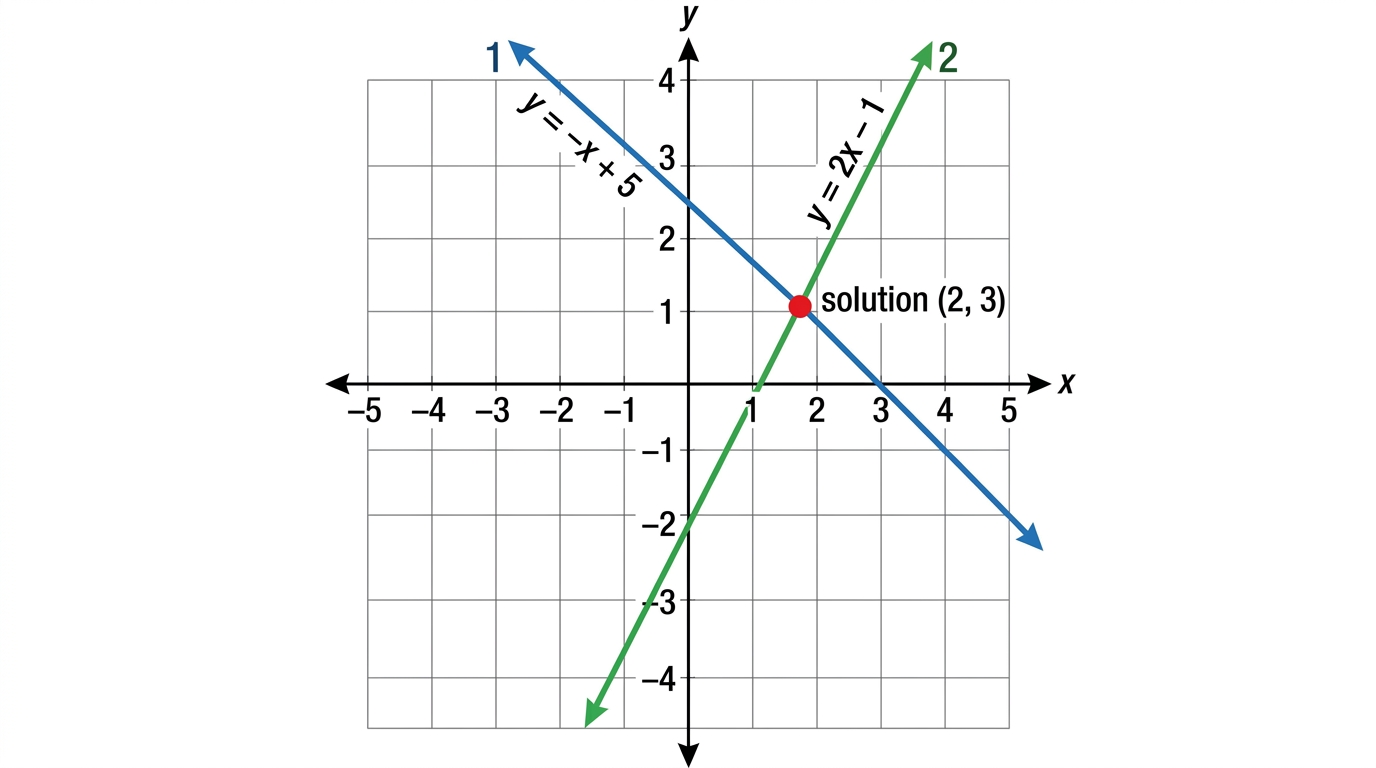
A solution is the pair of values that makes both equations true. For example, x=2x=2x=2 and y=3y=3y=3 is written as the solution pair (2,3)(2,3)(2,3).
Graphically, each linear equation is a straight line. The simultaneous solution is where the two lines cross.
Key Idea
The big picture
Solving simultaneous equations means finding the one value of xxx and the one value of yyy that work in both equations.
Example
Checking whether a pair is a solution
Check whether x=4x=4x=4 and y=1y=1y=1 solves the equations 2x+3y=112x+3y=112x+3y=11 and 5x−y=195x-y=195x−y=19.
-
Substitute x=4x=4x=4 and y=1y=1y=1 into the first equation.
2(4)+3(1)=8+3=112(4)+3(1)=8+3=112(4)+3(1)=8+3=11 -
The first equation works because the left side equals 11.
-
Substitute x=4x=4x=4 and y=1y=1y=1 into the second equation.
5(4)−1=20−1=195(4)-1=20-1=195(4)−1=20−1=19 -
The second equation also works, so x=4x=4x=4 and y=1y=1y=1 is the solution.
The elimination method
The main Grade 5 method is elimination.
Definition
Eliminate
To eliminate a variable means to remove it from the equations by adding or subtracting the equations.
You try to make either the xxx terms or the yyy terms cancel out. Then you solve for the remaining variable.
When the signs are opposite: add
If one equation has +3y+3y+3y and the other has −3y-3y−3y, adding the equations cancels the yyy terms.
Example
Eliminating by adding
Solve the simultaneous equations 4x+3y=264x+3y=264x+3y=26 and x−3y=−1x-3y=-1x−3y=−1.
-
Write the equations clearly and label them.
4x+3y=26(1)x−3y=−1(2)\begin{aligned} 4x+3y&=26 \quad \text{(1)}\\ x-3y&=-1 \quad \text{(2)} \end{aligned}4x+3yx−3y=26(1)=−1(2) -
The yyy terms are opposites, +3y+3y+3y and −3y-3y−3y, so add the two equations.
4x+x=5x3y−3y=026+(−1)=25\begin{aligned} 4x+x&=5x\\ 3y-3y&=0\\ 26+(-1)&=25 \end{aligned}4x+x3y−3y26+(−1)=5x=0=25 -
Solve the new equation.
5x=255x=255x=25 -
Divide by 5.
x=5x=5x=5 -
Substitute x=5x=5x=5 into equation (2).
5−3y=−15-3y=-15−3y=−1 -
Solve for yyy.
−3y=−6y=2\begin{aligned} -3y&=-6\\ y&=2 \end{aligned}−3yy=−6=2 -
Give both values.
x=5,y=2x=5,\quad y=2x=5,y=2
Tip
Add or subtract?
If the matching terms have opposite signs, add the equations. If they have the same sign, subtract the equations.
When the signs are the same: subtract
If both equations have the same xxx coefficient, such as 2x2x2x and 2x2x2x, subtracting can eliminate xxx.
Example
Eliminating by subtracting
Solve the simultaneous equations 2x+5y=282x+5y=282x+5y=28 and 2x−y=42x-y=42x−y=4.
-
Label the equations.
2x+5y=28(1)2x−y=4(2)\begin{aligned} 2x+5y&=28 \quad \text{(1)}\\ 2x-y&=4 \quad \text{(2)} \end{aligned}2x+5y2x−y=28(1)=4(2) -
The xxx terms are the same, so subtract equation (2) from equation (1).
(2x+5y)−(2x−y)=28−46y=24\begin{aligned} (2x+5y)-(2x-y)&=28-4\\ 6y&=24 \end{aligned}(2x+5y)−(2x−y)6y=28−4=24 -
Solve for yyy.
y=4y=4y=4 -
Substitute y=4y=4y=4 into equation (2).
2x−4=42x-4=42x−4=4 -
Solve for xxx.
2x=8x=4\begin{aligned} 2x&=8\\ x&=4 \end{aligned}2xx=8=4 -
State the solution.
x=4,y=4x=4,\quad y=4x=4,y=4
Common Mistake
Subtracting negatives incorrectly
Be careful with signs. In the example above, subtracting −y-y−y means 5y−(−y)=6y5y-(-y)=6y5y−(−y)=6y, not 4y4y4y.
Making a coefficient match
Sometimes neither variable cancels straight away. A coefficient is the number multiplying a variable, such as the 4 in 4x4x4x.
To eliminate a variable, you can multiply one whole equation so that a coefficient matches.
Example
Multiplying first, then eliminating
Solve 2x−3y=42x-3y=42x−3y=4 and 4x−y=184x-y=184x−y=18.
-
Label the equations.
2x−3y=4(1)4x−y=18(2)\begin{aligned} 2x-3y&=4 \quad \text{(1)}\\ 4x-y&=18 \quad \text{(2)} \end{aligned}2x−3y4x−y=4(1)=18(2) -
The first equation has 2x2x2x and the second has 4x4x4x. Multiply equation (1) by 2 so the xxx coefficients match.
4x−6y=8(3)4x-6y=8 \quad \text{(3)}4x−6y=8(3) -
Now subtract equation (2) from equation (3).
(4x−6y)−(4x−y)=8−18−5y=−10\begin{aligned} (4x-6y)-(4x-y)&=8-18\\ -5y&=-10 \end{aligned}(4x−6y)−(4x−y)−5y=8−18=−10 -
Solve for yyy.
y=2y=2y=2 -
Substitute y=2y=2y=2 into equation (2).
4x−2=184x-2=184x−2=18 -
Solve for xxx.
4x=20x=5\begin{aligned} 4x&=20\\ x&=5 \end{aligned}4xx=20=5 -
Write the final answer.
x=5,y=2x=5,\quad y=2x=5,y=2
Common Mistake
Only multiplying part of an equation
If you multiply an equation by 2, multiply every term on both sides. For example, 2x−3y=42x-3y=42x−3y=4 becomes 4x−6y=84x-6y=84x−6y=8.
Rearranged equations
Not every question starts in the neat form ax+by=cax+by=cax+by=c. You may first need to rearrange.
Definition
Standard form
For this topic, standard form means writing a linear equation like ax+by=cax+by=cax+by=c, with the xxx and yyy terms on the left and the number on the right.
Example
Rearranging before solving
Solve 3x=10+y3x=10+y3x=10+y and x+4y=12x+4y=12x+4y=12.
-
Rearrange the first equation by subtracting yyy from both sides.
3x−y=103x-y=103x−y=10 -
Label the two equations.
3x−y=10(1)x+4y=12(2)\begin{aligned} 3x-y&=10 \quad \text{(1)}\\ x+4y&=12 \quad \text{(2)} \end{aligned}3x−yx+4y=10(1)=12(2) -
Multiply equation (2) by 3 so the xxx coefficients match.
3x+12y=36(3)3x+12y=36 \quad \text{(3)}3x+12y=36(3) -
Subtract equation (1) from equation (3).
(3x+12y)−(3x−y)=36−1013y=26\begin{aligned} (3x+12y)-(3x-y)&=36-10\\ 13y&=26 \end{aligned}(3x+12y)−(3x−y)13y=36−10=26 -
Solve for yyy.
y=2y=2y=2 -
Substitute y=2y=2y=2 into equation (2).
x+8=12x+8=12x+8=12 -
Solve for xxx.
x=4x=4x=4 -
State the solution.
x=4,y=2x=4,\quad y=2x=4,y=2
Decimals in simultaneous equations
Decimals do not change the method. You can either work with decimals carefully or multiply everything by 10 to clear one decimal place.
Tip
Clearing decimals
If an equation contains 4.5, multiplying the whole equation by 10 changes it to 45. This can make elimination easier.
Example
Solving with decimals
Solve 6x+5y=6.56x+5y=6.56x+5y=6.5 and 3x−2y=5.53x-2y=5.53x−2y=5.5.
-
Label the equations.
6x+5y=6.5(1)3x−2y=5.5(2)\begin{aligned} 6x+5y&=6.5 \quad \text{(1)}\\ 3x-2y&=5.5 \quad \text{(2)} \end{aligned}6x+5y3x−2y=6.5(1)=5.5(2) -
Multiply equation (2) by 2 so the xxx coefficients match.
6x−4y=11(3)6x-4y=11 \quad \text{(3)}6x−4y=11(3) -
Subtract equation (3) from equation (1).
(6x+5y)−(6x−4y)=6.5−119y=−4.5\begin{aligned} (6x+5y)-(6x-4y)&=6.5-11\\ 9y&=-4.5 \end{aligned}(6x+5y)−(6x−4y)9y=6.5−11=−4.5 -
Solve for yyy.
y=−0.5y=-0.5y=−0.5 -
Substitute y=−0.5y=-0.5y=−0.5 into equation (2).
3x−2(−0.5)=5.53x-2(-0.5)=5.53x−2(−0.5)=5.5 -
Solve for xxx.
3x+1=5.53x=4.5x=1.5\begin{aligned} 3x+1&=5.5\\ 3x&=4.5\\ x&=1.5 \end{aligned}3x+13xx=5.5=4.5=1.5 -
Give the answer.
x=1.5,y=−0.5x=1.5,\quad y=-0.5x=1.5,y=−0.5
Word problems
In word problems, you choose variables first. Then translate the information into equations.
Definition
Variable
A variable is a letter that represents an unknown value. For example, ccc could represent the price of one coffee in pence.
Example
Prices in a shop
A café sells drinks and biscuits. Two drinks and five biscuits cost £8.90. One drink and three biscuits cost £4.95. Find the price of one drink and one biscuit.
-
Let ddd be the price of one drink in pence, and let bbb be the price of one biscuit in pence.
-
Write an equation for each sentence.
2d+5b=890(1)d+3b=495(2)\begin{aligned} 2d+5b&=890 \quad \text{(1)}\\ d+3b&=495 \quad \text{(2)} \end{aligned}2d+5bd+3b=890(1)=495(2) -
Multiply equation (2) by 2 so the ddd coefficients match.
2d+6b=990(3)2d+6b=990 \quad \text{(3)}2d+6b=990(3) -
Subtract equation (1) from equation (3).
(2d+6b)−(2d+5b)=990−890b=100\begin{aligned} (2d+6b)-(2d+5b)&=990-890\\ b&=100 \end{aligned}(2d+6b)−(2d+5b)b=990−890=100 -
Substitute b=100b=100b=100 into equation (2).
d+3(100)=495d+3(100)=495d+3(100)=495 -
Solve for ddd.
d+300=495d=195\begin{aligned} d+300&=495\\ d&=195 \end{aligned}d+300d=495=195 -
Convert from pence to pounds.
d=195,b=100d=195,\quad b=100d=195,b=100 -
The drink costs £1.95 and the biscuit costs £1.00.
Common Mistake
Remember the units
If you use pence in your equations, your final numbers are in pence. Convert back to pounds if the question asks for prices.
Exam technique
In the exam
-
Line up the equations neatly and decide which variable you want to eliminate.
-
If the coefficients do not match, multiply a whole equation first.
-
After finding one variable, substitute it back into one original equation and give both values clearly.
Self review
Check yourself
-
Can you explain when to add equations and when to subtract them?
-
If 3x=7+y3x=7+y3x=7+y, can you rearrange it into standard form?
-
In a word problem, what should you define before writing the equations?

Recap questions
Test yourself with 5 quick questions on this guide. Answer them all correctly to complete it.
You've reached the end
Test yourself on this topic, or move on to the next guide.
How was this guide?