Revision notes for CIE IGCSE Maths Expanding and Factorising Quadratics. Open the guide for explanations and worked examples. Written against the CIE IGCSE Maths (0580) specification, so the content matches what's examinable rather than general Maths background.
Expanding and Factorising Quadratics
What you'll learn
- How to expand two brackets and simplify the answer.
- How signs affect quadratic expressions.
- How to factorise quadratics of the form x2+bx+cx^2 + bx + cx2+bx+c.
- How to spot special cases like squares and difference of two squares.
The key language
Before we start, make sure these words feel familiar.
Definition
Term, coefficient, and quadratic
- A term is one part of an expression, such as x2x^2x2, 5x5x5x, or −12-12−12.
- A coefficient is the number multiplying a variable. In 7x7x7x, the coefficient is 7.
- A quadratic expression has a highest power of 2, such as x2+6x+8x^2 + 6x + 8x2+6x+8.
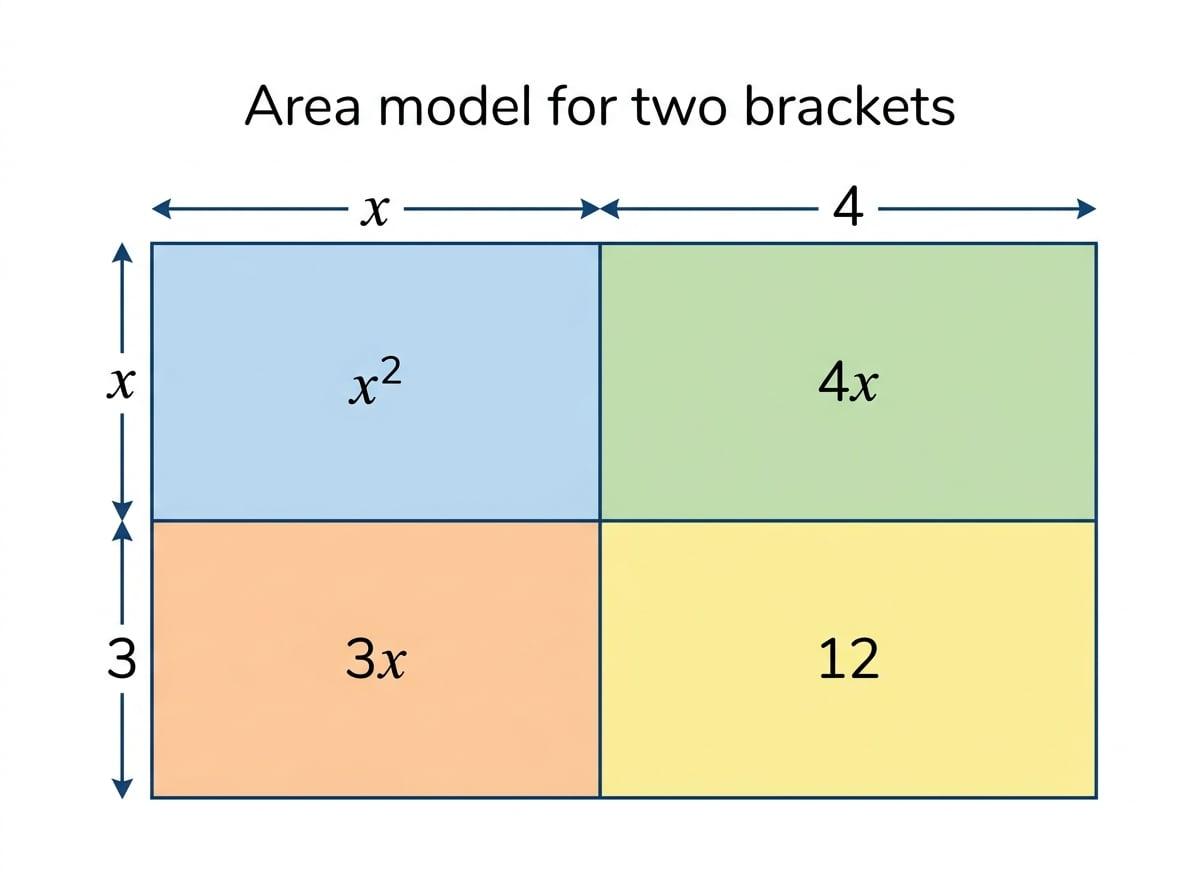
Quadratics often appear when you multiply two brackets together. For example, multiplying (x+4)(x+3)(x + 4)(x + 3)(x+4)(x+3) creates an x2x^2x2 term, so the answer is quadratic.
Prerequisite: multiplying algebra terms
When expanding brackets, you need to multiply numbers, variables, and signs accurately.
Useful rules:
- x⋅x=x2x \cdot x = x^2x⋅x=x2
- positive times positive gives positive
- negative times negative gives positive
- positive times negative gives negative
Example
Multiplying algebra terms
Simplify −3x⋅5x-3x \cdot 5x−3x⋅5x.
-
Multiply the numbers first:
−3⋅5=−15-3 \cdot 5 = -15−3⋅5=−15
-
Multiply the variables:
x⋅x=x2x \cdot x = x^2x⋅x=x2
-
Put the parts together:
−3x⋅5x=−15x2-3x \cdot 5x = -15x^2−3x⋅5x=−15x2
Common Mistake
Forgetting
A very common error is writing x⋅x=2xx \cdot x = 2xx⋅x=2x. That is not correct. Multiplying xxx by xxx gives x2x^2x2.
Expanding two brackets
Definition
Expand
To expand means to remove brackets by multiplying out. For two brackets, every term in the first bracket must multiply every term in the second bracket.
The safest method is the grid method or the “four products” method. Both do the same thing: they make sure nothing is missed.
This area model shows why four products appear when you expand two brackets.
Key Idea
Every term multiplies every term
For (x+a)(x+b)(x + a)(x + b)(x+a)(x+b), you get four products first, then you collect like terms.
Example: expanding simple brackets
Example
Expand and simplify
-
Multiply the first terms:
x⋅x=x2x \cdot x = x^2x⋅x=x2
-
Multiply the outside terms:
x⋅(−2)=−2xx \cdot (-2) = -2xx⋅(−2)=−2x
-
Multiply the inside terms:
5⋅x=5x5 \cdot x = 5x5⋅x=5x
-
Multiply the last terms:
5⋅(−2)=−105 \cdot (-2) = -105⋅(−2)=−10
-
Write all four terms:
x2−2x+5x−10x^2 - 2x + 5x - 10x2−2x+5x−10
-
Collect the like terms −2x-2x−2x and 5x5x5x:
x2+3x−10x^2 + 3x - 10x2+3x−10
Tip
Quick check
After expanding two linear brackets, you should usually have an x2x^2x2 term, an xxx term, and a number term. If one is missing, check whether it has cancelled out rather than assuming it disappeared by accident.
Expanding when there are coefficients
A coefficient in front of a variable, such as the 3 in 3x3x3x, changes the first product and the middle terms. These questions are still just four multiplications.
Example: expanding with coefficients
Example
Expand and simplify
-
Multiply the first terms:
3p⋅p=3p23p \cdot p = 3p^23p⋅p=3p2
-
Multiply the outside terms:
3p⋅(−6)=−18p3p \cdot (-6) = -18p3p⋅(−6)=−18p
-
Multiply the inside terms:
−4⋅p=−4p-4 \cdot p = -4p−4⋅p=−4p
-
Multiply the last terms:
−4⋅(−6)=24-4 \cdot (-6) = 24−4⋅(−6)=24
-
Write the four products:
3p2−18p−4p+243p^2 - 18p - 4p + 243p2−18p−4p+24
-
Collect the like terms:
3p2−22p+243p^2 - 22p + 243p2−22p+24
Common Mistake
Dropping the negative sign
In (3p−4)(p−6)(3p - 4)(p - 6)(3p−4)(p−6), the last product is (−4)(−6)(-4)(-6)(−4)(−6), which is positive 24. Treat subtraction signs as part of the term that follows them.
Expanding a squared bracket
A squared bracket means the bracket is multiplied by itself.
Definition
Squared bracket
(a−5)2(a - 5)^2(a−5)2 means (a−5)(a−5)(a - 5)(a - 5)(a−5)(a−5), not a2−25a^2 - 25a2−25.
Example: expanding a squared bracket
Example
Expand and simplify
-
Rewrite the square as two identical brackets:
(y−8)2=(y−8)(y−8)(y - 8)^2 = (y - 8)(y - 8)(y−8)2=(y−8)(y−8)
-
Multiply the first terms:
y⋅y=y2y \cdot y = y^2y⋅y=y2
-
Multiply the outside and inside terms:
y⋅(−8)=−8yy \cdot (-8) = -8yy⋅(−8)=−8y
−8⋅y=−8y-8 \cdot y = -8y−8⋅y=−8y
-
Multiply the last terms:
(−8)(−8)=64(-8)(-8) = 64(−8)(−8)=64
-
Collect the like terms:
y2−8y−8y+64=y2−16y+64y^2 - 8y - 8y + 64 = y^2 - 16y + 64y2−8y−8y+64=y2−16y+64
Common Mistake
The middle term matters
(y−8)2(y - 8)^2(y−8)2 is y2−16y+64y^2 - 16y + 64y2−16y+64, not y2+64y^2 + 64y2+64. The middle term only disappears in cases like (y+8)(y−8)(y + 8)(y - 8)(y+8)(y−8).
Factorising quadratics
Definition
Factorise
To factorise means to put an expression back into brackets. It is the reverse of expanding.
For Grade 5 questions, you often factorise quadratics where the coefficient of x2x^2x2 is 1, such as:
x2+9x+20x^2 + 9x + 20x2+9x+20You are looking for two numbers that:
- multiply to make the final number
- add to make the coefficient of xxx
For x2+bx+cx^2 + bx + cx2+bx+c, you need two numbers with product ccc and sum bbb.
Example: factorising when both signs are positive
Example
Factorise
-
Look for two numbers that multiply to 24.
Possible pairs include 1 and 24, 2 and 12, 3 and 8, and 4 and 6.
-
Choose the pair that adds to 11.
3+8=113 + 8 = 113+8=11
-
Write the brackets using those two numbers:
(x+3)(x+8)(x + 3)(x + 8)(x+3)(x+8)
-
Check by expanding mentally: the middle terms would be 3x+8x=11x3x + 8x = 11x3x+8x=11x.
Factorising with negative signs
The signs give you clues:
- If the final number is positive and the middle term is positive, both signs are positive.
- If the final number is positive and the middle term is negative, both signs are negative.
- If the final number is negative, one sign is positive and one sign is negative.
Example: factorising with two negatives
Example
Factorise
-
The final number is positive 20, so the two numbers have the same sign.
-
The middle term is negative, so both numbers must be negative.
-
Find two numbers that multiply to 20 and add to 9.
4+5=94 + 5 = 94+5=9
-
Use negative 4 and negative 5:
(x−4)(x−5)(x - 4)(x - 5)(x−4)(x−5)
-
Check the middle term:
−4x−5x=−9x-4x - 5x = -9x−4x−5x=−9x
Example: factorising with one positive and one negative
Example
Factorise
-
The final number is negative, so the bracket signs must be different.
-
Find a factor pair of 35 with a difference of 2.
5 and 7 have a difference of 2.
-
Since the middle term is positive, the larger number must be positive.
-
Write the brackets:
(x+7)(x−5)(x + 7)(x - 5)(x+7)(x−5)
-
Check the middle term:
7x−5x=2x7x - 5x = 2x7x−5x=2x
Tip
Use product and sum
For x2+bx+cx^2 + bx + cx2+bx+c, say to yourself: “multiply to the end, add to the middle.” This is the fastest way to choose the bracket numbers.
Special case: difference of two squares
Some expressions factorise very quickly.
Definition
Difference of two squares
A difference of two squares has the form x2−a2x^2 - a^2x2−a2. It factorises as (x+a)(x−a)(x + a)(x - a)(x+a)(x−a).
This works because the middle terms cancel:
(x+a)(x−a)=x2−a2(x + a)(x - a) = x^2 - a^2(x+a)(x−a)=x2−a2Example: factorising a difference of two squares
Example
Factorise
-
Recognise both terms as squares:
x2x^2x2 is a square, and 64 is 828^282.
-
Write one bracket with plus and one bracket with minus:
(x+8)(x−8)(x + 8)(x - 8)(x+8)(x−8)
-
Check that the middle terms cancel:
−8x+8x=0-8x + 8x = 0−8x+8x=0
Common Mistake
Only works with subtraction
x2−64x^2 - 64x2−64 factorises as (x+8)(x−8)(x + 8)(x - 8)(x+8)(x−8). But x2+64x^2 + 64x2+64 does not factorise like this at IGCSE level.
Special case: perfect square trinomials
A trinomial is an expression with three terms. Some quadratics come from squaring a bracket:
(x+a)2=x2+2ax+a2(x + a)^2 = x^2 + 2ax + a^2(x+a)2=x2+2ax+a2and
(x−a)2=x2−2ax+a2(x - a)^2 = x^2 - 2ax + a^2(x−a)2=x2−2ax+a2Example: factorising a perfect square
Example
Factorise
-
Notice that 49 is a square:
49=7249 = 7^249=72
-
Check the middle term: twice 7 is 14.
-
Since the middle term is positive, use plus signs:
(x+7)2(x + 7)^2(x+7)2
-
You can also write this as:
(x+7)(x+7)(x + 7)(x + 7)(x+7)(x+7)
Checking your factorisation
A quick check is to expand your answer. If it returns to the original expression, your factorisation is correct.
Example
Check whether matches
-
Expand the brackets:
n2−4n+6n−24n^2 - 4n + 6n - 24n2−4n+6n−24
-
Collect like terms:
n2+2n−24n^2 + 2n - 24n2+2n−24
-
Compare with the original expression.
The expressions match, so the factorisation is correct.
Exam technique
In the exam
-
For expanding, write all four products before collecting like terms.
-
For factorising x2+bx+cx^2 + bx + cx2+bx+c, find two numbers that multiply to ccc and add to bbb.
-
Always check signs carefully, especially when the final number is negative or when both brackets contain subtraction.
Self review
Check yourself
- Can you expand (x−4)(x+9)(x - 4)(x + 9)(x−4)(x+9) without missing any of the four products?
- Can you factorise x2−6x+8x^2 - 6x + 8x2−6x+8 by finding the correct product and sum?
- Can you spot why x2−121x^2 - 121x2−121 is a difference of two squares?

Recap questions
Test yourself with 5 quick questions on this guide. Answer them all correctly to complete it.
You've reached the end
Test yourself on this topic, or move on to the next guide.
How was this guide?