Revision notes for CIE IGCSE Maths Solving Equations. Open the guide for explanations and worked examples. Written against the CIE IGCSE Maths (0580) specification, so the content matches what's examinable rather than general Maths background.
Solving Equations
What you'll learn
- What an equation is, and what it means to solve one.
- How to use inverse operations to find an unknown.
- How to solve equations with brackets, fractions, and negatives.
- How to handle equations with variables on both sides.
1. Equations are balanced statements
An equation is a mathematical statement saying that two expressions are equal. The equals sign means “has the same value as”, not “write the answer next”.
Definition
Key words
- A variable is a letter that stands for an unknown number, such as xxx, mmm, or yyy.
- To solve an equation means to find the value of the variable.
- A solution is the value that makes the equation true.
For example, in x+6=14x + 6 = 14x+6=14, the solution is the value of xxx that makes the left side equal to 14.
Missing-number style questions
Before using letters, it helps to think about missing boxes. These are just equations without algebra notation.
Example
Finding a missing number
Find the missing number in:
9+□=169 + \Box = 169+□=16-
Ask: “What number added to 9 gives 16?”
-
Use subtraction to work backwards:
16−9=716 - 9 = 716−9=7 -
So the missing number is 7.
Example
A subtraction missing number
Find the missing number in:
13−□=513 - \Box = 513−□=5-
Ask: “13 subtract what gives 5?”
-
Work out the gap between 13 and 5:
13−5=813 - 5 = 813−5=8 -
So the missing number is 8.
2. Keep the equation balanced
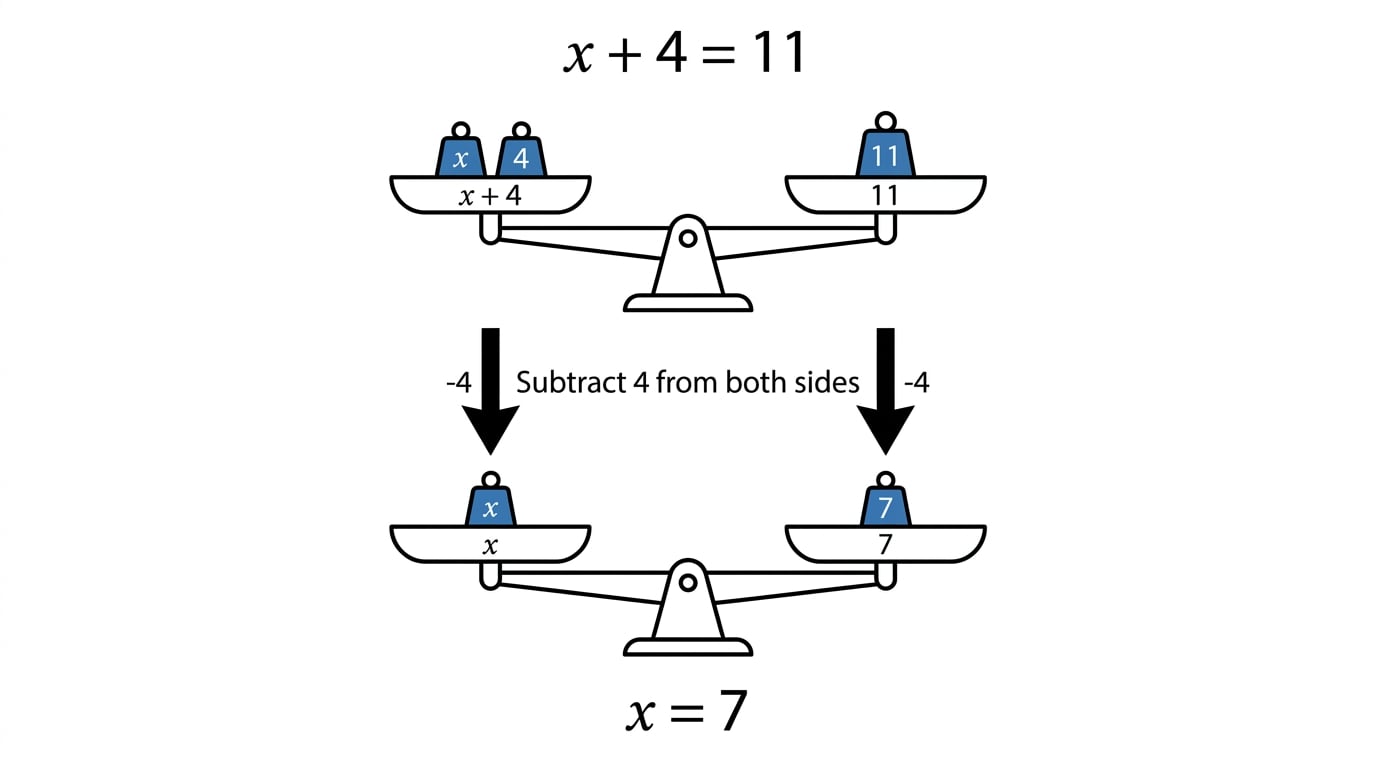
The most important idea is this: whatever you do to one side, you must do to the other side.
Think of an equation like a balance scale. If both sides are equal and you subtract the same amount from both sides, it stays balanced.
Key Idea
The balance rule
You may add, subtract, multiply, or divide both sides by the same number. This keeps the equation true.
Inverse operations
An inverse operation is the operation that undoes another operation.
- Adding is undone by subtracting.
- Subtracting is undone by adding.
- Multiplying is undone by dividing.
- Dividing is undone by multiplying.
Solving by adding or subtracting
Example
Solving an equation like
Solve x+5=18x + 5 = 18x+5=18.
-
The variable is xxx. It has 5 added to it.
-
Undo adding 5 by subtracting 5 from both sides:
x+5=18x=18−5\begin{aligned} x + 5 &= 18 \\ x &= 18 - 5 \end{aligned}x+5x=18=18−5 -
Calculate the right side:
x=13x = 13x=13
Example
Solving an equation like
Solve b−4=9b - 4 = 9b−4=9.
-
The variable is bbb. It has 4 subtracted from it.
-
Undo subtracting 4 by adding 4 to both sides:
b−4=9b=9+4\begin{aligned} b - 4 &= 9 \\ b &= 9 + 4 \end{aligned}b−4b=9=9+4 -
Calculate:
b=13b = 13b=13
Common Mistake
Forgetting the sign
In 5−m=125 - m = 125−m=12, the variable is being subtracted. The left side is not m−5m - 5m−5. Be extra careful when the letter comes after a minus sign.
Example
When the variable is subtracted
Solve 6−n=146 - n = 146−n=14.
-
Subtract 6 from both sides so the term with nnn is on its own:
6−n=14−n=8\begin{aligned} 6 - n &= 14 \\ -n &= 8 \end{aligned}6−n−n=14=8 -
If −n=8-n = 8−n=8, then nnn must be negative:
n=−8n = -8n=−8 -
Check: 6 minus negative 8 is 14.
3. Multiplication and division equations
A letter next to a number means multiplication. For example, 7y7y7y means 7 multiplied by yyy.
Definition
Coefficient
The coefficient is the number multiplying the variable. In 7y7y7y, the coefficient is 7.
Equations like 6x=426x = 426x=42
To solve, divide both sides by the coefficient.
Example
Solving a multiplication equation
Solve 8p=568p = 568p=56.
-
The variable ppp is multiplied by 8.
-
Undo multiplying by 8 by dividing both sides by 8:
8p=56p=56÷8\begin{aligned} 8p &= 56 \\ p &= 56 \div 8 \end{aligned}8pp=56=56÷8 -
Calculate:
p=7p = 7p=7
Equations like d2=9\frac{d}{2} = 92d=9
A fraction bar means division. So d2\frac{d}{2}2d means ddd divided by 2.
Example
Solving a division equation
Solve q3=7\frac{q}{3} = 73q=7.
-
The variable qqq is divided by 3.
-
Undo dividing by 3 by multiplying both sides by 3:
q3=7q=7×3\begin{aligned} \frac{q}{3} &= 7 \\ q &= 7 \times 3 \end{aligned}3qq=7=7×3 -
Calculate:
q=21q = 21q=21
Tip
Quick check
After solving, substitute your answer back into the original equation. If both sides match, your answer is correct.
4. Two-step equations
A two-step equation needs two inverse operations to solve it. Usually, you undo addition or subtraction first, then undo multiplication or division.
For example, in 4c+7=314c + 7 = 314c+7=31, the variable is multiplied by 4 and then 7 is added.
Example
Solving a two-step equation
Solve 5a−3=275a - 3 = 275a−3=27.
-
Undo subtracting 3 by adding 3 to both sides:
5a−3=275a=30\begin{aligned} 5a - 3 &= 27 \\ 5a &= 30 \end{aligned}5a−35a=27=30 -
Undo multiplying by 5 by dividing both sides by 5:
a=30÷5\begin{aligned} a &= 30 \div 5 \end{aligned}a=30÷5 -
Calculate:
a=6a = 6a=6
Example
Two-step equation with a negative answer
Solve 2x+9=32x + 9 = 32x+9=3.
-
Undo adding 9 by subtracting 9 from both sides:
2x+9=32x=−6\begin{aligned} 2x + 9 &= 3 \\ 2x &= -6 \end{aligned}2x+92x=3=−6 -
Undo multiplying by 2 by dividing both sides by 2:
x=−3x = -3x=−3
5. Equations with brackets
Brackets mean you do the expression inside as a group. In equations like 4(a−2)=284(a - 2) = 284(a−2)=28, you can often solve efficiently by dividing first.
Example
Solving an equation with brackets
Solve 3(g−4)=213(g - 4) = 213(g−4)=21.
-
The bracket is multiplied by 3, so divide both sides by 3 first:
3(g−4)=21g−4=7\begin{aligned} 3(g - 4) &= 21 \\ g - 4 &= 7 \end{aligned}3(g−4)g−4=21=7 -
Undo subtracting 4 by adding 4 to both sides:
g=11g = 11g=11
Example
Brackets with addition inside
Solve 2(k+6)=302(k + 6) = 302(k+6)=30.
-
Divide both sides by 2:
2(k+6)=30k+6=15\begin{aligned} 2(k + 6) &= 30 \\ k + 6 &= 15 \end{aligned}2(k+6)k+6=30=15 -
Undo adding 6 by subtracting 6:
k=9k = 9k=9
Common Mistake
Expanding only one term
If you expand 4(x−3)4(x - 3)4(x−3), it becomes 4x−124x - 124x−12, not 4x−34x - 34x−3. The 4 multiplies every term inside the bracket.
6. Fractions with variables
Some equations contain a fraction involving the variable. The aim is still to undo operations in reverse order.
Variable divided first, then subtract
Example
Solving an equation like
Solve r5−2=4\frac{r}{5} - 2 = 45r−2=4.
-
Undo subtracting 2 by adding 2 to both sides:
r5−2=4r5=6\begin{aligned} \frac{r}{5} - 2 &= 4 \\ \frac{r}{5} &= 6 \end{aligned}5r−25r=4=6 -
Undo dividing by 5 by multiplying both sides by 5:
r=30r = 30r=30
Whole bracket over a number
In d+34=6\frac{d + 3}{4} = 64d+3=6, the whole top line, d+3d + 3d+3, is divided by 4.
Example
Solving when the whole numerator is divided
Solve h+23=8\frac{h + 2}{3} = 83h+2=8.
-
Undo dividing by 3 by multiplying both sides by 3:
h+23=8h+2=24\begin{aligned} \frac{h + 2}{3} &= 8 \\ h + 2 &= 24 \end{aligned}3h+2h+2=8=24 -
Undo adding 2 by subtracting 2:
h=22h = 22h=22
A coefficient in a fraction
Example
Solving an equation like
Solve 3x4=9\frac{3x}{4} = 943x=9.
-
Undo dividing by 4 by multiplying both sides by 4:
3x=363x = 363x=36 -
Undo multiplying by 3 by dividing both sides by 3:
x=12x = 12x=12
7. Variables on both sides
Sometimes the variable appears on both sides, such as 6w=2w+166w = 2w + 166w=2w+16. Your first goal is to collect the variable terms on one side.
Definition
Like terms
Like terms are terms with the same variable part. For example, 6w6w6w and 2w2w2w are like terms because both contain www.
A good strategy is to move the smaller variable term first. This often keeps your answer positive while you work.
Example
Solving with variables on both sides
Solve 7x+5=3x+257x + 5 = 3x + 257x+5=3x+25.
-
Subtract 3x3x3x from both sides to collect the xxx terms on the left:
7x+5=3x+254x+5=25\begin{aligned} 7x + 5 &= 3x + 25 \\ 4x + 5 &= 25 \end{aligned}7x+54x+5=3x+25=25 -
Subtract 5 from both sides:
4x=204x = 204x=20 -
Divide both sides by 4:
x=5x = 5x=5
Example
Variables on both sides with negatives
Solve 12−3s=s−812 - 3s = s - 812−3s=s−8.
-
Add 3s3s3s to both sides so the variable terms are positive:
12−3s=s−812=4s−8\begin{aligned} 12 - 3s &= s - 8 \\ 12 &= 4s - 8 \end{aligned}12−3s12=s−8=4s−8 -
Add 8 to both sides:
20=4s20 = 4s20=4s -
Divide both sides by 4:
s=5s = 5s=5
Tip
Check by substitution
For s=5s = 5s=5, the left side is 12−15=−312 - 15 = -312−15=−3 and the right side is 5 minus 8, which is also -3. Both sides match.
Final checklist for solving equations
Before you start, identify what is happening to the variable. Then undo those operations in reverse order.
For most Grade 3 solving-equation questions:
- Simplify either side if needed.
- Move variable terms to one side if the variable appears twice.
- Undo addition or subtraction.
- Undo multiplication or division.
- Check your answer in the original equation.
Exam technique
In the exam
-
Write one clear line of working for each operation you do to both sides.
-
Be careful with negative signs, especially in equations like 9−2k=39 - 2k = 39−2k=3.
-
Substitute your answer back into the original equation if you have time.
Self review
Check yourself
- Can you explain why subtracting 6 from both sides keeps an equation balanced?
- In 4(x−5)=284(x - 5) = 284(x−5)=28, what operation would you undo first?
- If the variable appears on both sides, how do you decide which variable term to move?

Recap questions
Test yourself with 5 quick questions on this guide. Answer them all correctly to complete it.
You've reached the end
Test yourself on this topic, or move on to the next guide.
How was this guide?