Revision notes for CIE IGCSE Maths Fractions. Open the guide for explanations and worked examples. Written against the CIE IGCSE Maths (0580) specification, so the content matches what's examinable rather than general Maths background.
Fractions
What you'll learn
- How to add and subtract fractions using a common denominator.
- How to multiply and divide fractions accurately.
- How to change between mixed numbers and improper fractions.
- How to simplify your final answer and choose the right form.
Fraction basics
A fraction tells you how many equal parts of a whole you have.
Definition
Numerator and denominator
- The numerator is the top number in a fraction. It tells you how many parts you have.
- The denominator is the bottom number. It tells you how many equal parts the whole has been split into.
- For example, in 35\frac{3}{5}53, the numerator is 3 and the denominator is 5.
A fraction is in simplest form when the numerator and denominator have no common factor apart from 1. For example, 610\frac{6}{10}106 simplifies to 35\frac{3}{5}53 because both 6 and 10 divide by 2.
Example
Simplifying a fraction
Simplify 1218\frac{12}{18}1812.
-
Find a common factor of 12 and 18. Both divide by 6.
-
Divide the numerator and denominator by 6.
1218=12÷618÷6=23\frac{12}{18}=\frac{12\div 6}{18\div 6}=\frac{2}{3}1812=18÷612÷6=32 -
The answer is 23\frac{2}{3}32 because 2 and 3 have no common factor apart from 1.
Tip
Quick simplification check
If both numbers are even, divide by 2 first. If the digits add to a multiple of 3, the number divides by 3.
Adding and subtracting fractions
To add or subtract fractions, the denominators must be the same. This is called using a common denominator.
Key Idea
Adding and subtracting fractions
Make the denominators the same, then add or subtract the numerators. Do not add or subtract the denominators.
A good common denominator is often the lowest common multiple of the denominators. The diagram shows how different-sized fraction pieces can be changed into twelfths before adding.
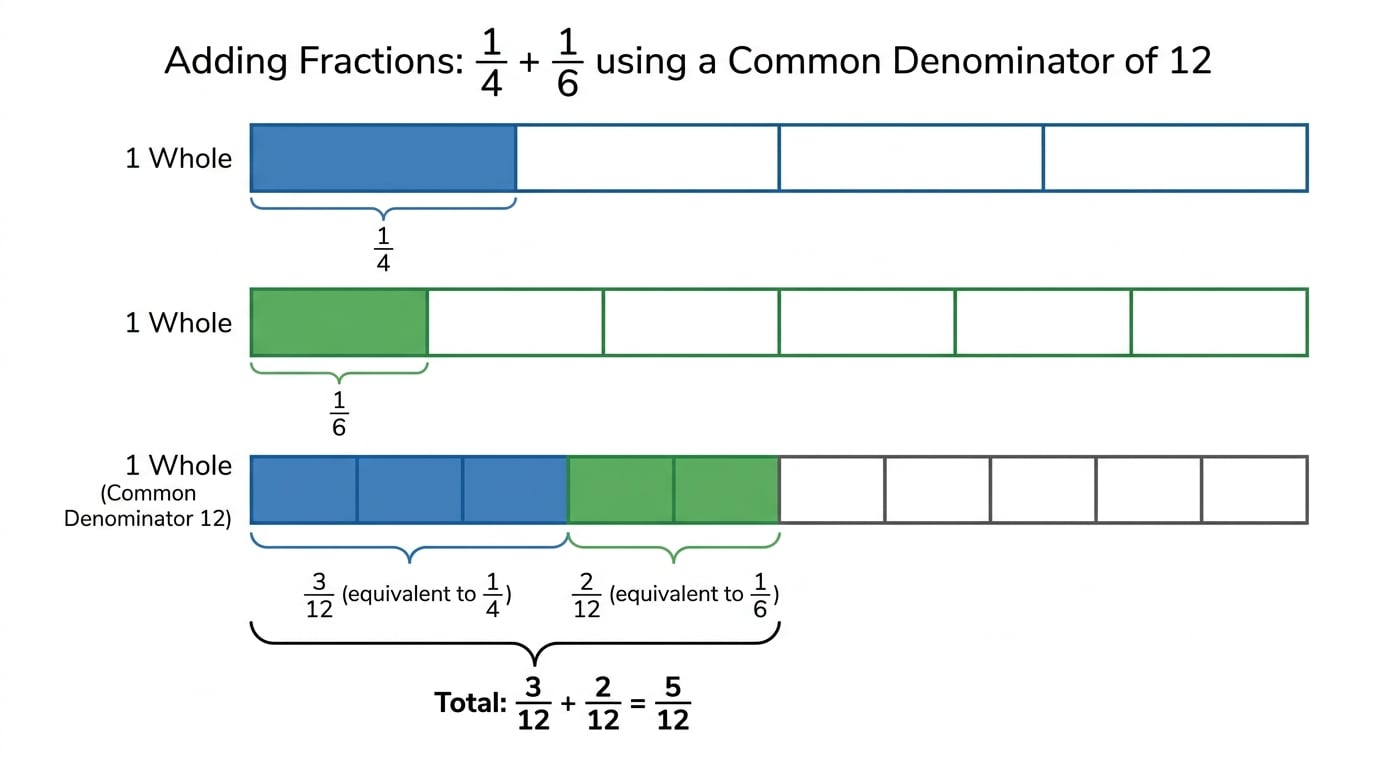
Adding fractions with different denominators
Example
Adding fractions
Work out 18+34\frac{1}{8}+\frac{3}{4}81+43.
-
The denominators are 8 and 4. Use 8 as the common denominator because fourths can be changed into eighths.
-
Rewrite 34\frac{3}{4}43 as eighths.
34=68\frac{3}{4}=\frac{6}{8}43=86 -
Add the numerators and keep the denominator the same.
18+68=78\frac{1}{8}+\frac{6}{8}=\frac{7}{8}81+86=87 -
The answer is 78\frac{7}{8}87.
Subtracting fractions with different denominators
Example
Subtracting fractions
Work out 56−14\frac{5}{6}-\frac{1}{4}65−41.
-
Find a common denominator for 6 and 4. The lowest common denominator is 12.
-
Change both fractions into twelfths.
56=101214=312\frac{5}{6}=\frac{10}{12} \qquad \frac{1}{4}=\frac{3}{12}65=121041=123 -
Subtract the numerators.
1012−312=712\frac{10}{12}-\frac{3}{12}=\frac{7}{12}1210−123=127 -
The answer is 712\frac{7}{12}127.
Common Mistake
Adding the denominators
A very common mistake is writing 15+25=310\frac{1}{5}+\frac{2}{5}=\frac{3}{10}51+52=103. The denominator stays as 5, so the correct answer is 35\frac{3}{5}53.
Multiplying fractions
Multiplying fractions is usually more direct than adding or subtracting. You multiply the numerators together, then multiply the denominators together.
Key Idea
Multiplying fractions
For multiplication: numerator times numerator, denominator times denominator.
Example
Multiplying two fractions
Work out 23×910\frac{2}{3}\times\frac{9}{10}32×109.
-
Multiply the numerators.
2×9=182\times 9=182×9=18 -
Multiply the denominators.
3×10=303\times 10=303×10=30 -
Write the fraction and simplify.
1830=35\frac{18}{30}=\frac{3}{5}3018=53 -
The answer is 35\frac{3}{5}53.
You can sometimes simplify before multiplying. This is called cancelling. It works because multiplication can be done in any order.
Tip
Cancel before multiplying
In 34×89\frac{3}{4}\times\frac{8}{9}43×98, you can cancel 8 with 4 first, and cancel 3 with 9 first. This keeps the numbers smaller.
Common Mistake
Cancelling across addition
You may cancel when fractions are being multiplied, but not when they are being added or subtracted. For example, do not cancel in 34+89\frac{3}{4}+\frac{8}{9}43+98.
Dividing fractions
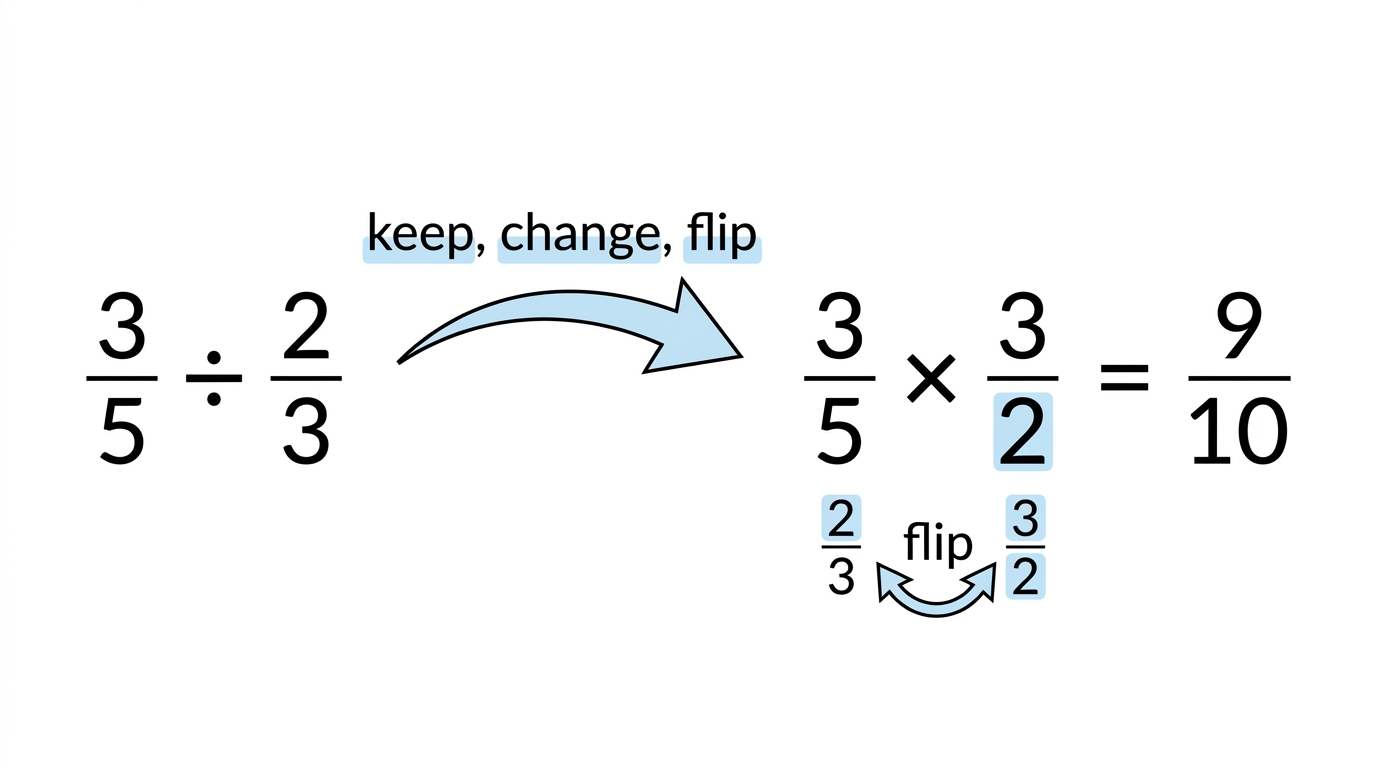
To divide by a fraction, multiply by its reciprocal.
Definition
Reciprocal
The reciprocal of a fraction is made by swapping its numerator and denominator. The reciprocal of 25\frac{2}{5}52 is 52\frac{5}{2}25.
The method is often remembered as keep, change, flip: keep the first fraction, change divide to multiply, flip the second fraction.
Example
Dividing fractions
Work out 47÷23\frac{4}{7}\div\frac{2}{3}74÷32.
-
Keep the first fraction the same.
-
Change the division sign to multiplication and flip the second fraction.
47÷23=47×32\frac{4}{7}\div\frac{2}{3} = \frac{4}{7}\times\frac{3}{2}74÷32=74×23 -
Multiply the numerators and denominators.
4×37×2=1214\frac{4\times 3}{7\times 2}=\frac{12}{14}7×24×3=1412 -
Simplify the fraction.
1214=67\frac{12}{14}=\frac{6}{7}1412=76 -
The answer is 67\frac{6}{7}76.
Common Mistake
Never divide by zero
A denominator can never be zero, and you cannot divide by a fraction equal to zero. Division by zero is undefined.
Mixed numbers and improper fractions
A mixed number has a whole number part and a fraction part, such as 1341\frac{3}{4}143.
An improper fraction has a numerator larger than or equal to its denominator, such as 74\frac{7}{4}47.
Definition
Changing a mixed number to an improper fraction
To change a mixed number into an improper fraction: multiply the whole number by the denominator, add the numerator, then keep the same denominator.
For example:
134=1×4+34=741\frac{3}{4}=\frac{1\times 4+3}{4}=\frac{7}{4}143=41×4+3=47You should usually change mixed numbers into improper fractions before multiplying or dividing.
Example
Multiplying with mixed numbers
Work out 125×1131\frac{2}{5}\times1\frac{1}{3}152×131. Give your answer as a mixed number.
-
Change each mixed number into an improper fraction.
125=75113=431\frac{2}{5}=\frac{7}{5} \qquad 1\frac{1}{3}=\frac{4}{3}152=57131=34 -
Multiply the fractions.
75×43=2815\frac{7}{5}\times\frac{4}{3}=\frac{28}{15}57×34=1528 -
Change 2815\frac{28}{15}1528 into a mixed number. There is one whole 15 in 28, with 13 left over.
-
The answer is 113151\frac{13}{15}11513.
Dividing with a mixed number
Example
Dividing a mixed number by a fraction
Work out 112÷351\frac{1}{2}\div\frac{3}{5}121÷53.
-
Change the mixed number into an improper fraction.
112=321\frac{1}{2}=\frac{3}{2}121=23 -
Keep, change, flip.
32÷35=32×53\frac{3}{2}\div\frac{3}{5} = \frac{3}{2}\times\frac{5}{3}23÷53=23×35 -
Multiply and simplify.
3×52×3=156=52\frac{3\times 5}{2\times 3}=\frac{15}{6}=\frac{5}{2}2×33×5=615=25 -
Change 52\frac{5}{2}25 into a mixed number.
-
The answer is 2122\frac{1}{2}221.
Adding mixed numbers
For addition and subtraction, you can either change to improper fractions or deal with the whole numbers and fractions separately. At this level, changing to improper fractions is often safest.
Example
Adding mixed numbers
Work out 214+1232\frac{1}{4}+1\frac{2}{3}241+132.
-
Change both mixed numbers into improper fractions.
214=94123=532\frac{1}{4}=\frac{9}{4} \qquad 1\frac{2}{3}=\frac{5}{3}241=49132=35 -
Find a common denominator. For fourths and thirds, use 12.
-
Rewrite both fractions.
94=271253=2012\frac{9}{4}=\frac{27}{12} \qquad \frac{5}{3}=\frac{20}{12}49=122735=1220 -
Add the numerators.
2712+2012=4712\frac{27}{12}+\frac{20}{12}=\frac{47}{12}1227+1220=1247 -
Change 4712\frac{47}{12}1247 into a mixed number.
-
The answer is 311123\frac{11}{12}31211.
Exam technique
In the exam
-
Check the operation first: adding and subtracting need a common denominator; multiplying and dividing do not.
-
If you see a mixed number in a multiplication or division question, change it to an improper fraction before you start.
-
Always simplify your answer, and if the question asks for a mixed number, convert any improper fraction at the end.
Self review
Check yourself
- Can you explain why 13+14\frac{1}{3}+\frac{1}{4}31+41 is not 27\frac{2}{7}72?
- What is the reciprocal of 58\frac{5}{8}85?
- How would you change 2352\frac{3}{5}253 into an improper fraction?

Recap questions
Test yourself with 5 quick questions on this guide. Answer them all correctly to complete it.
You've reached the end
Test yourself on this topic, or move on to the next guide.
How was this guide?