Revision notes for CIE IGCSE Maths Solving One Step Equations. Open the guide for explanations and worked examples. Written against the CIE IGCSE Maths (0580) specification, so the content matches what's examinable rather than general Maths background.
Solving One Step Equations
What you'll learn
- How missing-number boxes connect to algebra letters.
- What an equation, an unknown, and a solution mean.
- How to undo addition, subtraction, multiplication, and division.
- How to check your answer quickly and avoid common traps.
1. Equations are balanced statements
An equation is like a balance: the left side and the right side have the same value.
Definition
Equation
An equation is a mathematical statement with an equals sign, such as x+6=18x + 6 = 18x+6=18. The equals sign means “has the same value as”.
In algebra, a letter such as xxx, mmm, or aaa often stands for a number we do not know yet. This is called the unknown or variable. To solve an equation means to find the value of the unknown that makes the equation true.
A balance picture is useful because it reminds you that both sides of an equation must stay equal.
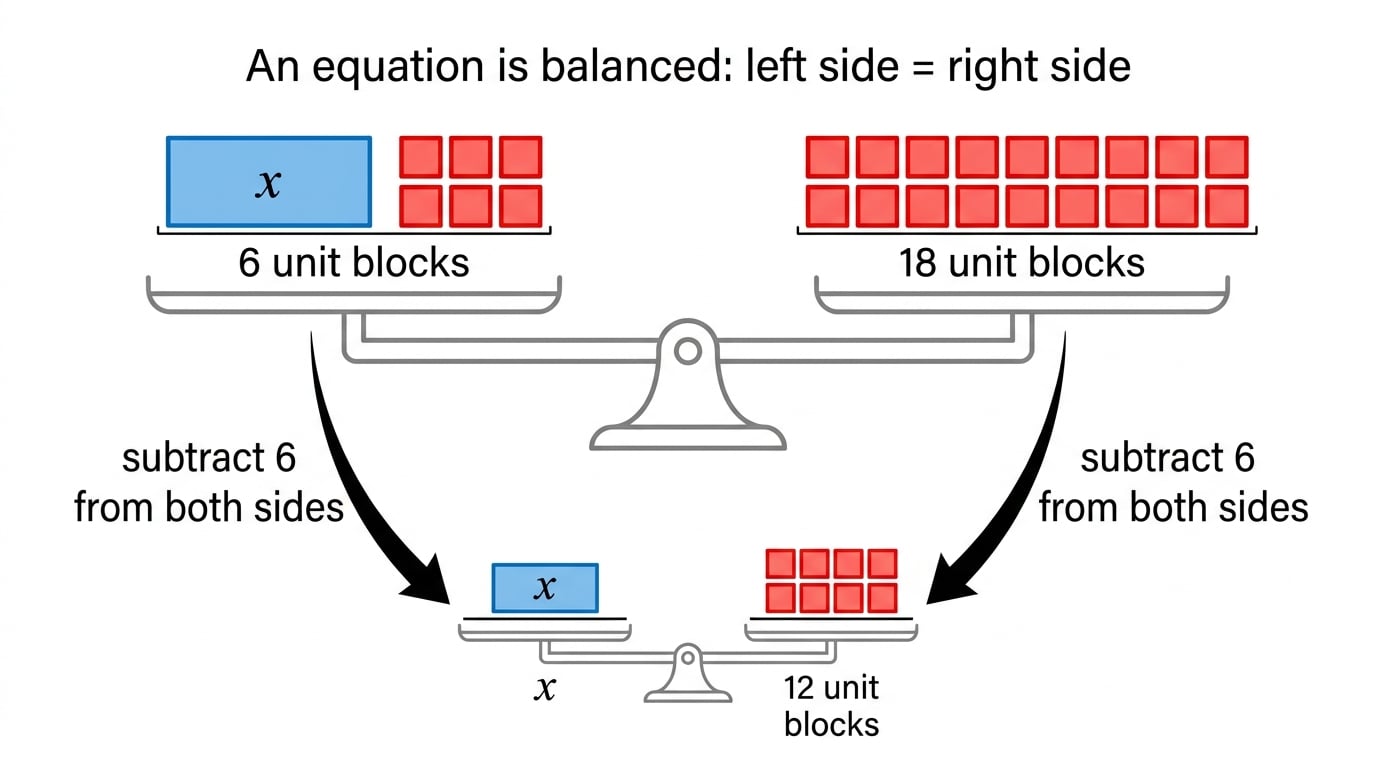
Key Idea
Keep the equation balanced
If you change one side of an equation, you must make the matching change to the other side. For one-step equations, this usually means using one inverse operation.
Worked example: missing boxes
Example
Finding missing numbers
-
For 7+0=197 + \boxed{\phantom{0}} = 197+0=19, ask: “What number must be added to 7 to make 19?”
-
Use the related subtraction fact.
19−7=1219 - 7 = 1219−7=12 -
So the missing number in 7+0=197 + \boxed{\phantom{0}} = 197+0=19 is 12.
-
For 18−0=1118 - \boxed{\phantom{0}} = 1118−0=11, ask: “What number was taken away from 18 to leave 11?”
-
Use the difference between 18 and 11.
18−11=718 - 11 = 718−11=7 -
So the missing number in 18−0=1118 - \boxed{\phantom{0}} = 1118−0=11 is 7.
2. From boxes to letters
A letter in an equation is just like a missing-number box. For example, x+5=16x + 5 = 16x+5=16 means:
“What number, when 5 is added, gives 16?”
Definition
One-step equation
A one-step equation is an equation that can be solved by undoing just one operation, such as adding, subtracting, multiplying, or dividing.
Worked example: a letter instead of a box
Example
Solving an addition equation
-
Start with the equation.
x+5=16x + 5 = 16x+5=16 -
The unknown has 5 added to it, so undo this by subtracting 5.
x+5=16x=16−5x=11\begin{aligned} x + 5 &= 16 \\ x &= 16 - 5 \\ x &= 11 \end{aligned}x+5xx=16=16−5=11 -
The solution is x=11x = 11x=11.
-
Check by putting 11 back into the original equation: 11 + 5 = 16, so it works.
Tip
Think of the question in words
For x+5=16x + 5 = 16x+5=16, you can read it as: “What number plus 5 equals 16?” This often makes Grade 2 algebra feel much less mysterious.
3. Inverse operations for adding and subtracting
Definition
Inverse operations
Inverse operations are operations that undo each other. Addition and subtraction are inverse operations. Multiplication and division are inverse operations.
For example:
- To undo adding 9, subtract 9.
- To undo subtracting 4, add 4.
Worked example: subtracting from the unknown
Example
Solving a subtraction equation
-
Start with the equation.
m−6=13m - 6 = 13m−6=13 -
The unknown has 6 subtracted from it, so undo this by adding 6.
m−6=13m=13+6m=19\begin{aligned} m - 6 &= 13 \\ m &= 13 + 6 \\ m &= 19 \end{aligned}m−6mm=13=13+6=19 -
The solution is m=19m = 19m=19.
-
Check: 19 minus 6 gives 13, so the answer is correct.
When the unknown comes after a minus sign
Equations like 20−p=1220 - p = 1220−p=12 need extra care. Here, ppp is not the starting number. It is the amount being taken away.
Common Mistake
Treating every subtraction equation the same way
In 20−p=1220 - p = 1220−p=12, do not write p=20+12p = 20 + 12p=20+12. The unknown is the number being subtracted, so you need the difference between 20 and 12.
Example
Solving when the letter is being subtracted
-
Start with the equation.
20−p=1220 - p = 1220−p=12 -
Ask: “What must be taken away from 20 to leave 12?”
-
Find the difference between 20 and 12.
20−12=820 - 12 = 820−12=8 -
So p=8p = 8p=8.
-
Check: 20 minus 8 gives 12.
4. Multiplication equations
When a number is written next to a letter, it means multiplication. For example, 6a6a6a means 6×a6 \times a6×a.
Definition
Coefficient
A coefficient is the number multiplying a variable. In 6a6a6a, the coefficient of aaa is 6.
To solve a multiplication equation, divide by the coefficient.
Worked example: solving by dividing
Example
Solving a multiplication equation
-
Start with the equation.
8g=488g = 488g=48 -
This means 8 lots of ggg make 48, so divide by 8.
8g=48g=48÷8g=6\begin{aligned} 8g &= 48 \\ g &= 48 \div 8 \\ g &= 6 \end{aligned}8ggg=48=48÷8=6 -
The solution is g=6g = 6g=6.
-
Check: 8 lots of 6 make 48.
5. Division equations
A fraction line can mean division. For example, d2=6.5\frac{d}{2} = 6.52d=6.5 means “ddd divided by 2 equals 6.5”.
To undo division, multiply.
Worked example: solving a division equation
Example
Solving when the unknown is divided
-
Start with the equation.
f3=7\frac{f}{3} = 73f=7 -
The unknown has been divided by 3, so undo this by multiplying by 3.
f3=7f=7×3f=21\begin{aligned} \frac{f}{3} &= 7 \\ f &= 7 \times 3 \\ f &= 21 \end{aligned}3fff=7=7×3=21 -
The solution is f=21f = 21f=21.
-
Check: 21 divided by 3 gives 7.
Division with decimals
Example
Solving with a decimal answer
-
Start with the equation.
d2=6.5\frac{d}{2} = 6.52d=6.5 -
Undo dividing by 2 by multiplying by 2.
d2=6.5d=6.5×2d=13\begin{aligned} \frac{d}{2} &= 6.5 \\ d &= 6.5 \times 2 \\ d &= 13 \end{aligned}2ddd=6.5=6.5×2=13 -
The solution is d=13d = 13d=13.
6. Repeated letters
Sometimes the same letter is added more than once, such as h+h+h=24h + h + h = 24h+h+h=24.
Because each hhh has the same value, h+h+hh + h + hh+h+h means 3 lots of hhh, so it can be written as 3h3h3h.
Worked example: repeated unknowns
Example
Turning repeated letters into multiplication
-
Start with the equation.
n+n+n=45n + n + n = 45n+n+n=45 -
Rewrite the left side as 3 lots of nnn.
3n=453n = 453n=45 -
Divide by 3 to find one nnn.
3n=45n=45÷3n=15\begin{aligned} 3n &= 45 \\ n &= 45 \div 3 \\ n &= 15 \end{aligned}3nnn=45=45÷3=15 -
The solution is n=15n = 15n=15.
7. When the letter is underneath
In equations like 36y=9\frac{36}{y} = 9y36=9, the unknown is the number you are dividing by. This number is called the divisor.
Read it carefully:
“36 divided by what number gives 9?”
Common Mistake
Dividing by zero
A divisor cannot be zero, because division by zero is not allowed.
Worked example: unknown as the divisor
Example
Solving when the letter is the divisor
-
Start with the equation.
48y=8\frac{48}{y} = 8y48=8 -
Read it as: “48 divided by what number gives 8?”
-
Use the related multiplication fact: 8 times what number gives 48?
8×6=488 \times 6 = 488×6=48 -
So y=6y = 6y=6.
-
Check: 48 divided by 6 gives 8.
8. Checking your answer
To check an answer, substitute it back into the original equation. Substitute means replace the letter with the number you found.
Example
Checking by substitution
-
Suppose you solve 5+p=145 + p = 145+p=14 and get p=9p = 9p=9.
-
Substitute 9 for ppp in the original equation.
5+9=145 + 9 = 145+9=14 -
Both sides are equal, so p=9p = 9p=9 is correct.
Exam technique
In the exam
-
Identify what operation is happening to the unknown: adding, subtracting, multiplying, or dividing.
-
Use the inverse operation and show one clear line of working, even for a 1-mark question.
-
Check tricky cases carefully, especially equations like 20−m=1220 - m = 1220−m=12 or 36y=9\frac{36}{y} = 9y36=9.
Self review
Check yourself
-
If x+7=19x + 7 = 19x+7=19, what operation undoes adding 7?
-
In 4a=284a = 284a=28, what does the 4 mean?
-
In 25−m=1825 - m = 1825−m=18, is mmm the starting number, the amount taken away, or the answer?

Recap questions
Test yourself with 5 quick questions on this guide. Answer them all correctly to complete it.
You've reached the end
Test yourself on this topic, or move on to the next guide.
How was this guide?