Revision notes for CIE IGCSE Maths Fractions of an Amount. Open the guide for explanations and worked examples. Written against the CIE IGCSE Maths (0580) specification, so the content matches what's examinable rather than general Maths background.
Fractions of an Amount
Finding a fraction of an amount is a core skill that pops up everywhere in Maths. Whether you are dealing with money, measurements, or sharing out items, understanding how to apply fractions to whole numbers is essential.
What you'll learn:
- How to calculate a basic fraction of a whole number.
- How to apply these skills to real-world word problems.
- How to work backwards to find the original amount when you are given a fraction of it.
The Basic Rule
To find a fraction of an amount, you need to understand what a fraction represents. The bottom number (denominator) tells you how many equal pieces the whole has been split into. The top number (numerator) tells you how many of those pieces you actually have.
Key Idea
Divide by the bottom, multiply by the top
To find a fraction of an amount:
- Divide the amount by the denominator (the bottom number).
- Multiply that result by the numerator (the top number).
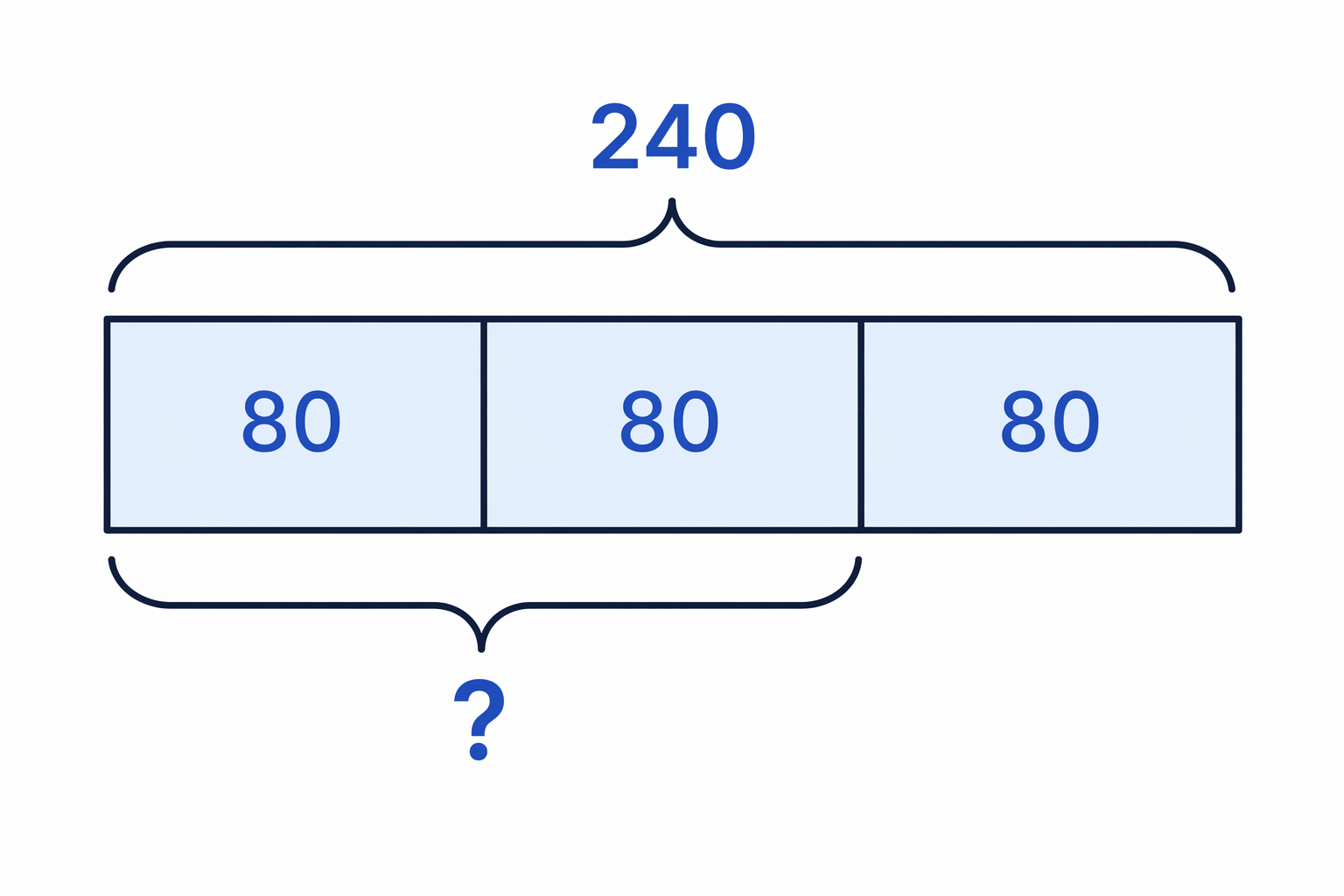
Let's visualise this with a bar model. If we want to find 23\frac{2}{3}32 of 240, we imagine the number 240 being split into 3 equal blocks. Once we know the value of one block, we want exactly 2 of them.
Example
Finding a fraction of a number
Find 23\frac{2}{3}32 of 240.
-
Divide the amount by the denominator (the bottom number) to find 13\frac{1}{3}31:
240÷3=80240 \div 3 = 80240÷3=80 -
Multiply the result by the numerator (the top number) to find 23\frac{2}{3}32:
80×2=16080 \times 2 = 16080×2=160
Tip
Order doesn't strictly matter
If it makes the mental maths easier, you can multiply by the top first, and then divide by the bottom. However, doing the division first usually keeps the numbers smaller and easier to work with!
Multi-Step Word Problems
Exam questions rarely just ask you to calculate a fraction. They wrap the maths in a real-world scenario where you have to find fractions of an amount, subtract them from a total, or compare them.
Example
Sharing and remaining amounts
Liam has £60. He spends 25\frac{2}{5}52 of his money on a video game. He spends 310\frac{3}{10}103 of his money on snacks. He saves the rest. Work out how much money Liam saves.
-
Find the amount spent on the video game:
60÷5=1212×2=24\begin{aligned} 60 \div 5 &= 12 \\ 12 \times 2 &= 24 \end{aligned}60÷512×2=12=24He spends £24 on the game.
-
Find the amount spent on snacks:
60÷10=66×3=18\begin{aligned} 60 \div 10 &= 6 \\ 6 \times 3 &= 18 \end{aligned}60÷106×3=6=18He spends £18 on snacks.
-
Calculate the total amount spent:
24+18=4224 + 18 = 4224+18=42 -
Subtract the total spent from his original amount to find his savings:
60−42=1860 - 42 = 1860−42=18Liam saves £18.
Common Mistake
Fractions of what?
Always read carefully to see if the fraction is of the original total or the remainder. In IGCSE Grade 2 questions, it is almost always fractions of the original total, but if the question says "He spends 12\frac{1}{2}21 of the remaining money", you must recalculate the new total before applying the next fraction!
Working Backwards (Reverse Fractions)
Sometimes, you aren't given the starting amount. Instead, you are told what a fraction of an unknown number equals, and you have to work backwards to find the original whole.
If you know that 34\frac{3}{4}43 of a number is 39, you know that 3 equal pieces add up to 39. To find the whole, you first find the value of one piece, and then scale it up to the whole (which is 4 pieces).
Key Idea
Working backwards
When you know the value of a fraction and need to find the whole amount:
- Divide by the numerator (top number) to find the value of one part.
- Multiply by the denominator (bottom number) to find the whole.
Notice this is the exact opposite of finding a fraction of an amount!
Example
Finding the original number
34\frac{3}{4}43 of a number is 39. Work out the number.
-
We know that 3 parts equal 39. Divide by the numerator (3) to find the value of 1 part (14\frac{1}{4}41):
39÷3=1339 \div 3 = 1339÷3=13 -
Multiply by the denominator (4) to find the total value of all 4 parts (the whole number):
13×4=5213 \times 4 = 5213×4=52
Exam technique
In the exam
- Underline the key values: Highlight the total amount, the fractions, and exactly what the question is asking for (e.g., the amount spent vs. the amount left over).
- Show every calculation: Even if you can do 240÷3=80240 \div 3 = 80240÷3=80 in your head, write it down. Examiners award method marks for seeing the division and multiplication steps.
- Check your answer makes sense: If you are finding 23\frac{2}{3}32 of an amount, your answer must be smaller than the original amount. If you are working backwards to find the whole, your answer must be larger.
Self review
Check yourself
- Can you calculate 45\frac{4}{5}54 of 60? What is the first step you take?
- If a coat costs £80 and has 14\frac{1}{4}41 off in a sale, do you know how to calculate the new price?
- If 25\frac{2}{5}52 of a number is 14, what is the original number? How does the method change compared to a normal fraction calculation?

Recap questions
Test yourself with 5 quick questions on this guide. Answer them all correctly to complete it.
You've reached the end
Test yourself on this topic, or move on to the next guide.
How was this guide?