Revision notes for CIE IGCSE Maths Area and Perimeter. Open the guide for explanations and worked examples. Written against the CIE IGCSE Maths (0580) specification, so the content matches what's examinable rather than general Maths background.
Area and Perimeter
What you'll learn
- How to tell the difference between area and perimeter.
- How to find areas of rectangles, squares, triangles, parallelograms and trapezia.
- How to work backwards to find missing lengths or draw a shape on a grid.
- How to find the perimeter of a shape made from rectangles.
Area and perimeter: the big difference
Area and perimeter are both measurements of a shape, but they measure different things.
Definition
Area and perimeter
- Area is the amount of flat space inside a 2D shape. It is measured in square units, such as cm² or m².
- Perimeter is the total distance around the outside edge of a 2D shape. It is measured in length units, such as cm or m.
If a shape is drawn on a centimetre grid, each small square has area 1 cm². You can sometimes count squares, but formulas are quicker and more reliable.
Example
Rectangle on a centimetre grid
A rectangle is 6 cm long and 3 cm wide. Find its area and perimeter.
-
For the area, multiply the length by the width.
Area=6×3=18 cm2\text{Area} = 6 \times 3 = 18\text{ cm}^2Area=6×3=18 cm2 -
For the perimeter, add all four sides.
Perimeter=6+3+6+3=18 cm\text{Perimeter} = 6 + 3 + 6 + 3 = 18\text{ cm}Perimeter=6+3+6+3=18 cm -
Notice the units: the area is 18 cm², but the perimeter is 18 cm.
Common Mistake
Mixing up the units
If your answer is an area, it needs square units like cm². If your answer is a perimeter, it needs length units like cm.
Rectangles and squares
A rectangle is a four-sided shape with four right angles. Opposite sides are equal.
A square is a special rectangle where all four sides are equal.
Key Idea
Rectangle and square formulas
- Rectangle area: A=l×wA = l \times wA=l×w, where lll is length and www is width.
- Rectangle perimeter: P=2l+2wP = 2l + 2wP=2l+2w.
- Square area: A=s2A = s^2A=s2, where sss is the side length.
- Square perimeter: P=4sP = 4sP=4s.
Working forwards with squares
If you know the area of a square, you can find the side length by asking: “What number multiplied by itself gives this area?”
Example
Square area to perimeter
A square has area 81 cm². Find its perimeter.
-
A square has equal sides, so find the side length by square-rooting 81.
s=81=9s = \sqrt{81} = 9s=81=9 -
The side length is 9 cm.
-
Multiply the side length by 4 to find the perimeter.
P=4×9=36 cmP = 4 \times 9 = 36\text{ cm}P=4×9=36 cm
Example
Square perimeter to area
A square has perimeter 32 cm. Find its area.
-
A square has 4 equal sides, so divide the perimeter by 4.
s=32÷4=8s = 32 \div 4 = 8s=32÷4=8 -
The side length is 8 cm.
-
Square the side length to find the area.
A=82=64 cm2A = 8^2 = 64\text{ cm}^2A=82=64 cm2
Working backwards to draw rectangles
Some questions describe a shape using words such as twice or three times.
- “The length is twice the width” means the length is 2 lots of the width.
- “The length is three times the width” means the length is 3 lots of the width.
Example
Drawing a rectangle from its perimeter
The length of a rectangle is twice its width. The perimeter is 30 cm. Find the dimensions so it can be drawn on a centimetre grid.
-
Let the width be www cm.
-
The length is twice the width, so the length is 2w2w2w cm.
-
A rectangle has two widths and two lengths.
w+w+2w+2w=30w + w + 2w + 2w = 30w+w+2w+2w=30 -
Simplify the left-hand side.
6w=306w = 306w=30 -
Divide by 6.
w=5w = 5w=5 -
The width is 5 cm and the length is 10 cm, so draw a 10 cm by 5 cm rectangle.
Example
Drawing a rectangle from its area
The length of a rectangle is three times its width. The area is 75 cm². Find the dimensions.
-
Let the width be www cm.
-
The length is 3w3w3w cm.
-
Use area equals length times width.
3w×w=753w \times w = 753w×w=75 -
This means 3w2=753w^2 = 753w2=75, so divide by 3.
w2=25w^2 = 25w2=25 -
The width is 5 cm, because 5 times 5 is 25.
-
The length is 15 cm, because it is three times the width.
Tip
Grid drawing tip
Once you have found the dimensions, count grid squares carefully: 1 square is usually 1 cm by 1 cm.
Triangles and parallelograms
A base is the side you choose to measure along the bottom, although it does not always have to be horizontal.
The perpendicular height is the height measured at a right angle to the base.
A parallelogram is a four-sided shape with two pairs of parallel opposite sides. Parallel lines stay the same distance apart and never meet.
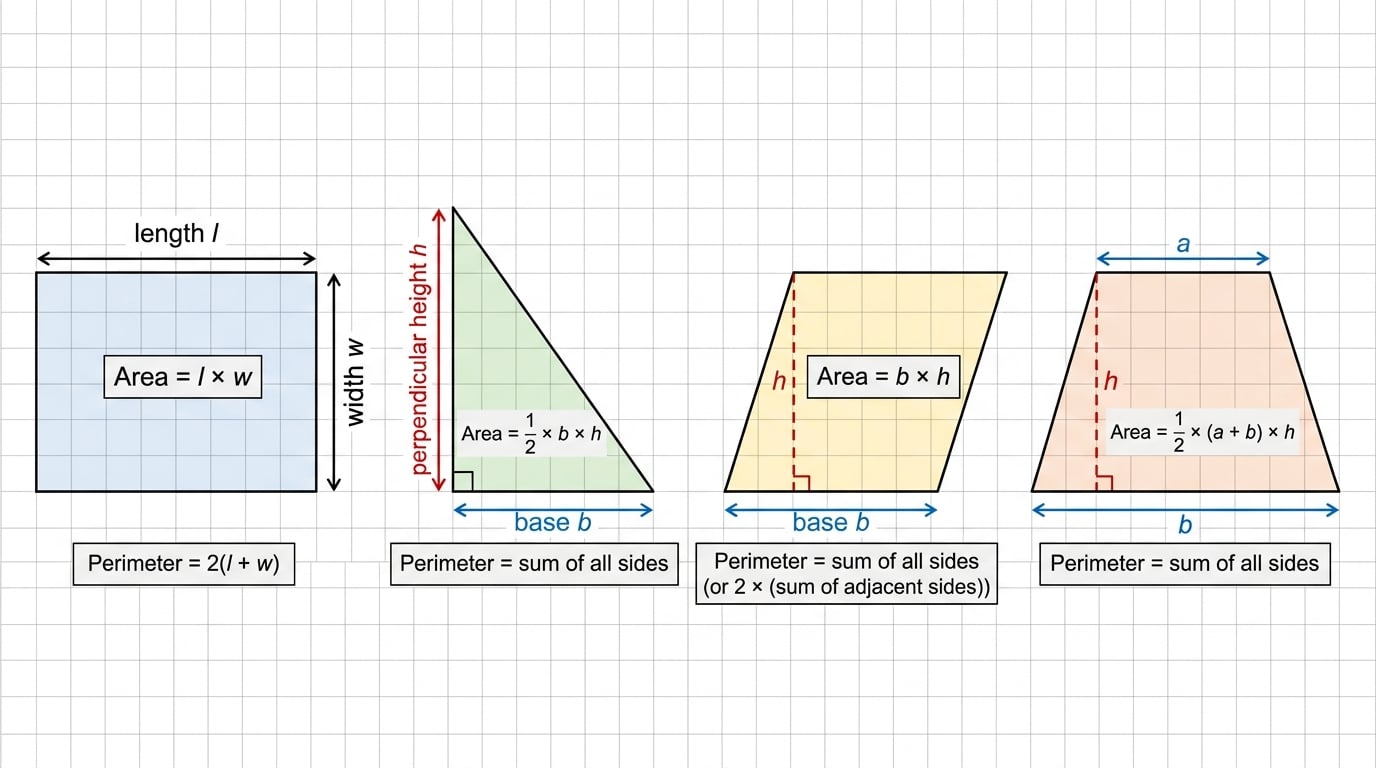
This diagram summarises the main area formulas you need.
Key Idea
Triangle and parallelogram formulas
- Triangle area: A=12bhA = \frac{1}{2}bhA=21bh, where bbb is the base and hhh is the perpendicular height.
- Parallelogram area: A=bhA = bhA=bh, where bbb is the base and hhh is the perpendicular height.
Example
Area of a triangle
A triangle has base 8 cm and perpendicular height 5 cm. Find its area.
-
Use the triangle area formula.
A=12bhA = \frac{1}{2}bhA=21bh -
Substitute the base and height.
A=12×8×5A = \frac{1}{2} \times 8 \times 5A=21×8×5 -
Work it out.
A=20 cm2A = 20\text{ cm}^2A=20 cm2
Example
Name and area of a parallelogram
A slanted four-sided shape has two pairs of parallel opposite sides. Its base is 6 cm and its perpendicular height is 4 cm. Name the shape and find its area.
-
A four-sided shape with two pairs of parallel opposite sides is a parallelogram.
-
Use the parallelogram area formula.
A=bhA = bhA=bh -
Substitute the base and perpendicular height.
A=6×4=24 cm2A = 6 \times 4 = 24\text{ cm}^2A=6×4=24 cm2
Common Mistake
Using the slanted side as the height
For triangles and parallelograms, the height must be perpendicular to the base. If the side is sloping, it is usually not the height.
Working backwards with triangle and parallelogram area
Sometimes you know the area and a relationship between the base and height.
Example
Triangle where the base is twice the height
The base of a triangle is twice its height. Its area is 25 cm². Find a possible base and height.
-
Let the height be hhh cm.
-
The base is twice the height, so the base is 2h2h2h cm.
-
Use the triangle area formula.
A=12bhA = \frac{1}{2}bhA=21bh -
Substitute the area and the base.
25=12×2h×h25 = \frac{1}{2} \times 2h \times h25=21×2h×h -
This simplifies to 25=h225 = h^225=h2, so the height is 5 cm.
-
The base is twice the height, so the base is 10 cm.
Perimeter of compound shapes
A compound shape is made by joining simpler shapes together.
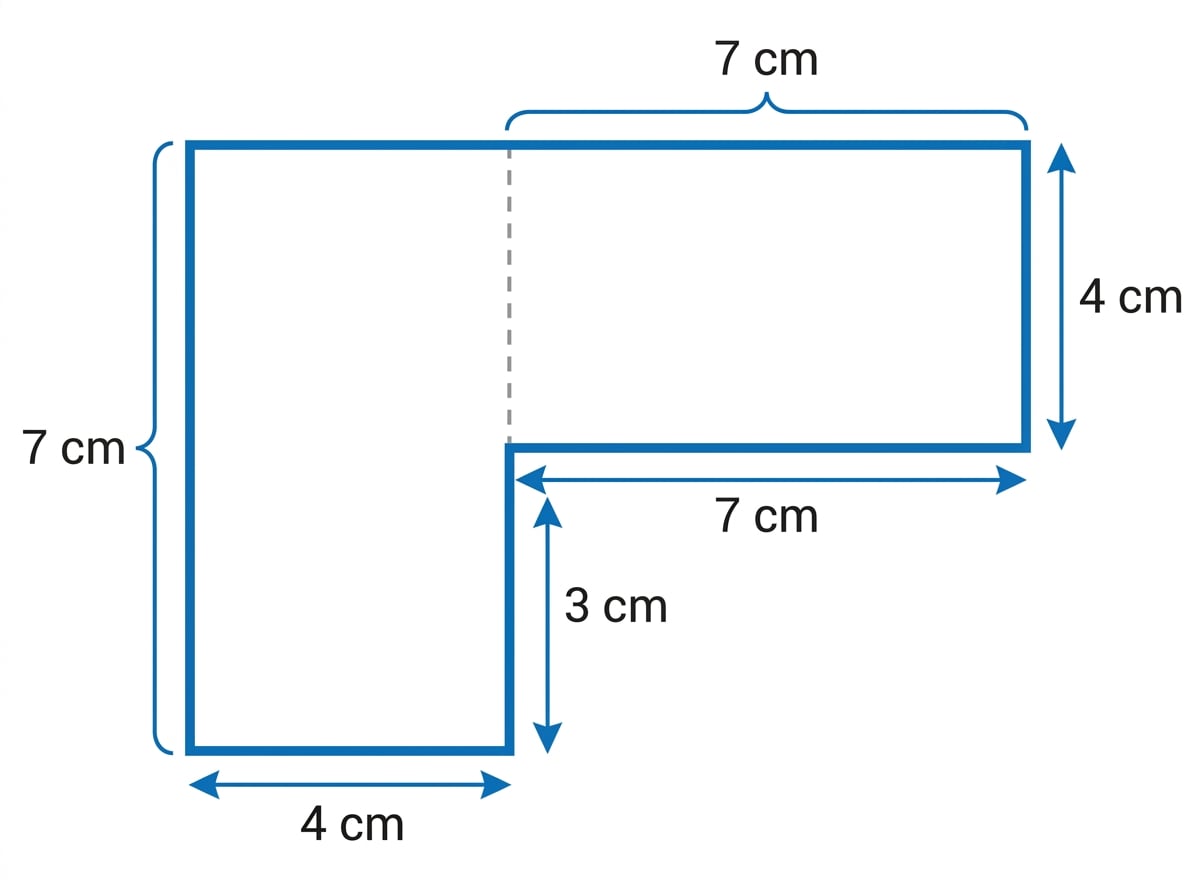
For perimeter, you only count the outside boundary. Any joined edge inside the shape is not part of the perimeter.
Example
Perimeter of a six-sided shape
Two identical rectangles, each 6 cm by 3 cm, are joined to make a step-shaped six-sided shape. The outside edges are 6 cm, 6 cm, 3 cm, 3 cm, 3 cm and 9 cm. Find the perimeter.
-
Perimeter means add the outside edges only.
-
Write down the outside lengths.
6+6+3+3+3+96 + 6 + 3 + 3 + 3 + 96+6+3+3+3+9 -
Add them carefully.
6+6+3+3+3+9=30 cm6 + 6 + 3 + 3 + 3 + 9 = 30\text{ cm}6+6+3+3+3+9=30 cm
Tip
Trace with your finger
In a compound perimeter question, trace around the outside with your finger or pencil. Tick each side as you add it so you do not miss or double-count a side.
Trapeziums
A trapezium is a four-sided shape with one pair of parallel sides.
For area, you need the two parallel side lengths and the perpendicular height.
Key Idea
Trapezium area formula
The area of a trapezium is:
A=12(a+b)hA = \frac{1}{2}(a+b)hA=21(a+b)hHere, aaa and bbb are the parallel sides, and hhh is the perpendicular height.
A good way to remember it is: add the parallel sides, halve the result, then multiply by the height.
Example
Area of a trapezium
A garden is shaped like a trapezium. The parallel sides are 6 m and 12 m, and the perpendicular height is 5 m. Find the area.
-
Add the two parallel sides.
6+12=186 + 12 = 186+12=18 -
Halve the total.
18÷2=918 \div 2 = 918÷2=9 -
Multiply by the perpendicular height.
9×5=45 m29 \times 5 = 45\text{ m}^29×5=45 m2
Example
Finding the height of a trapezium
A trapezium has area 42 cm². Its parallel sides are 4 cm and 8 cm. Find the perpendicular height.
-
Start with the trapezium area formula.
A=12(a+b)hA = \frac{1}{2}(a+b)hA=21(a+b)h -
Substitute the known values.
42=12(4+8)h42 = \frac{1}{2}(4+8)h42=21(4+8)h -
Add the parallel sides.
42=12×12h42 = \frac{1}{2} \times 12h42=21×12h -
Half of 12 is 6.
42=6h42 = 6h42=6h -
Divide by 6.
h=7h = 7h=7
Common Mistake
Forgetting to add both parallel sides
In a trapezium, do not just multiply one base by the height. Add the two parallel sides first, then halve.
Exam technique
In the exam
-
Decide first: are you finding area or perimeter? This tells you whether to multiply for space inside or add around the outside.
-
Label the formula before substituting numbers, especially for triangles, parallelograms and trapeziums.
-
Check your units at the end: cm² or m² for area, cm or m for perimeter.
Self review
Check yourself
- Can you explain why the area of a triangle is half of base times height?
- If a square has perimeter 40 cm, what would you do first to find its area?
- In a compound shape, how can you tell which sides should not be counted in the perimeter?

Recap questions
Test yourself with 5 quick questions on this guide. Answer them all correctly to complete it.
You've reached the end
Test yourself on this topic, or move on to the next guide.
How was this guide?