A Streetcar Named Desire: Plot and destructive confrontation
Dramatic irony
A situation in which the audience understands something that one or more characters do not.
- Arrival: Blanche DuBois arrives at Stella and Stanley's New Orleans apartment after losing Belle Reve and conceals details of her recent past.
- Conflict: Stanley investigates Blanche while her hopes for security with Mitch collapse as information about Laurel becomes public.
- Ending: After Stanley rapes Blanche, Stella chooses not to believe her account and Blanche is removed to an institution.
- Stanley's exposure of Blanche's lies is not equivalent to justice; the play distinguishes factual revelation from the violent power used to destroy her.
A Streetcar Named Desire: Desire, illusion and power
- Illusion: Blanche uses costume, dim light and stories to defend a fragile identity, while the play asks why some illusions are tolerated and others punished.
- Desire: Sexual desire sustains Stella's marriage, shapes Blanche's vulnerability and drives the streetcar journey named in the title.
- Power and violence: Stanley's physical, economic and patriarchal authority turns the apartment into a contested territory he ultimately controls.
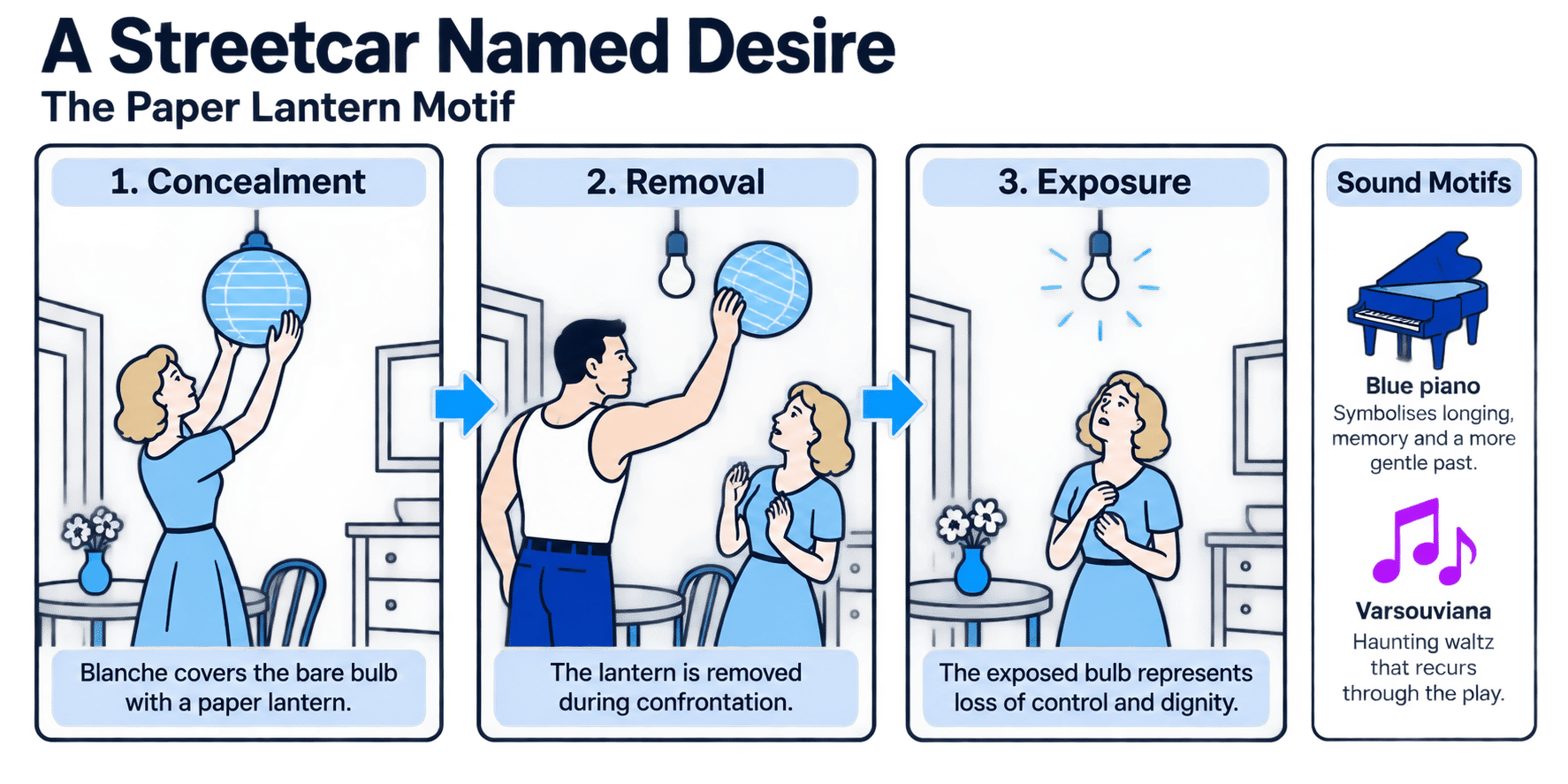
- Trace the paper lantern from concealment to removal to show how light becomes a struggle over dignity and domination.
A Streetcar Named Desire: Stagecraft, symbols and dramatic irony
- Expressionist sound: The blue piano and Varsouviana externalise memory, desire and panic rather than functioning as realistic background alone.
- Light: Blanche avoids exposure and covers the bulb, making illumination a recurring struggle over age, truth and control.
- Dramatic irony: Audiences recognise contradictions in Blanche's performance before every character possesses the facts, producing sympathy as well as doubt.
- Discuss sexual violence with precision and avoid blaming Blanche's behaviour for Stanley's assault.
A Streetcar Named Desire: Context, comparison and exam use
- Context: First performed in 1947, the play stages post-war New Orleans against the decline of the plantation South and changing class power.
- Comparison: Compare it with tragedy by asking how personal vulnerability and social power combine to produce destruction.
- Exam route: Track one stage motif across Blanche's arrival, confrontation and removal, linking theatrical form to her loss of control.
- Why does Blanche come to New Orleans?
- How does Stanley establish power?
- What do music and light reveal?
- Why is Stella's final choice morally troubling?
Developing a critical argument
A strong response to A Streetcar Named Desire by Tennessee Williams should move beyond retelling and build a clear interpretation of how meaning develops. Begin with the central tension, relationship or idea that the text explores, then trace how it changes across the work or extract. Each paragraph should make a claim that can be debated, support it with a brief and precise reference, and explain how the writer’s choices shape the reader’s understanding. Where the evidence allows more than one reading, acknowledge the alternative and explain why one interpretation is more convincing. This creates a sustained argument instead of a sequence of disconnected observations.
Evidence, method and context
When analysing A Streetcar Named Desire by Tennessee Williams, choose evidence for analytical value rather than length. Focus on individual words, images, contrasts, patterns of sound or syntax, narrative viewpoint, dramatic action, form and structural turning points. Name a method only when the term helps the explanation. The essential move is to connect the detail to its immediate effect and then to the larger theme or character development. Context should clarify the text rather than replace analysis: link relevant social, historical, literary or biographical knowledge directly to a specific choice in the writing, and avoid broad background paragraphs that could apply to any text.
Exam application
Before writing about A Streetcar Named Desire by Tennessee Williams, turn the question into a provisional argument and select three or four moments that show development, contrast or complication. Organise the response around ideas rather than following the text mechanically. Use topic sentences to answer the question, embed concise quotations, and end each paragraph by returning to the significance of the evidence. Reserve time to discuss the ending or final movement because it often confirms, unsettles or transforms the text’s earlier concerns. In the final check, remove unsupported assertions, replace vague comments such as “this makes the reader want to read on” with precise effects, and confirm that every paragraph advances the same overall interpretation.