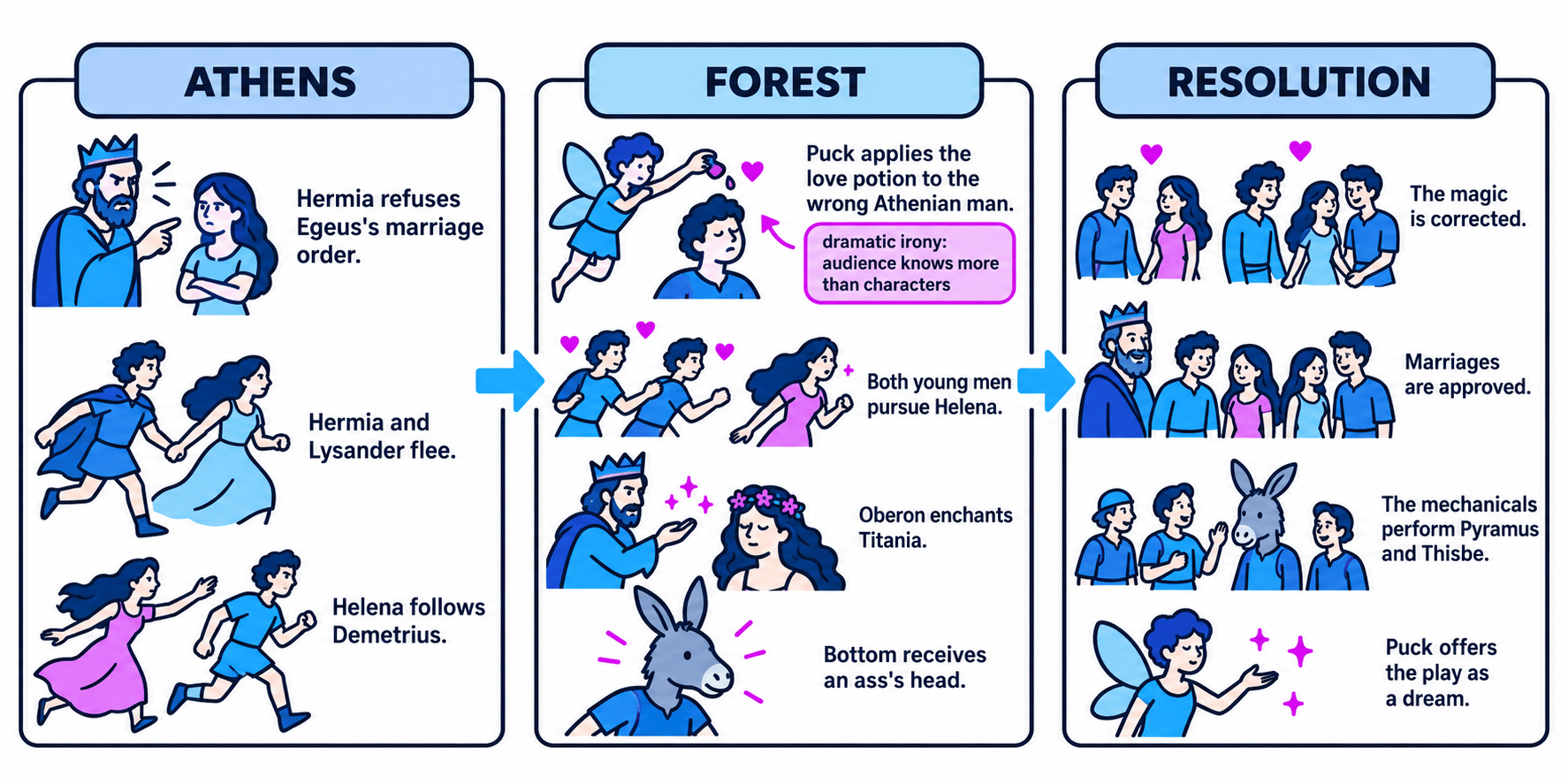
A Midsummer Night's Dream: Plot and comic entanglement
Dramatic irony
A situation in which the audience understands something that one or more characters do not.
- Athens: Hermia resists Egeus's order to marry Demetrius and flees with Lysander while Helena follows in pursuit of Demetrius.
- Forest: Puck's mistaken use of a love potion redirects both young men towards Helena as Oberon also enchants Titania to love the transformed Bottom.
- Resolution: Magic is corrected, marriages are approved and the mechanicals perform Pyramus and Thisbe before Puck offers the play as a dream.
- The happy ending restores social order, but the forest has exposed how easily love, authority and identity can be manipulated.
A Midsummer Night's Dream: Love, authority and transformation
- Love: Changing attractions expose desire as powerful, irrational and influenced by perception rather than stable merit.
- Authority: Athenian fathers and rulers claim power over marriage, while the forest temporarily disrupts legal and social hierarchy.
- Transformation: Magic makes emotional change visible through altered lovers, Titania's infatuation and Bottom's ass's head.
- Analyse Puck's error through audience knowledge and stage movement to show dramatic irony turning romantic certainty into comedy.
A Midsummer Night's Dream: Stagecraft, language and dramatic irony
- Dramatic irony: The audience understands Puck's error and the enchantments while characters treat magically produced desire as sincere.
- Parallel plots: Court, lovers, fairies and mechanicals mirror one another, testing love and performance at different social levels.
- Metatheatre: Pyramus and Thisbe and Puck's epilogue remind audiences that theatrical illusion can produce truth, embarrassment and pleasure.
- Do not treat the forest as simple freedom; Oberon's control of Titania and Puck shows that magic can reproduce coercion.
A Midsummer Night's Dream: Context, comparison and exam use
- Context: Likely written around 1595-96, the comedy draws on classical myth, English folklore and festive traditions associated with marriage and midsummer.
- Comparison: Compare it with comedy by asking how disorder permits challenges to authority before the ending restores or revises social order.
- Exam route: Connect one enchanted misunderstanding to a later resolution, explaining how stage knowledge creates comedy and unease.
- Why do the lovers enter the forest?
- How does magic destabilise desire?
- What does Bottom contribute?
- How does the final play comment on theatre?
Developing a critical argument
A strong response to A Midsummer Night's Dream by William Shakespeare should move beyond retelling and build a clear interpretation of how meaning develops. Begin with the central tension, relationship or idea that the text explores, then trace how it changes across the work or extract. Each paragraph should make a claim that can be debated, support it with a brief and precise reference, and explain how the writer’s choices shape the reader’s understanding. Where the evidence allows more than one reading, acknowledge the alternative and explain why one interpretation is more convincing. This creates a sustained argument instead of a sequence of disconnected observations.
Evidence, method and context
When analysing A Midsummer Night's Dream by William Shakespeare, choose evidence for analytical value rather than length. Focus on individual words, images, contrasts, patterns of sound or syntax, narrative viewpoint, dramatic action, form and structural turning points. Name a method only when the term helps the explanation. The essential move is to connect the detail to its immediate effect and then to the larger theme or character development. Context should clarify the text rather than replace analysis: link relevant social, historical, literary or biographical knowledge directly to a specific choice in the writing, and avoid broad background paragraphs that could apply to any text.
Exam application
Before writing about A Midsummer Night's Dream by William Shakespeare, turn the question into a provisional argument and select three or four moments that show development, contrast or complication. Organise the response around ideas rather than following the text mechanically. Use topic sentences to answer the question, embed concise quotations, and end each paragraph by returning to the significance of the evidence. Reserve time to discuss the ending or final movement because it often confirms, unsettles or transforms the text’s earlier concerns. In the final check, remove unsupported assertions, replace vague comments such as “this makes the reader want to read on” with precise effects, and confirm that every paragraph advances the same overall interpretation.