3.3.1 Units of concentration
Concentration
Solute
The substance that dissolves in a solvent to form a solution.
Solution
A mixture formed when a solute dissolves completely and spreads evenly through a solvent.
Concentration
The quantity of solute dissolved in each cubic decimetre of solution, measured in g/dm3\text{g/dm}^3g/dm3 or mol/dm3\text{mol/dm}^3mol/dm3.
- When a solute dissolves in a solvent such as water, it spreads evenly through the liquid to form a solution.
- The concentration of a solution tells you how much solute is present in a fixed volume of that solution.
- A concentrated solution has a large amount of solute in a given volume, while a dilute solution has a small amount in the same volume.
- In terms of particles, a more concentrated solution has more solute particles in each unit of volume, so they are closer together.
- Adding more water to a solution makes it more dilute, because the same amount of solute is spread through a larger volume.
- Concentration is always measured per volume of the final solution, not per volume of solvent added.
The cubic decimetre
Cubic decimetre
A unit of volume, written dm3\text{dm}^3dm3, equal to the volume of a cube with sides 10 cm10\ \text{cm}10 cm long, which is 1000 cm31000\ \text{cm}^31000 cm3.
- Chemists measure the volume of a solution in cubic decimetres, written dm3\text{dm}^3dm3, rather than in litres.
- A cubic decimetre is the volume of a cube 10 cm10\ \text{cm}10 cm long on every side, so it holds 10×10×10=1000 cm310 \times 10 \times 10 = 1000\ \text{cm}^310×10×10=1000 cm3.
- One dm3\text{dm}^3dm3 is the same volume as one litre, which is about the size of a large carton of juice.
- Smaller volumes, such as those read from a measuring cylinder or a burette, are measured in cubic centimetres, cm3\text{cm}^3cm3.
Concentration in grams per cubic decimetre
- A concentration in g/dm3\text{g/dm}^3g/dm3 gives the mass of solute in grams dissolved in each 1 dm31\ \text{dm}^31 dm3 of solution.
- Read the unit as "grams per cubic decimetre", where the solidus, ///, means "per".
- A solution labelled 40 g/dm340\ \text{g/dm}^340 g/dm3 contains 40 g40\ \text{g}40 g of solute in every 1 dm31\ \text{dm}^31 dm3 of solution.
- This unit is useful when the mass of solute has been measured on a balance.
- The same unit is sometimes printed as g dm−3\text{g dm}^{-3}g dm−3, which means exactly the same thing.
Concentration in moles per cubic decimetre
- A concentration in mol/dm3\text{mol/dm}^3mol/dm3 gives the amount of solute in moles dissolved in each 1 dm31\ \text{dm}^31 dm3 of solution.
- The mole, symbol mol\text{mol}mol, is the unit chemists use for an amount of substance, and it counts particles rather than measuring their mass.
- Read the unit as "moles per cubic decimetre".
- A bottle of dilute hydrochloric acid labelled 1.0 mol/dm31.0\ \text{mol/dm}^31.0 mol/dm3 contains 1.0 mol1.0\ \text{mol}1.0 mol of hydrogen chloride in every 1 dm31\ \text{dm}^31 dm3 of solution.
- Most laboratory solutions, such as acids and alkalis, have their concentrations given in mol/dm3\text{mol/dm}^3mol/dm3.
- The same unit is sometimes printed as mol dm−3\text{mol dm}^{-3}mol dm−3.
Comparing concentrations
- Two concentrations can be compared directly only when they are given in the same unit.
- Within one unit, the larger number always means the more concentrated solution.
- A 2.0 mol/dm32.0\ \text{mol/dm}^32.0 mol/dm3 solution of sodium hydroxide is twice as concentrated as a 1.0 mol/dm31.0\ \text{mol/dm}^31.0 mol/dm3 solution of sodium hydroxide.
- Always write the unit with the number, because 0.50.50.5 on its own could mean 0.5 g/dm30.5\ \text{g/dm}^30.5 g/dm3 or 0.5 mol/dm30.5\ \text{mol/dm}^30.5 mol/dm3, which are very different amounts.
Reading concentration labels
- A bottle of sulfuric acid in the school laboratory is labelled 0.5 mol/dm30.5\ \text{mol/dm}^30.5 mol/dm3.
- Every 1 dm31\ \text{dm}^31 dm3 of this acid contains 0.5 mol0.5\ \text{mol}0.5 mol of sulfuric acid.
- A sugar solution made for a food test is labelled 40 g/dm340\ \text{g/dm}^340 g/dm3.
- Every 1 dm31\ \text{dm}^31 dm3 of this solution contains 40 g40\ \text{g}40 g of dissolved sugar.
- Do not write g/cm3\text{g/cm}^3g/cm3 for a concentration, because that unit is used for density.
- Do not measure concentration per volume of solvent, because it is always per dm3\text{dm}^3dm3 of the final solution.
- Do not leave out the unit after a concentration, because the number alone does not show whether mass or moles was used.
- What does the concentration of a solution measure?
- Which two units are used for concentration?
- How many cm3\text{cm}^3cm3 are there in 1 dm31\ \text{dm}^31 dm3?
- What does a concentration of 25 g/dm325\ \text{g/dm}^325 g/dm3 mean?
- What is the difference between a concentrated solution and a dilute solution?
3.3.2 The mole, molar mass and gas volume calculations
The mole
Mole
The unit of amount of substance, symbol mol\text{mol}mol, where one mole of a substance contains 6.02×10236.02 \times 10^{23}6.02×10²³ particles.
Avogadro constant
The number of particles, such as atoms, ions or molecules, in one mole of a substance, equal to 6.02×10236.02 \times 10^{23}6.02×10²³.
- Atoms are far too small to count one by one, so chemists count them in very large, fixed-size groups called moles.
- The mole, symbol mol\text{mol}mol, is the unit of amount of substance.
- One mole of any substance contains 6.02×10236.02 \times 10^{23}6.02×10²³ particles, and this number is the Avogadro constant.
- The particles being counted can be atoms, ions or molecules, so you must always say which particle you mean.
- One mole of helium contains 6.02×10236.02 \times 10^{23}6.02×10²³ atoms, while one mole of carbon dioxide contains 6.02×10236.02 \times 10^{23}6.02×10²³ molecules.
- The number of particles in a sample is found using number of particles=amount (mol)×6.02×10²³\text{number of particles} = \text{amount (mol)} \times 6.02 \times 10^{23}number of particles=amount (mol)×6.02×10²³.
- Rearranging gives amount (mol)=number of particles6.02×1023\text{amount (mol)} = \dfrac{\text{number of particles}}{6.02 \times 10^{23}}amount (mol)=6.02×10²³number of particles.
- One mole of a compound can contain more than one mole of a particular atom or ion, depending on its formula.
- One mole of H2O\text{H}_2\text{O}H2O contains 2 mol2\ \text{mol}2 mol of hydrogen atoms and 1 mol1\ \text{mol}1 mol of oxygen atoms.
- One mole of CaCl2\text{CaCl}_2CaCl2 contains 1 mol1\ \text{mol}1 mol of Ca2+\text{Ca}^{2+}Ca2+ ions and 2 mol2\ \text{mol}2 mol of Cl−\text{Cl}^-Cl− ions.
Counting particles
- A sample contains 0.250 mol0.250\ \text{mol}0.250 mol of water molecules.
- Each water molecule contains three atoms, so the number of atoms is three times larger.
Molar mass
Molar mass
The mass of one mole of a substance, measured in g/mol\text{g/mol}g/mol.
- The molar mass, MMM, of a substance is the mass of one mole of it, measured in g/mol\text{g/mol}g/mol.
- The molar mass has the same numerical value as the relative mass of the particles.
- For atoms, the molar mass equals ArA_rAr, so 1 mol1\ \text{mol}1 mol of carbon atoms has a mass of 12 g12\ \text{g}12 g.
- For molecules and ionic compounds, the molar mass equals MrM_rMr, so 1 mol1\ \text{mol}1 mol of water has a mass of 18 g18\ \text{g}18 g.
- The key relationship is amount of substance (mol)=mass (g)molar mass (g/mol)\text{amount of substance (mol)} = \dfrac{\text{mass (g)}}{\text{molar mass (g/mol)}}amount of substance (mol)=molar mass (g/mol)mass (g).
- In symbols this is n=mMn = \dfrac{m}{M}n=Mm, which rearranges to m=n×Mm = n \times Mm=n×M and M=mnM = \dfrac{m}{n}M=nm.
- Finding MMM from a measured mass and amount tells you the ArA_rAr or MrM_rMr, because they have the same numerical value.
- The mass must be in grams, so convert a mass in kilograms by multiplying by 100010001000.
Amount and mass
- Calcium carbonate, CaCO3\text{CaCO}_3CaCO3, has Mr=40+12+(3×16)=100M_r = 40 + 12 + (3 \times 16) = 100Mr=40+12+(3×16)=100, so its molar mass is 100 g/mol100\ \text{g/mol}100 g/mol.
- Sodium hydroxide, NaOH\text{NaOH}NaOH, has Mr=23+16+1=40M_r = 23 + 16 + 1 = 40Mr=23+16+1=40, so 0.400 mol0.400\ \text{mol}0.400 mol of it has the mass below.
Identifying an element from its molar mass
- A sample of a metal containing 0.150 mol0.150\ \text{mol}0.150 mol of atoms has a mass of 3.60 g3.60\ \text{g}3.60 g.
- The metal has Ar=24A_r = 24Ar=24, so it is magnesium.
Particles from a mass
- A sample of carbon dioxide, Mr=44M_r = 44Mr=44, has a mass of 4.40 g4.40\ \text{g}4.40 g.
Molar gas volume
Molar gas volume
The volume occupied by one mole of any gas, taken as 24 dm324\ \text{dm}^324 dm3 at room temperature and pressure.
- At the same temperature and pressure, one mole of any gas takes up the same volume, whichever gas it is.
- This is because gas particles are very far apart, so the volume depends on the number of particles and hardly at all on their size.
- At room temperature and pressure, r.t.p., one mole of any gas is taken to occupy 24 dm324\ \text{dm}^324 dm3, which is 24 000 cm324\,000\ \text{cm}^324000 cm3.
- For a gas volume in dm3\text{dm}^3dm3, use amount (mol)=volume (dm3)24\text{amount (mol)} = \dfrac{\text{volume (dm}^3\text{)}}{24}amount (mol)=24volume (dm3).
- For a gas volume in cm3\text{cm}^3cm3, use amount (mol)=volume (cm3)24 000\text{amount (mol)} = \dfrac{\text{volume (cm}^3\text{)}}{24\,000}amount (mol)=24000volume (cm3).
- Rearranging gives volume (dm3)=amount (mol)×24\text{volume (dm}^3\text{)} = \text{amount (mol)} \times 24volume (dm3)=amount (mol)×24.
- These relationships apply only to gases, and only at r.t.p.
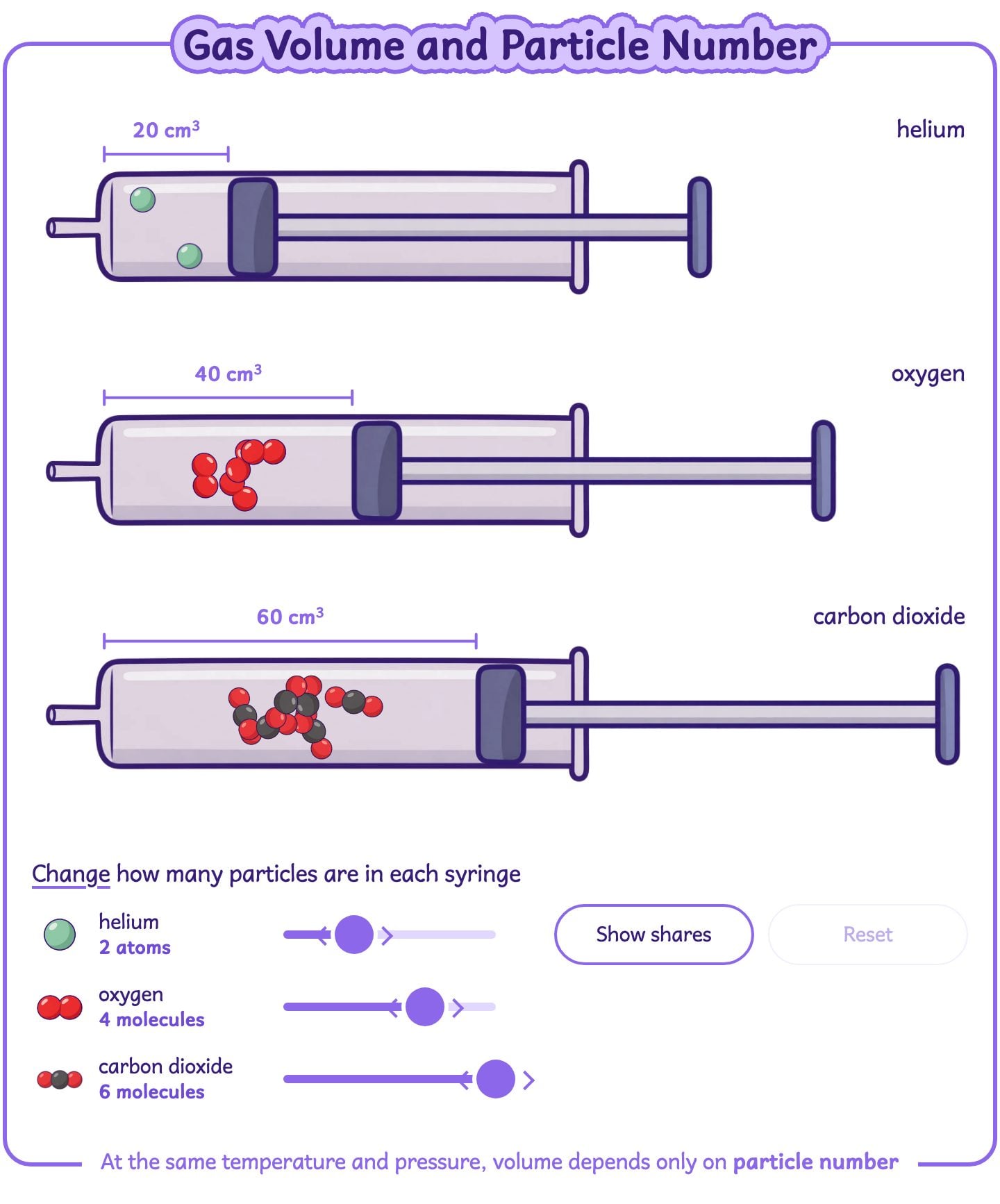
Change the number of gas particles and notice the volume depends only on particle number at the same conditions.
Gas volume calculations
- A sample of 0.350 mol0.350\ \text{mol}0.350 mol of oxygen at r.t.p. has the volume below.
- A volume of 600 cm3600\ \text{cm}^3600 cm3 of hydrogen at r.t.p. contains the amount below.
- A mass of 8.80 g8.80\ \text{g}8.80 g of carbon dioxide is 8.8044=0.200 mol\frac{8.80}{44} = 0.200\ \text{mol}448.80=0.200 mol, so its volume at r.t.p. is found next.
Reacting masses and gas volumes
- The coefficients in a balanced equation give the mole ratio of the reactants and products.
- N2+3H2→2NH3\text{N}_2 + 3\text{H}_2 \rightarrow 2\text{NH}_3N2+3H2→2NH3 means that 1 mol1\ \text{mol}1 mol of nitrogen reacts with 3 mol3\ \text{mol}3 mol of hydrogen to make 2 mol2\ \text{mol}2 mol of ammonia.
- A stoichiometric calculation uses this mole ratio to link the amount of one substance to the amount of another.
- Work through these steps in order:
- Convert the quantity you know into moles.
- Use the mole ratio from the equation to find the moles of the substance you want.
- Convert these moles into the mass, gas volume or solution volume that is asked for.
- For gases at r.t.p., the mole ratio is also the volume ratio, because equal amounts of gas occupy equal volumes.
- In H2+Cl2→2HCl\text{H}_2 + \text{Cl}_2 \rightarrow 2\text{HCl}H2+Cl2→2HCl, 30 cm330\ \text{cm}^330 cm3 of hydrogen reacts with 30 cm330\ \text{cm}^330 cm3 of chlorine to make 60 cm360\ \text{cm}^360 cm3 of hydrogen chloride.
Mass of product from mass of reactant
2Mg(s)+O2(g)→2MgO(s) 2\text{Mg(s)} + \text{O}_2\text{(g)} \rightarrow 2\text{MgO(s)} 2Mg(s)+O2(g)→2MgO(s)- A mass of 6.00 g6.00\ \text{g}6.00 g of magnesium is 6.0024=0.250 mol\frac{6.00}{24} = 0.250\ \text{mol}246.00=0.250 mol.
- The mole ratio Mg:MgO\text{Mg}:\text{MgO}Mg:MgO is 2:22:22:2, which is 1:11:11:1, so 0.250 mol0.250\ \text{mol}0.250 mol of magnesium oxide forms.
Gas volume from mass of reactant
CaCO3(s)+2HCl(aq)→CaCl2(aq)+H2O(l)+CO2(g) \text{CaCO}_3\text{(s)} + 2\text{HCl(aq)} \rightarrow \text{CaCl}_2\text{(aq)} + \text{H}_2\text{O(l)} + \text{CO}_2\text{(g)} CaCO3(s)+2HCl(aq)→CaCl2(aq)+H2O(l)+CO2(g)- A mass of 5.00 g5.00\ \text{g}5.00 g of calcium carbonate is 5.00100=0.0500 mol\frac{5.00}{100} = 0.0500\ \text{mol}1005.00=0.0500 mol.
- The mole ratio CaCO3:CO2\text{CaCO}_3 : \text{CO}_2CaCO3:CO2 is 1:11:11:1, so 0.0500 mol0.0500\ \text{mol}0.0500 mol of carbon dioxide forms.
Mass of reactant from a gas volume
2H2O2(aq)→2H2O(l)+O2(g) 2\text{H}_2\text{O}_2\text{(aq)} \rightarrow 2\text{H}_2\text{O(l)} + \text{O}_2\text{(g)} 2H2O2(aq)→2H2O(l)+O2(g)- A volume of 480 cm3480\ \text{cm}^3480 cm3 of oxygen at r.t.p. is 48024 000=0.0200 mol\frac{480}{24\,000} = 0.0200\ \text{mol}24000480=0.0200 mol.
- The mole ratio H2O2:O2\text{H}_2\text{O}_2 : \text{O}_2H2O2:O2 is 2:12:12:1, so 0.0400 mol0.0400\ \text{mol}0.0400 mol of hydrogen peroxide decomposed.
- Hydrogen peroxide has Mr=(2×1)+(2×16)=34M_r = (2 \times 1) + (2 \times 16) = 34Mr=(2×1)+(2×16)=34.
Limiting reactants
Limiting reactant
The reactant that is completely used up first in a reaction, so it decides the maximum amount of product that can form.
Excess reactant
A reactant present in more than the amount needed to react completely, so some of it is left over when the reaction stops.
- Reactants are often mixed in amounts that do not match the mole ratio in the equation.
- The reaction stops when the limiting reactant has been used up, and the leftover reactant is said to be in excess.
- The amount of product always depends on the limiting reactant and never on the reactant in excess.
- Making cheese sandwiches works the same way, because each sandwich needs two slices of bread and one slice of cheese.
- With 101010 slices of bread and 888 slices of cheese you can make only 555 sandwiches, so the bread is limiting and 333 slices of cheese are left over.
- Find the limiting reactant by following these steps:
- Convert the quantity of each reactant into moles.
- Divide each amount by the coefficient of that reactant in the balanced equation.
- The reactant with the smaller answer is the limiting reactant.
- Use the moles of the limiting reactant and the mole ratio to find the amount of product.
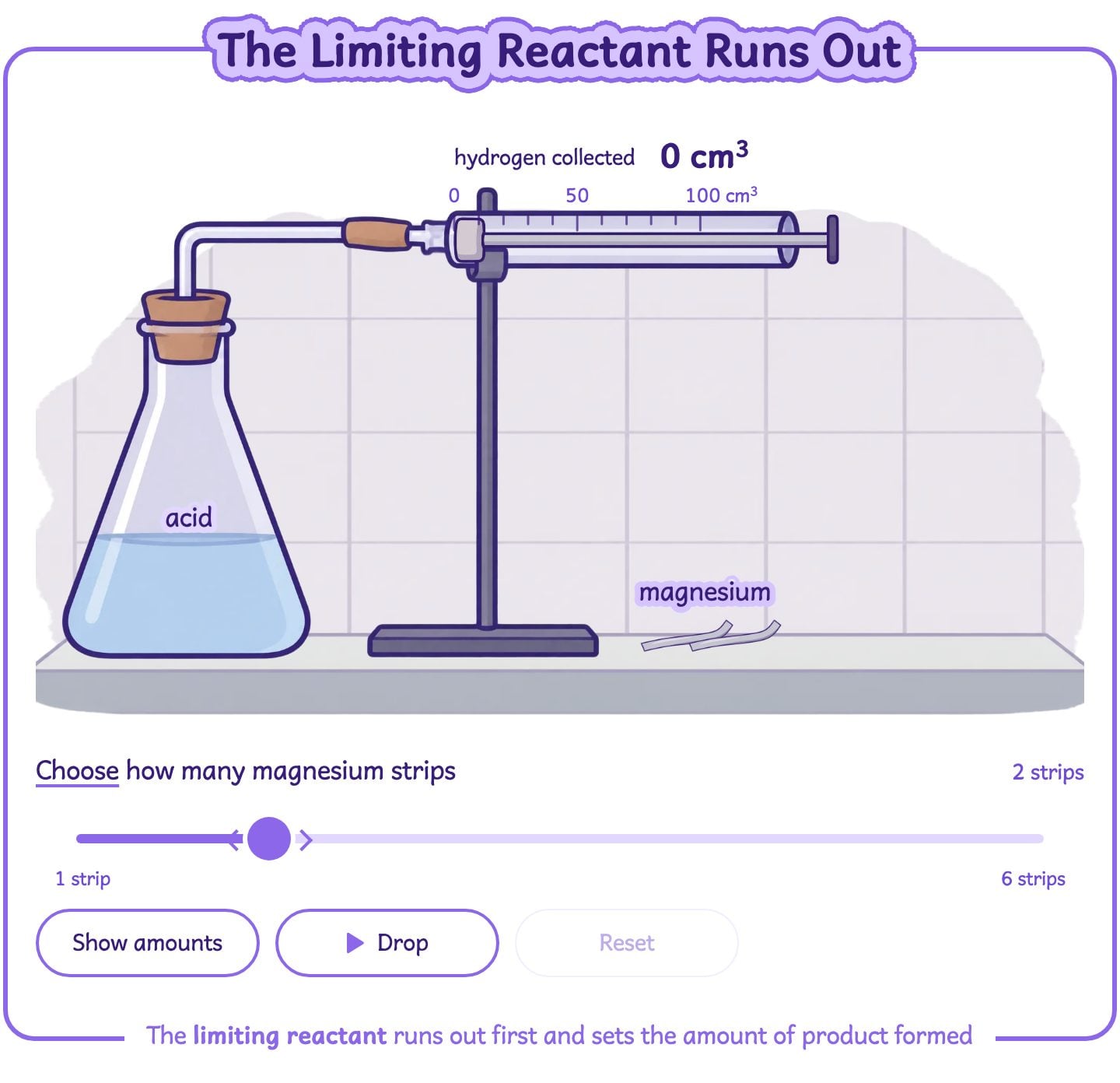
Change the amounts and notice the reactant that runs out first limits how much product forms.
Finding the limiting reactant
Mg(s)+2HCl(aq)→MgCl2(aq)+H2(g) \text{Mg(s)} + 2\text{HCl(aq)} \rightarrow \text{MgCl}_2\text{(aq)} + \text{H}_2\text{(g)} Mg(s)+2HCl(aq)→MgCl2(aq)+H2(g)- A 2.40 g2.40\ \text{g}2.40 g piece of magnesium is 2.4024=0.100 mol\frac{2.40}{24} = 0.100\ \text{mol}242.40=0.100 mol, and it is added to acid containing 0.150 mol0.150\ \text{mol}0.150 mol of HCl\text{HCl}HCl.
- Dividing by the coefficients gives 0.1001=0.100\frac{0.100}{1} = 0.10010.100=0.100 for magnesium and 0.1502=0.0750\frac{0.150}{2} = 0.075020.150=0.0750 for hydrochloric acid.
- Hydrochloric acid gives the smaller value, so it is the limiting reactant and magnesium is in excess.
- The mole ratio HCl:H2\text{HCl}:\text{H}_2HCl:H2 is 2:12:12:1, so 0.0750 mol0.0750\ \text{mol}0.0750 mol of hydrogen forms.
Concentration calculations
Concentration
The quantity of solute dissolved in each cubic decimetre of solution, measured in g/dm3\text{g/dm}^3g/dm3 or mol/dm3\text{mol/dm}^3mol/dm3.
- Concentration links the quantity of dissolved solute to the volume of the solution.
- The concentration in moles is concentration (mol/dm3)=amount of solute (mol)volume of solution (dm3)\text{concentration (mol/dm}^3\text{)} = \dfrac{\text{amount of solute (mol)}}{\text{volume of solution (dm}^3\text{)}}concentration (mol/dm3)=volume of solution (dm3)amount of solute (mol).
- The concentration by mass is concentration (g/dm3)=mass of solute (g)volume of solution (dm3)\text{concentration (g/dm}^3\text{)} = \dfrac{\text{mass of solute (g)}}{\text{volume of solution (dm}^3\text{)}}concentration (g/dm3)=volume of solution (dm3)mass of solute (g).
- The volume must be in dm3\text{dm}^3dm3, so convert a volume in cm3\text{cm}^3cm3 by dividing by 100010001000.
- A volume of 250 cm3250\ \text{cm}^3250 cm3 is 2501000=0.250 dm3\frac{250}{1000} = 0.250\ \text{dm}^31000250=0.250 dm3.
- To change dm3\text{dm}^3dm3 back into cm3\text{cm}^3cm3, multiply by 100010001000.
- In symbols, c=nVc = \dfrac{n}{V}c=Vn rearranges to n=c×Vn = c \times Vn=c×V and V=ncV = \dfrac{n}{c}V=cn.
- To change a concentration in mol/dm3\text{mol/dm}^3mol/dm3 into g/dm3\text{g/dm}^3g/dm3, multiply by the molar mass of the solute.
- To change a concentration in g/dm3\text{g/dm}^3g/dm3 into mol/dm3\text{mol/dm}^3mol/dm3, divide by the molar mass of the solute.
Concentration of a prepared solution
- A mass of 5.85 g5.85\ \text{g}5.85 g of sodium chloride is dissolved in water and made up to 500 cm3500\ \text{cm}^3500 cm3, which is 0.500 dm30.500\ \text{dm}^30.500 dm3.
- Sodium chloride has Mr=23+35.5=58.5M_r = 23 + 35.5 = 58.5Mr=23+35.5=58.5, so the amount dissolved is 5.8558.5=0.100 mol\frac{5.85}{58.5} = 0.100\ \text{mol}58.55.85=0.100 mol.
Amount and volume from a concentration
- A 25.0 cm325.0\ \text{cm}^325.0 cm3 portion of 0.200 mol/dm30.200\ \text{mol/dm}^30.200 mol/dm3 sodium hydroxide has a volume of 0.0250 dm30.0250\ \text{dm}^30.0250 dm3.
- The volume of 0.250 mol/dm30.250\ \text{mol/dm}^30.250 mol/dm3 solution that contains 0.0500 mol0.0500\ \text{mol}0.0500 mol of solute is found by rearranging.
Titration calculations
Titre
The volume of solution added from the burette to reach the end-point of a titration.
Concordant titres
Titres from repeated titrations that agree closely with one another and are used to calculate the mean titre.
- A titration finds the exact volume of one solution that reacts with a measured volume of another.
- The titre is the volume added from the burette, found by subtracting the initial burette reading from the final reading.
- The titration is repeated, and the mean titre is calculated using only the concordant titres.
- From titres of 24.3024.3024.30, 23.6523.6523.65 and 23.75 cm323.75\ \text{cm}^323.75 cm3, the first value is left out because it does not agree with the others.
- The mean titre is 23.65+23.752=23.70 cm3\frac{23.65 + 23.75}{2} = 23.70\ \text{cm}^3223.65+23.75=23.70 cm3.
- With the mean titre, the calculation follows these steps:
- Use n=c×Vn = c \times Vn=c×V to find the moles in the solution whose concentration and volume are both known.
- Use the mole ratio from the balanced equation to find the moles of the other solute.
- Use c=nVc = \dfrac{n}{V}c=Vn to find an unknown concentration, or V=ncV = \dfrac{n}{c}V=cn to find an unknown volume.
- Multiply by the molar mass if the concentration is needed in g/dm3\text{g/dm}^3g/dm3.
- Every volume must be converted from cm3\text{cm}^3cm3 into dm3\text{dm}^3dm3 before it goes into n=c×Vn = c \times Vn=c×V.
Concentration of sodium hydroxide
- A 25.0 cm325.0\ \text{cm}^325.0 cm3 portion of sodium hydroxide is neutralised by a mean titre of 20.0 cm320.0\ \text{cm}^320.0 cm3 of 0.100 mol/dm30.100\ \text{mol/dm}^30.100 mol/dm3 nitric acid.
- The mole ratio is 1:11:11:1, so the sodium hydroxide also contains 0.00200 mol0.00200\ \text{mol}0.00200 mol.
- Sodium hydroxide has Mr=40M_r = 40Mr=40, so the concentration by mass is 0.0800×40=3.20 g/dm30.0800 \times 40 = 3.20\ \text{g/dm}^30.0800×40=3.20 g/dm3.
Titration with a 1 to 2 mole ratio
- A 25.0 cm325.0\ \text{cm}^325.0 cm3 portion of 0.200 mol/dm30.200\ \text{mol/dm}^30.200 mol/dm3 sodium hydroxide is neutralised by a mean titre of 20.0 cm320.0\ \text{cm}^320.0 cm3 of sulfuric acid.
- The mole ratio H2SO4:NaOH\text{H}_2\text{SO}_4 : \text{NaOH}H2SO4:NaOH is 1:21:21:2, so the acid contains 0.005002=0.00250 mol\frac{0.00500}{2} = 0.00250\ \text{mol}20.00500=0.00250 mol.
- Do not divide a gas volume in cm3\text{cm}^3cm3 by 242424, because 242424 is the molar gas volume in dm3\text{dm}^3dm3.
- Do not use the molar gas volume for solids, liquids or solutions, because it applies only to gases.
- Do not skip the mole ratio, because the moles of two substances are equal only when the ratio is 1:11:11:1.
- Do not include a rough or anomalous titre in the mean.
- Do not round numbers partway through a calculation, because early rounding can change the final answer.
Mole calculations in the exam
- Set out each calculation as a chain of labelled steps, because a mistake in one step can still let you earn the marks for the steps after it.
- Write the unit after every value, because a missing or wrong unit on the final answer usually loses that mark.
- Give the final answer to the same number of significant figures as the least precise data in the question, which is usually three.
- Write the mole ratio out in words, such as "1 mol1\ \text{mol}1 mol of CaCO3\text{CaCO}_3CaCO3 gives 1 mol1\ \text{mol}1 mol of CO2\text{CO}_2CO2", so you never forget to use it.
- How many particles are there in one mole of a substance?
- Which equation links amount of substance, mass and molar mass?
- What volume does one mole of any gas occupy at r.t.p.?
- How do you decide which reactant is the limiting reactant?
- How many moles of solute are in 50.0 cm350.0\ \text{cm}^350.0 cm3 of a 0.200 mol/dm30.200\ \text{mol/dm}^30.200 mol/dm3 solution?
3.3.3 Empirical formulae, yield and purity calculations
Empirical formulae from masses
Empirical formula
A formula that shows the simplest whole-number ratio of the atoms or ions of each element in a compound.
- A formula shows a ratio of atoms, but analysing a compound gives the masses of the elements in it.
- Dividing each mass by the ArA_rAr of that element turns the masses into amounts in moles, and moles of atoms can be compared directly.
- Find an empirical formula by following these steps:
- Write down the mass of each element in the compound.
- Divide each mass by the ArA_rAr of that element to find its amount in moles.
- Divide every amount by the smallest amount.
- If any value is not close to a whole number, multiply all the values by the same small whole number.
- Write the empirical formula using the whole numbers as subscripts.
- When the data are percentages by mass, treat each percentage as the mass in grams of that element in a 100 g100\ \text{g}100 g sample.
- When the mass of one element is not given, find it by subtracting the masses of the other elements from the total mass of the compound.
- Some ratios must be scaled up rather than rounded.
- A value close to 1.51.51.5 means every value is multiplied by 222.
- A value close to 1.331.331.33 or 1.671.671.67 means every value is multiplied by 333.
- A value close to 1.251.251.25 or 1.751.751.75 means every value is multiplied by 444.
- Round to the nearest whole number only when a value is very close to it, such as 1.981.981.98 or 3.023.023.02, because small differences come from rounding in the data.
Empirical formula from masses
- A compound contains 11.2 g11.2\ \text{g}11.2 g of iron and 4.80 g4.80\ \text{g}4.80 g of oxygen.
- Dividing both amounts by 0.2000.2000.200 gives the ratio 1:1.51:1.51:1.5.
- Multiplying both values by 222 gives the whole-number ratio 2:32:32:3.
Empirical formula from percentages
- A hydrocarbon contains 85.7%85.7\%85.7% carbon and 14.3%14.3\%14.3% hydrogen by mass, so a 100 g100\ \text{g}100 g sample contains 85.7 g85.7\ \text{g}85.7 g of carbon and 14.3 g14.3\ \text{g}14.3 g of hydrogen.
- Dividing both amounts by 7.147.147.14 gives the ratio 1:2.001:2.001:2.00.
Finding the formula of magnesium oxide
- Aim: to find the empirical formula of magnesium oxide by measuring the mass of magnesium that burns and the mass of oxide it forms.
- Apparatus: a crucible with a lid, a pipeclay triangle, a tripod, a Bunsen burner, a heat-resistant mat, crucible tongs, a balance reading to 0.01 g0.01\ \text{g}0.01 g, about 15 cm15\ \text{cm}15 cm of magnesium ribbon, emery paper and eye protection.
- Method:
- Rub the magnesium ribbon with emery paper until it is shiny, which removes the dull layer of oxide from its surface.
- Weigh the empty crucible with its lid and record the mass.
- Coil the ribbon loosely, place it in the crucible, and weigh the crucible, lid and magnesium together.
- Stand the crucible in a pipeclay triangle on a tripod, put the lid on, and heat it strongly with a roaring blue flame.
- Once the magnesium starts to glow, use tongs to lift the lid slightly every minute or so, which lets oxygen in while keeping the white smoke of magnesium oxide inside.
- Keep heating until the magnesium no longer glows when the lid is lifted, which shows that it has finished reacting.
- Let the crucible cool on the heat-resistant mat with the lid on, then weigh the crucible, lid and contents.
- Heat, cool and reweigh again until two readings agree, which shows that all the magnesium has reacted.
- Results:
- The mass of the empty crucible and lid is 24.62 g24.62\ \text{g}24.62 g.
- The mass of the crucible, lid and magnesium is 24.86 g24.86\ \text{g}24.86 g, so the magnesium has a mass of 0.24 g0.24\ \text{g}0.24 g.
- The mass of the crucible, lid and magnesium oxide is 25.02 g25.02\ \text{g}25.02 g, so the oxide has a mass of 0.40 g0.40\ \text{g}0.40 g.
- The oxygen that combined has a mass of 0.40−0.24=0.16 g0.40 - 0.24 = 0.16\ \text{g}0.40−0.24=0.16 g.
- The shiny grey ribbon has turned into a white powder.
- Calculation:
- The amount of magnesium is 0.2424=0.010 mol\frac{0.24}{24} = 0.010\ \text{mol}240.24=0.010 mol and the amount of oxygen is 0.1616=0.010 mol\frac{0.16}{16} = 0.010\ \text{mol}160.16=0.010 mol.
- The ratio 0.010:0.0100.010:0.0100.010:0.010 simplifies to 1:11:11:1, so the empirical formula is MgO\text{MgO}MgO.
- Watch out:
- Lifting the lid too far lets white magnesium oxide smoke escape, which makes the final mass too low.
- Stopping the heating too early leaves some magnesium unreacted, which makes the mass of oxygen too low.
- Safety: wear eye protection, avoid looking straight at the burning magnesium because its light is very bright, and handle the hot crucible only with tongs.
Molecular formulae from empirical formulae
Molecular formula
A formula that shows the actual number of atoms of each different element in one molecule of a substance.
- The molecular formula is always a whole-number multiple of the empirical formula.
- To find the molecular formula, you need the empirical formula and the MrM_rMr of the compound.
- Work through these steps:
- Add up the ArA_rAr values in the empirical formula to find the empirical formula mass.
- Divide the MrM_rMr of the compound by the empirical formula mass.
- Multiply every subscript in the empirical formula by this whole number.
- If the division does not give a whole number, there is an error in an earlier step.
Molecular formula of glucose
- A compound has the empirical formula CH2O\text{CH}_2\text{O}CH2O and an MrM_rMr of 180180180.
- Multiplying every subscript by 666 gives the molecular formula C6H12O6\text{C}_6\text{H}_{12}\text{O}_6C6H12O6.
Molecular formula of a hydrocarbon
- The hydrocarbon with the empirical formula CH2\text{CH}_2CH2 has an MrM_rMr of 565656.
- Multiplying every subscript by 444 gives the molecular formula C4H8\text{C}_4\text{H}_8C4H8.
Percentage composition by mass
Percentage composition by mass
The percentage of the total mass of a compound that is made up by one particular element.
- The percentage by mass of an element in a compound is found using percentage by mass=number of atoms of the element×ArMr×100\text{percentage by mass} = \dfrac{\text{number of atoms of the element} \times A_r}{M_r} \times 100percentage by mass=Mrnumber of atoms of the element×Ar×100.
- Count every atom of the element, including any atoms inside brackets.
- The percentages of all the elements in a compound add up to 100%100\%100%, which gives a useful check.
- Percentage composition lets you compare compounds, such as which of two compounds supplies more nitrogen per kilogram.
Percentage of nitrogen in two compounds
- Calcium nitrate, Ca(NO3)2\text{Ca(NO}_3\text{)}_2Ca(NO3)2, has Mr=40+2×(14+48)=164M_r = 40 + 2 \times (14 + 48) = 164Mr=40+2×(14+48)=164 and contains two nitrogen atoms.
- Ammonium nitrate, NH4NO3\text{NH}_4\text{NO}_3NH4NO3, has Mr=14+4+14+48=80M_r = 14 + 4 + 14 + 48 = 80Mr=14+4+14+48=80 and also contains two nitrogen atoms.
Percentage yield
Theoretical yield
The maximum mass of product that could form from the reactants, calculated from the balanced equation.
Actual yield
The mass of product that is actually obtained at the end of a reaction.
Percentage yield
The actual yield of a product expressed as a percentage of its theoretical yield.
- The theoretical yield is calculated from the balanced equation, assuming that all of the limiting reactant turns into product.
- The actual yield is the mass of product that is really collected at the end.
- The percentage yield is percentage yield=actual yieldtheoretical yield×100\text{percentage yield} = \dfrac{\text{actual yield}}{\text{theoretical yield}} \times 100percentage yield=theoretical yieldactual yield×100.
- The actual yield is almost always smaller than the theoretical yield.
- The reaction may not go to completion, especially if it is reversible.
- Some product is lost when it is filtered, poured from one container to another or purified.
- Some of the reactants may form other, unwanted products.
- A percentage yield above 100%100\%100% is impossible, and it usually means the product is still wet or contains impurities.
Percentage yield of calcium oxide
CaCO3→CaO+CO2 \text{CaCO}_3 \rightarrow \text{CaO} + \text{CO}_2 CaCO3→CaO+CO2- Heating 10.0 g10.0\ \text{g}10.0 g of calcium carbonate uses 10.0100=0.100 mol\frac{10.0}{100} = 0.100\ \text{mol}10010.0=0.100 mol.
- The mole ratio is 1:11:11:1, so the theoretical yield of calcium oxide is 0.100×56=5.60 g0.100 \times 56 = 5.60\ \text{g}0.100×56=5.60 g.
- The actual yield collected is 4.76 g4.76\ \text{g}4.76 g.
Percentage purity
Percentage purity
The mass of the pure substance in a sample expressed as a percentage of the total mass of the sample.
- Many substances, such as medicines, foods and metal ores, contain impurities that are not the substance you want.
- The percentage purity is percentage purity=mass of pure substancetotal mass of sample×100\text{percentage purity} = \dfrac{\text{mass of pure substance}}{\text{total mass of sample}} \times 100percentage purity=total mass of samplemass of pure substance×100.
- The mass of pure substance is often found from a reaction, using the mass or volume of a product and the balanced equation.
- Purity matters most in medicines and foods, because even a small amount of a harmful impurity can make a product unsafe.
Purity of a limestone sample
CaCO3(s)+2HCl(aq)→CaCl2(aq)+H2O(l)+CO2(g) \text{CaCO}_3\text{(s)} + 2\text{HCl(aq)} \rightarrow \text{CaCl}_2\text{(aq)} + \text{H}_2\text{O(l)} + \text{CO}_2\text{(g)} CaCO3(s)+2HCl(aq)→CaCl2(aq)+H2O(l)+CO2(g)- A 5.00 g5.00\ \text{g}5.00 g sample of limestone reacts with excess acid and gives 1.08 dm31.08\ \text{dm}^31.08 dm3 of carbon dioxide at r.t.p.
- The amount of carbon dioxide is 1.0824=0.0450 mol\frac{1.08}{24} = 0.0450\ \text{mol}241.08=0.0450 mol, so the sample contained 0.0450 mol0.0450\ \text{mol}0.0450 mol of calcium carbonate.
- The mass of pure calcium carbonate is 0.0450×100=4.50 g0.0450 \times 100 = 4.50\ \text{g}0.0450×100=4.50 g.
- Do not divide masses by proton numbers, because an empirical formula calculation always uses ArA_rAr values.
- Do not round a ratio such as 1:1.51:1.51:1.5 to 1:21:21:2, because it must be doubled to give 2:32:32:3.
- Do not put the theoretical yield on the top of the percentage yield fraction.
- Do not put the mass of the impurity on the top of the percentage purity fraction.
Formula and percentage calculations
- Set out empirical formula working in columns, with a row for mass, a row for moles and a row for the ratio, so every step is clear to the examiner.
- Keep at least three significant figures in mole values until the final ratio, because early rounding can hide a ratio such as 1:1.331:1.331:1.33.
- Check that any percentage yield or percentage purity you calculate is below 100%100\%100%.
- When asked for a molecular formula, show the empirical formula mass and the multiplier as well as the final formula.
- Why must the mass of each element be divided by its ArA_rAr when finding an empirical formula?
- What should you do when a mole ratio comes out as 1:1.51:1.51:1.5?
- How do you find a molecular formula from an empirical formula and an MrM_rMr?
- What is the percentage by mass of nitrogen in NH4NO3\text{NH}_4\text{NO}_3NH4NO3?
- Which yield goes on the bottom of the percentage yield fraction?