Metallic bonding
Definition
Metallic bonding
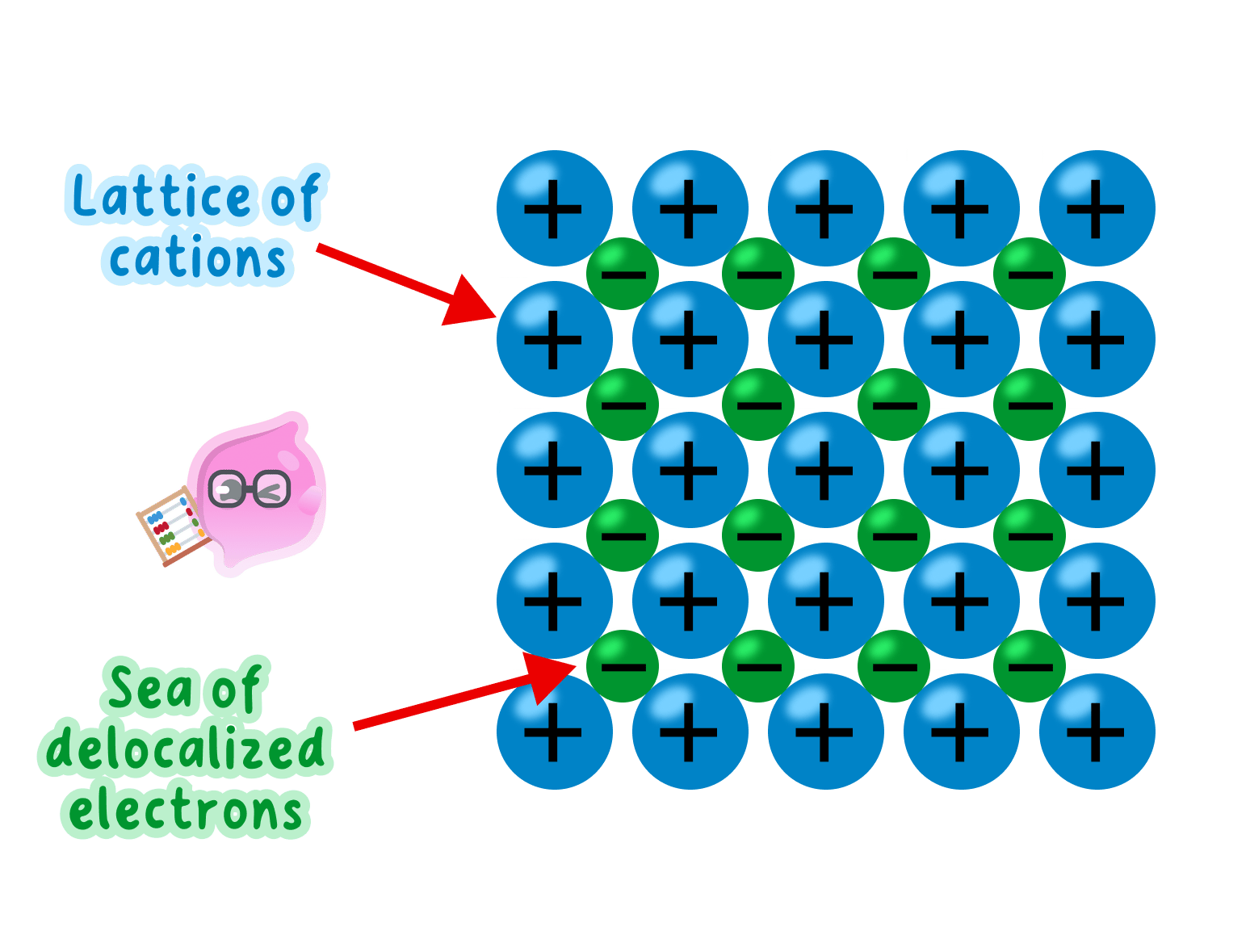
The electrostatic attraction between the positive metal ions in a giant lattice and the sea of delocalised electrons surrounding them.
Definition
Delocalised electrons
Electrons that are not held by one particular atom or bond and are free to move through a structure.
- In a solid metal, the atoms are packed closely together in a regular arrangement called a giant metallic lattice.
- Each metal atom loses its outer-shell electrons, which turns the atoms into positive ions.
- The electrons that have been lost do not belong to any one ion, so they become delocalised and move freely throughout the whole lattice.
- These delocalised electrons form a sea of electrons that surrounds the positive ions.
- Metallic bonding is the electrostatic attraction between the positive ions and the sea of delocalised electrons.
- The attraction acts in all directions, so each positive ion is held in the lattice by the electrons all around it.
- In magnesium, each atom gives up its two outer-shell electrons, so the lattice is made of Mg2+\text{Mg}^{2+}Mg2+ ions surrounded by a sea of delocalised electrons.
Electrical conductivity of metals
- Metals are good conductors of electricity, because they contain delocalised electrons that are free to move through the lattice.
- When a voltage is applied across a piece of metal, the delocalised electrons drift through the lattice towards the positive terminal.
- This flow of charged electrons through the metal is an electric current.
- The delocalised electrons are present whether the metal is solid or liquid, so metals conduct in both states.
- The positive ions stay in their places in the lattice and do not carry the current.
Malleability and ductility
Definition
Malleable
Able to be hammered or pressed into a new shape without breaking.
Definition
Ductile
Able to be drawn out into thin wires without breaking.
- The positive ions in a metal lattice are arranged in layers.
- When a force is applied to a metal, the layers of positive ions can slide over one another into new positions.
- The delocalised electrons move with the ions, so the metallic bonding is not broken and still holds the ions together in their new positions.
- Metals can therefore change shape without breaking.
- Metals are malleable, so they can be hammered or rolled into thin sheets, such as aluminium foil.
- Metals are ductile, so they can be drawn out into thin wires, such as copper wire.
- An ionic lattice behaves differently, because sliding a layer brings ions with the same charge next to each other, so they repel and the crystal shatters.
Example
Copper in electrical wiring
- Copper has a giant metallic lattice of positive ions surrounded by a sea of delocalised electrons.
- The delocalised electrons can move through the lattice and carry charge, so copper is a good conductor of electricity.
- The layers of copper ions can slide over one another without the metallic bonding breaking, so copper is ductile and can be drawn into long, thin wires.
- A metal used for wiring needs both properties, so copper is well suited to the job.
Common Mistake
- Do not say that the positive ions move to carry the current in a metal, because it is the delocalised electrons that move.
- Do not describe metallic bonding as an attraction between protons and electrons, or between atoms, because the attraction is between positive ions and delocalised electrons.
- Do not say that bonds break when a metal is bent, because the layers slide while the metallic bonding holds them together.
Exam technique
Describing metallic bonding
- Describe metallic bonding with all three parts: electrostatic attraction, positive ions and a sea of delocalised electrons.
- For conductivity, say that the delocalised electrons can move through the structure and carry charge.
- For malleability and ductility, say that the layers of ions slide over one another and the metallic bonding keeps the metal in one piece.
Self review
- What is metallic bonding?
- What particles carry the electric current in a metal?
- Why can the layers in a metal slide without the metal breaking?
- What is the difference between malleable and ductile?
- Why does an ionic crystal shatter when its layers are forced to slide?
