Multiple covalent bonds
Definition
Double covalent bond
A covalent bond in which two pairs of electrons are shared between the same two atoms.
Definition
Triple covalent bond
A covalent bond in which three pairs of electrons are shared between the same two atoms.
- Some atoms need more than one extra electron to fill their outer shell, but bond to only one other atom.
- These atoms fill their outer shells by sharing more than one pair of electrons with the same atom.
- A double covalent bond contains two shared pairs of electrons, which is four electrons in total, and is shown as a double line, such as O=O\text{O}=\text{O}O=O.
- A triple covalent bond contains three shared pairs of electrons, which is six electrons in total, and is shown as a triple line, such as N≡N\text{N}\equiv\text{N}N≡N.
- In a dot-and-cross diagram, every shared pair is still drawn in the overlap of the two outer shells, with one dot and one cross in each pair.
Oxygen and nitrogen molecules
- An oxygen molecule, O2\text{O}_2O2, is made of two oxygen atoms, each with the configuration 2,62,62,6 and so each needing two more electrons.
- Each oxygen atom shares two of its electrons, so the overlap contains two pairs, each with one dot and one cross, forming a double bond.
- Each oxygen atom keeps two non-bonding pairs, so it ends up with 4+4=84+4=84+4=8 outer-shell electrons.
- A nitrogen molecule, N2\text{N}_2N2, is made of two nitrogen atoms, each with the configuration 2,52,52,5 and so each needing three more electrons.
- Each nitrogen atom shares three of its electrons, so the overlap contains three pairs, forming a triple bond.
- Each nitrogen atom keeps one non-bonding pair, so it ends up with 6+2=86+2=86+2=8 outer-shell electrons.
Methanol and ethene
- A methanol molecule, CH3OH\text{CH}_3\text{OH}CH3OH, contains one carbon atom, one oxygen atom and four hydrogen atoms, all joined by single bonds.
- The carbon atom forms four single bonds, three to hydrogen atoms and one to the oxygen atom, and has no non-bonding pairs.
- The oxygen atom forms two single bonds, one to the carbon atom and one to a hydrogen atom, and keeps two non-bonding pairs, exactly as it does in water.
- Every hydrogen atom shares one pair of electrons, so each has 2 outer-shell electrons.
- An ethene molecule, C2H4\text{C}_2\text{H}_4C2H4, contains two carbon atoms and four hydrogen atoms.
- Each carbon atom forms single bonds with two hydrogen atoms, which uses two of its four outer-shell electrons.
- Each carbon atom shares its remaining two outer-shell electrons with the other carbon atom, forming a carbon-carbon double bond, C=C\text{C}=\text{C}C=C.
- Each carbon atom ends up with four shared pairs, which is 8 outer-shell electrons, and no non-bonding pairs.
Carbon dioxide
- A carbon dioxide molecule, CO2\text{CO}_2CO2, has a carbon atom in the centre with an oxygen atom on each side.
- The carbon atom, 2,42,42,4, needs four more electrons, while each oxygen atom, 2,62,62,6, needs two more.
- The carbon atom forms a double bond with each oxygen atom, sharing two of its electrons with each one.
- The structure is therefore O=C=O\text{O}=\text{C}=\text{O}O=C=O, with four shared pairs around the carbon atom and two non-bonding pairs on each oxygen atom.
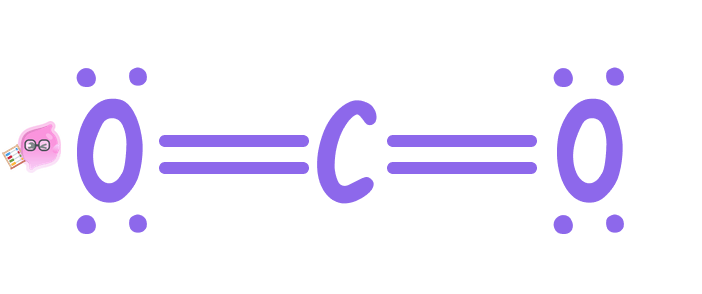
Example
Checking the diagram for carbon dioxide
- The outer-shell electrons available are 4 from carbon and 6 from each oxygen atom.
- Two double bonds use 4 of these pairs, leaving 4 pairs as non-bonding pairs, two on each oxygen atom.
- Carbon is surrounded by 4 shared pairs, which is 8 electrons.
- Each oxygen atom has 2 shared pairs and 2 non-bonding pairs, which is also 8 electrons.
Example
Checking the diagram for methanol
- The outer-shell electrons available are 4 from carbon, 6 from oxygen and 1 from each of the four hydrogen atoms.
- Five single bonds, four from carbon and one between oxygen and hydrogen, use 5 of these pairs.
- The remaining 2 pairs are the two non-bonding pairs on the oxygen atom.
Explaining the properties of simple molecules
Definition
Intermolecular forces
The weak forces of attraction that act between neighbouring molecules.
- A simple molecular substance contains two very different kinds of attraction.
- The covalent bonds within each molecule are strong.
- The intermolecular forces between neighbouring molecules are weak.
- When a simple molecular substance melts or boils, only the weak intermolecular forces are overcome, so the molecules separate while staying intact.
- Only a small amount of energy is needed to overcome these weak forces, so simple molecular substances have low melting points and boiling points.
- Oxygen boils at −183 ∘C-183\ ^{\circ}\text{C}−183 ∘C and nitrogen boils at −196 ∘C-196\ ^{\circ}\text{C}−196 ∘C.
- Carbon dioxide turns directly from a solid into a gas at −78 ∘C-78\ ^{\circ}\text{C}−78 ∘C, and ethene boils at −104 ∘C-104\ ^{\circ}\text{C}−104 ∘C.
- Methanol is a liquid at room temperature and boils at 65 ∘C65\ ^{\circ}\text{C}65 ∘C.
- When water boils, the steam is still made of H2O\text{H}_2\text{O}H2O molecules, which shows that the covalent bonds have not been broken.
- Simple molecular substances are poor conductors of electricity in every state, because their molecules have no overall charge and there are no ions or delocalised electrons free to move.
Common Mistake
- Do not say that covalent bonds are broken when a simple molecular substance melts or boils, because only the intermolecular forces are overcome.
- Do not describe covalent bonds as weak, because it is the forces between the molecules that are weak.
- Do not draw a double bond with a single dot and cross, because a double bond needs two pairs of shared electrons.
Exam technique
Explaining low boiling points
- A full explanation names the weak intermolecular forces, states that little energy is needed to overcome them, and refers to the substance being made of molecules.
- In dot-and-cross diagrams with double or triple bonds, count the shared pairs carefully and make sure each atom other than hydrogen ends with 8 outer-shell electrons.
- Show every non-bonding pair, because missing pairs on oxygen or nitrogen are a common reason for losing the mark.
Self review
- How many pairs of electrons are shared in a triple covalent bond?
- How many non-bonding pairs does each oxygen atom have in a carbon dioxide molecule?
- Which bond in ethene is a double bond?
- What is overcome when methanol boils?
- Why does nitrogen have a very low boiling point?
