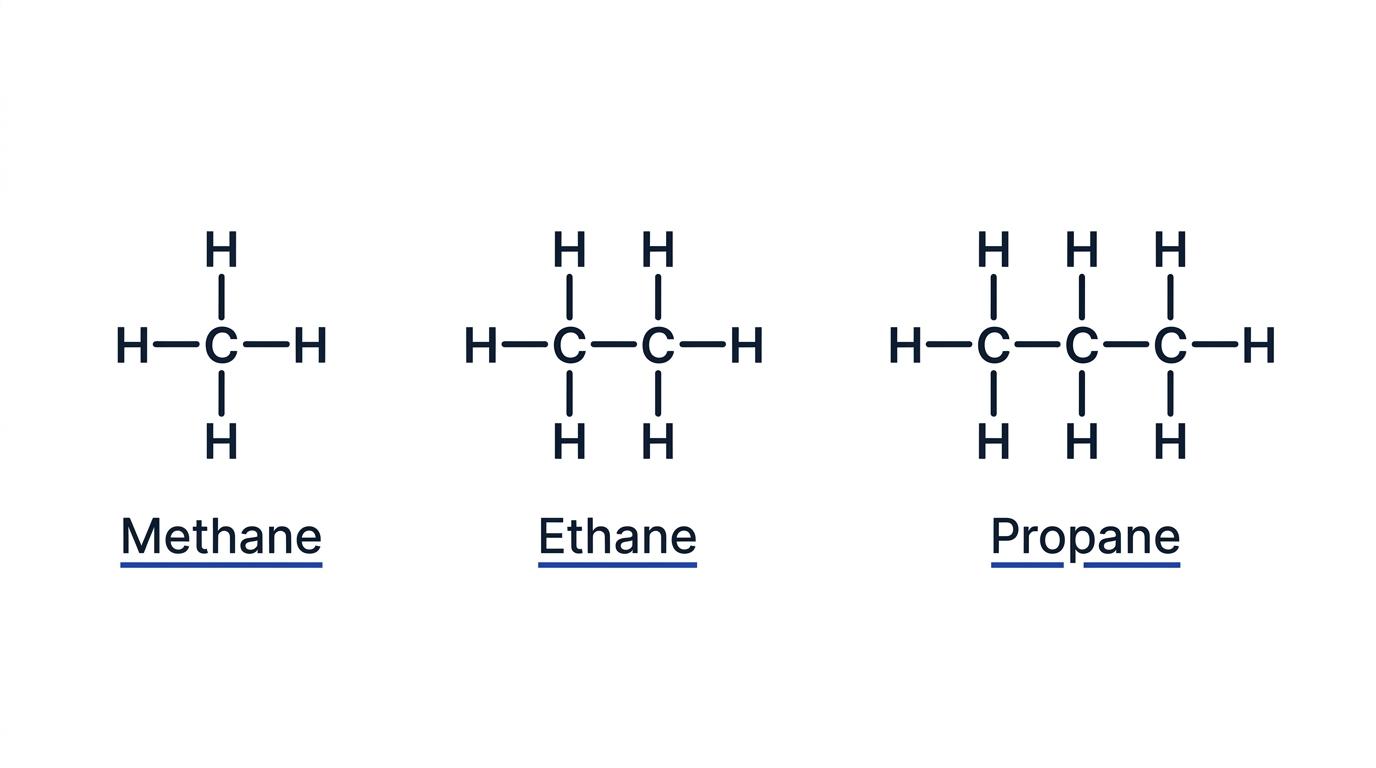
11.4.1 Alkanes and their properties
Bonding in alkanes
Alkane
A saturated hydrocarbon in which every bond between atoms is a single covalent bond.
- Alkanes are a family of hydrocarbons, so their molecules contain carbon and hydrogen atoms only.
- Every bond in an alkane molecule is a single covalent bond.
- A single covalent bond is one shared pair of electrons between two atoms.
- The carbon atoms are joined to each other by C−C\text{C}-\text{C}C−C single bonds, and the hydrogen atoms are joined to carbon by C−H\text{C}-\text{H}C−H single bonds.
- Each carbon atom forms four single bonds and each hydrogen atom forms one.
- Alkanes are saturated hydrocarbons, because they contain only single bonds between their carbon atoms.
- Saturated means that every carbon atom already holds the maximum number of atoms it can bond to, so no more atoms can be added to the molecule.
- The names of alkanes all end in -ane, such as methane, ethane and propane.
Bonds in ethane and propane
- Ethane, C2H6\text{C}_2\text{H}_6C2H6, has one C−C\text{C}-\text{C}C−C bond and six C−H\text{C}-\text{H}C−H bonds, all of them single.
- Propane, C3H8\text{C}_3\text{H}_8C3H8, has two C−C\text{C}-\text{C}C−C bonds and eight C−H\text{C}-\text{H}C−H bonds.
- Counting the lines around any carbon atom gives four, which confirms that every bond is single and the molecule is saturated.
Reactivity of alkanes
- Alkanes are generally unreactive, so they do not react with most common substances.
- They do not react with acids, with alkalis or with most metals, even when warmed.
- Their C−C\text{C}-\text{C}C−C and C−H\text{C}-\text{H}C−H bonds are strong single bonds that are hard to break.
- Alkanes take part in only two types of reaction.
- Combustion, in which the alkane burns in oxygen and releases a large amount of thermal energy.
- Substitution by chlorine, in which chlorine atoms replace hydrogen atoms, but only when ultraviolet light is present.
- Because they are unreactive apart from burning, alkanes can be stored and transported safely, which makes them useful as fuels.
Complete combustion
Complete combustion
The burning of a fuel in a plentiful supply of oxygen, so that all of the carbon in the fuel is converted into carbon dioxide.
-
Complete combustion happens when an alkane burns in a plentiful supply of oxygen, such as plenty of air.
-
The products of complete combustion are carbon dioxide and water.
alkane+oxygen→carbon dioxide+water \text{alkane} + \text{oxygen} \rightarrow \text{carbon dioxide} + \text{water} alkane+oxygen→carbon dioxide+water -
All the carbon atoms end up in CO2\text{CO}_2CO2 and all the hydrogen atoms end up in H2O\text{H}_2\text{O}H2O.
-
Combustion is exothermic, so it gives out thermal energy and the surroundings get hotter.
-
Methane burns completely with a clean blue flame.
CH4(g)+2O2(g)→CO2(g)+2H2O(l) \text{CH}_4\text{(g)} + 2\text{O}_2\text{(g)} \rightarrow \text{CO}_2\text{(g)} + 2\text{H}_2\text{O(l)} CH4(g)+2O2(g)→CO2(g)+2H2O(l)
Balancing the combustion of propane
- Write the formulae of the reactants and products first.
- Balance carbon first, so three carbon atoms give 3CO23\text{CO}_23CO2.
- Balance hydrogen next, so eight hydrogen atoms give 4H2O4\text{H}_2\text{O}4H2O.
- Balance oxygen last, so the products contain 6+4=106 + 4 = 106+4=10 oxygen atoms, which need 5O25\text{O}_25O2.
- Octane, C8H18\text{C}_8\text{H}_{18}C8H18, needs 121212\tfrac{1}{2}1221 oxygen molecules, so you double every number to remove the fraction.
Incomplete combustion
Incomplete combustion
The burning of a fuel in a limited supply of oxygen, which forms carbon monoxide or carbon instead of carbon dioxide.
-
Incomplete combustion happens when an alkane burns in a limited supply of oxygen.
-
There is not enough oxygen to turn all the carbon into carbon dioxide, so carbon monoxide, CO\text{CO}CO, or carbon, C\text{C}C, forms instead.
- Water is still formed, because the hydrogen atoms are still converted into H2O\text{H}_2\text{O}H2O.
- The carbon forms as tiny solid particles called soot, which blacken surfaces.
-
Methane can burn incompletely to form carbon monoxide or carbon.
2CH4+3O2→2CO+4H2O 2\text{CH}_4 + 3\text{O}_2 \rightarrow 2\text{CO} + 4\text{H}_2\text{O} 2CH4+3O2→2CO+4H2O-
With even less oxygen, solid carbon forms.
CH4+O2→C+2H2O \text{CH}_4 + \text{O}_2 \rightarrow \text{C} + 2\text{H}_2\text{O} CH4+O2→C+2H2O
-
-
Incomplete combustion releases less thermal energy than complete combustion of the same amount of fuel.
-
The flame is yellow and smoky because glowing soot particles are present.
-
Carbon monoxide is a toxic gas with no colour or smell, so faulty gas heaters in poorly ventilated rooms are dangerous.
Incomplete combustion of propane
- With a limited supply of oxygen, propane forms carbon monoxide and water.
- There are 6+8=146 + 8 = 146+8=14 oxygen atoms on the right, so 7O27\text{O}_27O2 is needed on the left.
- With even less oxygen, the carbon is released as soot.
- The hydrogen still ends up as water in every case, so only the carbon product changes.
Testing the products of combustion
- Aim: to show that burning a hydrocarbon fuel produces water and carbon dioxide.
- Apparatus: small spirit burner or candle, inverted glass funnel, rubber tubing, U-tube standing in a beaker of ice, boiling tube of limewater, water pump or filter pump, anhydrous copper(II) sulfate, clamp stands and eye protection.
- Method:
- Clamp the funnel upside down a few centimetres above the burner and connect it by tubing to the U-tube in the ice.
- Connect the outlet of the U-tube to a delivery tube dipping into about 5 cm35\ \text{cm}^35 cm3 of limewater, and connect the limewater tube to the pump.
- Light the burner and switch on the pump, so that the gases from the flame are drawn through the cold U-tube and then through the limewater.
- Run the apparatus for about five minutes and watch the U-tube and the limewater.
- Add a small amount of the liquid from the U-tube to some white anhydrous copper(II) sulfate.
- Results:
- A colourless liquid collects in the cold U-tube and turns white anhydrous copper(II) sulfate blue.
- The limewater turns milky.
- Conclusion: the colourless liquid is water and the gas is carbon dioxide, so the fuel contains both hydrogen and carbon.
- Safety: wear eye protection, keep loose hair and paper away from the flame, keep the funnel high enough that it does not overheat, and switch off the pump only after the flame is out.
- Do not call alkanes completely unreactive, because they do undergo combustion and substitution with chlorine.
- Do not leave water out of the products of incomplete combustion, because the hydrogen still forms H2O\text{H}_2\text{O}H2O.
- Do not say that carbon monoxide causes acid rain, because carbon monoxide is toxic and acid rain is caused by other oxides.
Writing about combustion
- State the condition as "plentiful oxygen" or "limited oxygen", because just saying "oxygen" does not tell the two types apart.
- Name the products in full, writing carbon dioxide and water for complete combustion and carbon monoxide or carbon plus water for incomplete combustion.
- Balance a combustion equation in the order carbon, hydrogen, oxygen, and double everything if you end up with half an oxygen molecule.
- Describe alkanes as saturated because they have only single bonds, using both key words.
- What type of bond joins the atoms in an alkane?
- Why are alkanes described as saturated hydrocarbons?
- Name the two types of reaction that alkanes undergo.
- What are the products of the complete combustion of methane?
- Write a balanced equation for the incomplete combustion of methane to carbon monoxide.
11.4.2 Substitution reactions of alkanes
Substitution reactions
Substitution reaction
A reaction in which an atom or group of atoms in a molecule is swapped for a different atom or group of atoms.
-
In a substitution reaction, one atom or group of atoms in a molecule is replaced by a different atom or group of atoms.
-
Alkanes react with chlorine by substitution, so a chlorine atom takes the place of a hydrogen atom in the alkane.
-
The hydrogen atom that is removed joins the other chlorine atom from the Cl2\text{Cl}_2Cl2 molecule to form hydrogen chloride, HCl\text{HCl}HCl.
-
A substitution reaction therefore gives two products.
- The organic product is a chloroalkane, which is an alkane with a chlorine atom in place of one hydrogen atom.
- The other product is always hydrogen chloride.
-
The carbon chain itself is not changed, so the product has the same number of carbon atoms as the alkane you started with.
-
The general word equation is shown below.
alkane+chlorine→UV lightchloroalkane+hydrogen chloride \text{alkane} + \text{chlorine} \xrightarrow{\text{UV light}} \text{chloroalkane} + \text{hydrogen chloride} alkane+chlorineUV lightchloroalkane+hydrogen chloride
The need for ultraviolet light
Photochemical reaction
A reaction that only takes place when light, such as ultraviolet light, supplies the energy needed to start it.
Activation energy
The minimum energy that colliding particles must have to react, given the symbol EaE_aEa.
- A mixture of an alkane and chlorine does not react in the dark, even though both substances are present.
- The reaction only starts when the mixture is exposed to ultraviolet (UV) light, such as the UV in sunlight.
- UV light provides the activation energy, EaE_aEa, which is the minimum energy the particles need to react.
- A reaction that needs light to supply this energy is called a photochemical reaction.
- The UV light is a condition, not a reactant, so you write it above the arrow and leave it out when you balance the equation.
- When the reaction happens, the pale yellow-green colour of the chlorine fades as the chlorine is used up.
Methane and chlorine
-
Methane reacts with chlorine in UV light to form chloromethane and hydrogen chloride.
methane+chlorine→UV lightchloromethane+hydrogen chloride \text{methane} + \text{chlorine} \xrightarrow{\text{UV light}} \text{chloromethane} + \text{hydrogen chloride} methane+chlorineUV lightchloromethane+hydrogen chloride -
The balanced symbol equation uses molecular formulae.
CH4+Cl2→UV lightCH3Cl+HCl \text{CH}_4 + \text{Cl}_2 \xrightarrow{\text{UV light}} \text{CH}_3\text{Cl} + \text{HCl} CH4+Cl2UV lightCH3Cl+HCl -
The structural formula of chloromethane is CH3Cl\text{CH}_3\text{Cl}CH3Cl, showing three hydrogen atoms and one chlorine atom on the single carbon atom.
-
The displayed formula of chloromethane shows every bond, with the C−Cl\text{C}-\text{Cl}C−Cl bond in place of one C−H\text{C}-\text{H}C−H bond.
H∣H−C−Cl∣H \begin{array}{ccccc} & & \text{H} & & \\ & & | & & \\ \text{H} & - & \text{C} & - & \text{Cl} \\ & & | & & \\ & & \text{H} & & \end{array} H−H∣C∣H−Cl -
Hydrogen chloride has the displayed formula H−Cl\text{H}-\text{Cl}H−Cl.
Chlorination of methane
- Methane, CH4\text{CH}_4CH4, starts with four hydrogen atoms around one carbon atom.
- One hydrogen atom is removed and one chlorine atom takes its place, so the carbon now holds three H atoms and one Cl atom.
- The removed hydrogen atom bonds to the second chlorine atom, forming HCl\text{HCl}HCl.
- Each side has one carbon atom, four hydrogen atoms and two chlorine atoms, so the equation is balanced.
Ethane and chlorine
-
Ethane reacts with chlorine in the same way, with one hydrogen atom replaced by one chlorine atom.
C2H6+Cl2→UV lightC2H5Cl+HCl \text{C}_2\text{H}_6 + \text{Cl}_2 \xrightarrow{\text{UV light}} \text{C}_2\text{H}_5\text{Cl} + \text{HCl} C2H6+Cl2UV lightC2H5Cl+HCl -
The organic product is chloroethane, which has the structural formula CH3CH2Cl\text{CH}_3\text{CH}_2\text{Cl}CH3CH2Cl.
-
In the displayed formula, the chlorine atom is bonded to one of the two carbon atoms and every carbon atom still has four bonds.
HH∣∣H−C−C−Cl∣∣HH \begin{array}{ccccccc} & & \text{H} & & \text{H} & & \\ & & | & & | & & \\ \text{H} & - & \text{C} & - & \text{C} & - & \text{Cl} \\ & & | & & | & & \\ & & \text{H} & & \text{H} & & \end{array} H−H∣C∣H−H∣C∣H−Cl -
All six hydrogen atoms in ethane are in equivalent positions, so replacing any one of them gives the same product.
-
With excess chlorine, more hydrogen atoms can be replaced, but here you only need monosubstitution, where exactly one hydrogen atom is replaced.
Drawing the products
- Copy the carbon chain of the alkane exactly as it is.
- Remove one hydrogen atom and draw a chlorine atom bonded to that carbon instead.
- Check that every carbon atom still has four bonds, every hydrogen atom one bond and the chlorine atom one bond.
- Add HCl\text{HCl}HCl as the second product, and write UV light above the arrow.
Monosubstitution of propane
- Propane, CH3CH2CH3\text{CH}_3\text{CH}_2\text{CH}_3CH3CH2CH3, has hydrogen atoms on its end carbons and on its middle carbon.
- Replacing a hydrogen atom on an end carbon gives 1-chloropropane.
- Replacing a hydrogen atom on the middle carbon gives 2-chloropropane.
- Both products have the molecular formula C3H7Cl\text{C}_3\text{H}_7\text{Cl}C3H7Cl, and either one is a correct monosubstituted product.
- Do not leave out HCl\text{HCl}HCl, because a substitution reaction always gives a second product.
- Do not write UV light as a reactant in the equation, because it supplies energy and contains no atoms.
- Do not replace more than one hydrogen atom when a question asks for the monosubstituted product.
- Do not confuse this with the reaction of an alkene, because an alkane has no double bond for chlorine to add across.
Writing about substitution
- Give the condition as ultraviolet light or UV light, because "light", "heat" or "a catalyst" on its own is not credited.
- Explain the role of UV light by saying that it provides the activation energy for the reaction.
- Describe the change as "a hydrogen atom is replaced by a chlorine atom", naming both atoms.
- In a displayed formula, draw every bond, including the C−Cl\text{C}-\text{Cl}C−Cl bond, and count four bonds around each carbon.
- What happens to an atom in a substitution reaction?
- Which condition is needed for an alkane to react with chlorine?
- Why is this reaction described as photochemical?
- Name the two products formed when methane reacts with chlorine.
- Give the structural formula of the organic product of ethane and chlorine.