11.6.1 Ethanol: manufacture, combustion and uses
Fermentation
Fermentation
The conversion of aqueous glucose into ethanol and carbon dioxide by enzymes in yeast in the absence of oxygen.
-
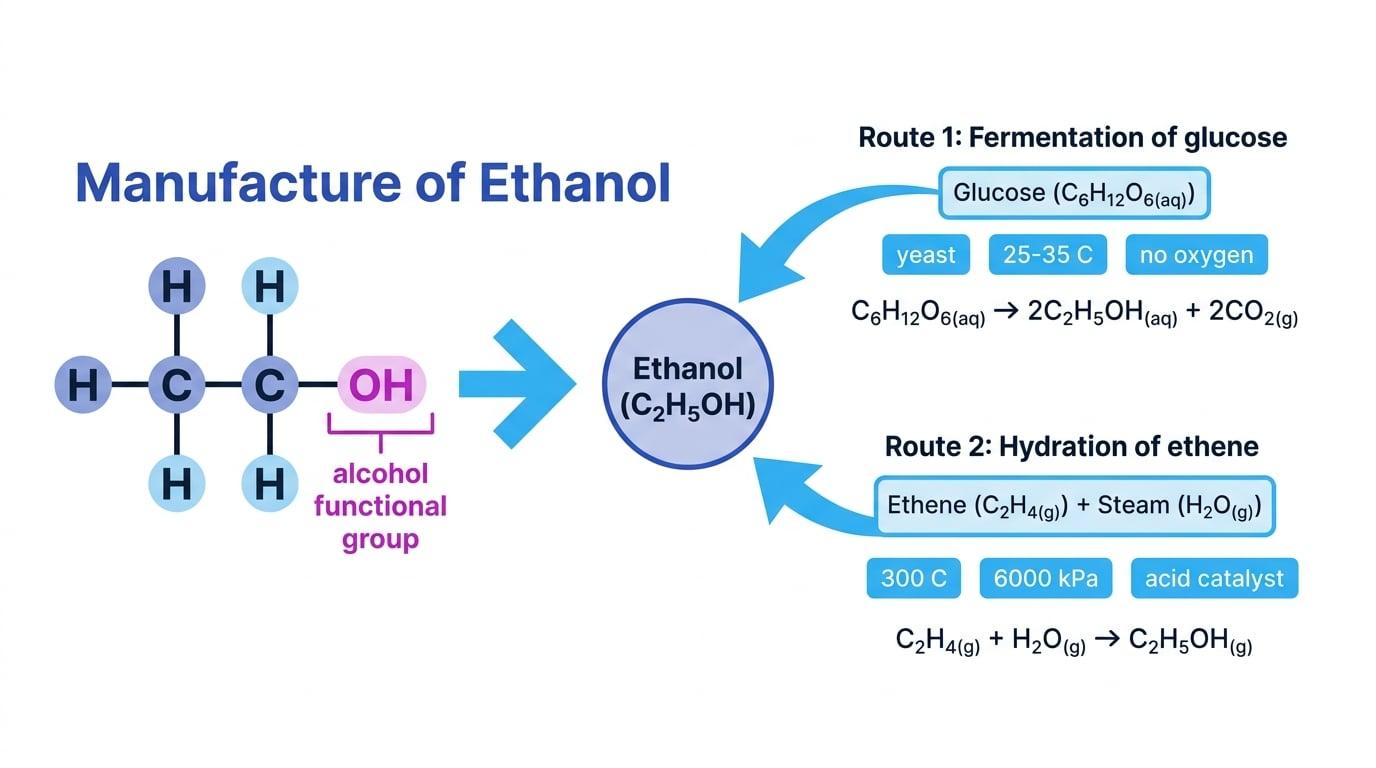
Ethanol, C2H5OH\text{C}_2\text{H}_5\text{OH}C2H5OH, is made on a large scale by two different methods: fermentation of glucose and catalytic addition of steam to ethene.
-
Fermentation starts with aqueous glucose, which is glucose dissolved in water, usually obtained from sugar-rich crops such as sugar cane or sugar beet.
-
Yeast is added to the glucose solution, because yeast cells contain enzymes that catalyse the breakdown of glucose.
-
Three conditions are needed for fermentation.
- Yeast must be present to supply the enzymes.
- The temperature is kept between 25 ∘C25\ ^\circ\text{C}25 ∘C and 35 ∘C35\ ^\circ\text{C}35 ∘C.
- Oxygen is kept out, so the process is anaerobic.
-
Below 25 ∘C25\ ^\circ\text{C}25 ∘C the enzymes work slowly, so fermentation takes much longer.
-
Above about 35 ∘C35\ ^\circ\text{C}35 ∘C the enzymes start to become denatured, so the rate falls and fermentation stops.
-
Oxygen must be excluded because, with air present, the yeast respires aerobically to make carbon dioxide and water instead of ethanol, and bacteria can oxidise the ethanol that has formed.
-
The fermentation vessel is fitted with an airlock, which lets carbon dioxide escape but stops air getting in.
-
Glucose is broken down into ethanol and carbon dioxide.
glucose→ethanol+carbon dioxide \text{glucose} \rightarrow \text{ethanol} + \text{carbon dioxide} glucose→ethanol+carbon dioxide -
The balanced symbol equation shows that one glucose molecule gives two ethanol molecules and two carbon dioxide molecules.
C6H12O6(aq)→2C2H5OH(aq)+2CO2(g) \text{C}_6\text{H}_{12}\text{O}_6\text{(aq)} \rightarrow 2\text{C}_2\text{H}_5\text{OH(aq)} + 2\text{CO}_2\text{(g)} C6H12O6(aq)→2C2H5OH(aq)+2CO2(g) -
Fermentation is slow and takes several days, with bubbles of carbon dioxide given off the whole time.
-
Fermentation stops when the glucose is used up or when the ethanol concentration reaches about 15%15\%15%, because ethanol at this concentration kills the yeast.
-
The product is a dilute aqueous solution of ethanol, so the yeast is removed by filtration and the ethanol is separated from the water by fractional distillation.
Balancing the fermentation equation
- Glucose, C6H12O6\text{C}_6\text{H}_{12}\text{O}_6C6H12O6, is the only reactant, and the products are ethanol, C2H5OH\text{C}_2\text{H}_5\text{OH}C2H5OH, and carbon dioxide, CO2\text{CO}_2CO2.
- Glucose has 12 hydrogen atoms and each ethanol molecule has 6, so 2 ethanol molecules are needed.
- Two ethanol molecules hold 4 carbon atoms, so the remaining 2 carbon atoms go into 2 carbon dioxide molecules.
- Checking oxygen, the left side has 6 atoms and the right side has 2+4=62 + 4 = 62+4=6 atoms, so the equation is balanced.
Fermenting a glucose solution
- Aim: to make ethanol by fermenting aqueous glucose with yeast and to identify the gas given off.
- Apparatus: 250 cm3250\ \text{cm}^3250 cm3 conical flask, 10 g10\ \text{g}10 g of glucose, 100 cm3100\ \text{cm}^3100 cm3 measuring cylinder, warm water, 1 g1\ \text{g}1 g of dried yeast, bung fitted with a delivery tube, boiling tube of limewater, thermostatically controlled water bath set to 30 ∘C30\ ^\circ\text{C}30 ∘C, filter funnel and filter paper, and eye protection.
- Method:
- Dissolve 10 g10\ \text{g}10 g of glucose in 100 cm3100\ \text{cm}^3100 cm3 of warm water in the conical flask and swirl until no solid remains.
- Stir in 1 g1\ \text{g}1 g of dried yeast.
- Fit the bung and delivery tube so that the end of the tube dips into limewater, which lets gas out but keeps air away from the mixture.
- Stand the flask in the water bath at 30 ∘C30\ ^\circ\text{C}30 ∘C and leave it for several days.
- When bubbling stops, filter the mixture to remove the yeast and keep the filtrate for fractional distillation.
- Results:
- Within about half an hour, bubbles rise steadily through the mixture and a froth forms on the surface.
- The limewater turns milky, showing that the gas is carbon dioxide.
- The filtrate smells of alcohol, and bubbling slows and stops after a few days.
- Conclusion: yeast ferments glucose into ethanol and carbon dioxide when it is kept warm and away from oxygen.
- Safety: wear eye protection, keep the ethanol-containing filtrate away from naked flames because ethanol is flammable, and never taste the product.
Steam addition to ethene
Catalyst
A substance that increases the rate of a reaction and is chemically unchanged at the end of the reaction.
-
The second method reacts ethene, C2H4\text{C}_2\text{H}_4C2H4, with steam, H2O\text{H}_2\text{O}H2O, to make ethanol.
-
The ethene comes from cracking large alkane molecules obtained from petroleum.
-
Three conditions are used for this reaction.
- A temperature of about 300 ∘C300\ ^\circ\text{C}300 ∘C.
- A pressure of about 6000 kPa6000\ \text{kPa}6000 kPa, which is the same as 60 atm60\ \text{atm}60 atm.
- An acid catalyst, usually phosphoric acid.
-
Steam adds across the C=C\text{C=C}C=C double bond, so ethene and steam join together to form ethanol as the only product.
ethene+steam→ethanol \text{ethene} + \text{steam} \rightarrow \text{ethanol} ethene+steam→ethanol -
The balanced symbol equation is shown below.
C2H4(g)+H2O(g)→C2H5OH(g) \text{C}_2\text{H}_4\text{(g)} + \text{H}_2\text{O(g)} \rightarrow \text{C}_2\text{H}_5\text{OH(g)} C2H4(g)+H2O(g)→C2H5OH(g) -
The reaction is reversible, so only a small fraction of the ethene reacts each time the gases pass over the catalyst.
-
The ethanol is condensed by cooling, and the unreacted ethene and steam are recycled back through the reactor.
-
The process runs continuously, with fresh ethene and steam fed in while ethanol is removed.
Combustion of ethanol
-
Ethanol is a flammable liquid that burns readily in air with a pale blue flame.
-
Combustion is exothermic, so burning ethanol releases a large amount of thermal energy.
-
In a plentiful supply of oxygen, ethanol undergoes complete combustion to form carbon dioxide and water only.
ethanol+oxygen→carbon dioxide+water \text{ethanol} + \text{oxygen} \rightarrow \text{carbon dioxide} + \text{water} ethanol+oxygen→carbon dioxide+water -
Each ethanol molecule needs three oxygen molecules for complete combustion.
C2H5OH(l)+3O2(g)→2CO2(g)+3H2O(l) \text{C}_2\text{H}_5\text{OH(l)} + 3\text{O}_2\text{(g)} \rightarrow 2\text{CO}_2\text{(g)} + 3\text{H}_2\text{O(l)} C2H5OH(l)+3O2(g)→2CO2(g)+3H2O(l) -
Ethanol already contains an oxygen atom in its molecule, so it needs less oxygen from the air than a hydrocarbon with the same number of carbon atoms.
-
Ethanol burns with a clean flame that produces very little soot.
-
In a limited supply of oxygen, incomplete combustion can also produce toxic carbon monoxide.
Balancing the combustion of ethanol
- Start with the unbalanced equation for complete combustion.
- Ethanol has 2 carbon atoms, so 2 carbon dioxide molecules are formed.
- Ethanol has 6 hydrogen atoms, so 3 water molecules are formed.
- The products now contain (2×2)+3=7(2 \times 2) + 3 = 7(2×2)+3=7 oxygen atoms.
- Ethanol supplies 1 of these oxygen atoms, so the other 6 come from 3 oxygen molecules.
Uses of ethanol
- Ethanol as a solvent
- Ethanol dissolves many substances that are insoluble in water, such as oils, resins and many dyes.
- Ethanol also mixes with water, so it can carry both kinds of substance in one solution.
- Ethanol evaporates quickly at room temperature, so it leaves a surface dry soon after it is applied.
- These properties make ethanol a common solvent in perfumes, aftershaves, medicines, inks, varnishes and hand sanitisers.
- Ethanol as a fuel
- Ethanol burns easily and releases a large amount of thermal energy, so it is a useful fuel.
- Complete combustion gives only carbon dioxide and water, and the clean flame produces little soot.
- Ethanol is mixed with petrol to fuel cars, and it is used on its own in some vehicles, in spirit burners and in camping stoves.
- Do not give a fermentation temperature above 35 ∘C35\ ^\circ\text{C}35 ∘C, because the enzymes in the yeast are denatured at higher temperatures.
- Do not leave carbon dioxide out of the products of fermentation, because two molecules form for every glucose molecule.
- Do not mix up the raw materials, because fermentation uses glucose while the catalytic process uses ethene and steam.
- Do not write "no air" for steam addition, because the absence of oxygen is a condition for fermentation only.
Stating conditions and equations
- When asked for the conditions for fermentation, give all three: yeast, a temperature of 25–35 ∘C25\text{–}35\ ^\circ\text{C}25–35 ∘C, and absence of oxygen or anaerobic.
- When asked for the conditions for steam addition, give 300 ∘C300\ ^\circ\text{C}300 ∘C, 6000 kPa6000\ \text{kPa}6000 kPa or 60 atm60\ \text{atm}60 atm, and an acid catalyst, always with units.
- Write "aqueous glucose" rather than "sugar" when describing the starting material for fermentation.
- Check that the combustion equation has 3 oxygen molecules, 2 carbon dioxide molecules and 3 water molecules before moving on.
- For a use of ethanol, name the use and give its reason, such as "a fuel because it releases a lot of energy when it burns".
- What three conditions are needed to make ethanol by fermentation?
- Why does fermentation slow down and stop above about 35 ∘C35\ ^\circ\text{C}35 ∘C?
- What temperature, pressure and catalyst are used to add steam to ethene?
- Write the balanced equation for the complete combustion of ethanol.
- Give two uses of ethanol.
11.6.2 Comparing methods of making ethanol
Fermentation
Renewable resource
A resource that can be replaced, for example by growing more crops, as quickly as it is used up.
Batch process
A manufacturing process in which a fixed amount of product is made at one time, after which the vessel is emptied before the next batch is started.
- Fermentation makes ethanol from aqueous glucose using yeast, at 25–35 ∘C25\text{–}35\ ^\circ\text{C}25–35 ∘C and in the absence of oxygen.
- Advantages of fermentation
- The glucose comes from crops such as sugar cane and sugar beet, which can be grown again every year, so the raw material is renewable.
- The low temperature and normal atmospheric pressure mean that little energy is needed to keep the reaction going.
- The equipment is simple and cheap, because the tanks do not have to withstand high temperatures or pressures.
- Fermentation does not depend on supplies of petroleum, so it suits countries that grow large amounts of sugar crops but have little crude oil.
- Disadvantages of fermentation
- Fermentation is slow, taking several days to make each batch of ethanol.
- It is a batch process, so the vessel has to be emptied, cleaned and refilled between batches, which wastes time.
- The product is a dilute solution, because the yeast dies when the ethanol concentration reaches about 15%15\%15%.
- The ethanol is impure, mixed with water, yeast and unused glucose, so it must be filtered and then purified by fractional distillation, which needs extra energy.
- Carbon dioxide forms alongside the ethanol, so not all of the atoms in the glucose end up in the useful product.
- Growing the crops needs large areas of land, which could otherwise be used to grow food.
Steam addition to ethene
Continuous process
A manufacturing process that runs without stopping, with reactants fed in and products removed all the time.
- Catalytic addition of steam to ethene makes ethanol at about 300 ∘C300\ ^\circ\text{C}300 ∘C and 6000 kPa6000\ \text{kPa}6000 kPa, using an acid catalyst.
- Advantages of steam addition
- The reaction is fast, so a large amount of ethanol is made in a short time.
- It is a continuous process, so ethanol is produced all the time without stopping to empty and refill the reactor.
- Ethanol is the only product, so all the atoms of the reactants end up in the ethanol and there is no waste product.
- The product is pure ethanol, so it does not need the long purification that fermentation needs.
- Unreacted ethene and steam are recycled, so a high overall yield is obtained.
- Disadvantages of steam addition
- The ethene is made by cracking fractions from petroleum, which is non-renewable and will eventually run out.
- The high temperature and high pressure need a lot of energy, which is often obtained by burning fossil fuels.
- The reactor and pipes must be strong enough to withstand 6000 kPa6000\ \text{kPa}6000 kPa, so the plant is expensive to build and maintain.
- The reaction is reversible, so only a small fraction of the ethene is converted on each pass and the gases must be separated and recycled.
Comparing the two methods
- Raw material
- Fermentation uses glucose from crops, which is renewable.
- Steam addition uses ethene from petroleum, which is non-renewable.
- Rate of production
- Fermentation is slow, while steam addition is fast.
- Type of process
- Fermentation is a batch process, while steam addition is a continuous process.
- Purity of the product
- Fermentation gives a dilute, impure solution that needs fractional distillation, while steam addition gives pure ethanol.
- Energy and conditions
- Fermentation uses a low temperature and atmospheric pressure, so its energy needs are low.
- Steam addition uses a high temperature and high pressure, so its energy needs are high.
- Equipment and cost
- Fermentation tanks are cheap, while a high-pressure steam addition plant is expensive.
- Products formed
- Fermentation also produces carbon dioxide, while steam addition produces ethanol only.
- The best method for a country depends on whether it has more farmland and sugar crops or more petroleum and money for an industrial plant.
Choosing a method for two countries
- Country A grows large amounts of sugar cane and has no petroleum reserves.
- Fermentation suits Country A, because its raw material is cheap, local and renewable.
- Low-cost tanks and low energy needs also keep the cost of setting up the process down.
- Country B has large petroleum reserves, a cracking industry and high demand for pure ethanol.
- Steam addition suits Country B, because ethene is readily available from cracking.
- The fast, continuous process gives pure ethanol in large amounts, which repays the high cost of the plant.
- Do not write only "fermentation is cheaper", because the mark is for the reason, such as low energy use or simple equipment.
- Do not describe ethene as renewable, because it is made from petroleum.
- Do not claim that steam addition needs no energy input, because high temperature and pressure need large amounts of energy.
- Do not forget that fermentation gives an impure product that has to be purified by fractional distillation.
Writing comparison answers
- Write each point as a comparison, such as "fermentation is slower than steam addition", rather than describing only one method.
- When you say a raw material is renewable or non-renewable, name it, such as "glucose from sugar cane" or "ethene from petroleum".
- Use the key terms batch and continuous when comparing how the two processes run.
- Link each advantage or disadvantage to its reason, such as "high pressure needs a lot of energy".
- If a question asks for one advantage and one disadvantage of a method, give one of each and do not list extra points that might contradict them.
- Why is the raw material for fermentation described as renewable?
- Give two disadvantages of making ethanol by fermentation.
- What is the difference between a batch process and a continuous process?
- Give two advantages of making ethanol by the catalytic addition of steam to ethene.
- Why does steam addition need a large amount of energy?