Revision notes for OCR GCSE Psychology Planning Research. Open the guide for explanations and worked examples. Written against the OCR GCSE Psychology (J203) specification, so the content matches what's examinable rather than general Psychology background.
Planning Research
What you'll learn
- How to write null and alternative hypotheses for differences, correlations and no patterns.
- How to identify variables, including IVs, DVs, co-variables and extraneous variables.
- How to choose between repeated measures and independent measures designs.
- How sampling and ethics affect reliability, validity and generalisability.
Why planning matters
Before psychologists collect any data, they need a clear plan. Good planning makes research more scientific: other people should be able to understand what was done, repeat it, and judge whether the conclusions are fair.
Definition
Reliability and validity
Reliability means consistency: would the study produce similar results if it were repeated? Validity means accuracy: does the study really measure what it claims to measure?
A research plan usually moves from a research question, to hypotheses, variables, design, sampling and ethics.
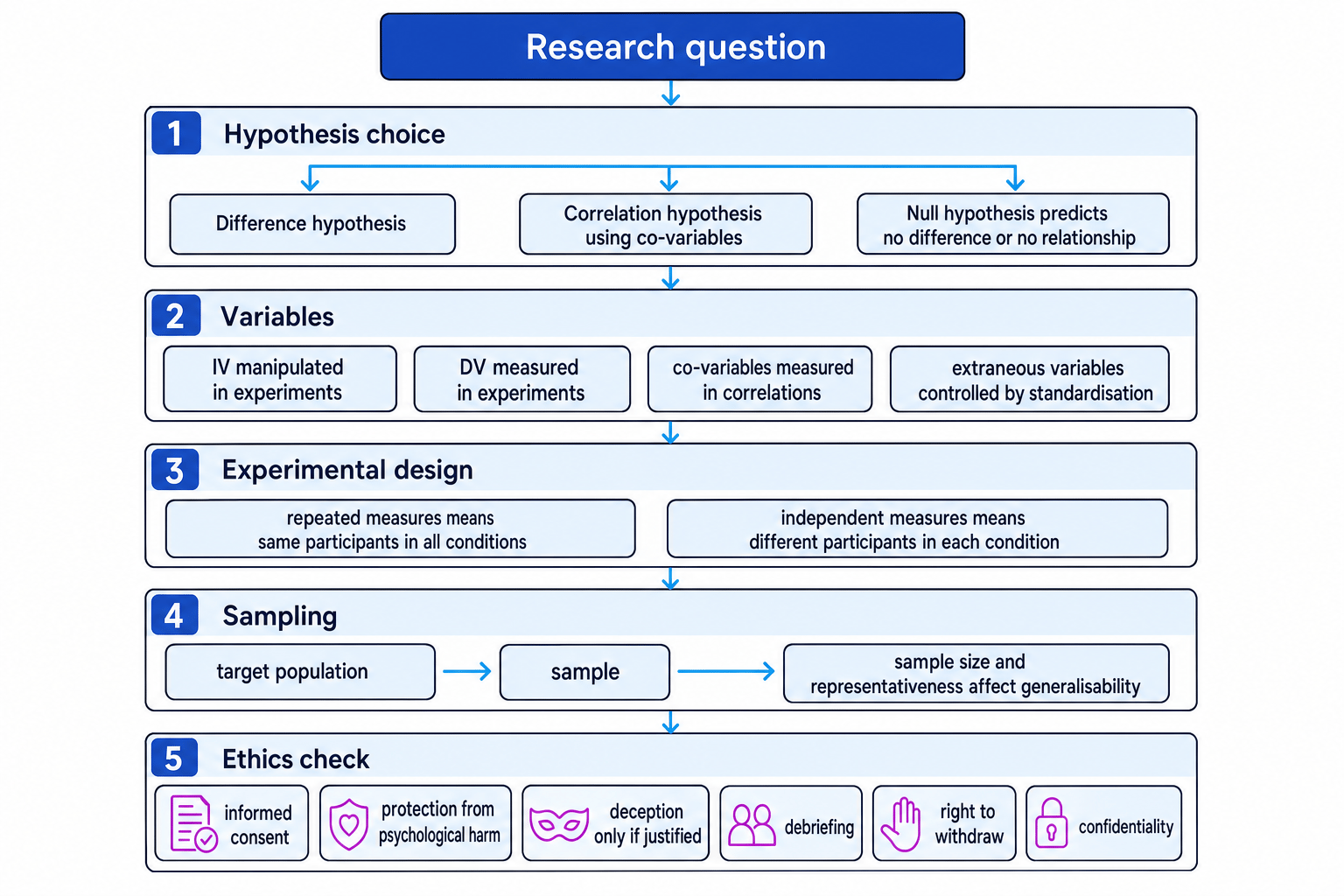
Hypotheses: turning an idea into a prediction
A hypothesis is a clear, testable prediction about what the researcher expects to find.
An alternative hypothesis predicts that there will be a pattern in the data, such as a difference between conditions or a relationship between two variables.
A null hypothesis predicts that there will be no pattern in the data. Any difference or relationship found would be due to chance or random variation.
Three kinds of prediction
| Prediction type | Used when | Example |
|---|---|---|
| Difference | Comparing groups or conditions | Students revising with music will recall a different number of words from students revising in silence. |
| Correlation | Measuring whether two co-variables are related | There will be a relationship between hours of sleep and memory score. |
| No pattern | Null hypothesis | There will be no relationship between hours of sleep and memory score. |
Key Idea
Hypotheses must be testable
A strong hypothesis names what is being compared or related, and states exactly how the outcome will be measured.
Example
Writing matched null and alternative hypotheses
- Decide the prediction type: background music is being changed between conditions, so this is a difference hypothesis.
- Operationalise the comparison: one condition is “background music while learning” and the other is “silence while learning”.
- Operationalise the outcome: memory will be measured as the number of words correctly recalled from a list.
- Write the alternative hypothesis: “Participants who learn words with background music will recall a different number of words from participants who learn words in silence.”
- Write the null hypothesis: “There will be no difference in the number of words recalled by participants who learn with background music and participants who learn in silence.”
Common Mistake
Vague hypotheses
Do not write “music affects memory” on its own. It does not say what kind of music, what kind of memory, or how memory will be measured.
Variables: what changes and what is measured
A variable is anything in a study that can change or vary.
Operationalisation means defining a variable in a precise, measurable way. For example, “memory” is vague, but “number of words correctly recalled from a 20-word list” is operationalised.
Independent and dependent variables
In an experiment, the independent variable, or IV, is the variable the researcher manipulates. It is changed between conditions, such as “music” and “silence”.
The dependent variable, or DV, is the variable the researcher measures. It depends on what happens in the study, such as the number of words recalled.
Co-variables
In a correlation, researchers do not manipulate an IV. Instead, they measure two co-variables to see whether they are related.
For example, a researcher might measure:
- hours of sleep per night
- score on a memory test
Neither variable is deliberately changed by the researcher, so it is not correct to call one the IV.
Extraneous variables and standardisation
An extraneous variable is an unwanted variable that could affect the DV and confuse the results. For example, if some participants complete a memory test in a noisy room and others complete it in silence, room noise could affect recall.
Standardisation means keeping the procedure the same for all participants. This can include using the same instructions, time limit, word list, room and scoring system.
Standardisation improves reliability because the procedure can be repeated consistently. It also improves internal validity, which means confidence that the IV caused the change in the DV, rather than an extraneous variable.
Example
Identifying and controlling variables
- In a study testing whether revision method affects quiz score, the IV is the revision method because the researcher changes it, such as flashcards or mind maps.
- The DV is the quiz score because this is the outcome being measured.
- A possible extraneous variable is revision time, because students who revise for longer may score higher regardless of method.
- The researcher can control this using standardisation: all participants revise for the same length of time, use the same topic material and complete the same quiz.
Common Mistake
Calling co-variables IVs
In a correlation, the researcher measures co-variables but does not manipulate them. If nothing is deliberately changed, there is no IV.
Experimental designs: who does which condition?
An experimental design is the way participants are arranged across the conditions of an experiment. A condition is one version of the IV, such as “music” or “silence”.
Repeated measures design
In a repeated measures design, the same participants take part in every condition.
Strengths:
- It controls participant variables, which are individual differences such as memory ability, motivation or confidence.
- Fewer participants are needed because each person completes all conditions.
Weaknesses:
- Participants may show order effects, where their performance changes because of practice, boredom or tiredness.
- They may guess the aim if they experience all conditions.
A control for order effects is counterbalancing, where different participants complete the conditions in different orders.
Independent measures design
In an independent measures design, different participants take part in each condition.
Strengths:
- There are no order effects because each participant only does one condition.
- Participants are less likely to guess the full aim of the study.
Weaknesses:
- Participant variables may affect results because the groups may differ before the study begins.
- More participants are needed than in repeated measures.
Example
Choosing an experimental design
- Suppose a researcher tests whether background music affects word recall using two conditions: music and silence.
- Repeated measures would control individual memory ability because the same participants would experience both conditions.
- However, participants might improve simply because they have practised the memory task once already.
- The researcher could still use repeated measures if they use two equally difficult word lists and counterbalance the order of conditions.
Tip
Design trade-off
Repeated measures controls differences between people, but risks order effects. Independent measures avoids order effects, but risks differences between groups.
Populations and sampling: who should be studied?
A target population is the whole group the researcher wants to draw conclusions about. For example, “UK GCSE students” could be a target population.
A sample is the smaller group of people who actually take part.
Sample size means how many participants are in the sample. A larger sample can improve representativeness, but only if it is chosen fairly.
Representativeness means how well the sample reflects the target population. Generalisability means whether findings from the sample can be applied to the wider target population.
Sampling methods
| Sampling method | How it works | Strength | Weakness |
|---|---|---|---|
| Random sampling | Every member of the target population has an equal chance of being chosen, often using a list and random numbers. | Reduces researcher bias. | Needs a complete list, called a sampling frame, and people may refuse to take part. |
| Opportunity sampling | The researcher uses people who are available at the time. | Quick, easy and cheap. | Often unrepresentative because it depends on who is nearby. |
| Self-selected sampling | Participants volunteer, for example by replying to an advert. | Participants are willing, which can help with consent. | Volunteer bias: volunteers may be more motivated or interested than non-volunteers. |
The principles of sampling in scientific research are that the sample should be selected in a fair, clear and repeatable way. Researchers should state who the target population is, how the sample was obtained, how large it was, and whether it is likely to be representative.
Example
Selecting a sample for a school study
- If the target population is “Year 11 students at a large secondary school”, the researcher should not only test their own friendship group because that would be biased.
- A random sample could be taken from the Year 11 register using randomly generated numbers, giving each student an equal chance of selection.
- The researcher should choose a sample size large enough to include a range of students, such as different classes, genders and ability levels.
- If the final sample reflects the wider Year 11 group, the findings are more likely to be generalisable to that school’s Year 11 population.
Common Mistake
Bigger is not automatically better
A large sample can still be biased. For example, 200 volunteers from one psychology club may be less representative than a smaller random sample from the whole school.
Ethical guidelines: protecting participants
Ethics are moral rules about how participants should be treated. In the UK, psychologists follow the British Psychological Society’s Code of Ethics and Conduct, which guides researchers to respect participants, reduce harm and act responsibly.
Ethical issues
Lack of informed consent happens when participants do not fully understand what they are agreeing to. Informed consent means participants know the aim, procedure, risks and their rights before agreeing to take part.
Deception means misleading participants or withholding important information. Sometimes deception is used to prevent demand characteristics, which are clues that make participants change their behaviour because they guess the aim. However, deception must be justified.
Protection of participants means avoiding physical and psychological harm. Psychological harm could include stress, embarrassment, anxiety or loss of self-esteem.
Ways of dealing with ethical issues
A debriefing happens after the study. The researcher explains the true aim, answers questions and checks that participants are okay.
The right to withdraw means participants can leave the study at any time and can ask for their data to be removed.
Confidentiality means personal information should be kept private. Researchers often use anonymous participant numbers instead of names.
Example
Reducing ethical problems in a memory study
- The researcher gives informed consent information explaining that participants will complete a word-learning task and may stop at any point.
- If the full aim is partly hidden to reduce demand characteristics, the deception must be minimal and justified by the value of the research.
- The procedure should avoid psychological harm by using ordinary word lists, a short task and reassurance that the test is not judging intelligence.
- At the end, the researcher debriefs participants, explains the true purpose, reminds them of their right to withdraw their data, and stores results confidentially.
Common Mistake
Debriefing does not erase harm
A debrief is important, but it does not make every ethical problem acceptable. Researchers must still prevent unnecessary distress in the first place.
Bringing the plan together
A strong research plan links each decision to reliability and validity.
- Clear hypotheses make the study testable.
- Operationalised variables make measurement more valid.
- Standardisation improves reliability.
- The design should control either participant variables or order effects as well as possible.
- Sampling affects representativeness and generalisability.
- Ethical planning protects participants and improves trust in psychology.
Exam technique
In the exam
- When writing hypotheses, include the exact groups or co-variables and the exact measured outcome.
- When identifying variables, use the scenario wording and say whether each variable is manipulated, measured or controlled.
- When evaluating, link the point to reliability, validity, generalisability or ethics rather than just naming a strength or weakness.
Self review
Check yourself
- Why is “stress affects memory” not a fully operationalised hypothesis?
- What is one strength and one weakness of repeated measures design?
- How could a researcher deal with deception ethically?
Content of Research Methods (Components 01 and 02)
Guide 1 of 3
You've reached the end
Test yourself on this topic, or move on to the next guide.
How was this guide?