Revision notes for OCR GCSE Psychology Core Areas and Debates in Psychology. Open the guide for explanations and worked examples. Written against the OCR GCSE Psychology (J203) specification, so the content matches what's examinable rather than general Psychology background.
Core Areas and Debates in Psychology
What you'll learn
- The five core areas of psychology and how each one explains behaviour.
- The three main debates you will use to evaluate theories and studies.
- How psychology changes over time as new evidence and methods develop.
- How to link theory, core studies, research methods and evaluation in GCSE answers.
The big picture: psychology explains behaviour
Psychology is the scientific study of behaviour and mental processes. Behaviour means actions you can observe, such as speaking, sleeping or obeying an instruction. Mental processes are internal processes, such as thinking, remembering, dreaming or feeling anxious.
Definition
Psychology
Psychology is the scientific study of behaviour and mental processes, using evidence from research to understand why people think, feel and act as they do.
This section is like the map for the whole GCSE course. Every topic you study — development, memory, psychological problems, social influence, criminal psychology, sleep and dreaming, brain and neuropsychology, and research methods — can be connected to these areas and debates.
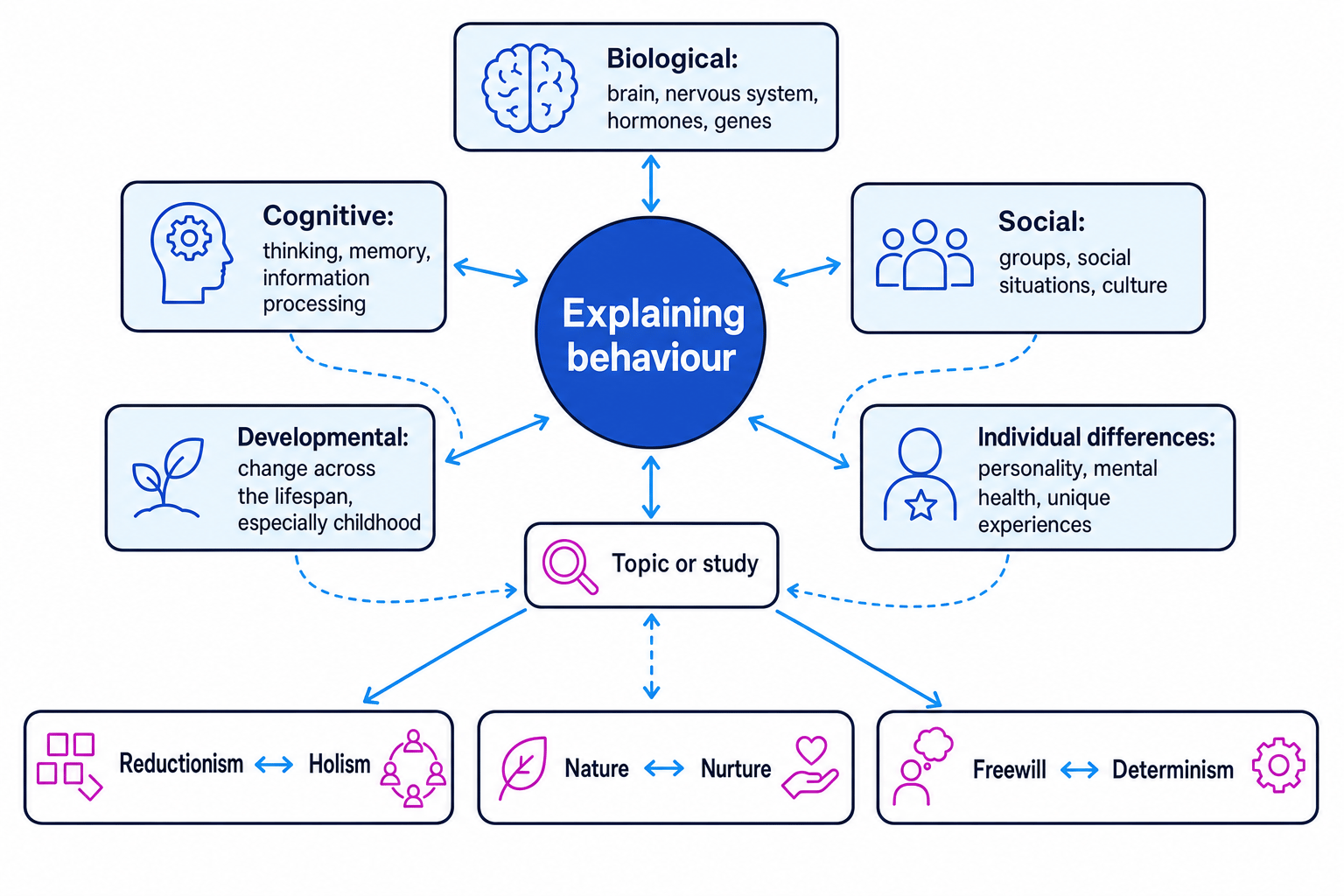
The five core areas of psychology
Definition
Core area
A core area is a broad way of explaining behaviour. It tells you what kind of causes a psychologist is focusing on, such as the brain, thinking, social situations, development or individual differences.
Biological area
The biological area explains behaviour using physical processes in the body. This includes the brain, nervous system, hormones, neurotransmitters and genes.
For example, a biological psychologist might explain memory loss by looking at damage to areas of the brain. In the GCSE course, Wilson, Kopelman and Kapur (2008) is important because the case of Clive Wearing links brain damage to memory difficulties.
The biological area often overlaps with neuroscience, which is the study of the brain and nervous system.
Cognitive area
The cognitive area explains behaviour through mental processes. These include thinking, attention, perception, memory, decision-making and problem-solving.
Cognitive psychologists often use models to explain processes we cannot directly see. For example, memory can be studied as a process involving encoding, storage and retrieval. Braun, Ellis and Loftus (2002) links to this area because it shows how memory can be affected by suggestion and imagination.
Social area
The social area explains behaviour through the influence of other people, groups, social roles, authority figures, culture and the environment.
For example, Bickman (1974) studied how a uniform could affect obedience. This is social because the explanation focuses on the power of a social cue: the appearance of authority.
Developmental area
The developmental area explains how people change across their lives, especially during childhood.
A developmental psychologist might ask how children’s thinking changes with age, or how learning experiences affect motivation. Piaget (1952) links to cognitive development, while Blackwell et al. (2007) links to Dweck’s ideas about fixed and growth mindsets in learning.
Individual differences area
The individual differences area focuses on why people differ from each other. This includes personality, mental health, intelligence, experiences and unusual behaviour.
For example, in criminal psychology, Heaven (1996) links personality traits to delinquency. In psychological problems, Tandoc et al. (2015) links social media use, envy and depressive symptoms.
Key Idea
Use core areas as lenses
A behaviour can usually be explained through more than one core area. Strong GCSE answers often recognise this instead of treating one explanation as the whole story.
Example
Classifying an explanation by core area
Scenario: A psychologist explains a teenager’s poor sleep by saying that their body clock is delayed, they worry about school at night, and their friends message them late in the evening.
-
The delayed body clock is a biological explanation because it focuses on internal body processes involved in sleep timing.
-
The worry about school is a cognitive explanation because it focuses on thoughts and mental processing.
-
The late messages from friends are a social explanation because other people and social routines are affecting behaviour.
-
The fact that the person is a teenager could also make the explanation developmental, because sleep patterns can change with age.
The three main debates in psychology
Definition
Debate
A debate in psychology is a big argument about how behaviour should be explained. Debates are usually not simple either/or choices; many explanations sit somewhere in the middle.
The three debates you need are:
- Reductionism and holism
- Nature and nurture
- Freewill and determinism
Reductionism and holism
Definition
Reductionism and holism
Reductionism explains behaviour by breaking it down into smaller parts, such as genes, brain areas or one learning process. Holism explains behaviour by looking at the whole person and their wider context.
A reductionist explanation might say that depression is caused by a chemical imbalance or by one type of negative thinking. This can be useful because it makes behaviour easier to test and treat.
A holistic explanation would consider several factors together, such as brain chemistry, thoughts, family life, culture, social media use and personal experiences.
Common Mistake
Calling reductionism automatically bad
Reductionism is not always a weakness. It can help psychologists produce clear research and practical treatments. The problem is when an explanation becomes too simple and ignores important factors.
Nature and nurture
Definition
Nature and nurture
Nature refers to inherited or biological influences, such as genes and brain structure. Nurture refers to environmental influences, such as learning, upbringing, culture and life experiences.
Many behaviours involve both nature and nurture. For example, a person might inherit a biological vulnerability to anxiety, but stressful experiences could trigger or worsen it.
This middle position is called an interactionist view because it sees nature and nurture as interacting.
Freewill and determinism
Definition
Freewill and determinism
Freewill is the idea that people can make choices and control their behaviour. Determinism is the idea that behaviour is caused by factors outside a person’s control, such as biology, past learning or social pressure.
A deterministic explanation of obedience might say that people obey because authority figures strongly influence them. A freewill explanation would say that people can still choose whether to obey.
In criminal psychology, this debate matters because it links to responsibility. If behaviour is strongly determined by biology or environment, it may seem unfair to blame the person completely. However, society also needs to hold people responsible for harmful actions.
Example
Applying debates to a social explanation
Scenario: A researcher says children become more aggressive after watching aggressive characters because they learn to copy what they observe.
-
This explanation is mainly nurture because it focuses on learning from the environment rather than inherited biology.
-
It is partly deterministic if it suggests that exposure to aggressive models causes aggressive behaviour without much personal choice.
-
It could be reductionist if it explains aggression only through observation and ignores personality, family background or brain factors.
-
A more holistic version would combine social learning with biological factors, individual differences and the child’s wider environment.
How psychological knowledge changes over time
Psychology is evidence-based, so ideas change when new research methods, new technology or better evidence appear.
Early explanations may be replaced, refined or supported by later research. For example:
- Piaget (1952) helped shape developmental psychology, but later researchers questioned whether some children could show abilities earlier than Piaget thought.
- Wilson, Kopelman and Kapur (2008) used a detailed case study to show how brain damage can deepen our understanding of memory.
- Braun, Ellis and Loftus (2002) showed that memory is not just a fixed recording; it can be reconstructed and influenced.
Key Idea
Psychology develops
Psychological knowledge is not fixed forever. Theories are judged against evidence, and new evidence can support, challenge or improve them.
Diversity in psychology
Diversity means differences between people and groups. Psychology contributes to our understanding of:
- Individual diversity, such as personality, mental health and memory ability.
- Social diversity, such as the influence of family, peers, authority and social roles.
- Cultural diversity, such as how beliefs, norms and expectations can differ between societies.
Good psychology avoids assuming that one group represents everyone. If a study uses a narrow sample, such as only children from one school or adults from one culture, this may limit how far the findings can be generalised.
Definition
Generalisability
Generalisability means how far findings from one study can be applied to other people, settings and times.
Ethics also matter when studying diversity. Psychologists should avoid stereotyping groups and should follow the British Psychological Society’s Code of Ethics and Conduct, including informed consent, protection from harm, right to withdraw, confidentiality and debriefing.
Interrelationships between core areas
The core areas are connected. Most real behaviours are too complex to fit neatly into only one box.
For example:
| Topic link | Areas that can interact | Why it matters |
|---|---|---|
| Memory | Cognitive and biological | Memory involves mental processing, but brain damage can affect it. |
| Criminal psychology | Biological, social and individual differences | Crime can be linked to brain factors, personality and social learning. |
| Psychological problems | Cognitive, biological, social and individual differences | Depression may involve thoughts, brain chemistry, life events and personal vulnerability. |
| Development | Developmental, cognitive and social | Children’s thinking changes with age and is affected by learning experiences. |
| Sleep and dreaming | Biological, cognitive and individual differences | Sleep involves body rhythms, mental experiences and differences between people. |
Tip
Think in combinations
If an exam scenario gives several causes of behaviour, do not force it into one area. Identify the main area, then mention any overlaps if they are relevant.
How studies relate to theories
Definition
Theory and evidence
A theory is an explanation of behaviour. A research study is a systematic investigation that collects evidence to support, challenge or develop a theory.
In GCSE Psychology, you need to connect core studies to the theory or explanation they are linked with. This helps you cover:
- AO1: describing the theory or study.
- AO2: applying it to a new scenario.
- AO3: evaluating strengths, weaknesses, methods and ethics.
For example, Bickman (1974) relates to social influence because it gives evidence about how authority cues, such as uniforms, can affect obedience. Blackwell et al. (2007) relates to mindset theory because it investigates whether changing beliefs about intelligence can affect motivation and achievement.
Example
Linking a core study to its theory
Scenario: A question describes Bickman’s study where people were more likely to obey someone dressed in a guard’s uniform than someone dressed in ordinary clothes.
-
The study links to the social area because the behaviour is affected by another person’s role and appearance.
-
It supports an explanation of obedience to authority because the uniform acts as a cue that the person has power or status.
-
It can be evaluated as having real-world validity because it took place in a natural setting, but there may be ethical issues because participants may not have given fully informed consent before being observed.
-
It links to the freewill/determinism debate because it suggests people’s behaviour can be influenced by situational pressures, even when they may feel they are choosing freely.
Research methods: the toolkit behind the evidence
Research methods are the ways psychologists plan, carry out and analyse studies. You will study them in more detail later, but they connect to every topic.
Key research-methods ideas include:
- Planning research: aims, hypotheses, samples, variables, controls and ethics.
- Doing research: experiments, observations, self-reports, case studies and correlations.
- Analysing research: quantitative data, qualitative data, averages, range, tables and graphs.
- Evaluating research: validity, reliability, generalisability, usefulness and ethics.
Definition
Validity and reliability
Validity means whether a study measures what it claims to measure. Reliability means whether a method is consistent and could produce similar results again.
You do not need A-Level statistical tests for GCSE Psychology. For J203, the maths stays at GCSE level: percentages, averages, range, tables, graphs, scatter diagrams and basic interpretation of data.
Exam technique
In the exam
-
Start by identifying the core area: biological, cognitive, social, developmental or individual differences.
-
Then choose the most relevant debate and explain both sides before judging which side the example fits best.
-
When evaluating a study, link method and ethics to the conclusion: ask whether the evidence is valid, reliable, generalisable and ethically acceptable.
Self review
Check yourself
- Can you explain the difference between the biological and cognitive areas using your own example?
- Which debate is involved when an explanation says behaviour is caused mainly by genes?
- Why might a holistic explanation be useful when studying depression or criminal behaviour?
You've reached the end
Test yourself on this topic, or move on to the next guide.
How was this guide?