Arithmetic and Numerical Computation
What you'll learn
- How to recognise and use decimals and standard form in psychology data.
- How to work with ratios, fractions and percentages.
- How to estimate answers so you can spot calculation errors.
- How these maths skills support AO2 application and AO3 evaluation in research methods.
Why maths appears in GCSE Psychology
In OCR GCSE Psychology, maths is mainly used in research methods. You might need to interpret findings from a study, compare groups, calculate a percentage, or check whether a numerical conclusion is sensible.
This topic is not about advanced statistics. You do not need inferential tests such as chi-square, Spearman’s rho, t-tests or p-values. At GCSE, the focus is on using number confidently and accurately.
Maths supports psychology answers
Arithmetic helps you turn raw data into clear evidence. In an exam, this can help you describe results, apply data to a scenario, and evaluate whether a conclusion is justified.
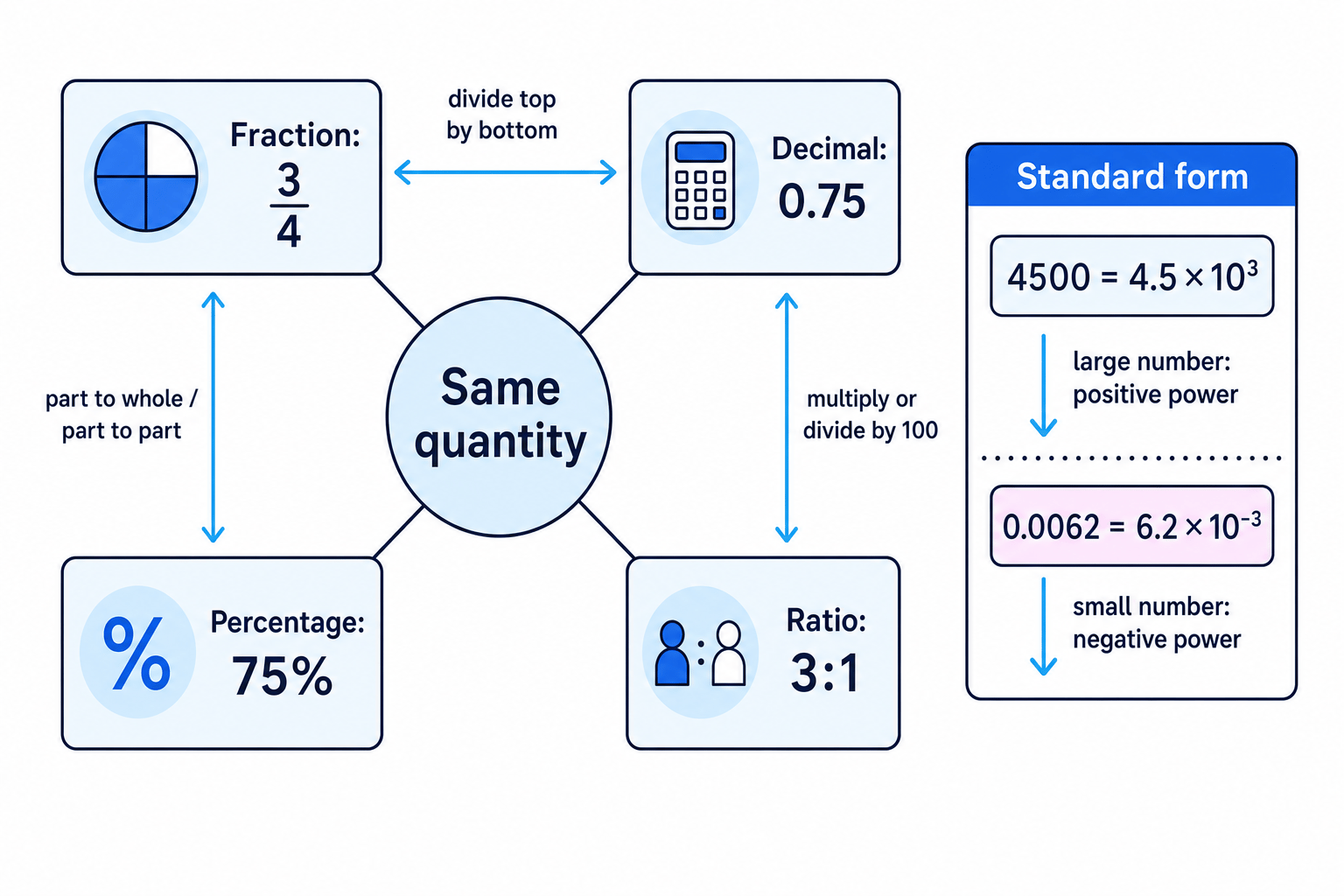
The same quantity can often be written in different forms: as a fraction, decimal, percentage or ratio. Standard form is useful when numbers are very large or very small.
Decimals
A decimal is a number written using a decimal point. It shows parts of a whole using place value. For example, 0.5 means five tenths, and 1.25 means one whole plus twenty-five hundredths.
Decimal
A decimal is a way of writing a number using place value after a decimal point, such as 0.25, 1.6 or 12.03.
Decimals are common in psychology when reporting means, proportions, averages, reaction times, scores or questionnaire results.
Place value after the decimal point
Each digit after the decimal point has a value:
- The first digit is tenths.
- The second digit is hundredths.
- The third digit is thousandths.
So 0.375 means 3 tenths, 7 hundredths and 5 thousandths.
Rounding decimals
You may be asked to give an answer to a certain number of decimal places. A decimal place is a position after the decimal point.
For example:
- 3.146 to 1 decimal place is 3.1.
- 3.146 to 2 decimal places is 3.15.
- 3.146 to 3 decimal places is 3.146.
If the next digit is 5 or more, round up. If it is 4 or less, leave the previous digit unchanged.
Rounding a mean score
A researcher calculates a mean memory score of 7.666666. Give the answer to 2 decimal places.
- Identify the second decimal place in 7.666666: the second digit after the decimal point is 6.
- Look at the next digit: the third decimal digit is also 6, so the second decimal place rounds up.
- Change 7.66 to 7.67, so the mean score is 7.67 to 2 decimal places.
Over-rounding too early
Do not round every number halfway through a calculation. Keep extra digits during working, then round the final answer to the required number of decimal places.
Standard form
Sometimes psychology data can involve very large numbers, such as population figures, or very small numbers, such as proportions close to zero. Standard form is a compact way to write these numbers.
Standard form
Standard form writes a number as a×10na \times 10^na×10n, where aaa is at least 1 but less than 10, and nnn is a whole-number power of 10.
For GCSE, remember:
- Large numbers have a positive power, such as 4.2×1054.2 \times 10^54.2×10⁵.
- Small numbers less than 1 have a negative power, such as 3.1×10−23.1 \times 10^{-2}3.1×10⁻².
Converting into standard form
To convert a number into standard form, move the decimal point until the first number is between 1 and 10. The number of places moved becomes the power of 10.
Writing numbers in standard form
Write 68,000 and 0.0049 in standard form.
- For 68,000, move the decimal point 4 places left to make 6.8.
- Because the original number was large, use a positive power: 68000=6.8×10468000 = 6.8 \times 10^468000=6.8×10⁴.
- For 0.0049, move the decimal point 3 places right to make 4.9.
- Because the original number was less than 1, use a negative power: 0.0049=4.9×10−30.0049 = 4.9 \times 10^{-3}0.0049=4.9×10⁻³.
Positive or negative power?
If the original number is bigger than 10, the power is positive. If the original number is between 0 and 1, the power is negative.
Ratios
A ratio compares quantities. In psychology, ratios may be used to describe group sizes, such as the number of males to females in a sample, or the number of participants in two conditions.
Ratio
A ratio compares one quantity with another using parts, such as 2:3. This means 2 parts of one thing for every 3 parts of another.
For example, if a sample has 12 boys and 18 girls, the ratio of boys to girls is 12:18. This can be simplified by dividing both sides by 6, giving 2:3.
Part-to-part and part-to-whole
A common trap is mixing up two types of comparison:
- Part-to-part compares one group with another group, such as boys:girls.
- Part-to-whole compares one group with the total sample, such as boys:all participants.
Simplifying a sample ratio
A psychology study has 20 participants in Condition A and 30 participants in Condition B. Simplify the ratio A:B.
- Write the ratio in the same order as the question: A:B is 20:30.
- Find a number that divides both sides exactly. Both 20 and 30 divide by 10.
- Divide both parts by 10 to get 2:3, so the simplified ratio is 2:3.
Changing the order of a ratio
If the question asks for males:females, do not write females:males. A ratio must stay in the order given.
Fractions
A fraction shows how many parts of a whole you have.
Fraction
A fraction is a number written as one quantity over another, such as 34\frac{3}{4}43. The top number is the numerator and the bottom number is the denominator.
In psychology, fractions can describe proportions of participants, responses or results. For example, if 18 out of 24 participants recalled a word list correctly, the fraction is 1824\frac{18}{24}2418, which simplifies to 34\frac{3}{4}43.
Simplifying fractions
To simplify a fraction, divide the numerator and denominator by the same number. The value stays the same, but the fraction is easier to read.
Simplifying a response fraction
In a questionnaire, 16 out of 40 participants agree with a statement. Write this as a simplified fraction.
- Put the number who agreed over the total number of participants: 1640\frac{16}{40}4016.
- Find a shared factor of 16 and 40. Both numbers divide by 8.
- Divide the numerator and denominator by 8: 1640=25\frac{16}{40} = \frac{2}{5}4016=52.
Percentages
A percentage means “out of 100”. Percentages are very useful in psychology because they make results easier to compare between groups of different sizes.
Percentage
A percentage is a proportion expressed out of 100. For example, 25% means 25 out of 100, or one quarter.
To convert a fraction to a percentage, divide the part by the whole and multiply by 100.
percentage=partwhole×100\text{percentage} = \frac{\text{part}}{\text{whole}} \times 100percentage=wholepart×100For example, if 12 out of 20 participants show a behaviour, the percentage is 60%.
Calculating a percentage of participants
In an observation, 18 out of 30 participants imitate an aggressive model. Calculate the percentage who imitate.
- Identify the part and the whole: the part is 18 and the whole sample is 30.
- Substitute into the percentage calculation: 1830×100\frac{18}{30} \times 1003018×100.
- Work out the proportion: 1830=0.6\frac{18}{30} = 0.63018=0.6.
- Convert to a percentage: 0.6×100=600.6 \times 100 = 600.6×100=60, so 60% of participants imitate.
Small samples can mislead
A percentage can look impressive even when the sample is tiny. If 2 out of 4 participants improve, that is 50%, but it is based on only four people, so you should be cautious when evaluating the result.
Moving between fractions, decimals and percentages
These three forms often describe the same thing.
- Fraction to decimal: divide the numerator by the denominator.
- Decimal to percentage: multiply by 100.
- Percentage to decimal: divide by 100.
- Percentage to fraction: write it over 100, then simplify.
For example, 14\frac{1}{4}41, 0.25 and 25% all mean the same proportion.
Converting a proportion
A researcher reports that 0.35 of participants gave a particular response. Convert this to a percentage and a fraction.
- Convert the decimal to a percentage by multiplying by 100: 0.35×100=350.35 \times 100 = 350.35×100=35, so the percentage is 35%.
- Write 35% as a fraction over 100: 35100\frac{35}{100}10035.
- Simplify by dividing top and bottom by 5: 35100=720\frac{35}{100} = \frac{7}{20}10035=207.
Same result, different format
Decimals, fractions, percentages and ratios can all describe proportions. The skill is choosing the format that makes the data easiest to compare.
Estimating results
To estimate means to find an approximate answer rather than an exact one. Estimation is useful before or after a calculation because it helps you check whether your answer is sensible.
Estimate
An estimate is an approximate answer found by rounding numbers to make a calculation easier.
In psychology exams, estimating can help you notice mistakes. For example, if you calculate that 19 out of 20 participants is 9.5%, your estimate should warn you that something has gone wrong because 19 out of 20 is nearly all of the sample.
How to estimate
A good method is to round numbers to nearby values that are easier to calculate with. You should not use an estimate as your final answer unless the question asks for one, but it is excellent for checking.
Estimating a percentage
A study finds that 47 out of 98 participants remembered a list correctly. Estimate the percentage.
- Round 47 to 50 and 98 to 100 because these are close and easy to use.
- Estimate the fraction as 50100\frac{50}{100}10050.
- Convert the estimate to a percentage: 50100×100=50\frac{50}{100} \times 100 = 5010050×100=50, so the answer should be about 50%.
Use estimates as a sense-check
If your exact answer is very different from your estimate, check the denominator, the order of the ratio, or whether you multiplied or divided by 100.
Evaluating numerical information in psychology
Using arithmetic accurately improves the quality of your psychology answers. It also helps with AO3 evaluation.
For example, a result may be less convincing if:
- the sample size is very small;
- percentages are used without giving raw numbers;
- the mean hides variation between participants;
- data are rounded so heavily that detail is lost;
- a conclusion goes beyond what the numbers show.
Numerical data can make research look scientific and objective, but calculations are only useful if the data were collected in a valid and reliable way. A precise percentage from a biased sample may still give a misleading conclusion.
In the exam
- Identify what the numbers represent before calculating: participants, scores, responses, conditions or totals.
- Keep the denominator clear when calculating fractions and percentages, especially if groups have different sizes.
- Estimate first or afterwards to check that your final answer is sensible.
Check yourself
- Can you convert 0.08 into a percentage and a fraction?
- Can you write 52,000 in standard form?
- Can you explain why 75% may be less convincing if it comes from only 4 participants?