What an observation is
Definition
Observation
A method that collects data by watching and recording what participants do, rather than asking them about it.
- An observation collects data by watching and recording behaviour, rather than asking people about it.
- Because behaviour is recorded directly, the data do not depend on what a participant remembers or is willing to admit.
- Counting how often each behaviour happens turns what is seen into quantitative data.
- Designing one means making three choices: where the watching happens, whether the participants know, and whether the observer joins in.
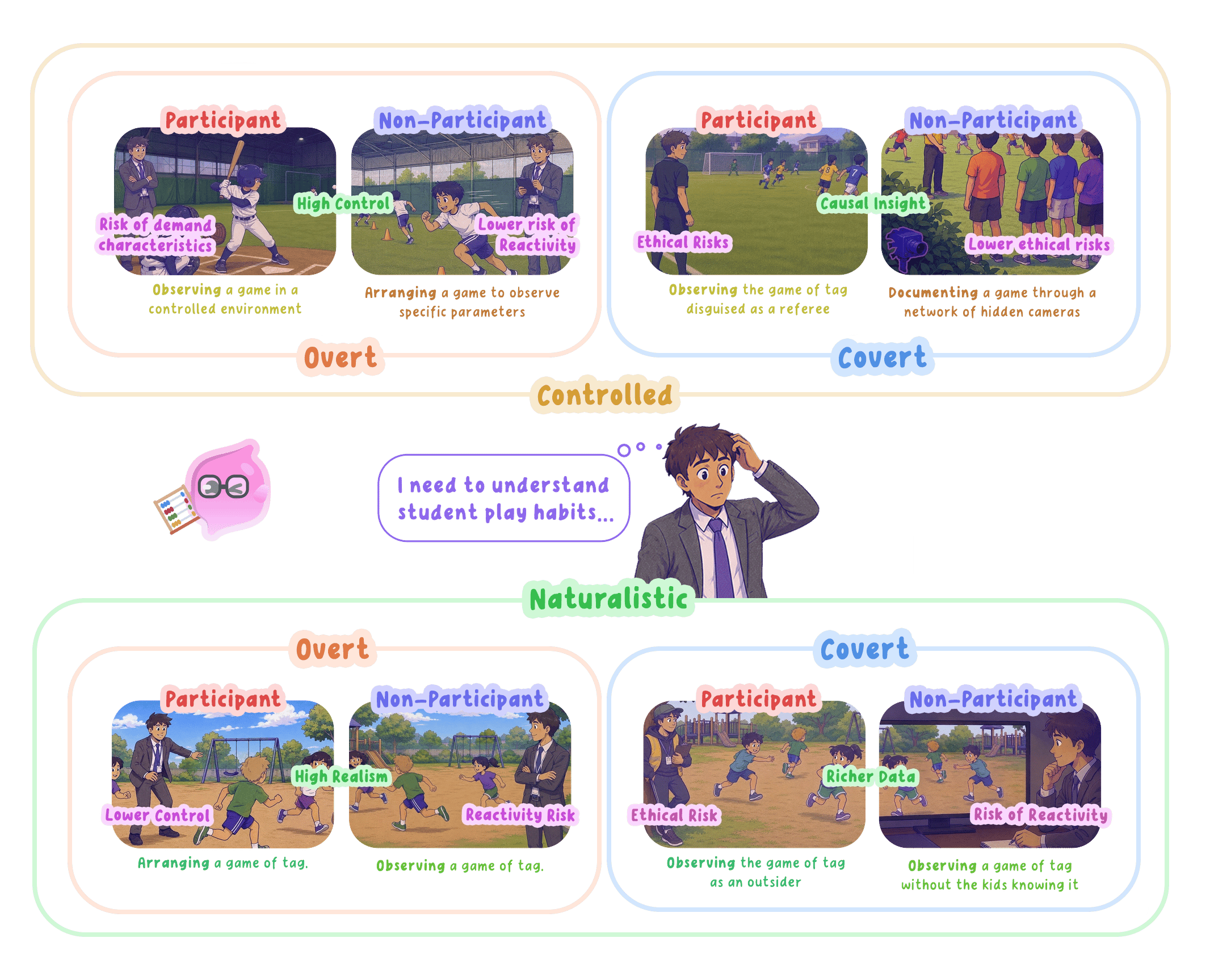
- Because one study takes one option from each of those pairs, the three choices give six types in all: naturalistic, controlled, overt, covert, participant and non-participant.
Key Idea
- An observation records what people did rather than what they say they did, which is how it reaches behaviour nobody would admit to on a form.
- The whole method rests on the behavioural categories, since a count is only as good as the definition of what was counted.
- Watching people who know they are being watched changes what there is to see, and that is the cost of asking for consent first.
Naturalistic and controlled observations
- Naturalistic observation watches behaviour in its normal everyday setting and changes nothing about it.
- Strength: the behaviour is the real thing, so ecological validity is high.
- Weakness: extraneous variables cannot be controlled, and the setting never repeats exactly, so reliability is lower.
- It suits an aim about how people behave in ordinary life, such as how politely pupils queue in the school canteen.
- Controlled observation watches in a setting the researcher has set up, holding some variables steady.
- Strength: the same set-up can be run again with a new group, so reliability is high and groups can be compared fairly.
- Weakness: the room is artificial, which lowers ecological validity and invites demand characteristics.
- It suits an aim that needs a fair comparison, such as whether children share more when an adult is in the room.
Overt and covert observations
Definition
Covert observation
An observation in which the observer's role is hidden or disguised, so the participants do not know they are being watched.
- Overt observation means the participants know they are being observed, because the observer's role is out in the open.
- Strength: informed consent can be gained and the right to withdraw explained.
- Weakness: being watched changes how people act, which is the observer effect, and validity drops as a result.
- It suits an aim where consent has to be gained in advance, such as observing a lesson with the class's agreement.
- Covert observation means the observer's role is hidden or disguised, so the participants do not know they are being watched.
- Strength: there is no observer effect, so behaviour stays natural and validity is higher.
- Weakness: there is no informed consent and privacy is at risk, so it is kept to public places where being seen is expected anyway.
- It suits an aim about behaviour people would tidy up if they knew, such as whether shoppers hold a door open for the person behind them.
Note
- The label refers to the observer's role rather than to the equipment, so a camera in plain sight is still an overt observation.
- A covert observation usually ends by telling the participants what was recorded and offering to remove their data.
Participant and non-participant observations
- Participant observation means the observer joins the group and takes part in whatever it is doing.
- Strength: being inside the group reveals meaning and context an outsider would miss.
- Weakness: recording while taking part is awkward, and getting close to the group brings observer bias, so objectivity falls.
- It suits an aim about what a group's behaviour means to the people in it, such as how a football squad encourages each other.
- Non-participant observation means the observer stays outside the group and only watches and records.
- Strength: tallying can be done as the behaviour happens, so the data are easy to count and compare.
- Weakness: from outside the group a behaviour can be misread, so a shove between friends gets logged as aggression.
- It suits an aim that needs counts of clearly defined actions.
Example
- Sitting on a bench near a bus stop and tallying how many people let someone else on first is naturalistic, covert and non-participant.
- Joining a training session, having told the players why the observer is there, is controlled, overt and participant.
- Every observation carries one label from each of the three pairs.
Behavioural categories
Definition
Behavioural categories
Clear, separate and observable actions that a behaviour is broken into so it can be recorded consistently, for example on a tally chart.
- Behavioural categories split a broad behaviour into separate actions that can be seen and counted.
- Each category is defined tightly enough that it is clear what does and does not count.
- A tally goes on a tally chart every time one of those actions happens.
- Totalling the columns gives frequencies, which can be turned into a bar chart, a percentage or a modal category.
- A vague category such as "being naughty" is the usual reason two observers end up with different totals.
Example
- For playground aggression the categories might be hitting, kicking and pushing.
- Each time one happens, a tally goes in that column.
- Across one break hitting scores 12, kicking 5 and pushing 19, giving 36 acts in total.
- Pushing is the modal category, and 19 out of 36 is just over half of all the acts recorded.
Structured and unstructured observations
Definition
Structured observation
An observation that records only a fixed set of behavioural categories chosen in advance, giving quantitative data.
- A structured observation records only the categories chosen before the watching starts.
- Strength: every observer uses the same checklist, so the data are quantitative and easy to compare between groups.
- Weakness: anything not on the list goes unrecorded, so a behaviour nobody predicted is lost.
- An unstructured observation records everything that happens, which gives qualitative notes with a great deal of detail.
- Those notes take judgement to summarise, so two observers can pull different findings from the same session.
Common Mistake
- Covert refers to a hidden observer and naturalistic refers to the setting, so the two labels answer different questions about the same study.
- A covert observation carries the ethical problem of no informed consent, because the people being watched were never asked.
- Observer bias is the observer misrecording, and the observer effect is being watched changing the participant.
Inter-rater reliability and the observer effect
Definition
Inter-rater reliability
How far two or more people who score, rate or observe the same behaviour agree on what they record. Close agreement means the measure is reliable.
- Inter-rater reliability is how far two observers watching the same behaviour agree on what they record.
- To check it, both observers watch the same event, tally separately, and then compare their totals.
- Close agreement shows the categories are working, and wide disagreement shows they need rewriting.
- Agreement between two observers shows the recording was consistent, but it does not show that the categories captured the behaviour worth counting.
- The observer effect threatens validity, because once people know they are being watched they may not behave as they usually would.
- Watching from an unobtrusive spot, giving people time to settle, and training both observers on the same categories are the standard defences.
Note
- A trial run is where a category that does not work shows itself, and rewording one is far cheaper than repeating the whole session.
- Recording the session lets both observers tally the same event afterwards, which is how agreement is checked when only one of them can be there at the time.
Choosing an observation
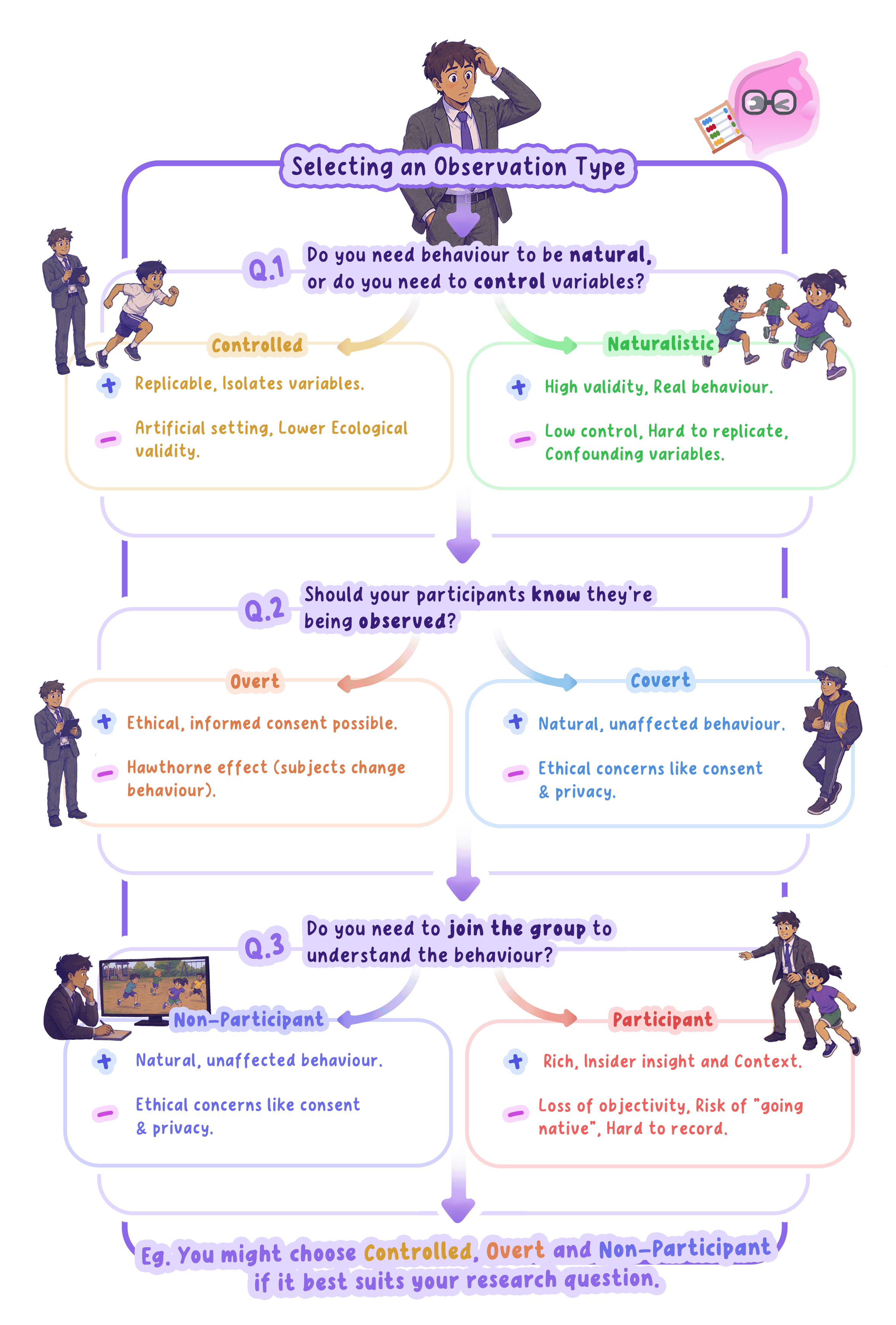
- An observation suits an aim about what people do, especially where they would not report it accurately.
- It suits behaviour that is visible and countable, because a tally chart needs actions rather than thoughts.
- It cannot supply reasons or feelings, because watching someone does not show why they acted.
- It cannot establish a cause, because no variable is manipulated.
Turning this into marks
- When a type and a reason are both asked for, keep them as two separate points, one naming the type and one naming what it does to the behaviour recorded.
- Give the behavioural categories by name, such as hitting, kicking and pushing, because "aggression" does not secure the knowledge mark.
- State whether the participants knew they were being watched, since that decides whether the observer effect applies.
- The mark most often lost is naming observer bias when the answer needed the observer effect.
Self review
- Name the six types of observation.
- What is the difference between a naturalistic and a controlled observation?
- Give one strength and one weakness of a covert observation.
- Why can a participant observer lose objectivity?
- What is inter-rater reliability, and how would you check it?
