Target populations and samples
Definition
Target population
The whole group of people a study is about and wants its findings to apply to; the sample is drawn from it.
- The target population is the whole group a piece of research is about, such as all Year 11 pupils in the UK.
- Testing all of them is almost never possible, so the researcher selects a sample, the smaller group who actually take part.
- The way that sample is picked is the sampling method, and three of them are random, opportunity and self-selected.
- The population is named precisely, because "teenagers" and "Year 11 pupils at one school in Cardiff" are very different claims.
- The sample is what gets studied, and the conclusion drawn from it is about the whole population.
Key Idea
- A conclusion is only as wide as the sample it came from, so 20 pupils in one canteen supports a claim about that canteen rather than about Year 11 across the UK.
- Representativeness is about the mix of people in the sample, which is why a sample of 200 drawn from one top set is still biased.
- Every sampling method trades effort against bias, and random sampling buys the least biased sample by demanding a full list of the population.
Representativeness and generalisability
Definition
Representative sample
A sample whose mix of people closely reflects the features of the target population, so findings can be generalised back to it.
- A representative sample holds the same mix of people as the target population, with age, gender, background and ability in roughly the right proportions.
- Generalisability is how far a finding from the sample can be applied to the whole target population.
- A sample that leaves out a whole group is unrepresentative however large it is.
- When a sample is unrepresentative, the study loses population validity, because the result may not hold for the groups it missed.
- Gender bias, cultural bias and age bias all start at the sampling stage, and can be built in without anyone intending it.
Example
- A year group has 300 pupils, 150 girls and 150 boys, spread across every ability set.
- A sample of 30 boys from the top set leaves out all 150 girls and every other set.
- A sample matching the year group would be 15 girls and 15 boys, since the population splits one to one.
- A sample of 30 that contained 18 girls is 18 out of 30, which cancels to 3/5, or 60%, so girls are over-represented.
Random sampling
Definition
Random sampling
A method in which every member of the target population has an equal chance of being selected, for example by drawing names from a hat.
- Random sampling gives everyone in the target population an equal chance of being picked.
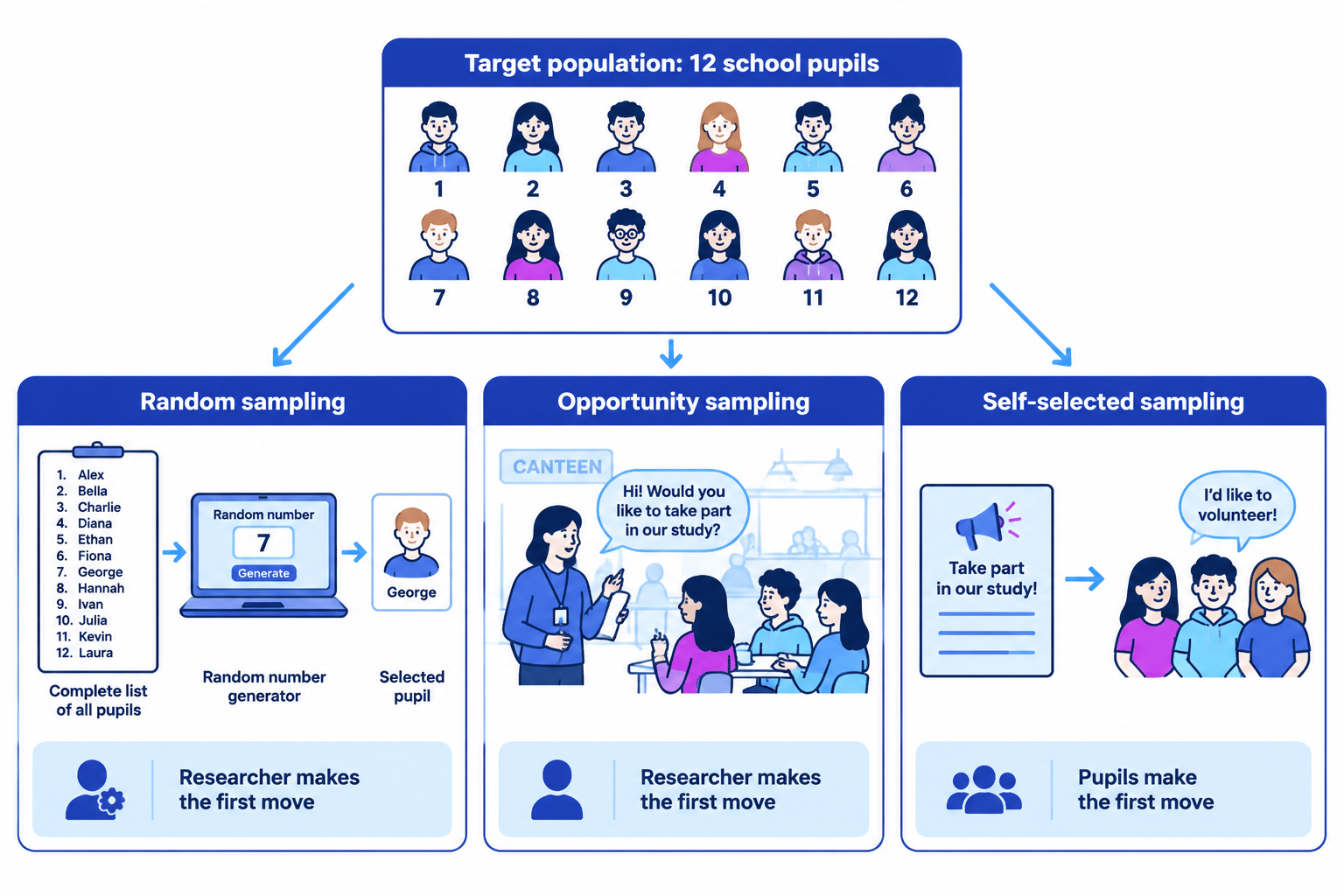
- It starts from a full list of the population, with every name numbered, and numbers are then drawn from a hat or produced by a random number generator until the sample is full.
- Strength: it is the least biased of the three methods, so it usually gives the most representative sample and the safest generalisation.
- Strength: the researcher has no say in which names come out, which rules out their own preferences shaping the sample.
- Weakness: a complete list of everyone in the population is needed, and for something like all UK teenagers no such list exists.
- Weakness: the people drawn can still refuse, and those who refuse may share a feature that then goes missing from the sample.
- Weakness: chance alone can produce an odd mix, such as 18 girls in a sample of 20 drawn from a mixed school.
Note
- In a school study the population is often taken to be one year group, because that is the only list the researcher can actually get hold of.
- Narrowing the population that way makes random sampling possible, and at the same time narrows the group the finding can be applied to.
Opportunity sampling
- Opportunity sampling uses whoever is available and willing at the time.
- In practice the researcher goes to one place at one time and asks the people there, such as the pupils in the canteen at lunch.
- Strength: it is the quickest and cheapest method and needs no list of the population.
- Strength: it fits a small study that has to be finished inside a single lesson.
- Weakness: it reaches only whoever happens to be in that place at that time, so the sample is tied to one setting and one moment.
- Weakness: the researcher chooses who to approach, so their own preferences can shape the sample.
- Weakness: a narrow sample lowers population validity, so a finding from 20 pupils in one canteen says little about Year 11 nationally.
Self-selected sampling
- Self-selected sampling means participants put themselves forward, which is why it is also called volunteer sampling.
- The researcher advertises, perhaps with a poster on the form room door or a message in a tutor group chat, and uses whoever replies.
- Strength: it takes little effort from the researcher, since the participants come forward on their own.
- Strength: volunteers are willing, so fewer of them drop out part way through a long study.
- Strength: it can reach people who would be hard to find any other way, such as anyone who has trouble getting to sleep.
- Weakness: volunteers tend to be one type of person, often more confident, more interested or keener to please the researcher.
- Weakness: that shared feature lowers representativeness, so the finding applies to keen volunteers more than to the population named.
- Weakness: a keen volunteer wants the study to work, which makes demand characteristics more likely.
Common Mistake
- An opportunity sample is whoever was available at the time, which is not the same as a random sample, where everyone in the population had an equal chance of selection.
- Self-selected participants reply to an advert and an opportunity sample is approached by the researcher, so the two methods are told apart by who made the first move.
Sample size
- A larger sample is more likely to be representative, because one unusual participant shifts the mean less.
- With 5 participants one very high score drags the mean upwards, and with 50 the same score barely moves it.
- A big sample costs more time, more money and more materials, so the size chosen is the largest one the study can actually run.
- A large sample drawn from one narrow group is still biased, so size is judged separately from representativeness.
- Sample size can be given as a fraction of the population, so 20 pupils out of a year group of 300 is 20 over 300, which cancels to 1/15, or about 6.7%.
Note
- No fixed number makes a sample large enough, so the size is judged against the population it has to stand for.
- A sample of 20 out of a year group of 300 is 1 in 15 of that year group, while the same 20 would be a tiny fraction of Year 11 nationally.
Principles of sampling in science
- The sample is chosen so that the results stand for the population rather than only for the people tested.
- The sampling method is written down in enough detail for another researcher to copy it exactly.
- Running the study again with a fresh sample from the same population is how psychologists check that a finding is reliable rather than a one-off.
- Sampling sets how far a finding can be generalised, and the measure used sets whether the study captured the right behaviour.
Describing a sampling method
- Name the target population first, as in "Year 10 pupils at one school".
- Give the method and the number, such as an opportunity sample of 20 pupils from that year group.
- Set out the actual steps, such as standing by the canteen door at lunch and asking the first 20 pupils who agree.
- Choose a method that can be carried out with the time, the space and the people available.
- Give one weakness of the method chosen and say what it costs the generalisation.
- When judging a sample that is already described, use its own numbers to show how far it matches the population.
Turning this into marks
- When a method and a weakness are both asked for, keep them as two separate points, one naming the method and one naming what it costs the generalisation.
- Name the population, such as Year 11 pupils at one school in Cardiff, because "teenagers" does not secure the knowledge mark.
- Describe the steps, such as numbering all 300 names and drawing 20 of them from a hat, rather than giving the label on its own.
- The mark most often lost is calling an opportunity sample random, when nobody outside the canteen had any chance of being picked.
Self review
- What is a target population?
- Describe the steps needed to obtain a random sample.
- How does opportunity sampling differ from self-selected sampling?
- Give one strength and one weakness of self-selected sampling.
- Why can a large sample still be unrepresentative?