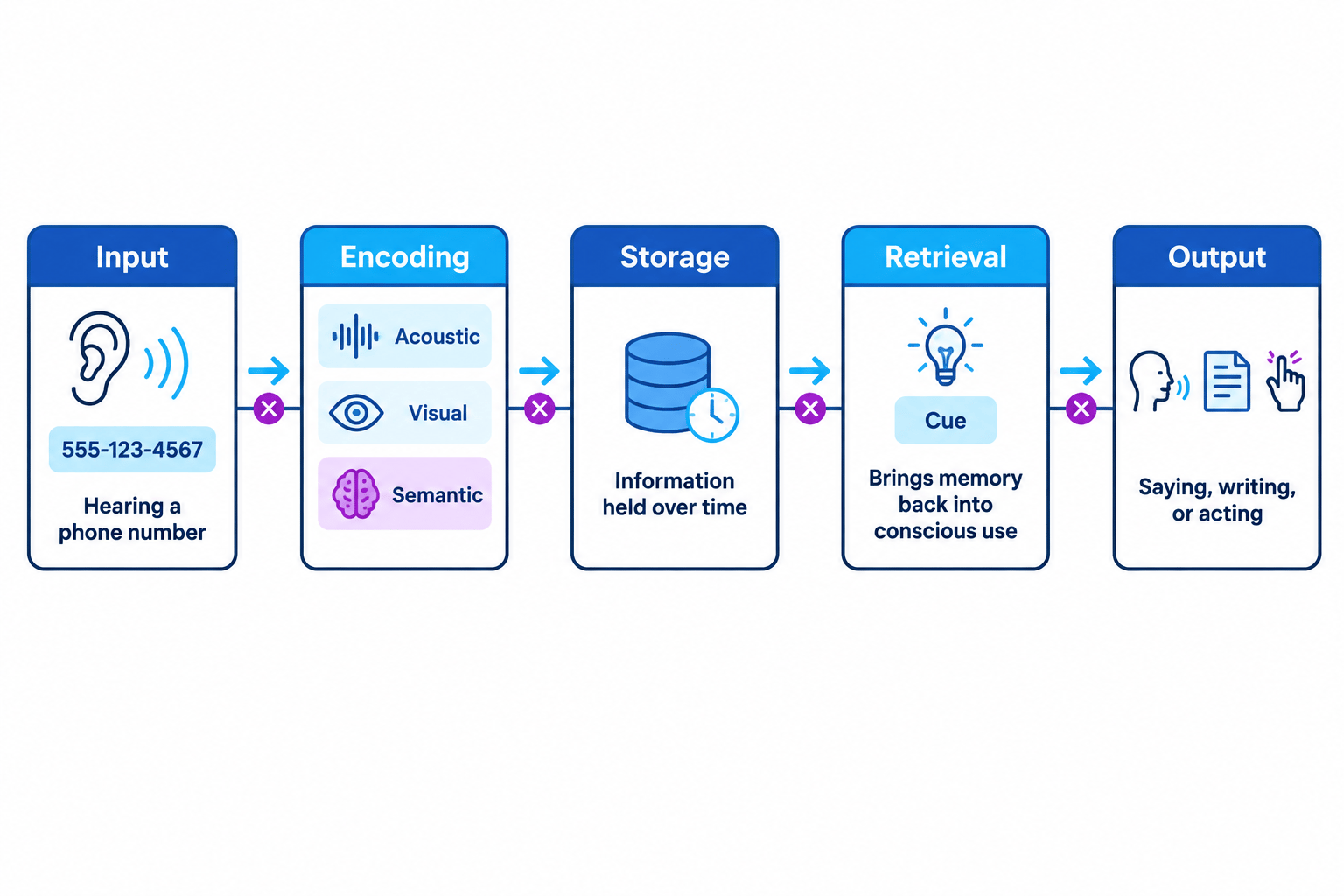
The five stages of information processing
Definition
Encoding
Changing incoming information into a form your memory can hold, so it can be stored. Encoding is the input stage of memory.
- Memory works as a system, so information goes in at one end and a response comes out at the other.
- Psychologists split that system into five named stages: input, encoding, storage, retrieval and output.
- Each stage does a different job, and each one can be described on its own.
- A memory survives only if all five stages work, so a failure at any one of them leaves nothing to recall.
Key Idea
- A memory only survives if the information gets in, is turned into a form you can hold, stays there, is found again and is finally acted on.
- Because every stage has to work, forgetting a phone number is a failure at one identifiable point rather than the memory simply going.
- Output is the only stage anyone else can see, so it is all a psychologist has to work from.
What each stage does
Definition
Storage
Holding information in memory over time, so it is still there when you go back for it. Storage keeps encoded information available between putting it in and getting it back out.
- Input
- Information from the world arrives through the senses, such as hearing a number read out or seeing a slide on the board.
- Input is the raw material that every later stage works on.
- Encoding
- The raw input is changed into a form that memory can hold.
- Encoding can be acoustic by sound, visual by appearance, or semantic by meaning.
- Information reaches a store only once it has been encoded.
- Storage
- The encoded information is held over time in a memory store, so it is still there when you come back for it.
- How long it survives depends on which store is holding it.
- Retrieval
- The stored information is found and brought back into conscious use.
- A cue such as a place, a smell or a single word makes that search easier.
- Output
- The retrieved information is acted on by saying it, writing it down or doing it.
- Output is the only stage another person can observe, so it is how a psychologist judges whether the memory is there.
Example
- A friend calls their mobile number to you across a noisy corridor, and the sound reaching your ears is the input.
- You encode it acoustically by muttering the digits under your breath.
- You hold those digits while you unlock the screen, which is storage.
- You bring them back as you open a new contact, which is retrieval.
- You tap them into the keypad, and that is output.
Forgetting and the stage that failed
Definition
Retrieval
Finding stored information and bringing it back into conscious use. Retrieval is the output stage of memory.
- If the corridor is too loud to make out the digits, the input never arrived, so there is nothing to encode.
- If the digits are heard but no attention is paid to them, encoding fails and nothing reaches a store.
- If they are encoded but never rehearsed, the trace fades and storage fails.
- If they are still stored but do not come to mind without a reminder, retrieval has failed while the memory itself is intact.
Common Mistake
- Input and encoding are two separate stages, because input is information arriving and encoding is converting it.
- Retrieval and output are two separate stages, because retrieval finds the memory and output is what you then say or do.
- There are five stages, not three.
Turning this into marks
- Name the stage that failed when you explain forgetting, because writing that the memory has gone does not secure the knowledge mark.
- Pair each stage with the part of the behaviour that shows it, because the name of a stage on its own gains no application mark.
- Use all five stage names when a question asks for the stages of information processing, keeping input separate from encoding and retrieval separate from output.
- The mark most often lost is calling a name on the tip of the tongue a storage failure when it is a retrieval failure.
Self review
- List the five stages of information processing in order.
- What is the difference between input and encoding?
- Name the three ways information can be encoded.
- Which stage has failed when a name sits on the tip of your tongue?
- Why is output the only stage another person can observe?