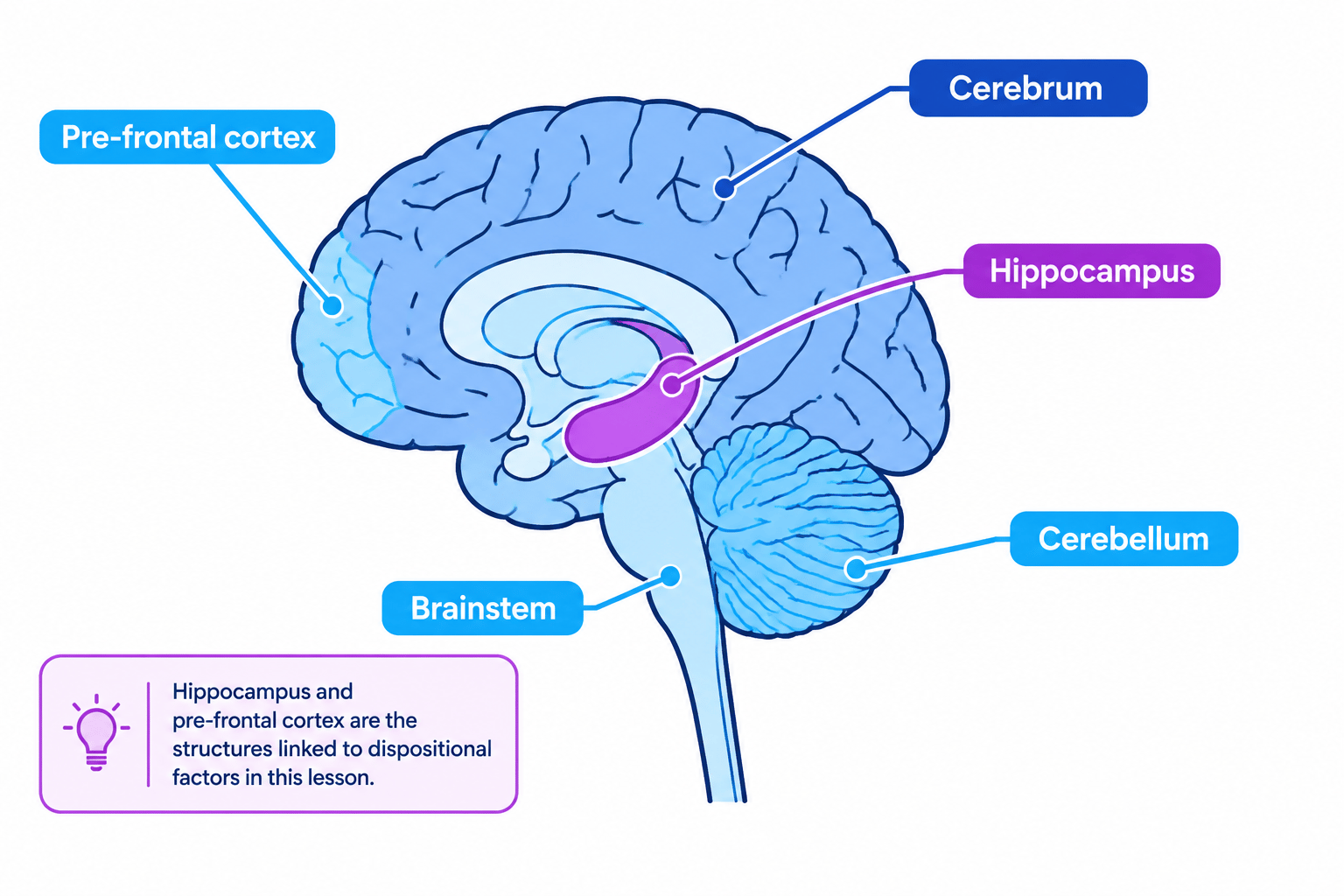
The biological basis of dispositional factors
- Dispositional factors have a biological basis, so part of a person's personality is linked to the structure of their brain.
- Hippocampal volume is linked to self-esteem, and regions of the pre-frontal cortex are linked to morality.
- Both structures sit in the cerebrum, the largest of the brain's three main divisions.
- Self-esteem is the dispositional factor behind conformity, and morality is the dispositional factor behind pro-social and anti-social behaviour.
Key Idea
- Some of what makes you the person who gives way in a group, or the one who holds firm, is built into the structure of your brain.
- A larger hippocampus goes with higher self-esteem, and self-esteem is what sets how hard a majority has to push before you move.
- Regions of the pre-frontal cortex attach a feeling to a moral decision, so damage there loosens the hold that feeling has on what you do next.
The three main divisions of the brain
Definition
Cerebrum
The largest of the brain's three main divisions, split into two hemispheres, which deals with thinking, language, personality and voluntary movement.
- Cerebrum
- The largest division, split into two hemispheres.
- It handles thought, language, decisions and personality, so both structures in this topic sit inside it.
- Cerebellum
- Sits at the back of the brain, tucked underneath the cerebrum.
- It handles balance, posture and co-ordinated movement.
- Brainstem
- The stalk joining the brain to the spinal cord.
- It controls breathing, heart rate and levels of arousal without conscious effort.
Common Mistake
- Only the hippocampus and the pre-frontal cortex are linked to dispositional factors, so neither the cerebellum nor the brainstem shapes personality.
Hippocampal volume and self-esteem
Definition
Hippocampus
A structure deep in the brain that helps transfer new information from short-term memory into long-term memory. Damage to it makes forming new long-term memories very difficult.
- Pruessner et al. (2005) reported that hippocampal volume correlates with self-esteem and with having an internal locus of control.
- Self-esteem is the dispositional factor behind conformity, so a difference in hippocampal volume is one indirect influence on how readily someone goes along with a majority.
- Locus of control is the dispositional factor behind crowd behaviour, so the same finding also reaches how people act in a crowd.
- The finding is a correlation, so a larger hippocampus may support higher self-esteem, or years of higher self-esteem may shape the structure.
- Neither direction of causation has been demonstrated.
Note
- Because this is a correlation, it cannot tell you whether the structure came first or the years of high self-esteem did.
- The hippocampus also does the work of moving new information into long-term memory, and that job belongs to the memory topic rather than this one.
- One structure never accounts for a whole trait, since self-esteem also grows out of how you have been treated by the people around you.
The pre-frontal cortex and morality
Definition
Pre-frontal cortex
The region at the very front of the cerebrum that handles planning, holding back impulses and weighing up the emotional side of a moral decision.
- Young and Dungan (2012) found that the ventromedial pre-frontal cortex becomes active when someone weighs up the emotional side of a moral decision.
- The region attaches an emotional response to a moral judgement.
- Damage to the region is associated with a lack of empathy towards others.
- Damage is also associated with more anti-social behaviour and with poor moral decision-making.
- Morality is the dispositional factor behind pro-social and anti-social behaviour.
- Differences in this region are one reason people in the same crowd differ in whether they join in with damage.
Example
- A person with damage to the ventromedial pre-frontal cortex may act on a cruel or risky impulse.
- The emotional response that usually holds that impulse back is reduced, so the behaviour follows.
Criticisms of dispositional factors
Definition
Generalisability
How far the findings from the people studied can be applied to other people beyond the study.
- The dispositional approach does account for individual differences in how people respond to the same situation.
- A trait may make someone more likely to obey, conform or follow a crowd, but that tendency cannot be generalised across all situations because other factors intervene.
- Situational features such as the size of the group and how well the people know each other change how far a trait shapes behaviour.
- Much of the brain evidence rests on scans of small groups or on a small number of patients with rare injuries.
- NatCen (2011) interviewed 36 people in Tottenham, a small fraction of those involved, so its dispositional conclusions cannot safely be applied to everyone.
- A correlation between the size of a structure and a trait does not show that one produces the other, because a third factor may influence both.
Common Mistake
- Generalisability is the criticism that lands on dispositional factors, and free will and determinism belongs with situational factors.
- The brain does not fully explain social behaviour, because it is one influence working alongside personality and the situation.
- Damage to the pre-frontal cortex does not make someone anti-social; it raises the likelihood of anti-social behaviour.
Turning this into marks
- Name hippocampal volume for self-esteem and regions of the pre-frontal cortex for morality, because a general statement that the brain affects personality does not secure the knowledge mark.
- Take the chain all the way to behaviour, from hippocampal volume to self-esteem to conformity, or from the pre-frontal cortex to morality to pro-social and anti-social behaviour, because a structure named on its own gains no development mark.
- Match the strength of the claim to the evidence, calling the hippocampal finding a correlation and the damage findings an effect.
- The mark most often lost is stating the generalisability criticism without an example of a trait leading to different behaviour in a different situation.
Self review
- Name the three main divisions of the brain and one job of each.
- Which structure is linked to self-esteem, and what kind of link is it?
- Which region is linked to morality, and what happens when it is damaged?
- State the generalisability criticism of dispositional factors.
- Give two reasons why this evidence is hard to generalise.