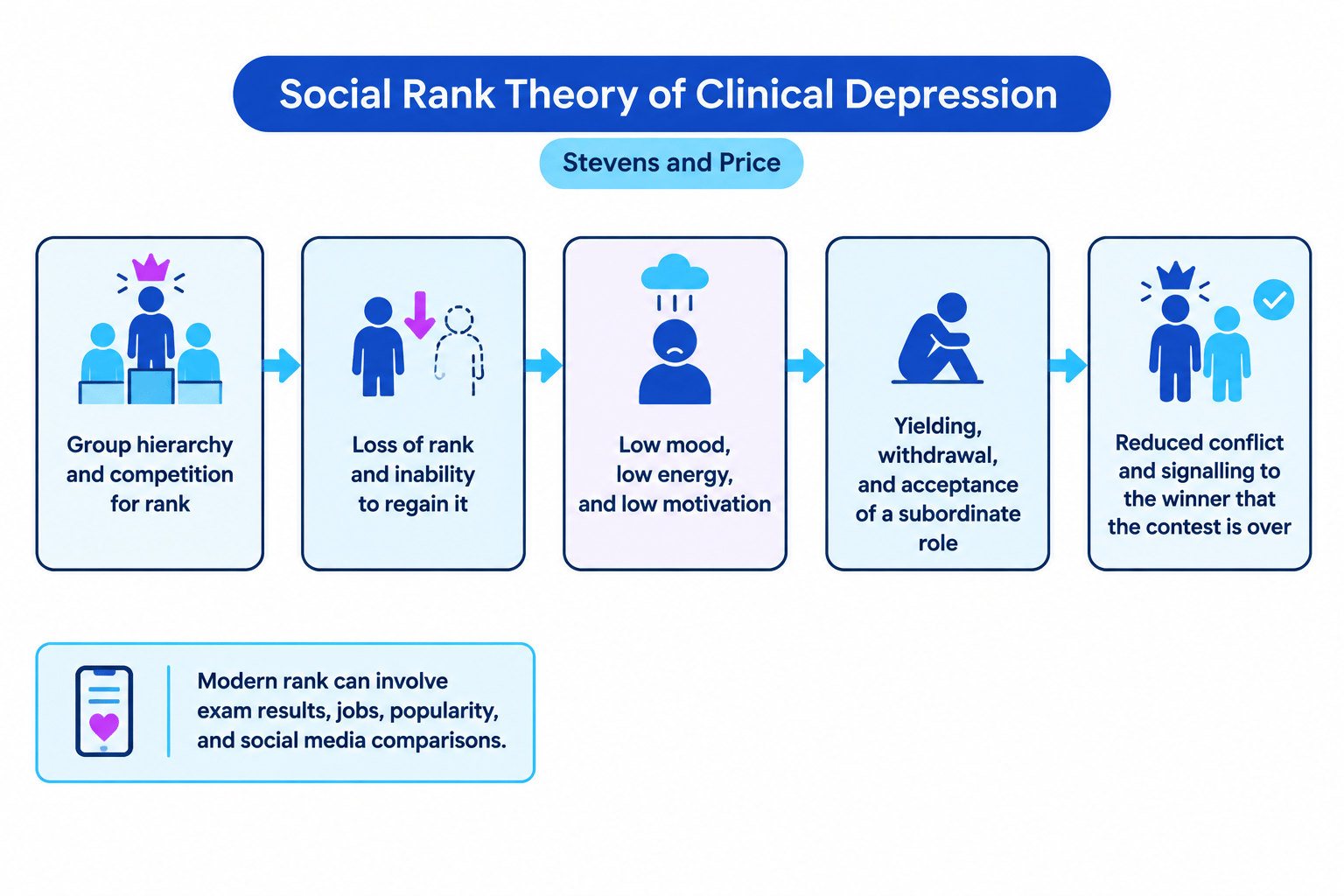
Social rank theory
- Social rank theory is the biological explanation of clinical depression, and it works through evolution.
- It was put forward by Stevens and Price, who argued that human beings evolved to live in groups arranged in a hierarchy.
- Inside such a group people compete for rank, status and the resources that come with them.
- The trigger the theory focuses on is losing rank and then being unable to regain it.
- Depression is treated as an adaptive response to that loss, and the appeal to evolution is what makes the explanation a biological one.
Key Idea
- Losing rank and then finding you cannot win it back is the trigger this theory picks out.
- Low mood, low energy and lost motivation stop a person competing again, which in our evolutionary past kept them out of a fight they would lose.
- Depression is therefore treated as an inherited adaptation rather than a fault in the person, and that appeal to evolution is what makes this the biological explanation.
The evolutionary function of depression
- In our evolutionary past, competing for rank was dangerous, because a losing fight risked injury or being pushed out of the group.
- Low mood, loss of energy and loss of motivation make the loser stop competing and lower their ambitions, which keeps them out of a fight they cannot win.
- Anything that improved survival in that way would be passed on to later generations, so the theory treats depression as an inherited adaptation rather than a fault in the person.
Example
- Modern rank runs on exam results, jobs, popularity and how other people's lives look on social media.
- Someone who fails to make the team, and then sees the squad photos posted all week, may quietly stop turning up rather than challenge the selection again.
- Withdrawing keeps them out of a contest they expect to lose a second time.
How a lower rank reduces conflict
- The theory says depression makes a person accept a subordinate role instead of fighting on.
- Outward symptoms such as sadness, crying and withdrawal act as a signal to everyone else that the person is not fit to compete.
- That signal discourages others from attacking again, because there is no longer anything to win.
- It also reassures the winner that the contest is over, so the winner has no reason to press the advantage.
- A damaging, drawn-out struggle is avoided, so the theory argues the individual and the group both benefit.
- Yielding in this way is how a lower rank reduces conflict.
- Tandoc et al. (2015) found that Facebook envy predicted symptoms of depression, and envy on Facebook is a sense of being lower in rank.
- That study is correlational, so it supports the theory without showing that a lower rank causes depression.
Note
- Rank here covers anything a group competes over, so exam results and job titles now do the work that physical contests once did.
- The theory explains the shape the symptoms take, and it does not suggest that a person is choosing to give up.
Criticisms and the reductionism debate
Definition
Reductionism
Explaining a complex behaviour by reducing it to one simple cause or process, rather than looking at the whole person and the range of factors involved.
- The debate this theory runs into is reductionism and holism.
- Being reductionist has an upside, because one clear mechanism is easier to test than a long list of interacting causes.
- Social rank theory is reductionist, because it explains a complex disorder through a single evolutionary mechanism.
- A holistic view says depression has many interacting causes, including life events, relationships, money worries and the way a person thinks.
- The evolutionary claim is hard to test, since nobody can observe how depression worked for our distant ancestors.
- It also struggles to explain why depression can be so disabling and last so long, if its function is to protect the person.
- It says little about why some people who lose rank become depressed and others do not.
Common Mistake
- Reductionism and holism is the debate attached to social rank theory, while nature and nurture belongs to the dopamine hypothesis and free will and determinism to the ABC model.
- Social rank theory is the biological explanation of depression, so an answer built on serotonin, genes or twin studies is answering a different question.
Turning this into marks
- When two parts of the theory are asked for, make them genuinely separate: the evolutionary function of depression, and the way a lower rank reduces conflict.
- Name Stevens and Price and the loss of rank, because a general reference to stress or low mood does not secure the knowledge mark.
- Where a question asks for criticisms, use the reductionism and holism debate and the difficulty of testing an evolutionary claim.
- The mark most often lost is giving the ABC model when the question asked for the biological explanation of depression.
Self review
- Is social rank theory the biological or the psychological explanation of depression?
- What is the evolutionary function of depression, according to Stevens and Price?
- How does accepting a lower rank reduce conflict?
- Which debate does this theory run into?
- How does Tandoc et al. (2015) support social rank theory?