Concrete-operational thinking
- In the concrete-operational stage, from about seven, a child's thinking becomes far more logical.
- Three processes mark the shift: decentration, reversibility and conservation.
- All three can be tested with one task: the same amount of squash poured into a taller, thinner glass while the child watches.
Key Idea
- A child conserves once they can hold the height and the width of the glass in mind at the same time and picture the squash poured back.
- Decentration supplies the first of those steps and reversibility supplies the second, which is why all three arrive together in the concrete-operational stage.
- Criticism of the theory turns on how much of that development Piaget put down to maturation alone.
Decentration
- Decentration: the ability to attend to several features of a situation at the same time.
- A pre-operational child centres on one feature only, such as the height of a glass or the length of a row.
- From about seven the child can weigh height and width together, so a taller glass stops meaning more.
- Decentration is also what lets the child take someone else's viewpoint, so egocentrism fades at the same age.
Note
- Centring means the child locks on to whichever feature stands out most, usually the one that has just got bigger.
- Judging squash by the height of the glass alone works like judging a packet of crisps by how large the bag looks rather than by the weight printed on it.
- Nothing about the amount changes in any of these tasks, only the way it is laid out.
Reversibility
- Reversibility: understanding that an action can be undone mentally to get back to the starting point.
- The child can picture the squash from the tall glass being poured straight back into the glass it came from.
- Because they can reverse the pour in their head, they can work out that the amount must have stayed the same.
Example
- In primary maths you spread ten counters into a long line and then bunch them up tight.
- A Year 1 pupil says the long line has more counters in it.
- A Year 3 pupil decentres from length, mentally pushes the counters back together, and sees the number never changed.
Conservation
Definition
Conservation
In Piaget's theory, understanding that the quantity of something stays the same even when its appearance changes, such as its shape or the way it is arranged.
- Conservation: knowing that the amount of something stays the same when only its appearance changes.
- Piaget poured the same amount of liquid into a tall thin glass and a short wide glass while the child watched.
- A pre-operational child says the tall glass has more, because they centre on its greater height and cannot reverse the pour.
- A concrete-operational child says the amount is unchanged, since nothing was added and nothing was taken away.
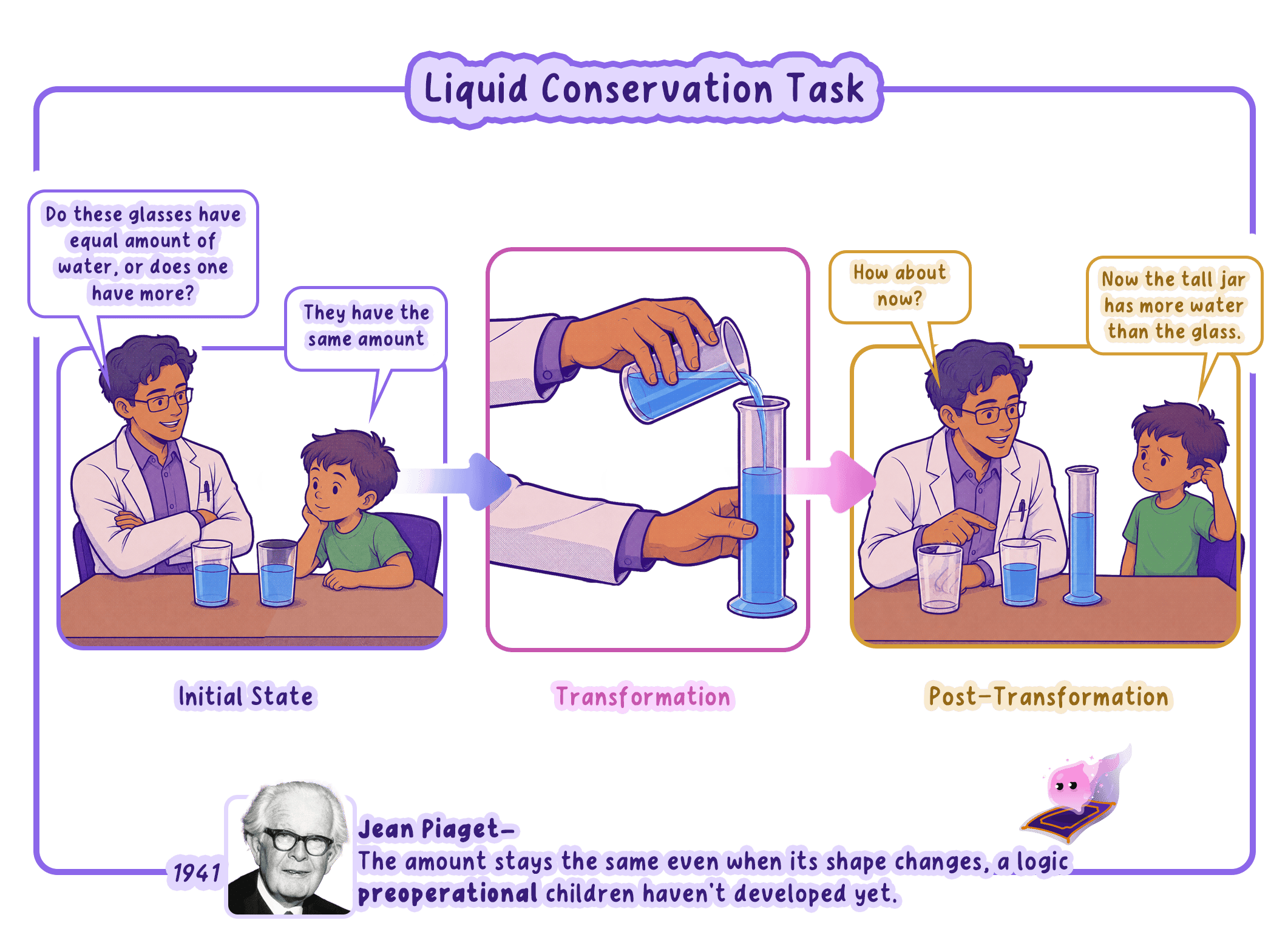
- Conservation depends on decentration and reversibility working together, so all three arrive in the same stage.
- Piaget's own study of conservation of number used rows of counters rather than glasses of liquid.
Common Mistake
- Decentration and reversibility are two separate processes.
- Decentration is noticing the width of the glass as well as its height.
- Reversibility is picturing the squash poured back into the glass it came from.
- A pre-operational child's failure is not an inability to count, since the failure is about being fooled by the new arrangement.
Criticisms of Piaget's theory
- The debate that criticisms of Piaget turn on is reductionism versus holism.
- Reductionism: explaining behaviour by breaking it down to one simple factor.
- Piaget reduces cognitive development to biological maturation working through four fixed, invariant stages.
- Holism: explaining behaviour by looking at the whole picture.
- A holistic account says teachers, parents, friends and culture all shape how a child thinks, and Piaget gives them very little weight.
- Reducing development to maturation made the theory clear, testable and easy to apply in schools.
- It leaves an incomplete account of why two seven-year-olds in the same class can be so far apart.
- Piaget also underestimated young children, because his tasks may have confused them.
- McGarrigle and Donaldson found that when a naughty teddy puppet knocked a row of counters out of line by accident, far more children aged four to six said the number was unchanged.
- Asking the same question twice, straight after a deliberate change, may have made children think a different answer was wanted.
- If a teacher rubbed out your answer and asked you the same question again, you would probably change it as well.
- The stages may be less fixed than Piaget claimed, since a child can show a skill in one situation and fail at it in another.
Note
- No reliable figure exists for how many children took part in Piaget's conservation study, so it has no sample size to quote.
- The naughty teddy version changes the task rather than the child, which is what makes it a criticism of Piaget's method.
- A child who conserves counters but not liquid is a problem for the idea that a whole stage switches on at once.
Turning this into marks
- When decentration and reversibility are both asked for, describe a different mental step for each rather than one step reworded.
- Name the reductionism and holism debate when you criticise the theory, because a general remark about nature and nurture does not secure the mark.
- The mark most often lost is describing the conservation task without saying what a child in each stage answers.
- Name McGarrigle and Donaldson when you argue that the task itself confused the children.
Self review
- What is decentration, and how does it help a child conserve?
- What is reversibility?
- What is conservation, and which stage does it arrive in?
- Which debate do criticisms of Piaget's theory turn on?
- Explain one way Piaget's theory is reductionist, and one thing a holistic account would add.
