The basis of the theory
- Hans Eysenck set out his Criminal Personality Theories in 1964 and 1992, and explained the biology behind them in the Biological Basis of Personality (1967).
- He argued that personality is largely inherited, so the nervous system you are born with sets how you behave.
- Personality sits on three dimensions: extraversion, neuroticism and psychoticism.
- Each dimension is a scale, so you sit somewhere along it.
- Eysenck measured all three with the Eysenck Personality Questionnaire (EPQ), a self-report questionnaire made up of closed questions.
- Score high on all three at once and you have what he called the criminal personality.
Key Idea
- Eysenck treated personality as largely inherited, so the nervous system you are born with sets how you react and how easily you are conditioned.
- The criminal personality is high extraversion, high neuroticism and high psychoticism in the same person, measured by the Eysenck Personality Questionnaire.
- That combination makes a child hard to condition, so the rules taught in childhood never fully take hold.
The three dimensions
Definition
Extraversion
A personality dimension describing how outgoing and stimulation-seeking someone is. Extraverts look for excitement and become bored easily, while introverts are quieter and more easily satisfied with calm.
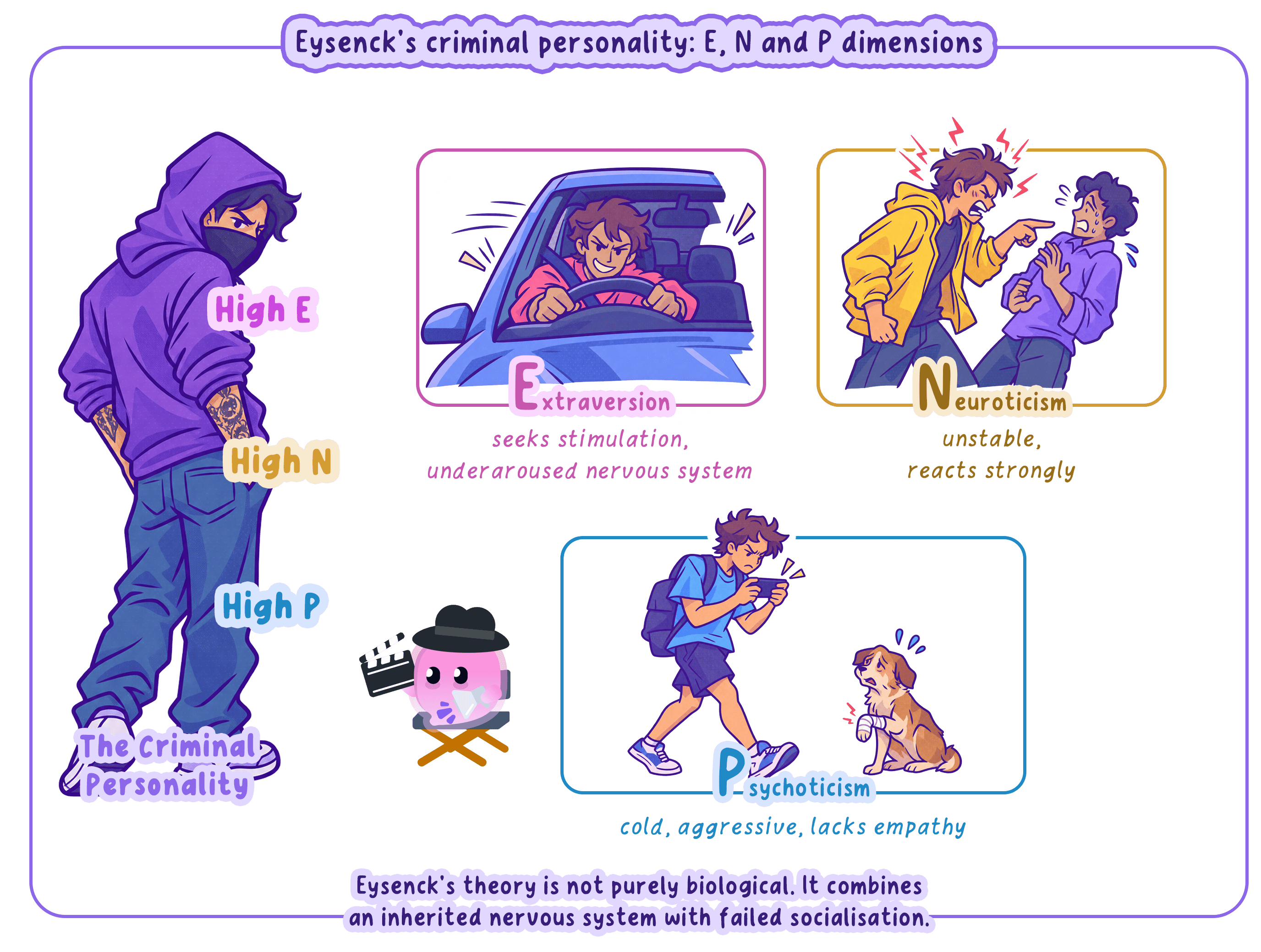
- Extraversion: how much company, excitement and risk you look for.
- A high scorer is sociable, impulsive and easily bored, and needs strong stimulation before anything feels interesting.
- A low scorer is an introvert: quiet, reserved and satisfied with far less going on.
- Neuroticism: how strongly and how quickly your emotions react.
- A high scorer is anxious and moody, reacts hard to anything unpleasant, and takes a long time to settle again.
- A low scorer is emotionally stable, staying steady when a day goes badly.
- Psychoticism: how cold, aggressive and unconcerned about other people you are.
- A high scorer is egocentric, hostile and short on empathy, so someone else's distress does not hold them back.
- A low scorer is warm and considerate, and is troubled by the thought of hurting anyone.
Note
- Each dimension has its own physiology, with a different set of structures behind it.
- Extraversion goes with dopamine reward systems, the reticular activating system and the cerebral cortex.
- Neuroticism goes with the autonomic nervous system and the limbic system.
- Psychoticism goes with an overactive dopamine system at the synapse.
- Those three pairings are easily muddled, and swapping them is the easiest way to go wrong on this theory.
How each dimension links to crime
Definition
Neuroticism
A personality dimension describing how emotionally reactive and anxious someone is. People high in neuroticism worry a lot and become upset quickly, while those low in it stay calm and stable.
- A high extraversion score means ordinary life feels flat, and crime is one of the few things that supplies enough excitement.
- Extraverts are impulsive too, so you take the opportunity before you have weighed up what follows.
- A high neuroticism score means a small setback produces a large reaction, so an argument turns into violence more readily.
- The anger is also slow to fade, so it lasts long enough to be acted on.
- A high psychoticism score takes away the brake that empathy usually provides, so the harm done to a victim is no deterrent.
- Psychoticism also brings aggression and anti-social behaviour, which is why Eysenck tied it most closely to violent offending.
Example
- Two 15-year-olds are offered a ride in a car a friend has just taken from a Tesco car park.
- The one who scores low on all three dimensions pictures the owner coming back to an empty space and walks home.
- The one who scores high on all three feels the pull of the risk, reacts to the dare on the spot, and is untroubled by the owner.
- Eysenck predicts a raised risk here, but most people with these traits never offend.
The criminal personality
Definition
Psychoticism
A personality dimension describing how cold, aggressive and lacking in empathy someone is. People who score high on psychoticism can be hostile and unconcerned about the feelings of others.
- The criminal personality is a combination of scores: high extraversion, high neuroticism and high psychoticism in the same person.
- That combination makes a child difficult to condition, so the rules taught during childhood never fully stick.
- Eysenck therefore predicted that prisoners would score higher on all three dimensions than the general population.
- Heaven (1996) tested that prediction and found psychoticism the strongest predictor of self-reported delinquency.
Note
- Scoring high on all three raises the likelihood of offending, but plenty of people with that profile never offend at all.
- The theory describes a general disposition, so it does not predict which offence a person will commit.
- Every score comes from a self-report questionnaire, so the measure carries the honesty and social desirability problems of any questionnaire.
Turning this into marks
- When the criminal personality is asked for, name all three dimensions and say the scores are high at the same time, because naming one dimension is not the same point as naming the combination.
- Name the dimension that fits the behaviour described, such as psychoticism for a cold act with no concern for the victim, because writing that the offender has a criminal personality does not secure the knowledge mark.
- The mark most often lost is pairing a dimension with the wrong biology, such as putting the limbic system with extraversion rather than with neuroticism.
Self review
- What are Eysenck's three personality dimensions?
- Which dates go with the Criminal Personality Theories, and which with the Biological Basis of Personality?
- What combination of scores makes up the criminal personality?
- What does a high psychoticism score describe?
- Why does a high extraversion score make offending more tempting?
