Identification with role models
Definition
Social learning theory
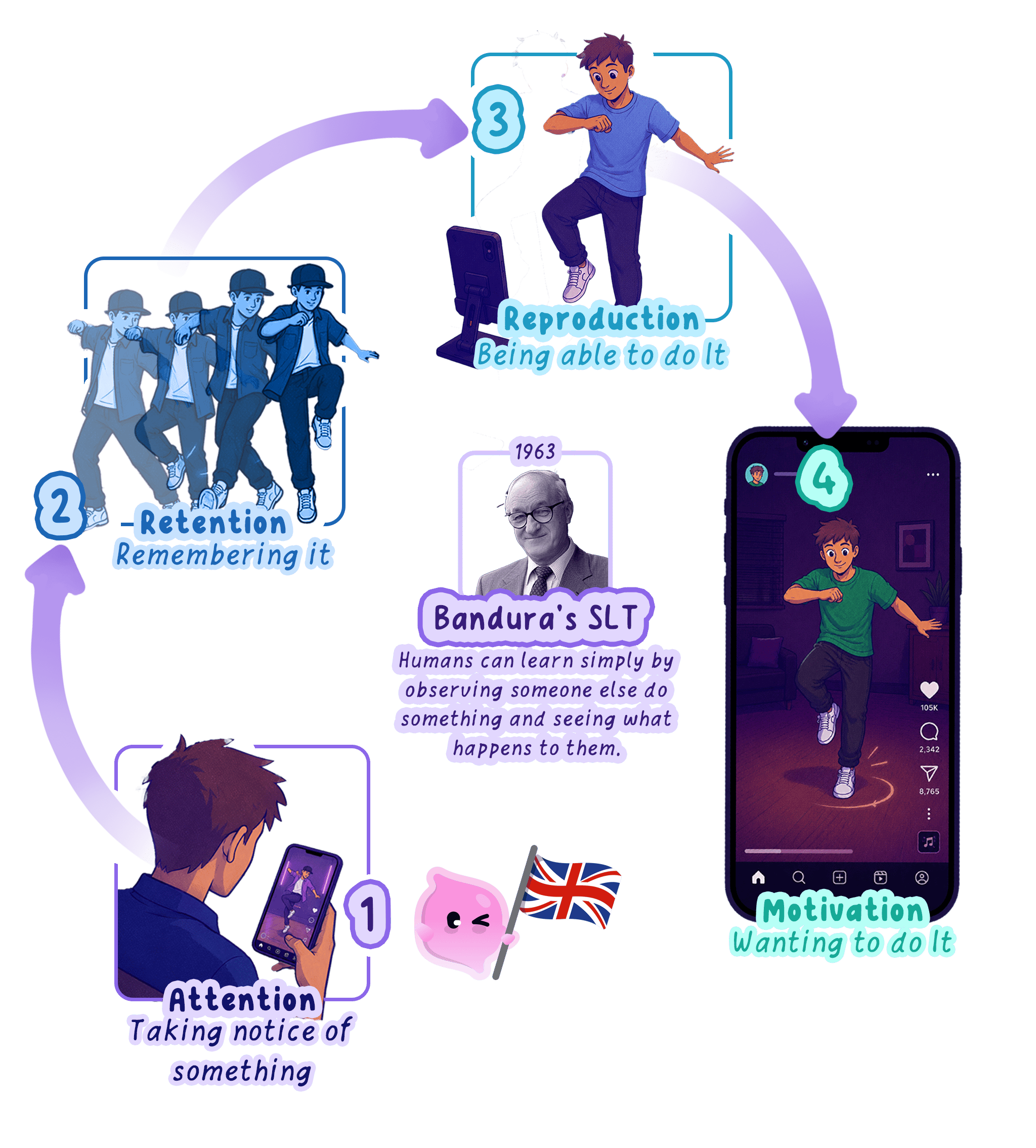
Bandura's idea that behaviour is learnt by watching and imitating other people, especially when you see the model being rewarded for that behaviour.
- The social learning theory of criminality says all behaviour, including offending, is learnt by watching other people.
- Children are the most open to it, because they are still working out how people in their world behave.
- The person being watched is the role model, and the pull you feel towards them is identification.
- Identification is the first link in the chain, because you attend closely to a model you feel connected to.
Key Idea
- You attend most closely to a model you can see yourself in, so similarity in age, sex, background and circumstances helps decide whose behaviour gets copied.
- Family are the first models, peers take over in adolescence, and a figure on a screen counts as a model as well.
- That is why offending clusters in families, friendship groups and particular streets without any shared gene doing the work.
Where role models come from
Definition
Role model
A person whose behaviour is watched and may later be copied, such as a parent, an older sibling, a friend or a figure on a screen. A role model does not have to be present in person or intend to be copied.
- Family: the earliest and usually the strongest models.
- Parents, carers and older siblings are watched for years before anybody else gets a look in.
- A child shares their background, accent and circumstances, so what they do looks like an option that is open to someone like them.
- Peers: the models who take over in adolescence.
- Friends and slightly older teenagers on the same estate or in the same year group model what is normal for that group.
- Because they are close in age, similarity is high and the behaviour looks achievable rather than adult and distant.
- Media and game characters: models watched on a screen rather than in person.
- Figures in television, film, music and video games are still models, even though they never meet you.
- Cooper and Mackie (1986) used exactly this kind of model, and children who had watched or played the violent game later chose the aggressive toy more often.
Example
- A 14-year-old in Manchester has an older brother who shoplifts and is admired for it by his friends.
- They share a home, a background and only three years in age, so identification is strong.
- That teenager is more likely to copy the shoplifting than they would be after watching a stranger do the same thing.
What makes identification stronger
Definition
Identification
Taking on the qualities, values or behaviour of a person you admire, so that you feel more like them. The stronger this connection, the more likely their behaviour is to be copied.
- Similarity: a model who matches you in age, sex, ethnicity or background is easier to identify with.
- Status: a model who is admired, feared or seen as successful carries more weight than an ordinary onlooker.
- Warmth: a model who is close to you and treats you well is copied more than a distant one.
- Contact: the more often you see the model behave that way, the more chances there are to attend to it.
- Once identification is in place, watching the model act leaves a mental representation of the behaviour, which is stored and available later.
Common Mistake
- Identification and imitation are not the same word.
- Identification is the connection you feel with the model, and imitation is the copying that may follow.
- Identifying with an offender does not make offending certain, because it only raises the likelihood.
Why offending runs in families and areas
- Where a child's closest models offend, the behaviour they see most often is the behaviour they are most likely to store.
- Two brothers can end up with similar records without any shared gene doing the work, because they shared the same models.
- It also explains area differences, since visible offending on a street supplies models to every child who walks down it.
- The same mechanism runs the other way, which is why rehabilitation schemes deliberately supply positive role models.
Note
- Identification only settles which model a young person attends to.
- How watching turns into copying is covered under observation and imitation.
- What happens to the model afterwards is covered under vicarious reinforcement, and what happens to the observer under direct reinforcement.
Turning this into marks
- When a question asks you to explain one person's offending, name the model and the shared characteristic as two separate points rather than one point rephrased.
- Name the feature that drives the identification, such as a three year age gap or a shared home, because writing that the boy looked up to his brother does not secure the knowledge mark.
- Finish by naming the behaviour that was copied, so the chain from model to identification to imitation is complete.
- The mark most often lost is describing what the model did without ever saying why that particular person was the model.
Self review
- What is meant by identification in the social learning theory of criminality?
- Give three kinds of role model a young person might identify with.
- Name two things that make identification with a model stronger.
- Explain the difference between identification and imitation.
- How does Cooper and Mackie (1986) support the influence of models on behaviour?
