The problem Gregory starts from
- The image landing on your retina is flat, incomplete and often blurred or partly hidden behind something else.
- A great deal of what you seem to see clearly is simply not present in that raw sensory input.
- Gregory's Constructivist Theory of Perception (1970) therefore argues that perception cannot mirror the input, so the brain has to add to it.
- On this account perception is largely constructed by you and only partly supplied by the light.
Building a perceptual hypothesis
Definition
Perceptual hypothesis
An informed guess the brain makes about what is out there, based on past experience, which perception then tests against the incoming sensory input.
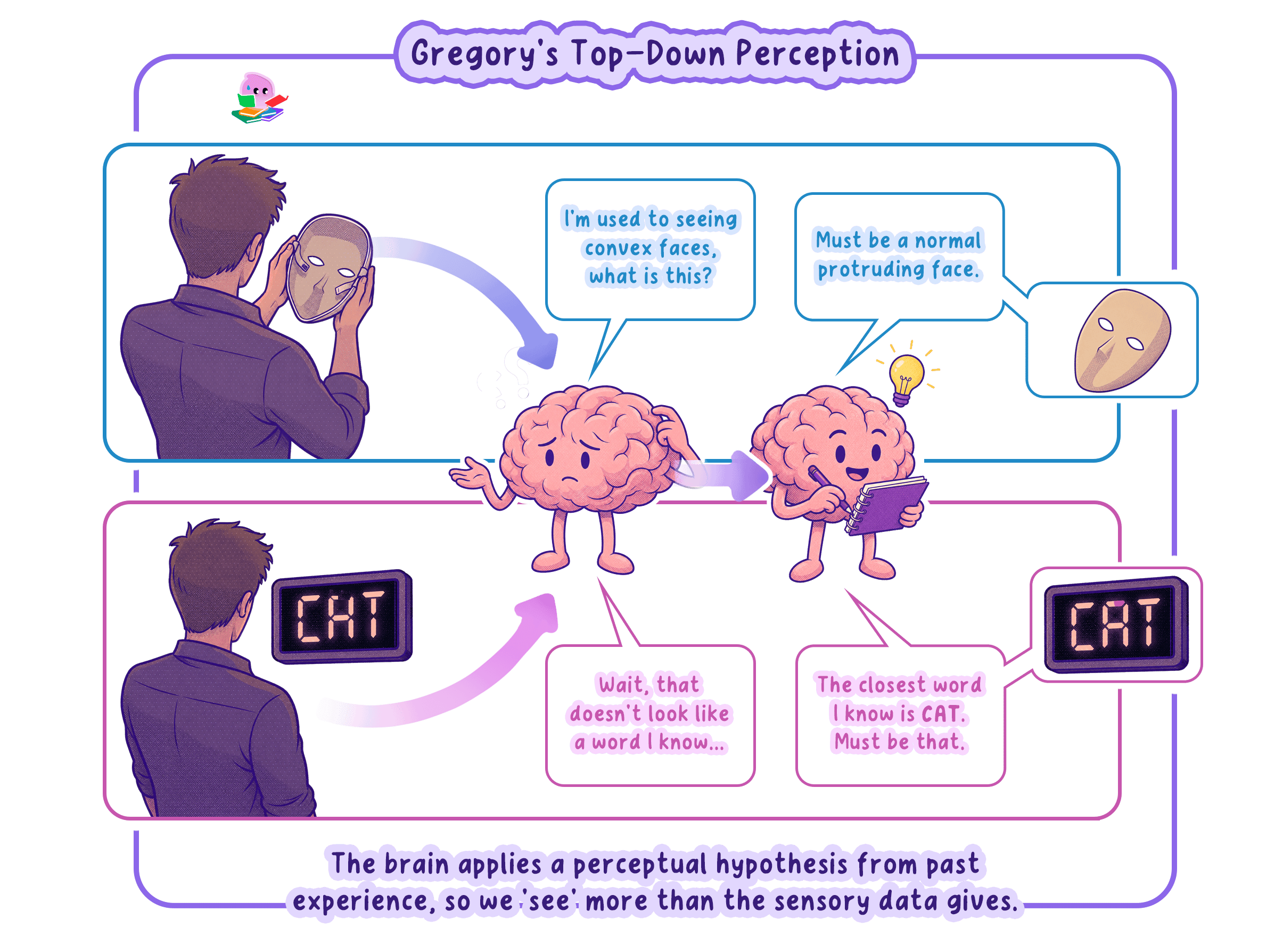
- The brain forms a perceptual hypothesis, which is its best guess about what is really out there.
- It assembles that guess from past experience of similar scenes and objects.
- It then tests the guess against the incoming sensory input.
- If the two fit, the guess becomes what you perceive.
- If they do not fit, the guess is revised and tested again.
- Because the first guess is usually right, perception feels instant even though this work is going on underneath.
Inferences
Definition
Inference (perception)
A conclusion the brain draws about what is really there by going beyond the incomplete sensory input, filling in detail the eye never actually received.
- An inference is the conclusion the brain draws when it goes beyond the input to decide what is there.
- Seeing a head above a postbox and legs below it, you infer one whole person, although your eye received only two separated fragments.
- Inferences happen without your awareness, which is why perception never feels like reasoning even though Gregory argues that reasoning is exactly what it is.
Prior knowledge
- Prior knowledge is the store of past experience the brain draws on when it forms a hypothesis and makes an inference.
- The more experience you have of a kind of scene, the faster and more accurate your guesses about it become.
- Because perception depends on what you have learned, two people can build different perceptions from exactly the same input.
- Context matters for the same reason, since the surrounding information decides which piece of prior knowledge gets used.
Example
- Written in the middle of THE CAT, an identical squiggle is read as an H in the first word and as an A in the second.
- The ink on the page never changes, so the difference has to come from prior knowledge of which words are likely.
Why this is a nurture account
Definition
Top-down processing
Processing that starts with your prior knowledge, context and expectations, using them to interpret incomplete sensory input.
- In top-down processing, perception starts from stored knowledge and expectation rather than from the input.
- Because that knowledge has to be acquired, perception on this account develops as your experience grows.
- A young child with little stored knowledge therefore makes poorer guesses than an experienced adult looking at the same scene.
- That reliance on learning places Gregory firmly on the nurture side of the debate.
Evidence that supports the theory
- A strength is the evidence from Carmichael, Hogan and Walter (1932), who gave two groups different names for the same ambiguous figures and found that 74 per cent and 73 per cent of the most-changed reproductions resembled the name supplied, against 45 per cent in a control group who saw the figures unnamed.
- A second strength is that the theory explains perceptual set and ambiguous figures neatly, because a readiness to perceive something is a hypothesis formed in advance and a Necker cube flips as one hypothesis gives way to another.
Problems with the theory
- A weakness is that it cannot say where the very first hypothesis comes from, because a newborn has no past experience to build one out of.
- A second weakness is that much of the supporting evidence comes from illusions and ambiguous figures built in a laboratory rather than from ordinary scenes.
Common Mistake
- Do not offer illusions as proof that the theory is complete, because their artificiality is itself one of the criticisms.
Reaching a judgement
- The theory is convincing wherever the input is poor, ambiguous or deliberately misleading.
- It is less convincing as a complete account of the quick, accurate perception you manage in clear, rich scenes.
- The fairest verdict is that this account and Gibson's direct account divide the work between them, with construction explaining the failures and directness explaining the everyday successes.
Turning this into marks
- State what a named study found and then say what it shows about prior knowledge, rather than retelling it as a story.
- Give strengths and weaknesses together, and address any debate the question names, such as nature and nurture.
- The mark most often lost is describing hypotheses and inferences with no evaluation attached to them.
Self review
- Why does Gregory say the sensory input on its own is not enough?
- What is a perceptual hypothesis, and how is it tested?
- What does it mean to say that perception involves an inference?
- Why does the theory struggle to explain a newborn's first perception?
