Aim
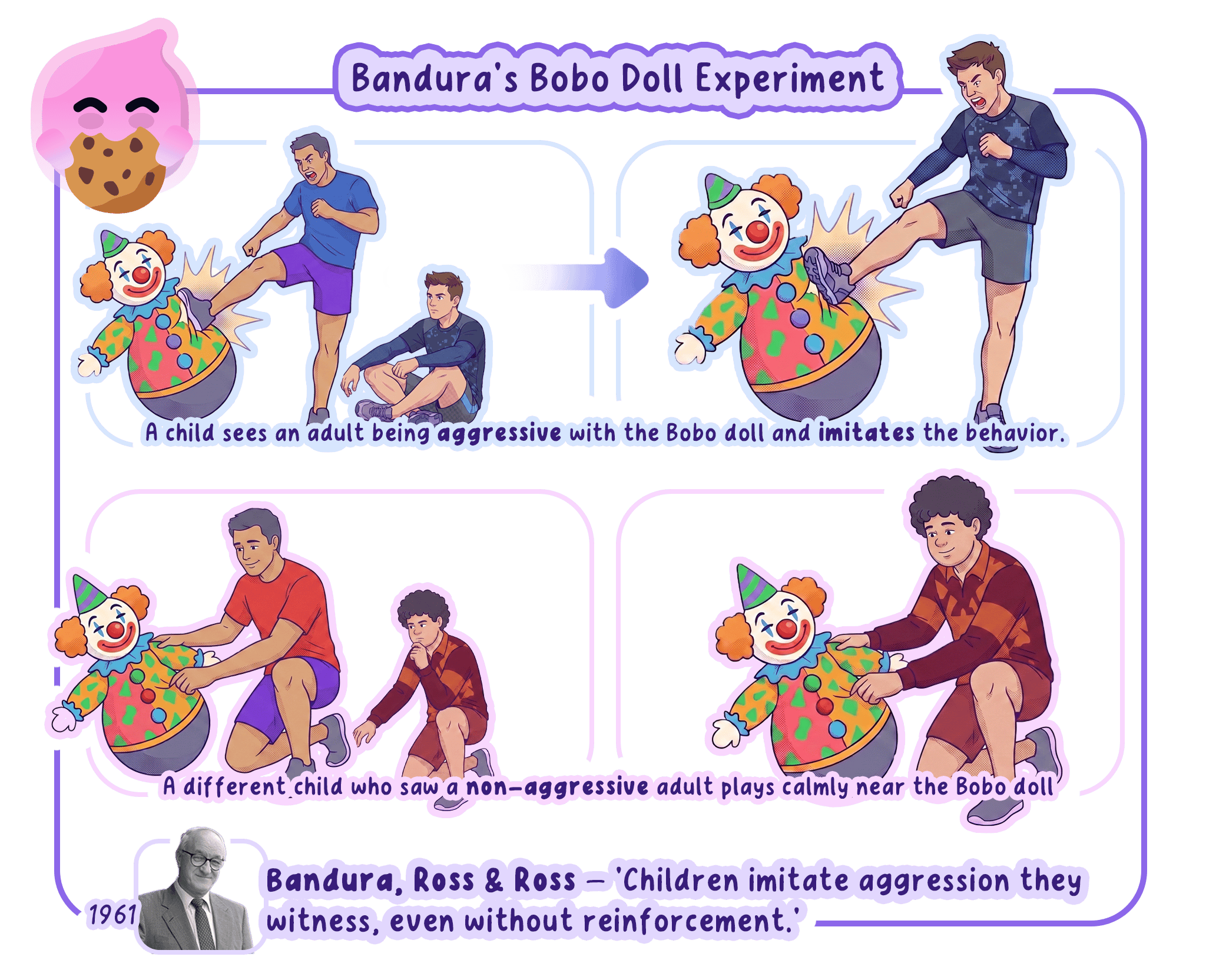
- Bandura, Ross and Ross ran this study to find out whether children would copy aggression they had only watched, without being rewarded themselves for copying it.
- They also asked whether the sex of the model mattered and whether boys were more aggressive than girls.
Definition
Social learning theory
Bandura's idea that behaviour is learnt by watching and imitating other people, especially when you see the model being rewarded for that behaviour.
Procedure
- Sample: 72 children, 36 boys and 36 girls aged 37 to 69 months, from the Stanford University nursery school.
- Every child was pre-rated for how aggressive they already were, and those ratings were used to match the children across the groups.
- Design: eight sub-groups of six children crossed what the model did with the model's sex and the child's sex, so boys and girls each saw either a male or a female model.
- In the aggressive condition the model attacked a Bobo doll, an inflatable figure that rights itself when it is knocked over, in distinctive and novel ways.
- The model struck the doll with a mallet, sat on it and punched it, threw it in the air and used verbal aggression such as 'kick him'.
- In the non-aggressive condition the model simply ignored the Bobo doll, and a control group of 24 children saw no model at all.
- Each child watched the model for 10 minutes, then met mild aggression arousal.
- The child was then observed for 20 minutes through a one-way mirror in a room of new toys.
Results
- Children who had watched the aggressive model reproduced far more physical and verbal aggression than the other children, including the novel acts the model had performed.
- Boys imitated more physical aggression than girls, though there was no significant sex difference in verbal aggression.
- Imitation was greatest after the male model, whichever sex the child was.
Conclusion
- Watching an aggressive adult weakens a child's inhibitions about behaving aggressively.
- Aggression can therefore be acquired by observation alone, with no reinforcement given to the observer, which is what social learning theory predicts.
Strengths
- A strength is that the study was tightly controlled, with matched groups and clearly identifiable novel acts, so imitation could be measured objectively.
- A second strength is that matching on pre-rated aggression removes the rival explanation that the aggressive group were simply more aggressive children to begin with.
Definition
Ecological validity
How well the findings of a study apply to real, everyday settings rather than only to the artificial conditions of a laboratory.
Weaknesses
- A weakness is that a Bobo doll is designed to be hit, so hitting one is not evidence about aggression towards a person and ecological validity is low.
- A second weakness is that there are ethical objections to deliberately exposing young children to aggression and then arousing them before the observation.
Turning this into marks
- Quote the figures, because 72 children, an age range of 37 to 69 months and the control group of 24 each earn credit.
- The mark most often lost is the second side, so set the control and the objective measure against the Bobo doll problem and the ethics.
Self review
- How many children took part, what was their age range in months, and where were they recruited?
- What did the model do in each of the two conditions?
- Name two of the novel acts the aggressive model performed on the doll.
- Which model produced the most imitation, and why is 'children copy their own sex' the wrong answer?
