Two learning explanations of criminality
- The first explanation is Operant Conditioning (Skinner, 1948), where behaviour is shaped by the consequences that follow it.
- The second is Social Learning Theory (Bandura, 1977), where behaviour is learnt by watching other people and copying them.
Operant conditioning and the consequences of offending
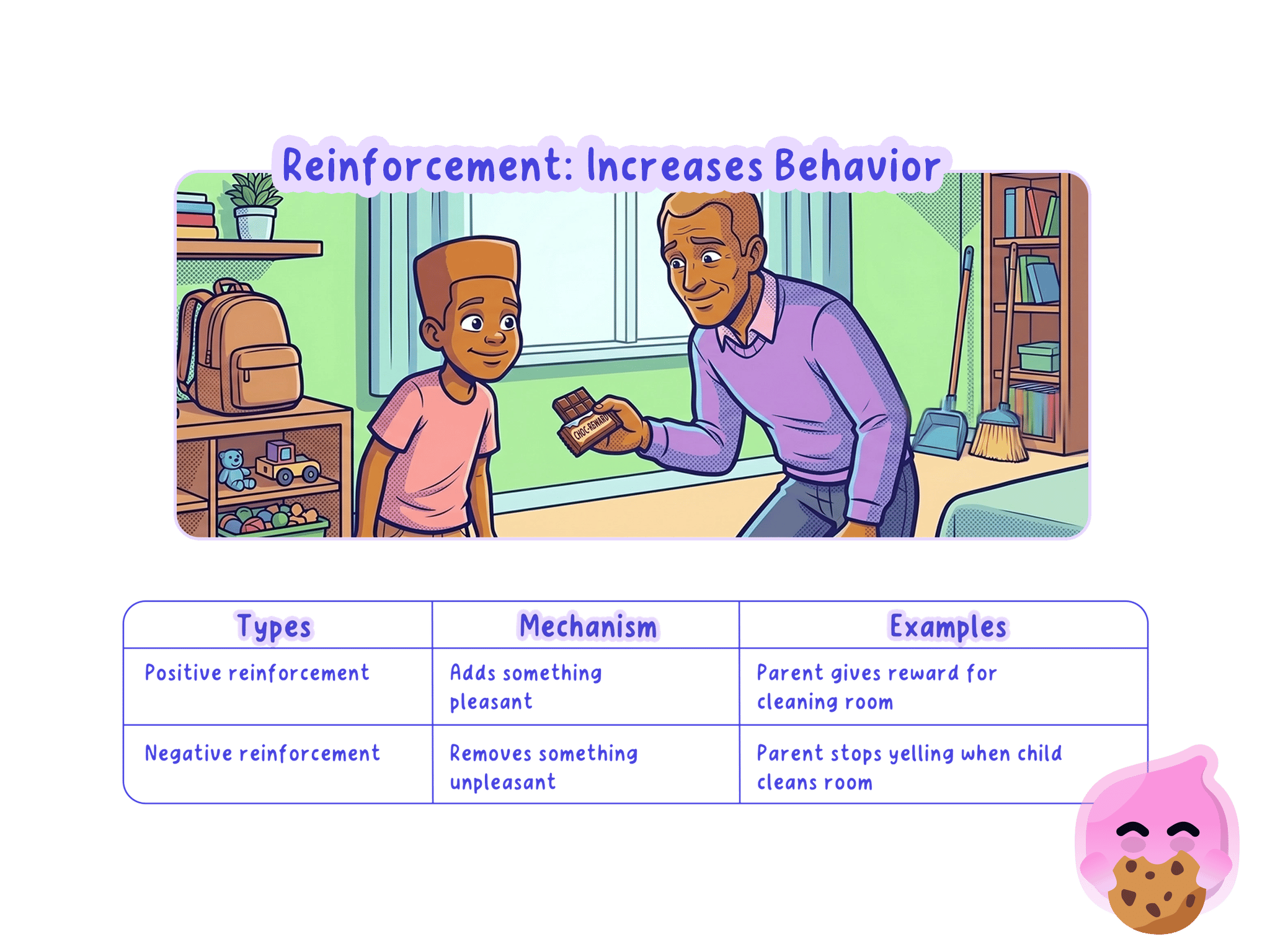
- Positive reinforcement means something rewarding is added after the act, such as the goods or money gained from a theft, which makes the act more likely to be repeated.
- Negative reinforcement means something unpleasant is removed by the act, such as a debt or a threat going away, which also makes the act more likely.
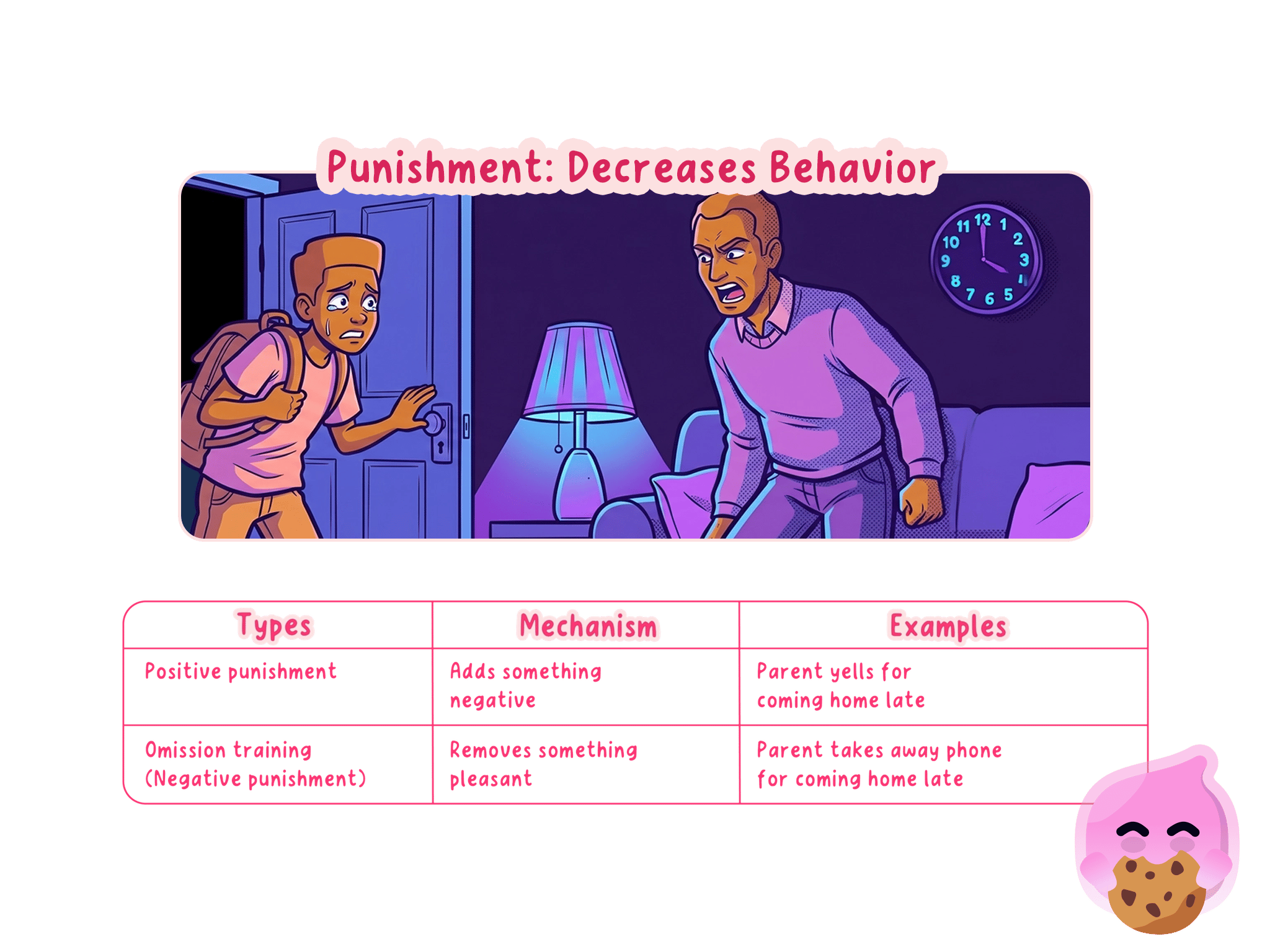
- Positive punishment means something unpleasant is added after the act, such as a prison sentence or a criminal record, which makes the act less likely.
- Negative punishment means something valued is taken away because of the act, such as a fine removing money or a curfew removing free time, which also makes it less likely.
Definition
Secondary reinforcer
A reward that has no value in itself and is rewarding only because you have learnt that it can be exchanged for something that meets a basic need, such as money or a token.
Primary and secondary reinforcers
- A primary reinforcer is rewarding in itself because it meets a basic biological need, such as food, drink or warmth.
- A secondary reinforcer has no value of its own and is rewarding only because you have learnt that it can be exchanged for primary reinforcers.
- Most theft is reinforced by money, a secondary reinforcer, which is why the reward can feel powerful even though money meets no need directly.
Strengths and weaknesses of operant conditioning
- A strength is that reinforcement and punishment can be observed and counted, so the explanation can be tested objectively rather than only argued about.
- A second strength is that it has a direct practical use, because reward-based programmes used in institutions are built on exactly these principles.
- A weakness is that it struggles to explain a first offence, because there has been no reinforcement or punishment for that behaviour yet.
- A second weakness is that it is reductionist, explaining offending only through consequences and leaving out inherited personality differences.
Definition
Social learning theory
Bandura's idea that behaviour is learnt by watching and imitating other people, especially when you see the model being rewarded for that behaviour.
Social learning theory and the people you copy
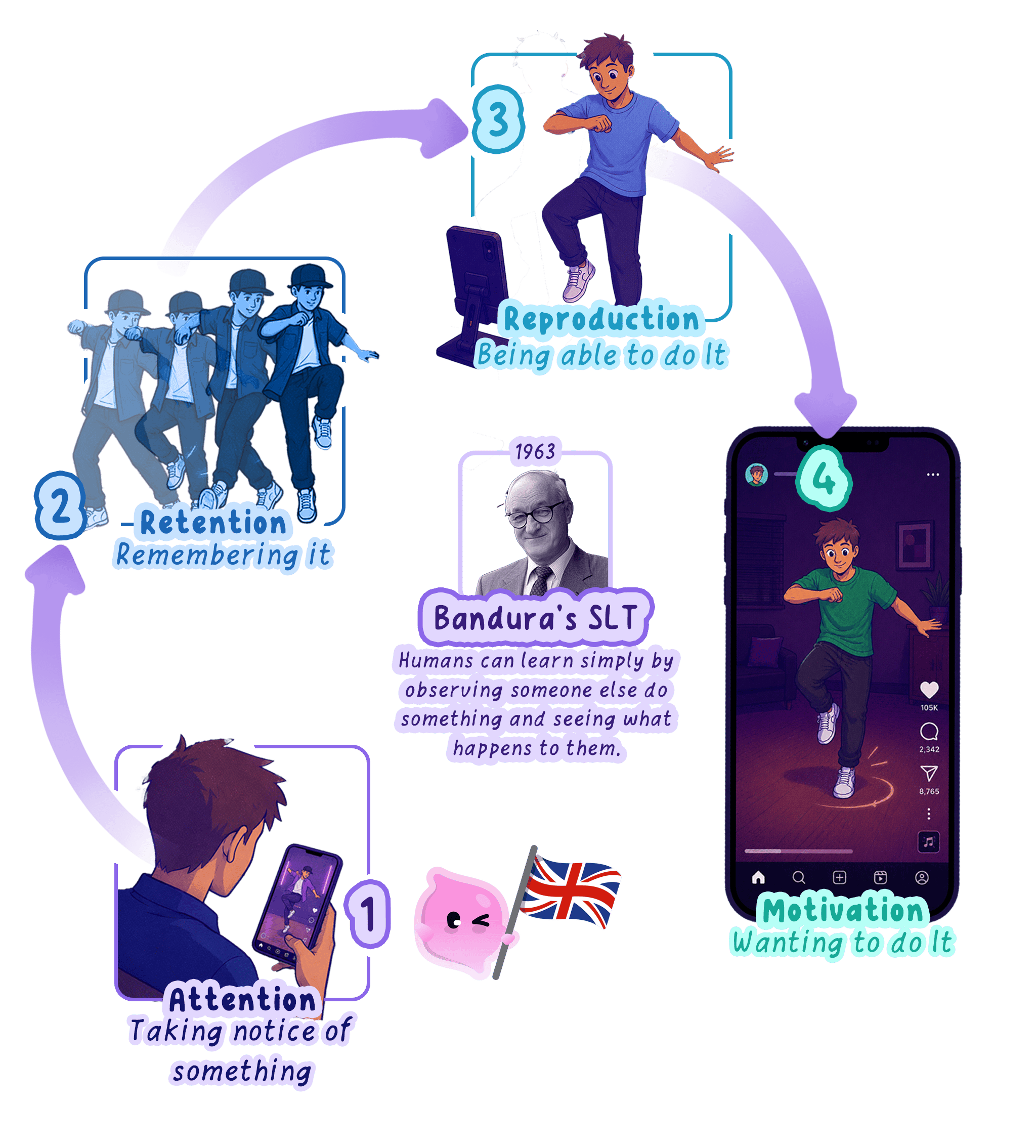
- Role models are the people whose behaviour you notice and take as an example, most often family, friends, older peers or figures in the media.
- Modelling is the model demonstrating a behaviour that someone else can then reproduce.
- Identification is feeling similar to a model or wanting to be like them, and it is why you copy some people far more than others.
- Observational learning is acquiring a new behaviour by watching it rather than by being taught it or rewarded for it.
Definition
Vicarious reinforcement
Learning to expect a reward by watching someone else be rewarded for a behaviour, which makes you more likely to copy it yourself.
Vicarious reinforcement
- Vicarious reinforcement is seeing a model rewarded for a behaviour and therefore expecting the same reward yourself, which makes copying more likely.
- If an older peer is seen gaining money and status from offending and getting away with it, the behaviour looks rewarding even though the observer has gained nothing.
Strengths and weaknesses of social learning theory
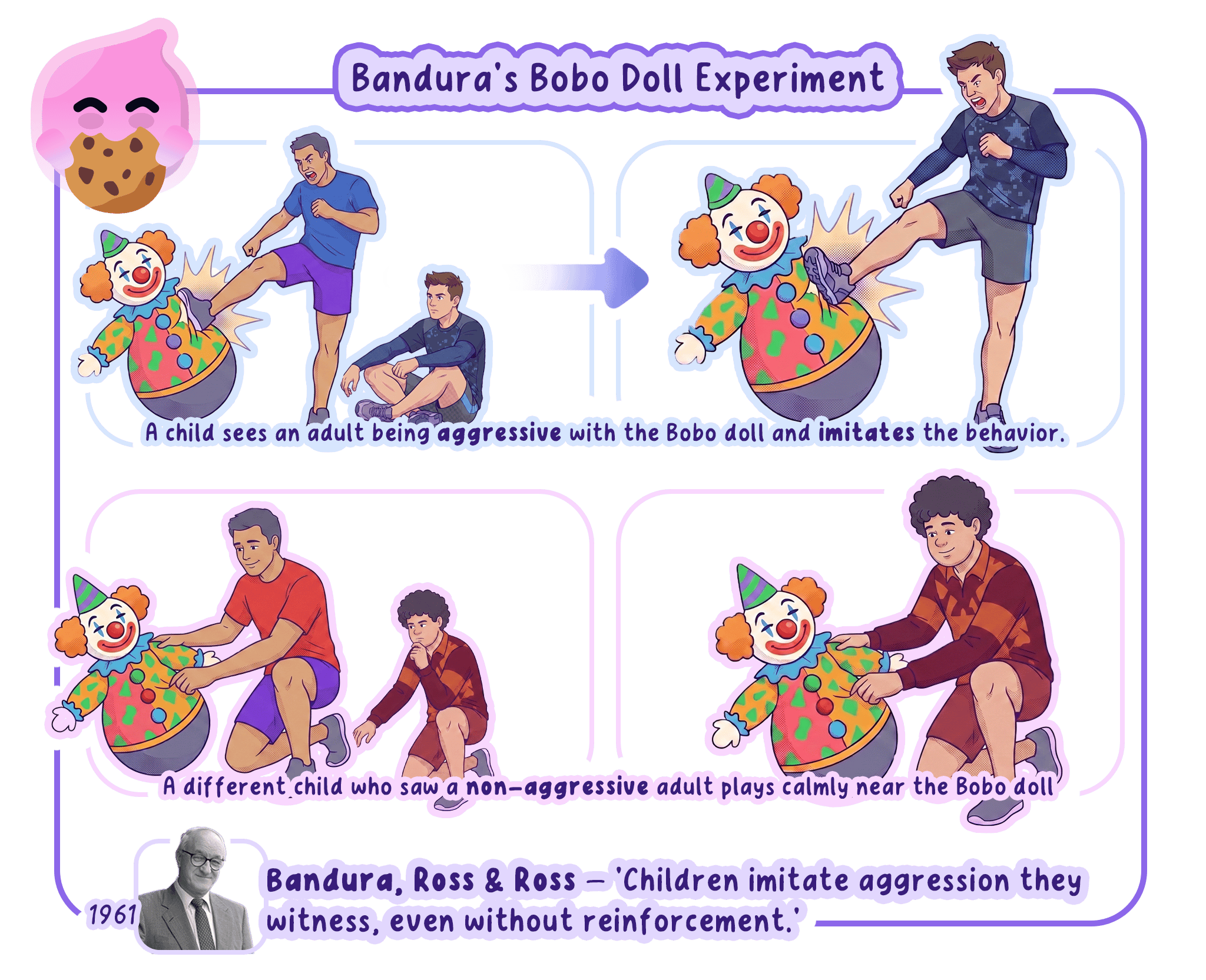
- A strength is that Bandura, Ross and Ross used a controlled procedure with novel acts that could be identified, so imitation was measured objectively.
- A second strength is that it explains why offending often clusters in families and peer groups, where models are close at hand and easy to identify with.
- A weakness is that Charlton et al. found little change once television arrived, so exposure to models does not reliably produce imitation.
- A second weakness is that the supporting evidence involves hitting a doll designed to be hit, so it has low ecological validity and may not generalise to real offending.
Turning this into marks
- Name the process and say whether it makes the behaviour more or less likely to be repeated.
- Quote the detail you are given about the person, because the link to the scenario usually carries a mark of its own.
- The mark most often lost is the second theory, so cover both operant conditioning and social learning theory when the question asks for both.
Self review
- What is the difference between negative reinforcement and negative punishment?
- Give an example of a primary reinforcer and of a secondary reinforcer.
- How do identification and vicarious reinforcement each raise the chance of imitation?
- Give one strength of social learning theory and one weakness of operant conditioning.
