The case behind the study
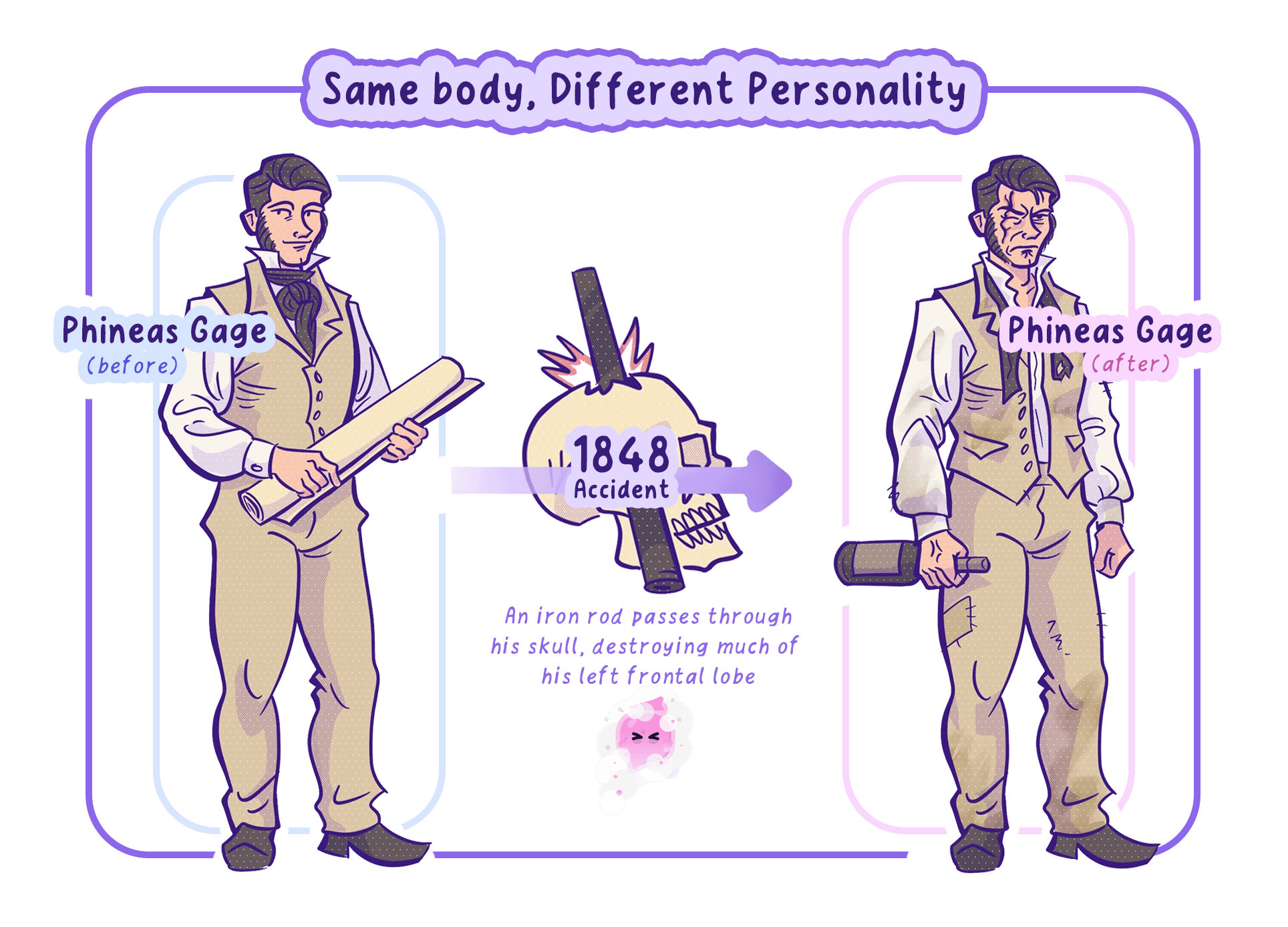
- In 1848 Phineas Gage, a 25-year-old construction worker for a railroad company in the USA, survived a tamping iron being blown straight through his head.
- The iron was 109 cm long and 3 cm thick.
- His physician, John Harlow, described a change in his personality and social behaviour afterwards. Harlow's fullest account was published in 1868, twenty years after the accident.
Aims
- The first aim was to identify the location of the damage in Phineas Gage using modern neuroimaging methods.
- The second aim was to compare that damage with other patients in order to infer what those brain regions normally do.
Procedures
- The team obtained Gage's skull and the tamping iron from a museum, then took x-rays and measurements to build a three-dimensional reconstruction of the skull.
- They used 20 points on the skull to determine where the iron was likely to have entered, and narrowed that down to five possibilities.
- They then modelled the most likely trajectory of the iron through the brain, drawing on reports written at the time of the accident and on more recent research, since there was no brain left to scan.
- They also examined 12 comparison patients of their own who had damage in the region the model pointed to.
Results
- The most likely path placed the damage in the ventromedial region of both frontal lobes, the lower middle part of the frontal lobes.
- The dorsolateral region, Broca's area and the motor cortices were all spared, matching the record that Gage's movement, speech, memory and intelligence were not lost.
- The study's own 12 comparison patients showed the same profile, with calculation and abstract reasoning intact but emotional processing and personal and social decision-making impaired.
Conclusions
- The ventromedial frontal region is involved in emotion and in the neural machinery that participates in decision making.
- The study therefore supports localisation of function rather than the view that the brain works as one undivided whole.
Strengths and weaknesses
- A strength is that the method was modern and quantified, so a classic case was re-examined by measurement instead of guesswork.
- A second strength is that the findings converge with living patients, because 12 people with damage in the same region showed the same profile.
- A weakness is that the records from 1848 are incomplete, so parts of the reconstruction rest on limited historical evidence.
- A second weakness is that Gage is a single case, which limits how far the findings generalise to other people.
Turning this into marks
- Name the ventromedial region as damaged and the dorsolateral region, Broca's area and the motor cortices as spared.
- Say the path was reconstructed from Gage's skull, because writing that Gage himself was scanned loses the mark.
Self review
- Describe how the team moved from the preserved skull to the most likely path of the iron.
- Which region was damaged, and which three regions were spared?
- What did the 12 comparison patients show about that region?
- Give one strength and one weakness of the study.
