The role of the central nervous system
Definition
Central nervous system
The brain and the spinal cord. It receives information, processes it and decides how the body should respond.
- Your central nervous system is made up of the brain and the spinal cord.
- Its role is to take in information from your senses, process it and decide what your body should do next.
- It then sends instructions back out so that muscles and glands carry the response out.
What a neuron is
Definition
Neuron
A specialised cell that carries electrical signals through the nervous system. Its shape lets it receive, conduct and pass on messages.
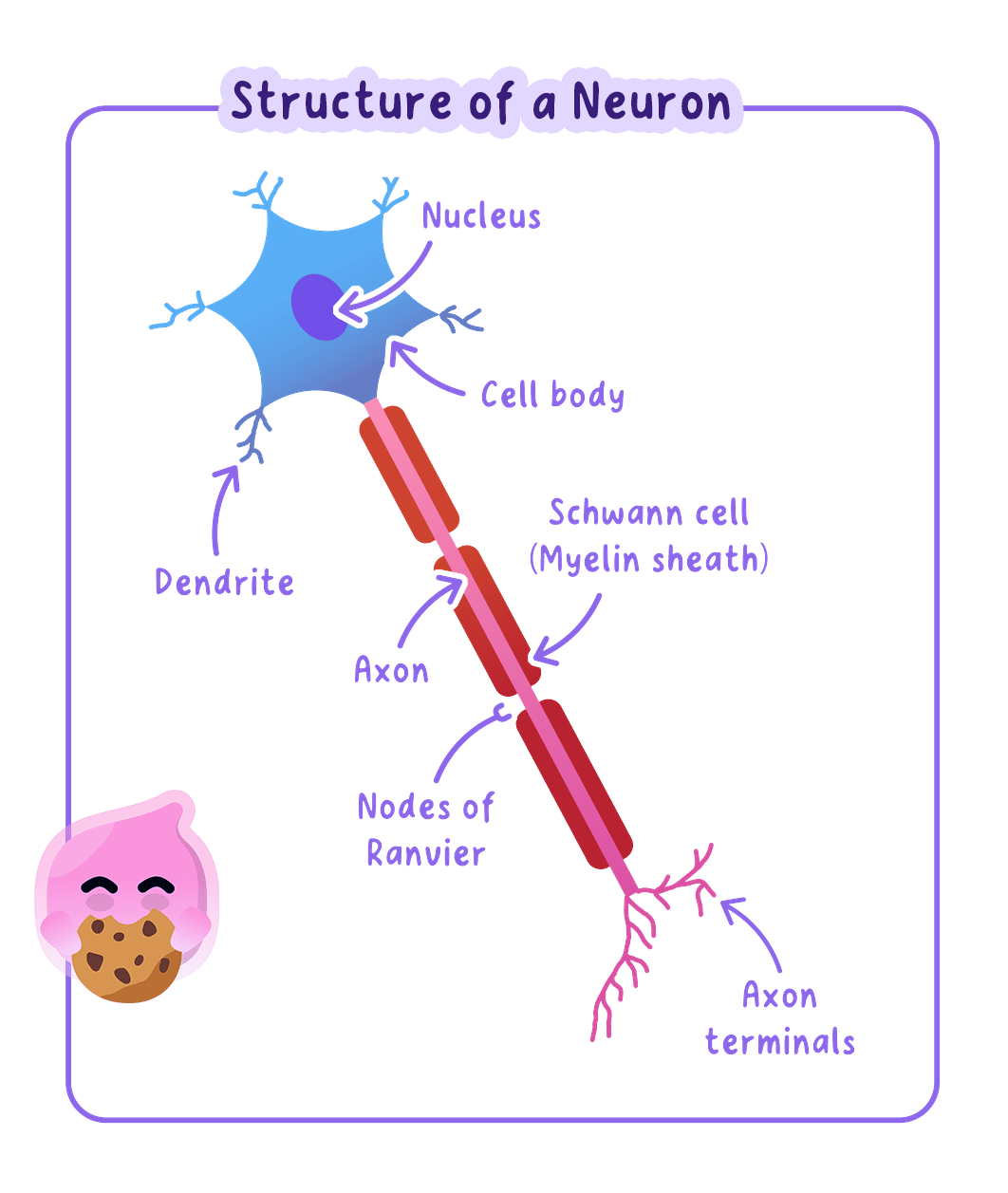
- Dendrites
- Branch-like endings that receive the signal coming in from other neurons.
- Cell body
- Holds the nucleus and pulls the incoming signals together.
- Axon
- The long fibre that carries the signal away from the cell body as an electrical impulse.
- Axon terminals
- The endings that pass the signal on to the next neuron at a synapse.
The three types of neuron
- Sensory neuron
- Carries messages from sense receptors, such as those in your skin, into the central nervous system.
- Relay neuron
- Sits inside the central nervous system and connects the incoming message to the outgoing one.
- Motor neuron
- Carries messages from the central nervous system out to muscles or glands so that they act.
Common Mistake
- Sensory neurons carry messages in and motor neurons carry them out, so do not swap the two.
- Relay neurons are only found inside the brain and spinal cord, never out in the limbs.
How neurons and synapses interact
Definition
Synapse
The tiny gap between the end of one neuron and the start of the next, where the signal is passed from one to the other.
- Neurons do not touch one another, so an electrical impulse cannot simply run out of one and into the next.
- The message therefore changes form at each junction, from an electrical impulse inside the neuron to a chemical signal across the gap.
- The electrical impulse travels down the axon and arrives at the axon terminal.
- The arrival of the impulse makes the neuron release neurotransmitter into the gap.
- The neurotransmitter spreads across the gap to the receiving neuron.
- It binds to receptors on the surface of that neuron, which only fit particular neurotransmitters.
- If enough of it binds, a new electrical impulse is set off in the receiving neuron.
- Any neurotransmitter left in the gap is cleared away, which leaves the synapse ready for the next message.
The function of neurotransmitters
Definition
Neurotransmitter
A chemical released by a neuron that carries the signal across the synapse and binds to the next neuron.
- The job of a neurotransmitter is to carry the message across the synapse and tell the receiving neuron what to do with it.
- Different neurotransmitters carry different messages, so the effect on the receiving neuron depends on which one is released.
- Some make the next neuron more likely to fire and others make it less likely. You will sometimes see those two labelled excitatory and inhibitory, which is worth recognising rather than learning.
- Because the message depends on a chemical, anything that changes how much neurotransmitter is around changes how the brain works, which is why so many drugs act at the synapse.
Common Mistake
- Do not write that the impulse jumps or sparks across the gap, because a chemical carries it over.
- Do not say the neurotransmitter carries on into the next neuron, because it binds to receptors on the surface and the signal turns back into an electrical impulse.
Turning this into marks
- Give the stages of synaptic transmission in order, because a stage out of sequence loses the mark it would have earned.
- Name the neurotransmitter and the receptor, since those are the two words the marks are written against.
- The mark most often lost is writing that the impulse jumps the gap, so always say a chemical carries it across.
Self review
- What two structures make up the central nervous system?
- Which type of neuron carries messages out to the muscles?
- Describe how a message is passed across a synapse from one neuron to the next.
- What is the job of a neurotransmitter at the synapse?
