The four lobes and the cerebellum
Definition
Cerebral cortex
The brain's wrinkled outer layer, responsible for higher mental functions such as thinking, perception, language and voluntary movement.
- The wrinkled outer layer of your brain is divided into four lobes, and each one takes the lead on a different kind of job.
Where each lobe sits and what it does
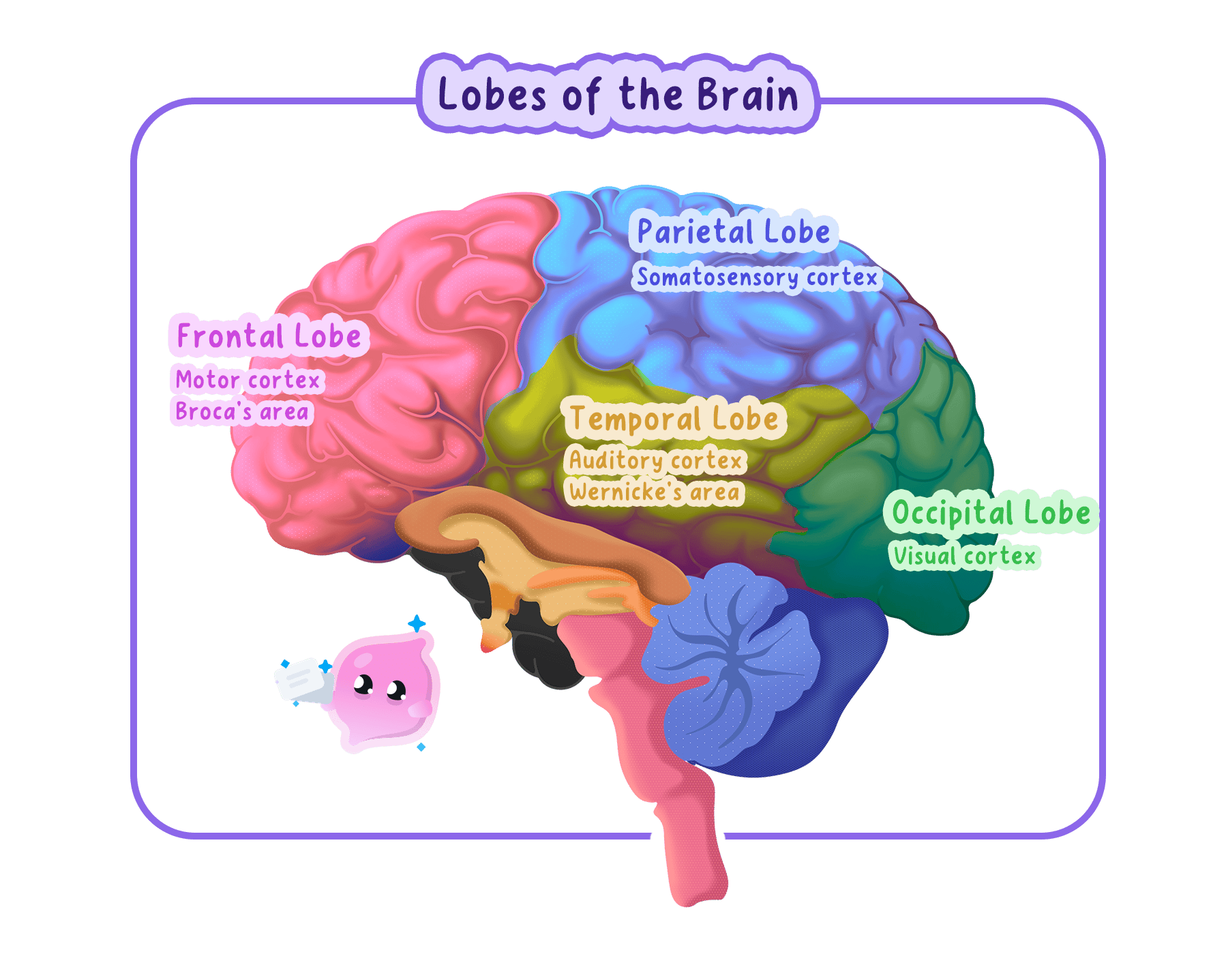
- Temporal lobe
- It lies at the side of each hemisphere, roughly above and around your ear, and it is the primary target for auditory information, so this is the lobe that deals with hearing.
- It is also involved in advanced visual processing and in emotional and motivational behaviour.
- Occipital lobe
- It sits at the very back of the brain and is the main target for visual information, so this is the lobe that deals with vision.
- Frontal lobe
- It sits behind your forehead and deals with the planning of movements, recent memory, and some aspects of emotion such as aggression.
- Parietal lobe
- It sits towards the top of the brain behind the frontal lobe, and it is responsible for bodily sensations such as touch, temperature and pain.
- It also monitors all the information about eye, head and body positions, which is how you know where your limbs are without looking.
The cerebellum
Definition
Cerebellum
A structure at the back of the brain, part of the hindbrain, involved in balance, posture and the coordination of movement.
- The cerebellum sits at the back and base of your brain, tucked underneath the four lobes.
- It controls movement, balance and coordination.
- It fine tunes the movements the frontal lobe has set going, so an action such as tying a shoelace comes out smooth rather than jerky.
Common Mistake
- Do not call the cerebellum a lobe, because it is a separate structure with its own function.
- Vision belongs to the occipital lobe at the back of the brain, not to the frontal lobe at the front.
Turning this into marks
- Name the structure precisely, because a vague label such as 'the front of the brain' earns nothing.
- Pair every structure with a named function, so write 'the parietal lobe processes touch' rather than 'it controls things'.
- The mark most often lost is the application one, so tie the structure to the exact behaviour the scenario describes.
Self review
- Name the four lobes and say where each one sits.
- Which lobe processes vision?
- Give one function of the frontal lobe and one function of the temporal lobe.
- Where is the cerebellum and what does it do?
