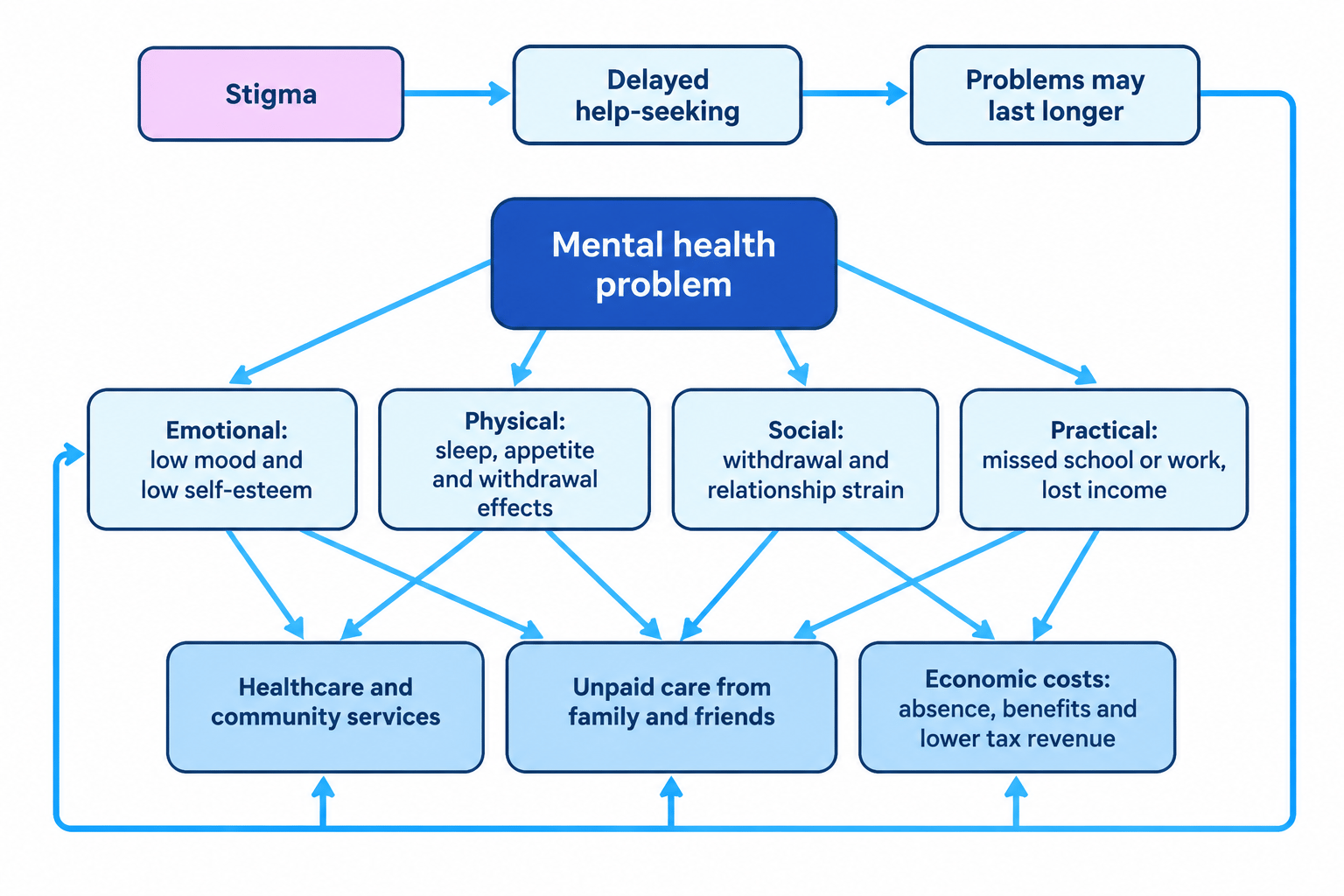
Two levels of effect
- A mental health problem affects the person living with it, and those individual effects add up into effects on society as a whole.
Key Idea
- Individual effects are emotional, physical, social and practical.
- Society effects are the demands and costs that follow once many individuals are affected at once.
How depression affects the individual
- Low mood and loss of interest make ordinary activity feel effortful, so a person may withdraw from friends and stop doing things they used to enjoy.
- Reduced concentration makes school, revision or work harder to keep up with, which can cost a person grades, a place or a job.
- Disturbed sleep and reduced appetite damage physical health, and being run down then makes coping with everything else harder.
- Low self-esteem and a pessimistic view of the future can stop a person seeking help, which lengthens how long the episode lasts.
- Family and friends are affected too, since they may take on extra practical tasks and worry about someone they cannot easily help.
How addiction affects the individual
- As the substance or activity takes priority, time and money go to it instead of to family, friends and interests.
- Relationships suffer, because intentions to cut down are hard to keep and trust breaks down when they are not.
- Physical health can be harmed by the substance itself and again by the withdrawal state when use stops.
- Work and money problems follow, and the clients in Young's 2007 study reported exactly this pattern.
- Their most common problems were time at 96 per cent, then relationships at 85 per cent, work at 71 per cent and finances at 42 per cent.
Stigma as an added effect
Definition
Stigma
Stigma is the unfair negative judgement attached to a characteristic, such as having a mental health problem, which can leave a person feeling ashamed or being treated differently.
- Before help is sought, fear of being judged can delay a person going to a GP, so the problem runs on untreated for longer.
- After a diagnosis, a person may be treated unfairly at work or by people they know, which lowers self-esteem further.
- Addiction tends to be judged more harshly than depression, because it is wrongly assumed to be a matter of willpower rather than a diagnosable condition.
Common Mistake
- Write about a person with an addiction rather than using a label as a noun, because the wording itself carries stigma.
- Do not describe either problem as a choice or a weakness, since that is both inaccurate and the kind of statement examiners flag.
How society carries the cost of care
Definition
Care in the community
Care in the community is an approach that supports people with mental health problems through local services and in their own homes, rather than in long-stay hospitals.
- Many people need support from GPs, from the NHS and from community mental health teams, all of which take trained staff and funding.
- Support has moved away from long-stay psychiatric hospitals towards care in the community, so services are delivered locally and often at home.
- Addiction adds its own services, including help through withdrawal and the relapse prevention that Young found CBT could support.
- Family and friends provide a large amount of unpaid care, which is a real cost to society even though it never appears on any bill.
Example
- A community mental health team visiting someone at home costs less than a hospital bed but still needs staff, training and travel.
- That is the trade-off society makes when it chooses care in the community.
The economic cost
- Someone who is unwell may need time off, so less is produced and the employer carries the absence.
- Some people leave work altogether, which cuts household income and reduces the tax the country collects.
- The state spends on treatment and on benefits, and that money then cannot be spent on anything else.
- Added together the cost to the country is large, so treat any single figure you meet as an estimate rather than a fact.
- Early support cuts these costs, which is why the economic argument and the humane argument point the same way.
Being careful with the link to crime
- Most people with a mental health problem never commit any crime, and they are more likely to be victims of crime than offenders.
- Where addiction is linked to offending, the link usually runs through the cost of obtaining a substance rather than through the condition making anyone violent.
- Any link that is found tends to involve other factors such as poverty or lack of support, so it is not caused by the diagnosis on its own.
Common Mistake
- Never write that people with mental health problems are dangerous, because it is untrue and it reinforces stigma.
- If you use the crime point at all, qualify it in the same sentence.
Turning this into marks
- Work from the scenario, so if the person is described as missing shifts you name lost work and lost income rather than effects in general.
- Cover both individuals and society whenever the question names both.
- The mark most often lost is describing effects without applying any of them to the person you were given.
Self review
- Give two ways unipolar depression can affect a person's daily life.
- Give two ways addiction can affect a person's relationships or finances.
- How does stigma add to the effects of a mental health problem?
- Name two costs that mental health problems create for society.
- Why must any link with crime be stated with care?