What the debate is about
- The reductionism and holism debate asks at what level a behaviour is best explained.
- One side breaks the behaviour down into separate simpler parts, and the other keeps it whole.
Reductionism and reductionist
Definition
Reductionism
Explaining a complex behaviour by reducing it to one simple cause or process, rather than looking at the whole person and the range of factors involved.
- Reductionism is the noun for the approach itself.
- Reductionist is the adjective you use to describe a theory, an explanation or a study that takes that approach.
- Write that the Multi-store Model is a reductionist theory, not that it is a reductionism.
Holism and holistic
Definition
Holism
Explaining behaviour by looking at the whole system or whole person together, rather than reducing it to separate parts.
- Holism is the noun for the opposite approach.
- Holistic is the adjective for a theory, an explanation or a study that keeps the whole person in view.
- Write that Bartlett's account of memory is holistic, not that it is a holism.
The Multi-store Model as a reductionist theory
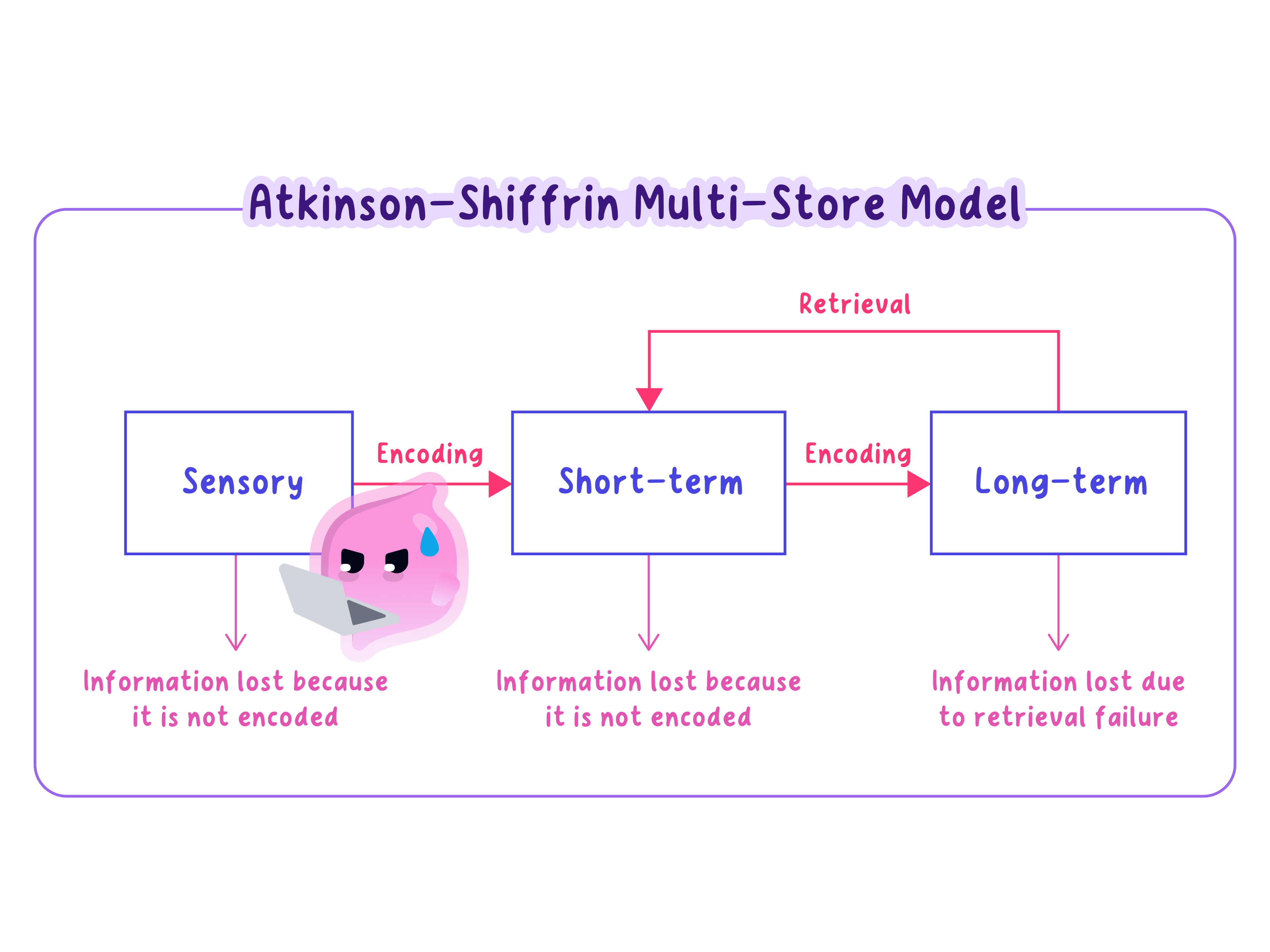
- The Multi-store Model (Atkinson and Shiffrin, 1968) splits memory into separate stores, namely the sensory register, short-term memory and long-term memory.
- It also splits the work into separate processes, giving attention the job of moving information into short-term memory and rehearsal the job of moving it into long-term memory.
- That is reductionist because one whole ability, remembering, is explained by breaking it into parts that each have their own capacity and duration.
Peterson and Peterson as reductionist research
- Peterson and Peterson (1959) had students recall consonant trigrams after counting backwards in threes or fours to block rehearsal.
- Correct recall fell from about 80 per cent after 3 seconds to about 10 per cent after 18 seconds.
- The design is reductionist because it reduces memory to whether a meaningless three-letter string survives a few seconds, with meaning, context and the person's own experience deliberately stripped out.
- That control makes the study standardised and replicable, which is a real strength for reliability.
- It also makes the task artificial, so low ecological validity is the price of reducing memory that far.
Reconstructive memory as a holistic theory
- Bartlett's theory of reconstructive memory treats remembering as the whole person actively rebuilding an event rather than a store playing it back.
- What you recall depends on your schemas, the packets of prior knowledge and cultural expectation you bring to the task.
- That is holistic because the explanation uses the person's whole background rather than one isolated part of a system.
War of the Ghosts as holistic research
- Bartlett (1932) had 20 British participants read an unfamiliar Native American folk tale twice and then recall it repeatedly, from 15 minutes afterwards to almost ten years later.
- The order of events and the main themes survived, but the detail was reshaped, so that canoes became boats and unfamiliar material was rationalised into something more acceptable.
- Bartlett called this effort after meaning, and it is holistic because a whole meaningful story is being remembered by a whole person inside their own culture.
- Meaningful material and long intervals give the study ecological validity, but the recall intervals were not standardised and scoring the distortions was subjective, which weakens its reliability and objectivity.
Reaching a judgement
- Neither side is simply correct, so an answer that argues only one way stays one-sided.
- Reductionist accounts win on precision, control and testability, which is why the Multi-store Model and Peterson and Peterson produce clear figures.
- Holistic accounts win on realism, which is why Bartlett's findings look far more like everyday remembering.
- A supported judgement usually concludes that the two levels answer different questions about the same behaviour and are strongest when used together.
Common Mistake
- Do not drift into brain biology for your reductionist example, because the question asks for content, theories and research drawn from human memory.
- Do not describe the two studies without saying what each one shows about the debate, because description on its own is not evaluation.
- Do not save the judgement for the final line, because it has to be supported as the argument goes along.
Turning this into marks
- Bring memory material to both sides, so the Multi-store Model and Peterson and Peterson for reductionism and Bartlett for holism.
- Say what each study shows about the debate rather than simply describing what was done.
- The mark most often lost is arguing only one side when the question names both.
Self review
- Write one sentence using reductionism as a noun and one using reductionist as an adjective, then do the same for holism and holistic.
- Explain why the Multi-store Model counts as a reductionist theory of memory.
- Explain what makes Peterson and Peterson reductionist research and Bartlett holistic research, using one finding from each.
- Plan a 9-mark answer on this debate in four lines, with one line for each of the two sides, one for the comparison and one for the judgement.
