The multi-store model of memory
- Atkinson and Shiffrin (1968) argued that memory is not one box but three separate stores arranged in a line.
- Information arrives in the sensory register, may pass into short-term memory, and may then pass into long-term memory.
- The stores differ in three ways: what they take in, how much they can hold, and how long they hold it for.
- Nothing moves along the line by itself, because each step depends on you doing something with the information.
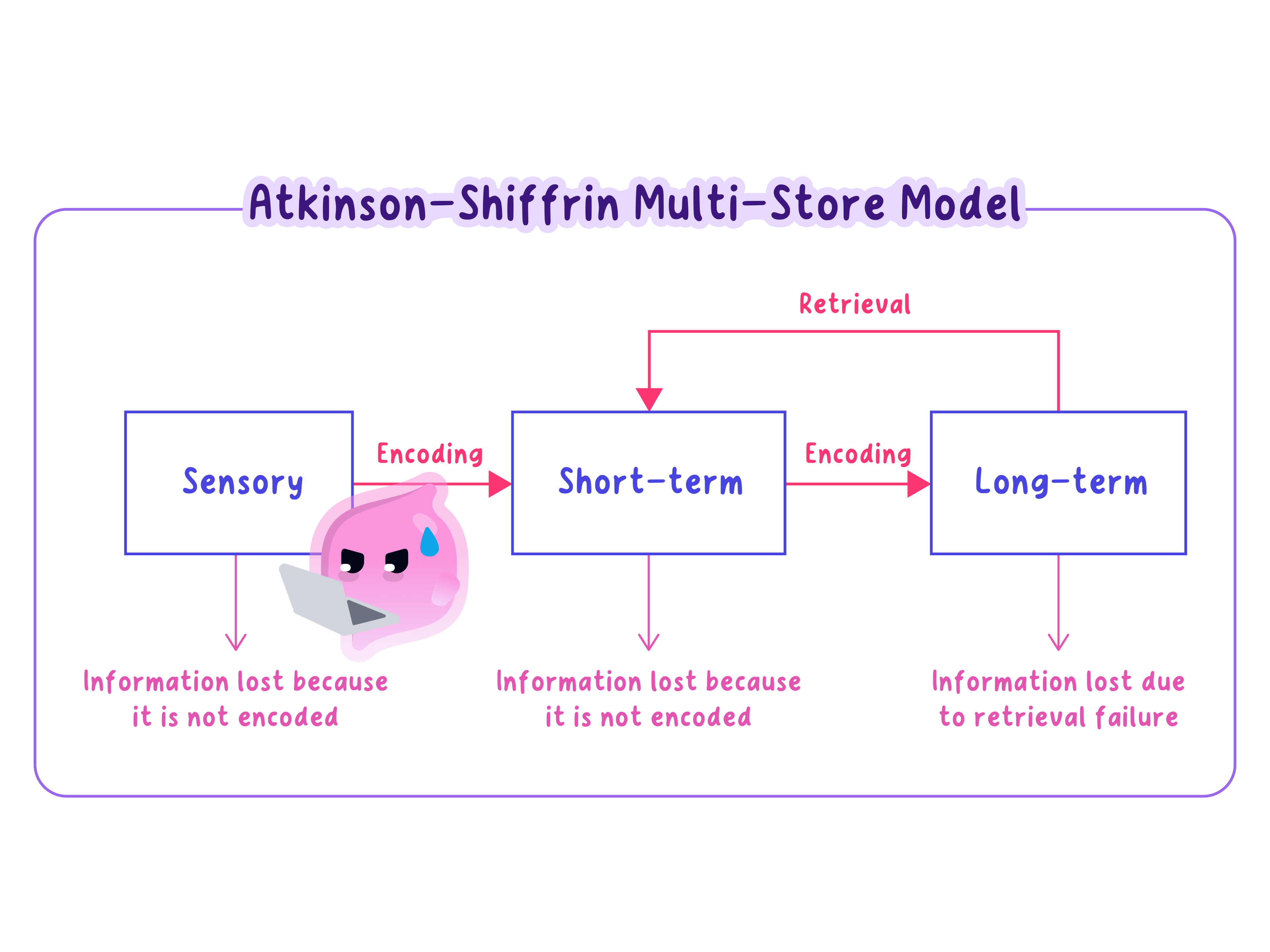
The sensory register
- The sensory register is the first store, and it receives everything your senses pick up.
- It takes information in a modality-specific way, so iconic (visual), echoic (auditory) and haptic (touch) input stay separate.
- It holds that raw input for only a fraction of a second before the trace decays.
- Almost all of it is lost, because you can only attend to a tiny part of what arrives.
Example
- Walking down a corridor, your eyes take in every face, poster and scuffed floor tile.
- A second later you could not name one of them, because the sensory register let them go before you attended to them.
The capacity of short-term memory
- Capacity means how much a store can hold at any one moment.
- Short-term memory has a very limited capacity of roughly 5 to 9 items, which Miller (1956) wrote as 7 plus or minus 2.
- Once it is full, new items push older ones out, so the store never grows to fit what you are given.
The duration of short-term memory
- Duration means how long a store can keep information available.
- Short-term memory has a short duration of about 15 to 30 seconds, and almost 90 per cent of information was lost when rehearsal was prevented for 18 seconds.
Common Mistake
- Do not merge capacity and duration, because they answer different questions: how much, and how long.
- Do not quote the 18 seconds as the duration of short-term memory, since it is the point at which almost 90 per cent was lost with rehearsal prevented.
The capacity of long-term memory
- Long-term memory has no known limit, so its capacity is described as potentially unlimited.
- You are not thought to reach a point where a new memory can only be stored by deleting an old one.
The duration of long-term memory
- Long-term memory has a potentially lifelong duration, so information can stay available for decades.
- Bartlett's participants still produced recognisable versions of a story almost ten years after reading it, which shows how long a trace can last.
Example
- You can probably still name your Year 3 teacher without any effort at all.
- That memory was laid down years ago and has sat in long-term memory ever since.
The role of attention
- Attention is what moves information from the sensory register into short-term memory.
- Whatever you attend to is passed on, and everything you do not attend to simply decays where it is.
Example
- In a noisy common room you can follow one conversation while a dozen others wash over you.
- Only the conversation you attended to reaches short-term memory, and the rest never leaves the sensory register.
The role of rehearsal
Definition
Rehearsal
Repeating or actively thinking about information so that it passes from short-term memory into long-term memory.
- Rehearsal is repeating information or actively thinking it over while it sits in short-term memory.
- Rehearsing keeps information circulating in short-term memory, which holds it there beyond its usual short duration.
- Enough rehearsal transfers the information into long-term memory, and in this model rehearsal is the route by which that happens.
Common Mistake
- Do not treat the flow as automatic, because without attention and rehearsal nothing moves along the line.
- Do not confuse the two processes, since attention feeds short-term memory and rehearsal feeds long-term memory.
Strengths of the model
- Peterson and Peterson (1959) support the claim that short-term memory has its own short duration, because recall collapsed from about 80 per cent to about 10 per cent once rehearsal was blocked.
- Amnesia gives further support for separate stores, since retrograde and anterograde amnesia damage different parts of memory.
Weaknesses of the model
- The model is oversimplified, because it treats short-term memory and long-term memory as single unitary stores.
- The support from Peterson and Peterson is narrow, because their 24 participants were all Indiana University students taking part as a course requirement.
Turning this into marks
- Give the capacity and the duration of each store as figures rather than calling short-term memory small.
- In a scenario, say what the person attended to and what they rehearsed.
- The mark most often lost is listing a strength and a weakness without setting one against the other and reaching a judgement.
Self review
- Name the three stores of the multi-store model in order.
- What are the capacity and the duration of short-term memory?
- What are the capacity and the duration of long-term memory?
- What does attention do, and what does rehearsal do?
- Give one strength and one weakness of the model, each with its evidence.
