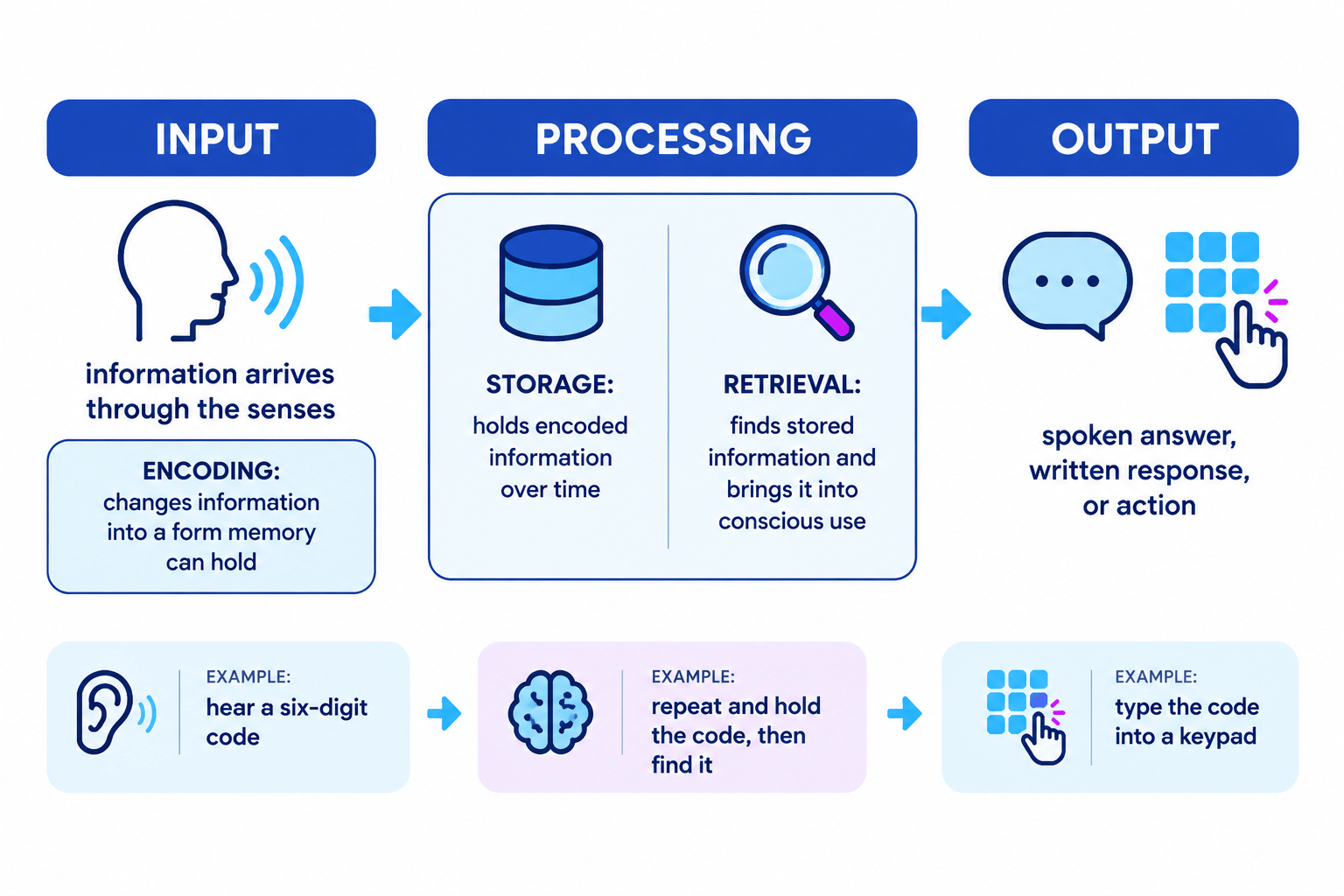
Memory as an information processing system
- Psychologists describe memory using the information processing model, which treats your mind as a system that handles information in an orderly way.
- The model has three stages: input, processing and output.
- Every memory you use has passed through all three stages, so a fault at any one of them shows up as forgetting.
Input, processing and output
- Input
- Input is information reaching you through your senses, such as a voice you hear or words you read.
- Processing
- Processing is everything your memory does with that information between it arriving and you using it.
- Output
- Output is the information coming back out of the system as an answer you say, a sentence you write or an action you carry out.
Example
- A friend reads out the six-digit code from a parcel slip, and hearing it is the input.
- Repeating it silently and holding on to it while you cross the room is the processing.
- Typing it into the keypad is the output.
Encoding
Definition
Encoding
Changing incoming information into a form your memory can hold, so it can be stored. Encoding is the input stage of memory.
- Encoding changes information from input into a form your memory can hold, such as a sound, a picture or a meaning.
- If information is never encoded it never enters memory at all, so there is nothing there to find later.
Storage
Definition
Storage
Holding information in memory over time, so it is still there when you go back for it. Storage keeps encoded information available between putting it in and getting it back out.
- Storage holds encoded information over time so that it is still available when you come back for it.
- Some information is held for a few seconds and some for years, and how long depends on which memory store it is in.
Retrieval
Definition
Retrieval
Finding stored information and bringing it back into conscious use. Retrieval is the output stage of memory.
- Retrieval locates stored information and brings it back into conscious use so that it can become output.
- Information can be safely stored and still fail at retrieval, which is why an answer can sit on the tip of your tongue.
How the three processes map onto the model
- Encoding is what your memory does with information at the input stage.
- Storage and retrieval both sit inside the processing stage, because they happen after information has arrived and before you use it.
- Retrieval is what makes the output stage possible, since nothing can come out until it has been found.
Common Mistake
- Do not treat processing as a fourth memory process, because it is the stage of the model inside which encoding, storage and retrieval happen.
- Do not use encoding and retrieval as if they mean the same thing, because one puts information in and the other brings it back out.
- Do not assume forgetting is a single fault, because a memory can fail at encoding, at storage or at retrieval.
Turning this into marks
- On a define or state item, give one accurate sentence and stop, because extra sentences earn nothing.
- On a describe item, pair every process you name with a statement of what that process does.
- The mark most often lost is naming a process in a scenario without quoting the words in the scenario that show it.
Self review
- Name the three stages of the information processing model in order.
- In one sentence, explain why a memory can fail even though it was encoded and stored successfully.
- You read a revision card, hold the fact in mind while you walk to the kitchen, then write it out an hour later, so label the encoding, the storage and the retrieval in that sequence.