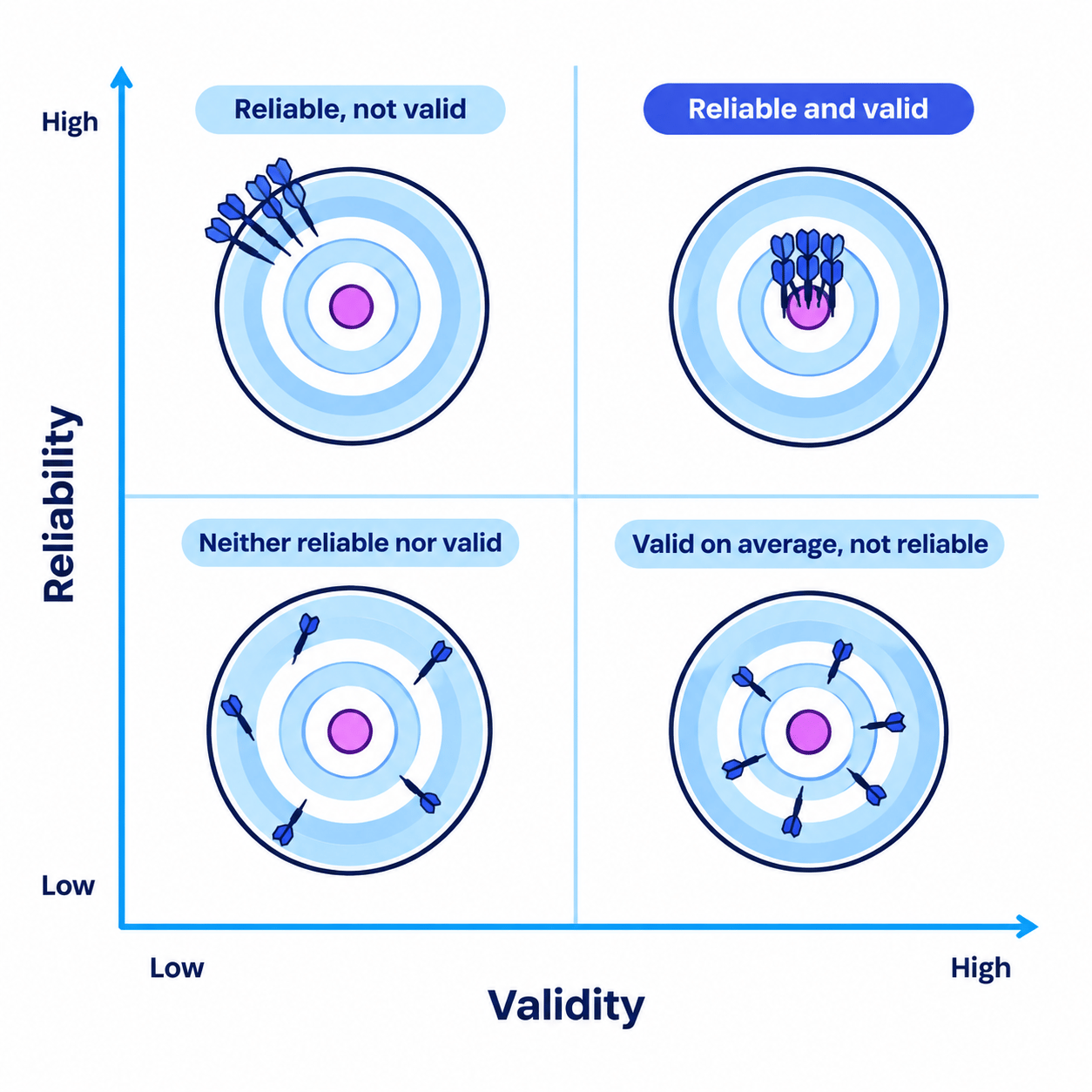
Two different questions about a study
Definition
Reliability
The extent to which a measure gives the same, consistent result each time it is used.
- Reliability is consistency, so it asks whether the study would give you the same result again if it were run the same way.
Definition
Validity
The extent to which a measure actually assesses what it claims to measure.
- Validity is aim, so it asks whether the study measured the thing you actually meant to measure rather than something else that moved at the same time.
- The two come apart, because a badly aimed measure can be perfectly consistent and still be measuring the wrong thing every single time.
Key Idea
- A bathroom scale that always reads three kilograms heavy is completely reliable and completely invalid.
Applied to sampling methods
- A stratified sample supports validity because every subgroup is present in proportion, so the findings really are about the population you named.
- A volunteer or opportunity sample weakens validity, because you have measured the keen or the nearby rather than the population.
- Reliability is a different question, and random and stratified sampling are written-down procedures another researcher can follow and end up with a similar sample, so a repeat is more likely to give a similar result.
- Opportunity sampling depends on who happened to be there that lunchtime, so a repeat can produce a completely different group and a completely different figure.
Example
- You measure revision habits in Year 11 by asking the pupils queuing for the library at lunchtime.
- Library queuers are probably the most organised pupils in the year, so your figure describes them and not Year 11, which is a validity problem.
Applied to experimental designs
- Independent measures protects validity from order effects, because nobody does the task twice and so practice and tiredness cannot build up.
- It threatens validity through participant variables, because the two conditions are different people and a difference between those people can be read as an effect of the independent variable.
- Repeated measures protects validity against participant variables, because each person is compared with themselves and cannot simply be out-scored by a stronger group.
- It threatens validity through order effects, because an improvement caused by practice gets counted as an effect of the independent variable when it is nothing of the kind.
- Matched pairs protects validity on both counts, because pairing people on a variable that matters, such as a memory score, evens out the groups without anyone doing the task twice.
- It threatens validity because you can only match on the variables you thought of, so any you missed still differ between the groups.
- Turning to reliability, a repeated measures study is the easiest to repeat, because one modest group of people can be run through the same conditions again.
- An independent measures study sits in between, because it needs a fresh set of people for every condition, but nothing has to be paired up before the study can start.
- A matched pairs study is the hardest, because the whole matching exercise has to be done again before the conditions can even start.
Applied to quantitative and qualitative methods
- Quantitative methods produce numbers, such as a score out of twenty or a count of how often a behaviour happened.
- Reliability is usually high, because a fixed set of closed questions is applied in the same way to everybody and gives the same answer when repeated.
- Validity can suffer, because squeezing a complicated feeling into a number from one to five may not capture what the person actually meant.
- Qualitative methods produce words, such as what somebody said in an interview or wrote in an open question.
- Validity is usually high, because people describe their experience in their own words and can raise things the researcher never thought to ask about.
- Reliability is harder to secure, because an open conversation goes differently every time and two researchers can read the same answers in two different ways.
Example
- A closed questionnaire scoring stress from one to ten lets you compare 200 pupils and run the survey again next year, which is strong on reliability.
- An open interview lets a pupil explain that the stress is really about one subject and one teacher, which is strong on validity.
Turning this into marks
- Name the feature of the study and say what it does to consistency or to aim.
- Write it out in full, such as the sample being 20 volunteers so the findings may only describe unusually keen pupils.
Self review
- Explain the difference between reliability and validity in one sentence each.
- Why does an opportunity sample threaten both the validity and the reliability of a study?
- Explain how order effects in a repeated measures design damage validity.
- What does a matched pairs design protect against that independent measures does not, and what does it still miss?
- Why are closed questions usually more reliable but less valid than open ones?